
Your team sees the constant stream of superyacht news. A new build launch, a change in regulations, a technological breakthrough. But for most marine businesses, this is just passive information. Your marketing remains disconnected, struggling to create content that resonates with a high-value audience, while competitors rehash the same tired topics. The result? Unpredictable lead flow and a constant fight for operational stability.
This ends now. This article is not about simply reporting on trends; it’s about building a system to leverage them for business growth. We will give you a repeatable process to filter the noise, identify the developments that directly impact your ideal clients, and transform industry updates into a powerful engine for generating qualified inquiries. It’s time to stop reacting to the news and start using it to take control of your client pipeline and dominate your market.
Key Takeaways
- Treat industry updates as actionable business intelligence, not gossip, to link market trends directly to client spending habits.
- Pinpoint the four key news categories that signal high-value opportunities and learn to filter out the operational noise.
- Develop a systematic process to convert the latest superyacht news into a proactive content engine that generates qualified inquiries.
- Build an efficient monitoring system to control your messaging and dominate your niche without adding more work to your schedule.
Why Superyacht News is a Business Intelligence Goldmine, Not Gossip
Most marine businesses get this wrong. They see headlines about a new launch or a record-breaking sale and dismiss it as industry gossip-interesting, but irrelevant to their operations. This is a critical error. The world of luxury vessels, from the technical definition of what is a superyacht to its intricate supply chain, is a constant stream of actionable data. Viewing superyacht news as entertainment is a direct path to stagnant growth and missed opportunities.
The alternative is to treat it as what it is: a real-time feed of market intelligence. Every story contains clues about client spending habits, emerging technologies, and future service demands. Stop chasing vanity metrics like clicks and traffic. The insights buried in these reports are what allow you to intercept high-value clients with solutions to problems they are just beginning to articulate. This isn’t about being in the know; it’s about using information to gain a decisive operational edge and fuel your pipeline with qualified inquiries.
Decoding the ‘Why’ Behind the Headlines
To turn news into revenue, you must look past the vessel and analyze the signals. The headlines are not the story; the underlying market shifts are. Every announcement is a data point that informs your strategy:
- A new yacht launch signals specific demand. Don’t just see a beautiful boat. See the demand for the exact sustainable propulsion systems, the integrated smart technology, and the specialized composite materials used in its construction. This is a direct indicator of where the market is spending.
- Regulatory changes create new problems. When new emissions standards or cybersecurity mandates are announced, it creates an immediate and expensive problem for owners and management companies. This is a direct sales opportunity for businesses that can provide the refit, upgrade, or compliance solution.
- Owner trend reports reveal shifting priorities. The growing demand for explorer yachts isn’t just a trend; it’s a fundamental shift in how owners use their assets. This signals a new market for ice-class refits, long-range communication systems, and expedition-focused crew training.
The Cost of Ignoring Market Signals
Failing to integrate this intelligence into your business system carries a heavy price. While you operate on outdated assumptions, your competitors are adapting in real-time. The consequences are predictable and severe: your marketing message becomes stale, your service offerings become irrelevant, and you lose control over your growth. You miss the critical window to connect with high-intent buyers who are actively searching for solutions to these new, trend-driven challenges. In short, you become invisible to the clients who matter most.
How to Identify Actionable Marketing Signals in the Noise
The daily flood of superyacht news is overwhelming. Most of it is vanity-gossip, launch photos, and rankings that do nothing for your bottom line. A systematic approach is required to filter this noise and extract actionable intelligence. Stop consuming content; start using it to control demand for your services.
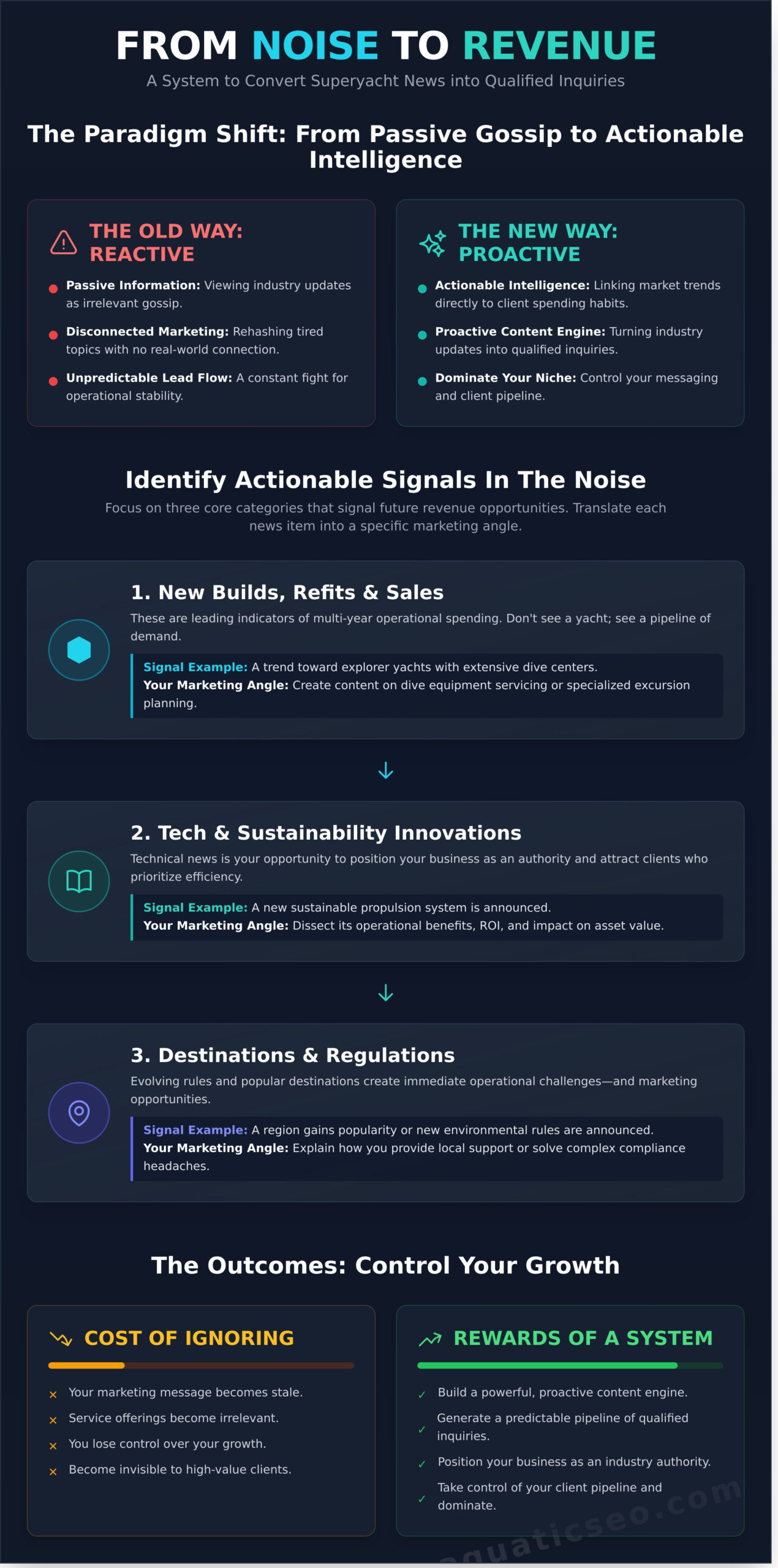
Focus your attention on three core categories that directly signal future revenue opportunities. For each, the goal is the same: translate a news item into a specific marketing angle that attracts qualified, high-value clients.
Category 1: New Builds, Refits, and Sales
Every new build, sale, or major refit is a leading indicator of future operational spending. Don’t just see a yacht; see a multi-year pipeline of demand. Track sales data to identify which vessel sizes are gaining traction and tailor your service messaging accordingly. A trend toward explorer yachts with extensive dive centers is a direct signal for companies providing dive equipment servicing or specialized excursion planning. This isn’t just news; it’s a blueprint for targeting your next client.
Category 2: Technological and Sustainability Innovations
Technical news is your opportunity to position your business as an authority. When a new propulsion system or sustainable technology is announced, your audience isn’t just curious-they are evaluating its impact on their asset’s value and operational costs. Create content that explains how these advancements affect the owner or charter experience. By dissecting the operational benefits of new green tech, you attract principals who prioritize efficiency, longevity, and forward-thinking partners over cheap vendors.
This isn’t limited to propulsion; it includes aesthetic and functional technologies as well. For example, a superyacht might feature a completely custom exterior lighting scheme designed to highlight its architectural lines. Companies specializing in this niche, such as LED Artistry, demonstrate how technological innovation can directly enhance a yacht’s luxury appeal and value.
Category 3: Shifting Charter Destinations and Regulations
Emerging charter destinations and regulatory changes create immediate operational challenges-and marketing opportunities. When a region like Southeast Asia gains popularity, it signals a need for agents with local knowledge, proven logistical support, and security expertise. Similarly, evolving environmental rules are not a burden; they are a filter. Your content can explain how your service helps owners navigate complex international maritime environmental regulations, turning a potential compliance headache into a solved problem and demonstrating your operational mastery.
Turning News into a High-Performance Content Machine
Most marine businesses treat news as a passive feed. They see a story, they share it. This is a reactive, low-margin tactic that generates vanity traffic, not qualified inquiries. A high-performance content machine does the opposite. It systematically intercepts industry trends and converts them into assets that build authority and attract your ideal client. This isn’t about posting more; it’s about controlling the narrative and demonstrating your operational expertise.
By moving from random posts to a proactive, trend-driven calendar, you stop chasing clicks and start building a pipeline of high-value leads. The key is choosing the right format to deliver a precise message.
The ‘Trend-Analysis’ Blog Post
Don’t just report on a major story. Dismantle it. A long-form blog post allows you to analyze the operational impact of the latest superyacht news for your specific audience. Go beyond the press release and offer your expert take on what a trend means for owners, charter brokers, or shipyards. Frame your analysis with headlines that promise tangible value, like ‘3 Things the Latest Feadship Launch Means for the Charter Market’.
Quick-Hit Social Media and Video Content
Not every insight requires a 1,000-word article. Use faster formats to prove your agility. Create a 60-second video explaining a new sustainable propulsion system. Post a concise, data-backed analysis of a major acquisition on LinkedIn. This content demonstrates that your business is not just aware of industry movements but is actively aligned with them, building trust with prospects who value forward-thinking partners.
Exclusive Insights for Your Email Newsletter
Your email list is your most valuable audience-treat it that way. Deliver a monthly intelligence briefing that summarizes the top industry news and, more importantly, offers a perspective they won’t get anywhere else. This is where you connect the dots between market shifts and your clients’ bottom line. Provide real analysis, not just links. Ready to apply this level of strategic thinking to your own marketing? Get a no-BS analysis of your current marketing strategy.
A System to Monitor Trends and Control Your Messaging
Reacting to industry trends without a plan creates chaos. A system isn’t about adding more work; it’s about establishing control over your content strategy and ensuring every piece of content serves a business objective. This framework transforms random industry chatter into a predictable pipeline of qualified client interest. It allows you to intercept conversations, demonstrate authority, and filter out the noise.
Choosing Your Intelligence Sources
You don’t need to monitor everything. You need to monitor the right things. An effective system focuses on a small number of high-value sources to get a clear signal on what matters. This is about precision, not volume.
- Primary News Outlets: Select 2-3 core industry publications like SuperYacht Times or Boat International. These are your baseline for major announcements.
- Key Personnel: Follow influential journalists, designers, and shipyard executives on LinkedIn. Their posts often provide the context behind the headlines.
- Targeted Alerts: Set up Google Alerts for specific yacht names, competing shipyards, or new technologies. This delivers critical superyacht news directly to your inbox.
The 30-Minute Weekly ‘News to Content’ Workflow
Discipline drives results. Dedicate one 30-minute block each week to this process. The goal is ruthless efficiency. Use a simple spreadsheet with three columns: News Item, Client Pain Point It Solves, and Content Angle. This forces you to connect every trend to a tangible client need. From this review, schedule one or two high-impact, news-driven posts for the week ahead. That’s it. Control your schedule, control your message.
Executing and Measuring Real Impact
Most marketing stops at posting. We focus on results. The final step is to measure what actually generates business, not just vanity metrics. Track which topics and formats produce the most engagement and, more importantly, qualified inquiries. If a post about new charter regulations gets you three calls while a yacht launch video only gets likes, you know where to focus your energy. This is how you refine your system and turn superyacht news into measurable business growth, a core principle of a true demand control system.
Turn Superyacht Intelligence into Market Control
The lesson is clear: treating superyacht news as mere gossip is a costly operational mistake. For a strategic marine business, it is a critical source of business intelligence. The most successful operators don’t just consume this information-they systematically extract actionable signals from the noise. This transforms volatile industry trends into a high-performance content machine that consistently fuels their growth and client pipeline.
But a strategy without a system is just a guess, and guessing is expensive. The difference between reacting to the market and controlling your corner of it comes down to methodical implementation. We reject vanity metrics because we demand real, measurable results for your bottom line. Our focus is on building you a complete demand control system-not just another website-that delivers a predictable flow of qualified inquiries and reinforces your long-term operational stability.
Stop guessing. Get a clear plan to attract high-value marine clients.
Take control of your pipeline and build the operational stability you deserve.
Frequently Asked Questions
How do I find reliable superyacht news sources?
Focus on primary sources like shipyard press releases, brokerage announcements, and official reports from industry bodies. Supplement this with established trade publications known for rigorous fact-checking. Avoid relying solely on social media or forums, which are prone to speculation. The goal is to build your content on a foundation of verifiable facts, not industry chatter. This ensures your analysis is credible and authoritative, attracting clients who value accuracy.
Can a small marine business realistically compete by creating news-based content?
Yes, if you focus on niche analysis instead of broad reporting. Large media outlets will always be faster. Your advantage is deep operational expertise. A small business can dominate a specific topic, such as analyzing the maintenance demands of a new build or the technical challenges of a new regulation. This targeted content attracts highly qualified inquiries from clients who value your specific knowledge, not just general website traffic.
How often should I publish content based on industry news?
The correct frequency is dictated by your strategic goals, not an arbitrary schedule. Publishing low-value content just to meet a quota wastes resources and attracts unqualified traffic. Instead, publish only when you have a unique, valuable insight to share that directly supports your business objectives. One piece of expert analysis that generates a single qualified lead is infinitely more valuable than ten quick news summaries that generate none.
What’s the difference between reporting news and providing analysis?
Reporting states the facts: “Shipyard X launched Yacht Y.” It’s a commodity. Analysis explains the operational or financial implications for your target client: “Yacht Y’s new hybrid system will impact crew training and long-term maintenance costs in these specific ways.” Reporting generates clicks; analysis generates qualified leads. To demonstrate true expertise and control the conversation, your business should focus exclusively on providing actionable analysis.
How can I use news about a new yacht build to promote my charter business?
Do not just announce the build. Create content that answers the questions a potential charter client would have. Analyze its charter-focused features: the sundeck layout, the water toy garage, or the crew-to-guest ratio. Write an article titled “A Charter Guest’s First Look at [Yacht Name]” or “Why [Yacht Name] is the Ultimate Mediterranean Charter Platform.” This positions you as an expert and captures qualified demand from clients actively researching their next charter.
Is it a good idea to comment on negative or controversial superyacht news?
Approaching controversial superyacht news requires a disciplined strategy. Avoid speculative or opinion-based commentary. Instead, focus on providing a factual, operational analysis of the situation. For example, if a new regulation is causing controversy, write a guide on how to maintain compliance. This positions your brand as a stable, authoritative voice, attracting clients who value control and operational excellence over industry drama.