
Is your phone silent while your local competitors’ bays are full? Are you invisible on Google Maps when a boater is stranded, wasting time on unqualified calls for services you don’t even offer? This isn’t just bad luck; it’s a failure of your marketing system to capture local demand when a customer searches for roadside marine Williston services. The most successful operators don’t just wait for the phone to ring-they build a system that forces it to. They control their local market, ensuring they are the first and only call for high-margin, qualified jobs.
This playbook is not about ‘more clicks’ or vague promises. It is a direct guide to taking control of your business’s visibility and profitability. We will break down the essential, actionable strategies you need to implement to dominate local search results, ensure your business is found in an emergency, and build a predictable pipeline of high-value clients. It’s time to stop losing work to the competition and start building a reputation as the go-to marine expert in your town.
Key Takeaways
- Your Google Business Profile is your single most powerful free tool to capture urgent “near me” searches from customers who need help on the water now.
- Learn how to structure your website to signal to Google that you are the top roadside marine Williston service, turning your site into a local customer magnet.
- Building consistent business citations across the web is a non-negotiable step to establish trust with search engines and dominate your local service area.
- Getting found is only the first step; the real goal is to implement a system that filters for qualified, high-margin jobs and gives you control over your demand.
The Local Search Battlefield: Why ‘Near Me’ Is Your Most Important Keyword
The game has changed. Your potential customers are no longer searching for your business name. They are searching for a solution to an immediate, high-stakes problem. When a boater is stranded, they don’t type “Bob’s Marine Repair” into their phone; they type “emergency boat service near me.” This shift to hyperlocal, intent-driven searches has transformed your local service area into a digital battlefield. Winning this battle isn’t about having the best-looking website; it’s about being the first, most credible solution that Google presents.
For a roadside or waterside service business, visibility is credibility. When a customer is in a high-stress situation, the businesses that appear in Google’s ‘Local Pack’-the prominent map results at the top of the page-are automatically seen as the most legitimate and reliable options. If you are not in that top-three listing, you are functionally invisible to the most motivated and profitable customers in your market.
Understanding the Stranded Boater’s Mindset
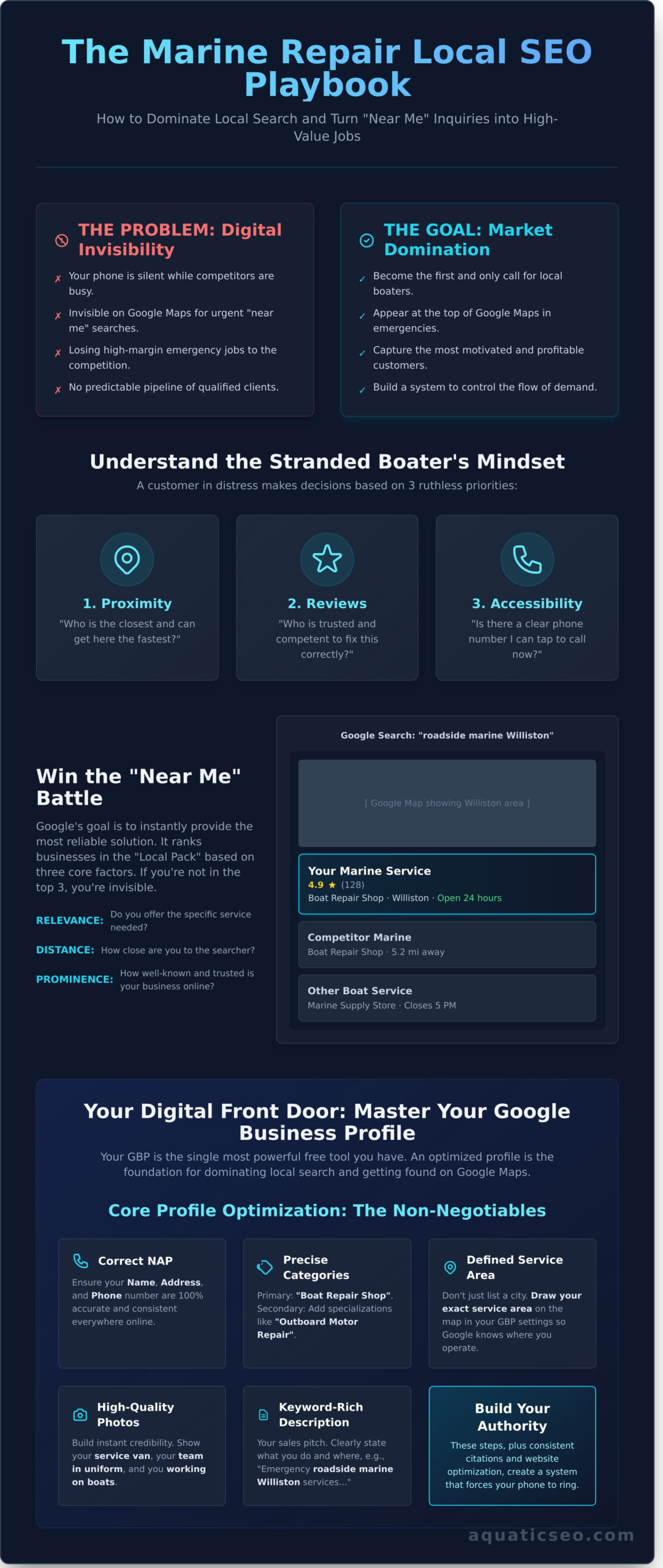
This is not a customer who is comparison shopping for a future project. This is a client with an urgent, high-margin problem that needs solving now. They are on a mobile device, stressed, and their decision-making is ruthlessly efficient. They prioritize three things above all else:
- Proximity: Who is the closest and can get here the fastest?
- Reviews: Who is trusted and competent to fix this problem correctly?
- Accessibility: Is there a clear phone number I can tap to call immediately?
Deconstructing a ‘Marine Repair Near Me’ Search
Google’s objective is to deliver the most reliable solution instantly. Its algorithm relentlessly filters businesses based on three core factors: relevance, distance, and prominence. The entire discipline of Local search engine optimization (local SEO) is built on systematically proving to Google that you are the superior answer. Simply existing is not enough; you must demonstrate that your roadside marine Williston service is the most relevant, authoritative solution for that searcher, at that exact moment.
Dominating these local search results does more than generate calls. It builds a defensive moat around your business. Every urgent, qualified inquiry you capture is one your competitors never see. You stop competing on price and start controlling the flow of high-value demand in your territory.
Your Digital Front Door: Mastering Your Google Business Profile (GBP)
Forget every other free marketing tool. For a local service business, your Google Business Profile is the single most powerful asset you have. It’s not an option; it’s the system that controls whether a stranded boater finds you or your competitor on Google Maps. An unmanaged, incomplete profile is a direct gift to the competition. It signals to Google-and to potential customers-that you aren’t serious or available.
Every action you take on your GBP directly influences your map ranking and how often you appear in the coveted “local pack.” Mastering this profile is the foundational step to controlling local demand. This isn’t just about being listed; it’s about dominating the search results when a boater needs immediate help. The principles of GBP management are a core part of what any comprehensive guide to local SEO will teach, because it works.
Core Profile Optimization: The Non-Negotiables
This is the foundation. Absolute accuracy is mandatory. Start by ensuring your Name, Address (if applicable), and Phone number (NAP) are 100% correct and consistent everywhere online. Then, implement these controls:
- Select Correct Categories: Your primary category must be precise, like “Boat Repair Shop.” Add secondary categories for specializations like “Outboard Motor Repair Shop” or “Marine Electronics.”
- Define Your Service Area: As a mobile business, don’t just list a city. Draw your exact service area on the map within your GBP settings so Google knows precisely where you operate.
- Upload High-Quality Photos: Show, don’t just tell. Post clear photos of your service van, your team in uniform, and you actively working on repairs. This builds instant credibility.
- Write a Keyword-Rich Description: This is your sales pitch. Clearly state what you do and where. For example: “We provide emergency roadside marine Williston services, specializing in rapid-response engine diagnostics and electrical repair for stranded boaters.”
Activating Your Profile: Posts, Q&A, and Services
An optimized profile must be an active profile. Consistent activity signals relevance to Google. Use Google Posts weekly to announce immediate availability, highlight a specific service, or share a recent success story. Pre-emptively load the Q&A section with common questions like “What are your emergency call-out fees?” and provide clear, professional answers. Finally, use the Services section to list every single task you perform-from impeller replacement to GPS installation-with detailed descriptions. Each service is another opportunity to be found.
Building Trust with Reviews and Photos
Trust is the final filter for a customer in distress. Implement a simple, repeatable system to request a review after every single completed service call. Respond professionally to every review-positive or negative-to demonstrate accountability. A thoughtful response to a complaint can be more powerful than a dozen five-star ratings. When you ask for a review, also encourage the customer to upload a photo of their successful repair. This user-generated content is authentic proof that you deliver results when it matters most.
On-Site SEO: Turning Your Website into a Local Magnet
Your Google Business Profile and local ads get the click, but your website closes the deal. It’s the ultimate destination to convert a stranded boater into a qualified, high-margin customer. Forget vague marketing fluff; the goal of on-site SEO is brutally simple: to signal to Google exactly what you do and where you do it. This isn’t about vanity traffic, it’s about operational control.
In a roadside emergency, that search is happening on a phone. If your site is slow, hard to navigate, or doesn’t have a click-to-call button front and center, you’ve already lost the job. Mobile-first design isn’t a feature; it’s a requirement for survival. If your website isn’t built for conversions, we need to talk.
Creating Hyper-Local Service Pages
A generic “Services” page is a revenue killer. To dominate local search, you need a dedicated page for each core service you offer in your primary location. This system allows you to target specific, high-intent searches with precision. For a roadside marine Williston operator, this means pages like “Mobile Boat Engine Repair in Williston” or “Emergency Boat Fuel Delivery Levy County.” Each page should feature an embedded map of that specific service area and mention local landmarks like Lake Rousseau or marinas in Cedar Key to reinforce your geographic authority with both users and Google.
Essential On-Page Elements for Local SEO
Once you have the right page structure, you must enforce a few non-negotiable on-page elements. These are the technical signals that build trust with search engines and turn your site into a reliable source of qualified leads.
- Consistent NAP: Your business Name, Address, and Phone number (NAP) must be displayed identically on every single page, usually in the footer. This consistency is a foundational element of mastering your Google Business Profile and local search rankings.
- Local Business Schema: This is structured data-a piece of code-that spoon-feeds your business details directly to Google. It removes all guesswork, telling the search engine your hours, service area, and offerings in its native language.
- Local Testimonials: Displaying reviews from actual customers in Williston, Morriston, or Bronson provides powerful social proof. It tells a potential customer that you are the trusted, go-to operator in their immediate area.
Off-Site Authority: Building Citations and Local Backlinks
Your website is your digital storefront, but its authority is built elsewhere on the web. To dominate local search, Google needs to see consistent, verifiable proof that your business is a legitimate, recognized operator in your service area. This proof comes from two primary sources: citations and local backlinks. Ignoring them means leaving your visibility and operational stability to chance.
A citation is any online mention of your business’s Name, Address, and Phone number (NAP). Think of it as your business’s digital footprint. Consistent, accurate citations build trust with search engines. Inconsistent data creates confusion and erodes that trust, directly suppressing your ability to rank for high-value search terms.
The Foundational Citations Every Marine Business Needs
This is not about getting listed on thousands of low-quality directories; it’s about controlling your business information on the platforms that have real authority. We enforce consistency across a specific hierarchy of sources to build a stable foundation for any service, including roadside marine Williston providers. Your citation strategy must include:
- Core Data Aggregators: Platforms like Foursquare and Data Axle that feed hundreds of other online directories. Getting these right is the critical first step.
- Major Directories: Your Google Business Profile, Yelp, Apple Maps, and Bing Places are non-negotiable and must be perfectly optimized.
- Marine-Specific Directories: Listings on relevant sites like Marinas.com, Waterway Guide, and active boating forums signal niche expertise to search engines.
A full citation audit is the only way to find and fix the damaging inconsistencies that are actively holding your rankings back.
Earning High-Value Local Backlinks
While citations are foundational, local backlinks are the ultimate vote of confidence. A backlink is simply a link from another website to yours. Forget vague agency promises of “more links.” We focus on earning high-authority links that prove you are a trusted local operator. This is about quality and relevance, not sheer quantity. For instance, a top concrete driveway contractor bay area might publish a detailed guide on their quality process to earn trust and authoritative links, a strategy that works for any local service business.
Real authority comes from real-world actions, not digital tricks:
- Sponsor a local fishing tournament or boat show and get featured as an official partner on their website.
- Partner with local marinas, bait shops, or yacht clubs to create a referral system that includes a link from their “Partners” page.
- Get your business featured in a local news story about boating safety or a community blog covering lake activities.
Building this off-site authority is a systematic process, not a one-time task. It is a critical component for controlling demand and ensuring a steady flow of qualified inquiries. Managing this digital footprint is a core function of the Marine Demand Control System we implement for our partners.
The Aquatic SEO System: From Being Found to Controlling Demand
Getting found online is a critical first step. When a boater is stranded, you need to appear at the top of the search results. But showing up for terms like roadside marine Williston is just the beginning, not the end goal. The real problem isn’t a lack of calls-it’s a flood of unqualified, low-margin inquiries that disrupt your schedule and kill your profitability. This is the operational chaos that keeps good businesses from growing.
The solution is to move beyond simple visibility and install a system that filters demand, giving you control. This is how you stop being just a service provider and start running a growth-focused operation.
Moving Beyond Visibility to Profitability
Our system is engineered to do one thing: ensure the calls you get are for your most valuable services. We don’t chase vanity traffic; we capture high-intent customers searching for high-margin work. Instead of fielding dozens of calls for minor fixes, you attract the profitable jobs that stabilize your revenue and your schedule. This operational control means:
- Higher Average Job Value: You attract clients who need complex, profitable repairs, not just a quick tow.
- Predictable Scheduling: Fill your calendar with high-value work instead of reacting to random, low-priority calls.
- Dominant Market Position: Become the go-to provider for the services that actually build your business.
Why a System Beats Random Tactics
Local SEO is just one gear in a larger machine. Random marketing tactics might generate clicks, but they don’t build a resilient business. A system integrates your dominant local presence with a process that qualifies inquiries before they hit your phone. It gives you control over your growth, allowing you to scale deliberately instead of just getting busier. You stop reacting to the market and start commanding it. This is the difference between generating traffic and controlling demand.
See how the Marine Demand Control System works.
Take Control of Your Local Marine Market
This playbook lays out the essential tactics for local search dominance. Mastering your digital front door-your Google Business Profile and website-is the first critical step. For a roadside marine williston service, this isn’t just about getting more calls; it’s about attracting the right calls. True growth comes from a system that filters for high-value customers, turning your online visibility into a predictable, profitable asset.
But visibility without strategy leads to chaos-random calls and unpredictable schedules that kill your margins. That’s why we built the proprietary Marine Demand Control System. We are not another marketing agency chasing vanity traffic. As marketing operators built specifically for marine businesses, we focus exclusively on delivering qualified inquiries that stabilize your operations and drive real growth.
Stop wasting time on bad leads. Request a No-BS Analysis of your local visibility.
The tools to dominate your local market are within reach. It’s time to take control.
Frequently Asked Questions
What’s the difference between local SEO and regular SEO for a marine business?
Regular SEO chases “vanity traffic” from anywhere on the globe. Local SEO is about operational control. It focuses on dominating your service area to attract high-value clients searching for marine services right where you operate. It’s not about abstract rankings; it’s a system designed to generate qualified, profitable jobs that don’t stretch your resources thin. This is the key to controlling demand, not just getting clicks.
Do I need a physical address to show up on Google Maps for my mobile repair service?
No. A physical storefront is not required for mobile operations. A Google Business Profile can be registered as a Service Area Business (SAB), which defines your operational footprint without publicizing a physical address. This is a critical step for a roadside marine Williston service, ensuring you appear in local map searches for customers in your target territory and establishing your command of the local market.
How long does it take to see results from a local marine marketing campaign?
Forget vague timelines. While foundational SEO takes 90-180 days to establish market dominance, you should see an increase in qualified inquiries much sooner. A properly implemented system shows initial traction within 30-45 days as critical business listings are corrected and optimized. We focus on measurable operational impact-like more calls from the right customers-not just ranking reports. The goal is predictable revenue, not just patience.
How do I get more positive reviews for my marine service business?
Stop hoping for reviews and start systemizing their acquisition. Implement a simple, automated process. After a job is completed and payment is received, send a direct link to your Google Business Profile via text or email asking for feedback. Making it effortless for the client is key. This isn’t about begging; it’s an operational process that builds social proof, filters for higher-quality customers, and reinforces your market authority.
Should I use paid ads in addition to local SEO?
Yes, but only as a strategic tool for demand control, not a crutch. Local SEO builds your long-term, foundational authority. Paid ads, like Google Local Services Ads, are a faucet you can turn on to fill specific schedule gaps or target high-margin emergency jobs immediately. Using them together gives you total control over your lead flow, allowing you to scale up or down based on your operational capacity and profitability goals.
My competitor is ranking above me. What are the first three things I should check?
Focus on what moves the needle for a roadside marine Williston business. First, audit their Google Business Profile: is it 100% complete, with more positive reviews and recent photos than yours? Second, check their business listing consistency (citations) across key directories. Third, evaluate their website’s mobile speed and clarity. These foundational elements directly impact local search performance and are where most competitors show operational weakness.