

You’ve spent a small fortune on traditional advertising, maybe even a premium listing in yp, only to find your schedule packed with low-margin repairs and tire-kickers. Your phone might be ringing, but are those calls building the stable, high-profit business you want? Or are they just creating chaos, leaving you bouncing between frantic weeks and dead ones with no real control over your income and no way to tell if your marketing dollars are actually working?
This isn’t a lead generation problem; it’s a systems problem. The old model of casting a wide net is fundamentally broken for specialized marine businesses. In this article, we will dismantle why this approach fails and show you how a modern Demand Control System is your only option. You will discover the precise method to filter out price shoppers, systematically attract high-margin clients who value your expertise, and finally gain absolute control over your job schedule and profitability. It’s time to stop buying unqualified leads and start engineering the demand you deserve.
Key Takeaways
- Understand why legacy advertising like YP is designed to generate volume, not the high-margin clients your marine business needs to thrive.
- Discover how to shift from being a passive advertiser to actively controlling the demand for your services with a system built for operational stability.
- Learn the critical difference between chasing unqualified “leads” and attracting pre-qualified inquiries that respect your pricing and expertise.
- Get the first actionable steps to reclaim control over your client acquisition process and build a more predictable, profitable schedule.
The Old Playbook: Why YP-Style Marketing Fails the Modern Marine Business
Let’s be direct. For decades, getting your marine business in front of local customers meant one thing: buying a bigger ad in the phone book. Visibility in directories like the Yellow Pages was the only game in town. That model is now a direct threat to the profitability and stability of a modern, specialized marine operation. It was built for a different era and a different type of customer.
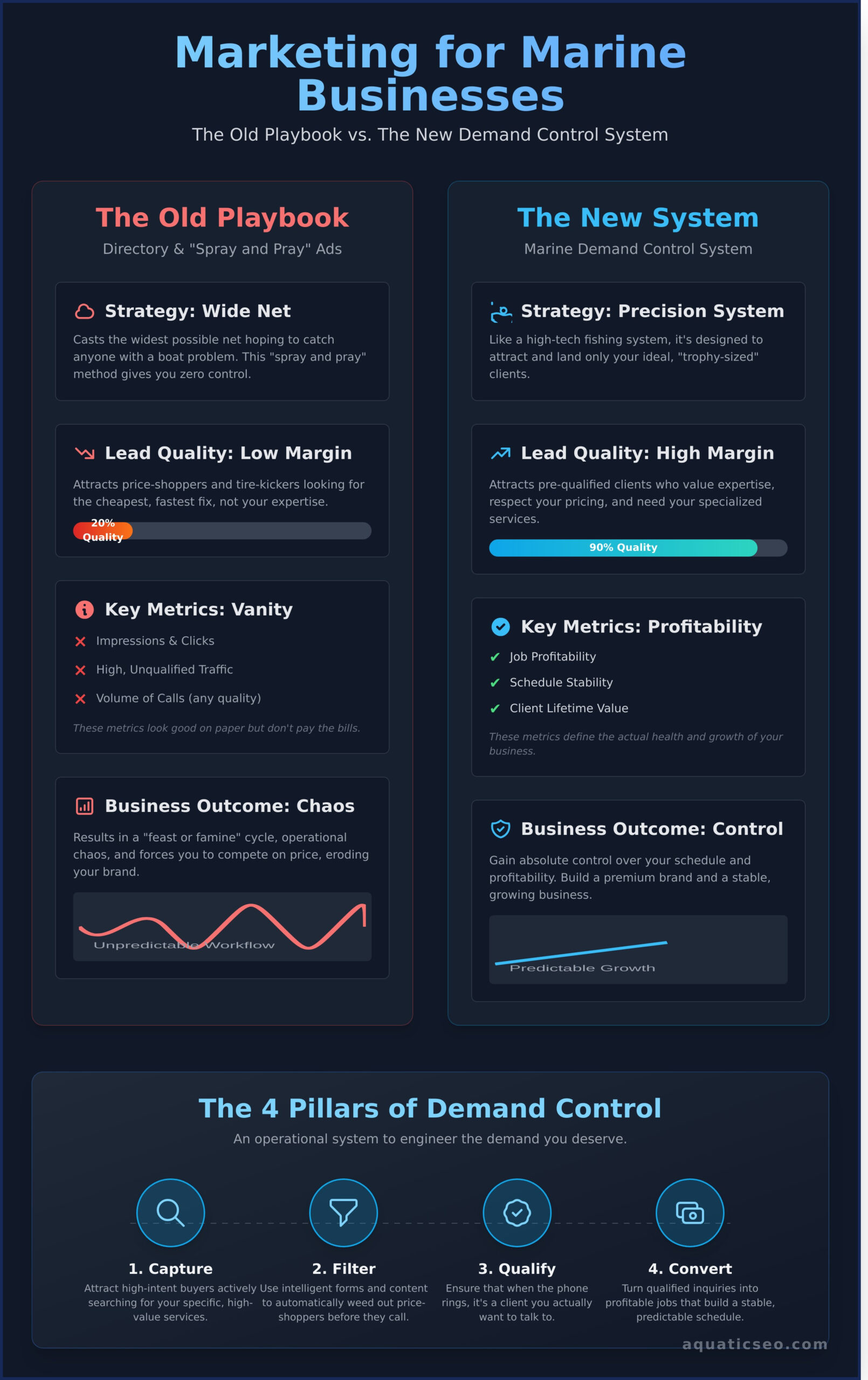
The core problem is simple: directory-style marketing is a volume game, not a quality game. It operates on a “spray and pray” philosophy, casting the widest possible net to attract anyone with a boat problem. This approach gives you zero control over who sees your business, why they call, or if they are a good fit for your services. The result is a flood of low-margin inquiries from price shoppers, creating operational chaos instead of predictable growth.
The Profile of a ‘Directory Lead’
A lead generated from a generic, volume-focused platform is fundamentally different from a qualified buyer. This individual is not seeking your specific expertise; they are looking for the fastest, cheapest fix. They are uneducated on the value of specialized service and see your business as just another commodity to be bid down. This drains your team’s most valuable resource-time-on quotes for jobs you don’t even want.
Vanity Metrics vs. Operational Reality
The old yp playbook and its digital successors sell you on “vanity metrics.” They report on impressions, views, and clicks-numbers that look impressive on a report but do nothing to pay your technicians or fuel your trucks. This is a distraction from the metrics that actually define the health of your business:
- Job Profitability: Are you protecting your margins on every project?
- Schedule Stability: Can you forecast your workflow and avoid the “feast or famine” cycle?
- Client Lifetime Value: Are you attracting repeat business from high-value clients?
High traffic is not a sign of success; it’s a liability if it’s unqualified. It clogs your operational pipeline, burns out your team, and forces you to compete on price, systematically destroying the premium brand you’ve worked to build.
The New System: Taking Command with a Marine Demand Control System
The old model of marine marketing is broken. Passively waiting for the phone to ring from a vague directory ad or a scattergun social media post is a strategy for stagnation, not growth. It’s time to move from being a passive advertiser to an active operator who manages demand. This is the core principle behind our Marine Demand Control System-a methodical process designed to give you control over your client acquisition.
Forget the obsession with ‘more leads.’ That metric is a vanity trap set by traditional agencies. We focus on delivering the right inquiries that protect your margins and stabilize your schedule. Think of it less like a giant dragnet that catches everything and more like a high-tech fishing system designed to land only trophy-sized clients. This isn’t a service for marketers; it’s an operational system for growth partners built on four pillars: Capture, Filter, Qualify, and Convert.
Capture: Attracting High-Intent Buyers
We target and attract clients who are actively searching for your specific, high-value services. This means moving beyond simple brand name searches to intercept problem-aware buyers. In the multi-billion dollar U.S. marine economy, the best clients aren’t just browsing; they’re looking for a specialist. We use niche-specific SEO and content that speaks their language to ensure you are the only logical choice when they are ready to act.
Filter & Qualify: Protecting Your Time and Margins
Answering calls from tire-kickers and price-shoppers is a direct drain on your profitability. Our system implements intelligent filters directly on your website to pre-qualify inquiries automatically. Unlike a passive yp listing that invites anyone to call, our strategic forms and content weed out low-value leads. The result is simple: when your phone rings, it’s a client you actually want. See how our system filters out low-quality leads and protects your operational focus.
A Head-to-Head Comparison: Directory Listings vs. Demand Control
Most marine contractors are stuck in a cycle of renting attention from outdated platforms. You pay a monthly fee to a directory, hope the phone rings, and deal with whatever comes in. This isn’t a growth strategy; it’s a gamble. The alternative is owning an asset that gives you complete control over your growth.
Let’s break down the fundamental differences between paying for a spot in a generic directory and investing in a system designed to control demand for your specific services.
Investment & ROI
A listing on a platform like yp is a pure advertising expense. The money is spent, and you’re left with a handful of untraceable calls of varying quality. A Demand Control System is an investment in an operational asset-a digital machine that appreciates in value and generates predictable, high-margin work. We measure success not by cost-per-call, but by your cost-per-qualified-job.
Control & Predictability
Directory listings offer zero control. You cannot choose who calls you or what they want. This leads to chaotic schedules and unpredictable revenue. Demand Control is the opposite. It allows you to turn the dial up or down for specific, high-margin services, creating a stable, predictable workflow and eliminating the feast-or-famine cycle for good.
Targeting & Specialization
Generic directories are built for everyone, from pizzerias to plumbers. They lack the sophistication to understand the unique needs of a marine contractor-the seasonality, the specialized equipment, and the high-stakes nature of the work. Our system is engineered exclusively for the marine industry, designed to attract and filter for the exact clients and jobs that build a stronger, more profitable operation.
| Factor | Directory Listings (e.g., YP) | Marine Demand Control System |
|---|---|---|
| Core Function | Renting a spot in a list | Owning a client acquisition asset |
| Control | None. You take any call you can get. | Total. You dictate the job type and volume. |
| ROI Measurement | Vague “cost-per-lead” or “cost-per-call” | Auditable “cost-per-qualified-job” |
| Business Outcome | Unpredictable revenue, low-quality inquiries | Stable schedules, improved margins, predictable growth |
The choice is clear: you can continue to rent visibility from a generic platform, or you can invest in a system that gives you permanent control over your company’s growth. Stop gambling with your marketing budget and start building an asset. See how the Marine Demand Control System puts you in the driver’s seat.
Making the Switch: How to Move from Passive Ads to Active Growth
You understand the problem. Relying on passive, pay-to-play directories is a recipe for unstable revenue and shrinking margins. The decision to reclaim control is the most important one you can make for your business. This isn’t about flipping a switch overnight; it’s about methodically building a client acquisition asset that you own-one that frees you from dependency on rented attention.
The path to operational control starts with data, not guesswork. Here are the first, non-negotiable steps to building a system that delivers qualified, high-margin work on your terms.
Step 1: Audit Your Current Lead Flow
Before you can build a better system, you must have a brutally honest understanding of your current reality. Stop guessing where your best work comes from and start tracking. This simple audit will reveal the true cost of your current client acquisition strategy.
- Analyze the Source: Pull your last 20-30 job invoices. Where did each client find you? A referral? Your website? A paid ad on a platform like yp? Be specific.
- Calculate True Profit: For each lead source, calculate the actual profit margin. Factor in not just the ad spend but the time spent on unqualified calls, low-ball quotes, and operational headaches.
- Identify Your Winners: Isolate the job types that consistently produce the highest margins with the least amount of friction. This is your new target.
Step 2: Define Your ‘Ideal Client’ Profile
Armed with data, you can now build a profile of the only client you want to attract. This goes far beyond basic demographics. We’re talking about operational fit-the clients who make your business run smoother and more profitably. Which projects drain your resources, and which ones energize your team? Your new system will be engineered to attract the latter and repel the former.
Step 3: Request a No-BS Marketing Analysis
Once you know what you have and what you want, the final step is to get a clear, data-driven roadmap to bridge the gap. A professional analysis cuts through the noise of vanity metrics. It shows you exactly where your ideal clients are searching online and what it will take to dominate those channels. This is how you see what a true Marine Demand Control System looks like for your specific operation-before making any commitments.
Take control of your growth. Request your no-BS marketing analysis today and get the clarity you need to build a more stable and profitable future.
Take Control of Your Growth-The YP Era is Over
The verdict is in: the old playbook of passive directory listings simply doesn’t work for the modern marine business. Relying on an outdated yp strategy is an exercise in hope, not control, leaving you at the mercy of unqualified inquiries and unpredictable revenue swings. This passive approach is a direct threat to your margins and your sanity.
We are a growth partner, not a marketing agency. Built exclusively for the marine industry, our Marine Demand Control System gives you command over your growth. We don’t chase vanity metrics like clicks or traffic; we engineer a system that delivers qualified customers, protects your margins, and creates the operational stability you need to scale profitably.
Stop leaving your success to chance. If you’re ready to move from passive ads to active, predictable growth, the next step is to see what real control looks like. Request a No-BS Analysis of Your Marine Marketing today and take command of your future.
Frequently Asked Questions
Is there any value left in being listed on Yellow Pages or similar directories?
While a basic listing on YP or other directories won’t necessarily hurt, its value for generating high-quality leads is minimal. These platforms are designed for price shoppers and create a “race to the bottom” environment. Our system bypasses this entirely by targeting serious clients who are actively searching for the specific, high-value marine services you provide, not just browsing a generic list of vendors.
My marine business is very local. Isn’t a local directory the best way to be found?
Being listed locally is not the same as being chosen. Local directories simply place you alongside every competitor, forcing you to compete on price. The Marine Demand Control System dominates your local service area by actively capturing high-intent customers and positioning your business as the premier authority. We don’t just make you visible; we make you the only logical choice for profitable local work.
How is a ‘Demand Control System’ different from just running my own Google Ads campaigns?
Running Google Ads is like having an engine with no steering wheel. Our Marine Demand Control System is a complete operational framework. It combines precision-targeted advertising with a robust filtering and qualification process. We don’t just send you clicks; we deliver qualified inquiries from customers who are pre-vetted for your specific, high-margin services, giving you total control over your workflow.
What kind of results can I realistically expect from this system in the first 6 months?
Forget vanity metrics. Within six months, you will see a measurable increase in the volume of qualified inquiries for your most profitable services. This translates directly to a more predictable work schedule, higher average job value, and a significant reduction in the “feast or famine” cycle that plagues many marine businesses. We build a stable pipeline of the work you actually want.
I’m a small marine service operator. Is a system like this affordable for my business?
This is an investment in operational control and profitability, not a marketing cost. The system is designed for operators who are tired of wasting time and money on unqualified leads and unpredictable schedules. If the cost of low-margin jobs and chaotic workflow is hurting your growth, then you cannot afford to continue without a system. We focus on delivering a clear, measurable ROI.
How do you track success if you’re not focused on traffic and rankings?
We track the only metrics that impact your bank account: the number of qualified inquiries, the conversion rate into booked jobs, and the average profit margin per job. Our success is tied directly to your success. Unlike traditional agencies that hide behind vague reports on clicks or YP impressions, our tracking is auditable and transparent, showing a clear line from our system to your revenue growth.