
Your inbox is full of Yachtworld inquiries, but your sales pipeline is empty. You’re spending hours chasing down ‘tire-kickers’ and unqualified leads, all while paying steep listing fees for the privilege. The problem isn’t your inventory or your sales team. The issue is systemic, rooted in a flawed yachtworld user experience that prioritizes lead quantity over quality, burying your high-value vessels and stripping you of brand control. This platform-level problem directly impacts your operations, wasting your team’s valuable time and eroding your margins with every dead-end follow-up.
You stop guessing and start measuring. A high-quality lead is one that has been systematically qualified before it hits your CRM. This is achieved with multi-step intake forms that ask for critical data: budget, purchase timeline, trade-in details, and specific needs. A serious buyer will provide this information. This automated filtering process ensures your sales team only engages with prospects who have demonstrated genuine intent and capacity; for brokers looking to streamline this workflow, you can learn more about EasyMLS CRM, a platform designed for the yachting industry.
This is not another article about writing better listing descriptions. This is a crucial analysis that exposes exactly how Yachtworld’s UX failures are silently killing your sales efficiency. We will break down the specific design flaws that generate unqualified inquiries and give you actionable strategies to regain control. You will learn how to filter the noise, attract genuinely qualified buyers, and finally justify investing in digital assets you own. It’s time to stop letting a broken system dictate your success and start building a predictable pipeline of high-value clients.
Key Takeaways
- Understand the core operational risk of building your sales process entirely on a platform you don’t control.
- Pinpoint the specific friction points in the Yachtworld user experience that cause high-value buyers to drop off before contacting you.
- Learn how to connect platform flaws directly to tangible business costs, including wasted broker time and lost commission.
- Discover a system to bypass marketplace limitations, take back control of your lead quality, and improve sales efficiency.
The Broker’s Dilemma: Trapped in the Yachtworld Ecosystem
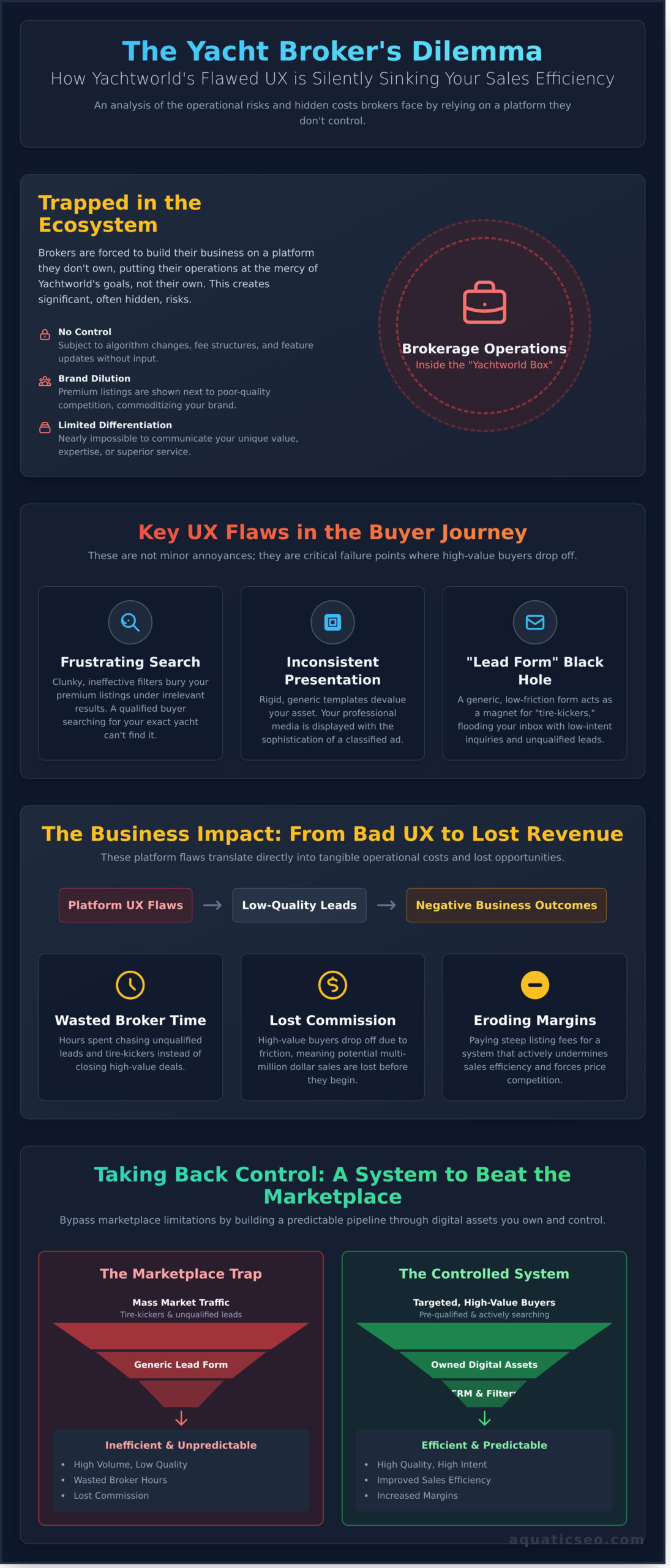
Let’s be direct: You have to be on Yachtworld. It is the dominant marketplace, and it is where the buyers are. This market dominance, however, creates a fundamental operational conflict for every serious brokerage. You are forced to build your business inside a system you do not own and cannot control, severely limiting your ability to filter inquiries, protect your margins, and build true brand equity.
This is where the concept of User Experience (UX) becomes a critical factor in your sales performance. UX isn’t about aesthetics; it is the total experience a potential buyer has interacting with the platform-from their initial search to the moment they submit an inquiry. A seamless process qualifies high-value buyers. A clunky one generates low-quality leads that waste your team’s time. The quality of the comprehensive user experience on a platform directly dictates the quality of the opportunities that land in your inbox.
User Experience vs. User Interface: What Brokers Need to Know
Do not confuse User Interface (UI) with User Experience (UX). UI is the visual design-the buttons, the colors, the layout of the photos. UX is the entire functional journey. Yachtworld might have a familiar UI, but if the search is frustrating or the inquiry process is vague, the UX fails. This flawed yachtworld user experience trains buyers to behave in specific, often inefficient, ways before they ever speak to your team.
Why Marketplace Dependency Creates Operational Risk
Relying solely on a third-party marketplace puts your operations at the mercy of their business goals, not yours. This dependency introduces significant and often hidden risks to your stability and profitability:
- No Control: You are subject to their algorithm changes, fee structures, and feature updates, which can alter your lead flow overnight without your input.
- Brand Dilution: Your premium listings are displayed right next to poorly presented boats from less professional competitors, commoditizing your brand and forcing you to compete on price.
- Limited Differentiation: Beyond basic photos and a price tag, it is nearly impossible to communicate your unique value, expertise, or superior service level.
- Misaligned Goals: The platform’s objective is to serve thousands of brokers and capture mass-market traffic, not to optimize your specific sales process for qualified, high-margin clients.
These platform-level limitations create friction that you inherit. In the following sections, we will dissect specific UX flaws within the ecosystem and connect them directly to the operational costs they impose on your brokerage.
A Deep Dive: Key UX Flaws in the Yachtworld Buyer Journey
To understand why a poor yachtworld user experience directly impacts your bottom line, we must dissect the typical buyer journey. From initial search to final inquiry, the platform is riddled with operational friction. These are not minor annoyances; they are critical failure points where high-value, qualified buyers abandon their search and your sales pipeline leaks revenue.
The Frustrating Search & Discovery Process
High-net-worth buyers value their time. They expect a seamless digital experience, but Yachtworld’s search is notoriously clunky. As countless user complaints on forums like Reddit confirm, the filters are often ineffective. Trying to search a specific region like “New England” or even multiple adjacent states is a frustrating exercise in futility. This basic failure buries your premium, well-maintained listings under a mountain of irrelevant results. The direct result: a qualified buyer, actively searching for a yacht exactly like yours, cannot find it and moves on.
Inconsistent Listing Quality and Presentation
Once a buyer does find a listing, the presentation often undermines the asset’s value. The rigid, templated layout forces every vessel into the same generic box, actively preventing effective brand storytelling. Your professional photography is placed next to low-quality, poorly-lit images from other brokers, devaluing the entire platform. Furthermore, the platform’s limitations on embedding rich media like high-definition video tours ignore fundamental usability best practices for modern digital sales. The outcome is that your multi-million dollar asset is presented with the sophistication of a common classified ad.
The ‘Lead Form’ Black Hole and Low-Intent Inquiries
The final step in the flawed yachtworld user experience is the inquiry, which is perhaps the most damaging to your sales operations. Yachtworld uses a generic, low-friction contact form that acts as a magnet for low-intent inquiries. It encourages unqualified questions and endless price-shopping from “tire-kickers.” This system provides no mechanism to pre-qualify interest or capture critical information, forcing your sales team to waste dozens of hours sifting through noise instead of engaging with genuinely qualified, ready-to-buy clients.
The Business Impact: How Bad UX Translates to Lost Revenue
The abstract flaws discussed previously are not just theoretical annoyances. They are operational liabilities with real-world costs. A frustrating digital journey for a potential buyer quickly translates to lost revenue, sabotaging your sales efforts before your team even gets a chance. It’s time to connect the poor yachtworld user experience to the numbers that dictate your company’s health: ROI, operational stability, and brand equity.
Wasted Ad Spend and Diminishing Listing ROI
Your Yachtworld listing fee is an investment intended to generate qualified demand. But if a confusing layout or broken search prevents a serious buyer from finding your specific vessel, that investment is wasted. When leads are unqualified or tire-kickers, your marketing dollars are being burned. A poor yachtworld user experience fundamentally breaks the marketing funnel, inflating your effective cost-per-qualified-lead and delivering a negative return on your biggest sales platform.
Sales Team Burnout and Operational Drag
The damage extends beyond marketing costs. The hidden operational cost of a sales team chasing junk leads is immense. Every hour spent filtering out unqualified inquiries is an hour not spent nurturing high-value clients and closing deals. This operational drag leads directly to:
- Lower team morale and higher employee turnover.
- Reduced capacity to follow up with genuinely interested buyers.
- Compressed profit margins and unpredictable cash flow.
Your team becomes reactive, not proactive, and your entire sales operation suffers.
Erosion of Brand Value and the Race to the Bottom
Your brand is a premium asset, but a clunky, unprofessional platform experience cheapens it. When the digital storefront doesn’t build value or effectively showcase your unique offerings, buyers default to the only metric they can easily compare: price. This commoditizes your inventory and forces you into price negotiations, eroding your margins. You lose control of your brand narrative, allowing a third-party platform’s poor UX to dictate your market position. This is the opposite of the demand control needed to grow profitably.
Taking Back Control: A System to Beat the Marketplace
Stop treating Yachtworld as the endpoint of your sales process. The platform is a powerful search engine, but relying on its limited interface means you’re competing on someone else’s turf with a standardized yachtworld user experience. The key to winning is to use the marketplace for what it is-a massive source of initial traffic-and then systematically pull high-intent buyers into a sales environment you completely control. This three-step process puts you back in command.
Step 1: Maximize Your Visibility Within Yachtworld
First, you must dominate the initial search. This means investing in professional photography and videography that stops scrollers in their tracks. Your listing copy must be detailed, benefit-driven, and meticulously crafted to pre-qualify serious buyers. Use every available field to demonstrate expertise. Treat your Yachtworld listing not as a brochure, but as a high-impact advertisement designed for one purpose: to drive the most qualified clicks to your own website.
Step 2: Drive Traffic to a High-Converting Website You Own
Your website is the hero of this strategy. Every Yachtworld listing should prominently feature a link to a dedicated, detailed landing page for that specific vessel. On your own site, you escape the restrictive templates that define the typical yachtworld user experience. You can tell a compelling story, showcase extensive galleries, and present video walkthroughs without limitation. Most importantly, you capture leads on your turf. This is where you control the conversation and the entire sales journey, free from competitor listings and platform distractions.
Step 3: Implement a ‘Demand Control System’ for Leads
Once traffic hits your site, the final step is to filter it for quality. Stop wasting your sales team’s valuable time on tire-kickers. A demand control system uses intelligent, multi-step forms to qualify a buyer’s intent, timeline, and budget before they submit an inquiry. AI-powered chat can handle common questions 24/7, ensuring only serious, well-informed leads reach a human. This operational discipline is the difference between being busy and being profitable. This is what our Marine Demand Control System is built for.
Take Control and Stop Relying on a Broken System
The conclusion is simple: continuing to rely on a third-party marketplace means surrendering control of your sales pipeline. As we’ve detailed, the flawed yachtworld user experience is not just a minor annoyance; it’s a systemic problem that actively bleeds qualified buyers from your funnel and erodes your margins. You are paying to participate in an ecosystem that works against your own operational stability and growth.
The alternative is to build an asset you own. We build Marine Demand Control Systems, not just websites, to give you that power back. It’s time to stop wasting time on vanity traffic and focus on generating qualified inquiries that you control. Take command of your lead flow, improve your margins, and build a more predictable business.
Ready to stop competing and start dominating? Request a No-BS Analysis of Your Marine Marketing and discover what true control feels like.
Frequently Asked Questions
Is Yachtworld still worth the listing fees for brokers in 2026?
Yachtworld remains a significant source of traffic, but its value is directly tied to your ability to manage the leads it generates. The platform itself provides volume, not quality. Without a system to filter out the noise, brokers find their teams wasting time on unqualified inquiries. Therefore, the fee is only ‘worth it’ if you control the process after the click, turning raw traffic into operational intelligence and real sales opportunities.
Can’t I just rely on Yachtworld’s own site improvements to get better leads?
Relying on Yachtworld’s site improvements is a passive strategy that surrenders control of your lead quality. Their primary goal is to increase platform-wide traffic, not to deliver pre-qualified buyers to your specific brokerage. An optimized yachtworld user experience on their end doesn’t guarantee a better lead for you. You must own the system that captures and qualifies prospects, turning their broad audience into your specific, high-value clients.
What are the most important elements of a yacht broker’s website?
A broker’s website is a tool for operational efficiency, not just a digital brochure. The critical elements are: 1) A clear value proposition that answers ‘why you?’. 2) High-resolution imagery and detailed specifications that build trust and reduce initial questions. 3) An intelligent lead capture system that filters and qualifies inquiries automatically. These components work together to deliver sales-ready leads, not just contact form submissions.
How can I tell if a lead is ‘high-quality’ before my sales team calls them?
You stop guessing and start measuring. A high-quality lead is one that has been systematically qualified before it hits your CRM. This is achieved with multi-step intake forms that ask for critical data: budget, purchase timeline, trade-in details, and specific needs. A serious buyer will provide this information. This automated filtering process ensures your sales team only engages with prospects who have demonstrated genuine intent and capacity.
What are the best alternatives to Yachtworld for listing high-end yachts?
The most powerful alternative is not another marketplace-it’s your own branded website. Marketplaces put you in a direct price comparison with every competitor, commoditizing your service. Your own site allows you to control the narrative, showcase your unique expertise, and build a brand that attracts ideal clients directly. Use marketplaces as a source of traffic, but your website must be the destination where you convert and qualify.
How much does it cost to build a website that can generate qualified leads?
This is an investment question, not a cost question. A basic website is a cost center. A strategic website with an integrated lead qualification system is a profit center that delivers predictable growth. The investment depends on the complexity of the system, but the focus should be on ROI. A system that saves your sales team dozens of hours a month and closes one extra deal a quarter provides a return that makes the initial investment an operational necessity.