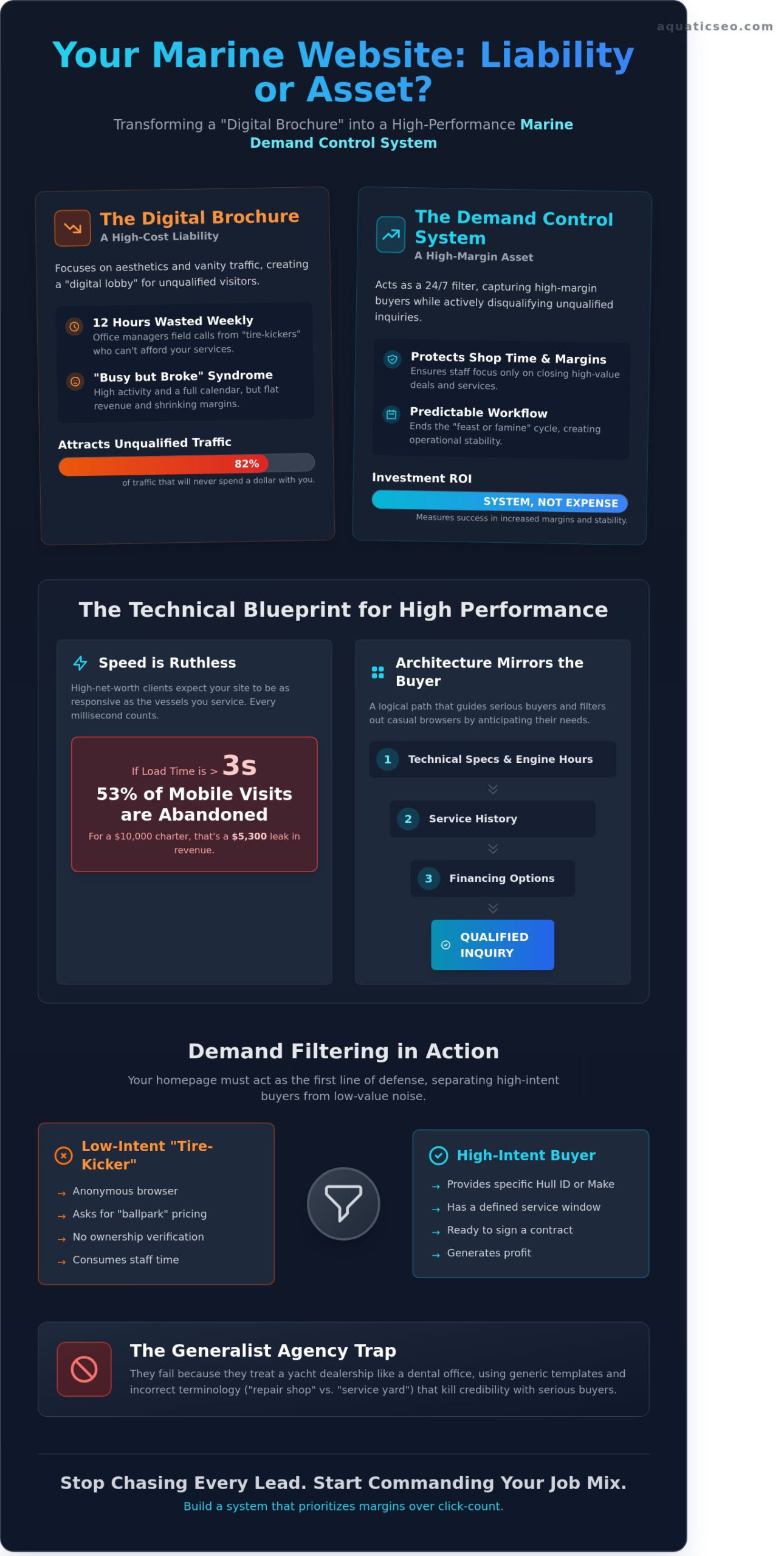
The most beautiful website in the harbor is often the most expensive liability for a service yard or yacht charter operator. If your site looks great but forces your office manager to spend 12 hours every week fielding calls from tire-kickers who can’t afford a 40,000 dollar repower, it’s a liability. Effective website design for marine companies isn’t about aesthetics or vanity traffic. It’s about building a specialized system that acts as a 24/7 filter to protect your shop time and your profit margins.
You’ve likely felt the exhaustion of the “feast or famine” cycle where revenue grows while your actual schedule stability stays in the gutter. It’s a common trap that keeps owners working in the business instead of on it. You deserve a predictable flow of work that fits your specific operational capacity.
I’m going to show you how to transform your digital presence into a Marine Demand Control System that captures high-margin buyers while ignoring the noise. We’ll examine the exact framework used to stabilize operations and give you total command over your job mix so you can finally stop chasing every lead that floats by.
Key Takeaways
- Stop treating your site as a “digital brochure” that attracts low-value tire-kickers and start building a system that filters for high-margin jobs.
- Ensure your technical setup is optimized for clients literally on the water, where a three-second lag can lose a high-value charter or service contract.
- Master the principles of website design for marine companies to turn your homepage into a first-line defense that disqualifies unqualified inquiries.
- Apply niche-specific UX strategies for service yards and dealers that prioritize operational reliability and expertise over generic marketing fluff.
- Transition from viewing your site as a one-time expense to a specialized system that measures success through operational stability and increased margins.
Why Most Marine Website Designs are High-Cost Liabilities
Your current website is likely a digital brochure that costs you money every hour it stays live. Most owners invest $15,000 to $65,000 in website design for marine companies thinking that high-resolution photography and a sleek layout will automatically translate to profit. This is a fundamental misunderstanding of how high-value marine transactions occur. Aesthetics without business logic create a “digital lobby” where visitors wander without purpose, consuming your bandwidth without ever intending to book a slip or purchase a vessel. If your site doesn’t actively filter out the 82% of traffic that will never spend a dollar with you, it’s a liability, not an asset.
The hidden cost of vanity traffic is a silent killer of margins. When a generic agency promises “more leads,” they often deliver a flood of low-intent inquiries that overwhelm your sales team. Every minute your staff spends answering a basic question from a non-buyer is a minute they aren’t closing a $200,000 refit or a premium charter. While standard web design principles focus on general user experience and interface beauty, a specialized marine system focuses on demand control. You don’t need more people looking at your boats; you need the right people committed to a transaction. We are moving away from passive displays toward active demand filtering systems that enforce your business rules before a lead is even generated.
The Failure of Generalist Marketing Agencies
Generalist agencies fail because they treat a yacht dealership like a local dental office. They don’t understand that confusing a “yacht charter” with a “boat rental” is a positioning error that kills credibility with high-net-worth individuals. Using templates designed for retail or home services results in zero qualified inquiries because the terminology is wrong. If your site calls a service yard a “repair shop,” serious captains will look elsewhere. A generalist won’t know that 74% of marine buyers research technical specifications for 14 days before making contact; they just want to put a “Buy Now” button on every page and call it a day.
This is why partnering with a specialized agency is critical. Full-service agencies that focus on cohesive digital strategies, such as the German-based Dockside Media, demonstrate how deep brand understanding translates into effective web design—a principle that applies globally.
The “Busy but Broke” Syndrome
Poorly designed sites create a “Busy but Broke” cycle where your team is constantly “working” but revenue stays flat. This happens when your site fails to act as a gatekeeper. You end up with a calendar full of tours for people who can’t afford the fuel, let alone the vessel. A high-intent marine lead is a prospect who provides a specific hull ID or vessel make and a defined service window, while a tire-kicker is an anonymous browser asking for “ballpark” pricing without any ownership verification. Without a system to identify the gap between revenue growth and schedule stability, you will continue to burn resources on low-value noise. We replace this chaos with a methodical approach that prioritizes your margins over your click-count.
The Technical Blueprint of a High-Performance Marine Website
Your website is a digital sales representative that never sleeps. If it’s slow, confusing, or broken, it’s a liability that actively drives qualified prospects to your competitors. Effective website design for marine companies isn’t about winning design awards for pretty sunset photos. It’s about engineering a platform that functions as a predictable engine for your Marine Demand Control System. Every millisecond of load time and every pixel of layout must serve the goal of converting a high-intent browser into a scheduled service or a booked charter.
Speed is the most ruthless conversion factor in the marine industry. Data from Google indicates that 53% of mobile visits are abandoned if a page takes longer than three seconds to load. If you run a yacht charter business with a $10,000 average booking value, that three-second lag isn’t just a technical glitch; it’s a $5,300 leak in your revenue bucket. High-net-worth individuals don’t have the patience for spinning loading icons. They expect your site to be as responsive as the vessels you sell or service. We focus on lean code and optimized asset delivery to ensure your site outperforms 90% of the market.
Site architecture must mirror the actual research journey of a marine buyer. A prospect looking for a $250,000 center console doesn’t buy on impulse. They need a logical path from technical specifications and engine hours to service history and financing options. Your site’s navigation shouldn’t be a guessing game. It needs to be a structured funnel that filters out “tire kickers” and prioritizes inquiries from users ready to sign a contract. This methodical approach ensures your team spends time on high-margin deals rather than answering basic questions that your website should have handled.
Security protocols are the final pillar of this blueprint. When you’re handling $5,000 deposits or facilitating the sale of a multi-million dollar vessel, a simple SSL certificate is the bare minimum. You need robust, PCI-compliant booking gateways and encrypted lead capture forms to protect your business and your clients’ sensitive data. A single security breach can destroy a decade of reputation in the local marina. We implement enterprise-grade security layers that give your clients the confidence to transact online without hesitation.
Optimizing for the “On-the-Dock” User
Mobile users in this industry aren’t just sitting on couches; they’re often on a sun-drenched dock or a moving boat. Your UX must account for high-glare environments with high-contrast buttons and thumb-friendly navigation. We prioritize click-to-call buttons and instant booking features that work even with spotty LTE signals. If a captain can’t find your service yard’s coordinates or emergency haul-out number in two taps, your website design for marine companies has failed its primary mission.
Search Visibility without the Fluff
Visibility is about dominating local search results where the high-intent buyers live. We integrate SEO rich text that targets specific marine keywords without sounding like a robot wrote it. This falls under our pillar of Marine Industry Marketing Education, where we teach you how technical SEO and local citations drive actual foot traffic. By focusing on “Demand Visibility,” we ensure your yard or dealership appears exactly when a boat owner searches for “repowering services” or “winter storage near me.” You can see how this fits into a broader Marine Demand Control System to stabilize your seasonal revenue.
Demand Filtering: Using Design to Protect Your Margins
Most marine business owners mistake a high volume of inquiries for success. If your inbox is full of “tire kickers” asking for quotes on 15 year old outboard repairs while your techs are booked for six months; your site is failing you. Effective website design for marine companies acts as a digital gatekeeper. It’s the first stage of the Marine Demand Control System. This isn’t about being polite. It’s about protecting your production schedule from low-margin distractions that eat your profit.
The psychology of disqualification is your strongest tool. When you explicitly state who you are not for, you become infinitely more attractive to your ideal client. A yacht refit yard that declares they only work on vessels over 60 feet isn’t losing money. They’re signaling to the 100 foot boat owner that their project won’t be delayed by a fleet of center consoles. You must use your design to enforce your ideal job mix. High-value buyers don’t want a generalist; they want the specialist who has the balls to say “no” to the wrong work.
The Anatomy of a Qualified Inquiry Form
Stop using “Name and Email” forms. They’re an invitation for waste. A high-performing marine site uses multi-step forms that capture vessel make, model, year, and project scope before a user can hit submit. This creates just enough friction to stop the uncommitted. We use conditional logic to route these leads instantly. If a prospect selects a “re-power” project with a budget over $50,000, they go directly to your top closer. If they select a budget below your minimum threshold, the system triggers an automated “not a fit” email with a link to a helpful DIY resource. This ensures your high-value talent only speaks to high-value prospects.
Content that Filters Demand
Transparency is a filtration device. Many operators fear putting pricing on their site because they think it scares people away. That’s the point. If a customer is scared by your “starting at” price for a seasonal charter or a ceramic coating package, they were never going to pay your full rate anyway. Use your content to explain the “why” behind your premium. Position your process as the only logical choice for someone who values their time on the water more than a bottom-dollar deal.
- Price Anchoring: List your starting rates to eliminate 40% of low-margin shoppers before they call.
- Service Specificity: Use technical language like “IPS pod drive service” or “gyro-stabilizer installation” to signal expertise to sophisticated owners.
- Operational Boundaries: Clearly define your service radius and vessel size limits to prevent out-of-area logistical nightmares.
Implementing this Demand Filtering layer within your site architecture saves your service manager or sales lead at least 10 hours of manual follow-up time weekly by eliminating non-viable leads before they hit the inbox. This is how you transition from being a “busy” business to a profitable one. You don’t need more traffic. You need a system that captures the right demand and discards the rest without human intervention. Strategic website design for marine companies makes your operations leaner by ensuring every lead in your CRM is worth the time it takes to call them back.
Industry-Specific UX: Tailoring for Charters, Yards, and Dealers
Generic templates kill conversions. A service yard needs to prove technical capability while a charter needs to sell a dream. Effective website design for marine companies recognizes that a captain looking for a refit has different psychological triggers than a family booking a sunset cruise. You can’t use the same layout for both and expect your margins to stay healthy.
We treat your website as a functional part of your operations, not a digital brochure. If your site doesn’t filter inquiries or demonstrate specific technical authority, it’s a liability. Every pixel must serve the “Marine Demand Control System” by moving a qualified lead closer to a transaction.
Yacht Charter and Rental Optimization
Stop trying to look like a search engine. Many charter operators make the mistake of mimicking “YachtWorld” or other massive aggregators. This commoditizes your fleet. Your website must sell the experience of being on the water, not just the technical specs of the hull. Data shows that 68% of luxury charter bookings occur only after a user views high-definition video walkthroughs of the galley and staterooms.
- Visual Storytelling: Use original media of your actual crew and local destinations. Stock photos of people pointing at the horizon suggest you don’t actually own the boats you’re listing.
- Frictionless Booking: Integrate real-time availability that syncs with your internal calendar. If a user has to call just to see if a Friday is open, they’ll bounce to a competitor who respects their time.
- Direct Authority: Highlight your local knowledge. Provide specific itineraries for the Exumas or the Florida Keys to prove you aren’t just a booking middleman.
Service and Contractor Credibility
Service yards and mobile mechanics live on reputation and specialized equipment. If you own a 75-ton Travelift or have ABYC Master Technicians on staff, these facts should be the cornerstone of your design. Reliability is the only currency in marine repair. Your website design for marine companies must communicate that you won’t leave a boat hanging in the slings or a project half-finished.
Trust is built through “in the trenches” photography. Show a diesel engine mid-repower or a complex NMEA 2000 electronics installation. These images prove you have the tools and the talent to handle high-value assets. For mobile contractors, the mobile UX must prioritize a “Request Emergency Dockside Repair” button. When a pump fails at 4:00 PM on a Friday, the customer doesn’t want to read your “About Us” page; they want a 1-second path to a human.
Marine Construction and Inventory Management
Marine construction is a high-ticket, long-cycle business. Your site needs to showcase the scale of your projects, such as a 300-linear-foot seawall or a commercial marina dock system. Include a dedicated “Equipment” section. Showing your barges, pile drivers, and specialized dive gear proves you’re a legitimate operator rather than a guy with a truck and a clipboard.
For boat dealers, inventory management is the primary friction point. Manual data entry is a waste of your team’s time. Your website must integrate via API with platforms like BoatTrader or YachtWorld to ensure your listings stay current. Statistics from 2023 show that dealers who update their inventory daily see 41% higher engagement than those with stagnant listings. Don’t let a sold boat sit on your site for three weeks; it frustrates buyers and wastes your sales team’s time on dead leads.
Stop losing high-value leads to outdated design. Build a high-performance system with our marine website design services.
Turning Your Website into a Growth Partner
Most marine operators view a website as a static brochure. They pay a developer, launch the site, and hope for the best. This project-based mindset is why many $2M service yards struggle with inconsistent job flow and seasonal lulls. A website shouldn’t be a one-time cost; it must be an ongoing demand compounding asset. Effective website design for marine companies creates a system where every month of data makes the next month more profitable. It moves you away from the “busy but broke” cycle and toward a predictable, high-margin schedule that keeps your best techs on the payroll year-round.
Success is measured in dollars and margins, not clicks or “likes.” If your yacht charter site gets 10,000 hits but your calendar is empty for the July 4th weekend, those hits are worthless. We look at the specific quality of the inquiry. We want the client who books the 100-foot vessel for a week, not the one asking for a two-hour discount on a center console. By integrating your site with the Marine Demand Control System, you gain the ability to turn the “faucet” of leads up or down based on your actual yard capacity or fleet availability. This isn’t marketing; it’s operational control over your job flow that prevents your crew from being overwhelmed or sitting idle.
- Transition from one-off design projects to a continuous growth engine.
- Prioritize high-margin service contracts over high-volume, low-profit tasks.
- Use the site as a filter to protect your team’s time from “tire kickers.”
- Align digital lead generation with your physical dockage or shop capacity.
Auditable Tracking and Accountability
You need to know exactly which lead source paid for your last $20,000 repower or your most recent boat sale. Most agencies hide behind vague reports that focus on “total sessions” or “impressions.” This is a vanity metric that tells you nothing about your actual bank account. We set up conversion tracking that identifies exactly where high-value leads originate. If 85% of your profit comes from 15% of your traffic, you need to know which 15% that is. This data allows you to refine your job mix, ensuring your crew stays focused on the most profitable work while maintaining schedule stability through the off-season. Stop guessing which ads work and start looking at the auditable numbers.
Getting Started with a Specialized Partner
Is your current site an asset or a liability? If it hasn’t directly increased your average job value by at least 18% in the last year, it’s a liability that is costing you more than just the hosting fee. The Aquatic SEO approach focuses on building high-intent marine systems, not just pretty pictures. We understand the difference between a service yard and a marina; we build for the operator who needs results, not the hobbyist. Stop wasting money on generic agencies that don’t know a transom from a trim tab. If you are ready to stop the feast-and-famine cycle, Request a No-BS Marine Marketing Analysis to take control of your demand today.
Stop Building Brochures and Start Controlling Demand
Your website is either a drain on your time or a high-performance filter for your service yard. Most website design for marine companies fails because it focuses on vanity metrics like traffic volume instead of lead quality. For a $1M charter operation or a busy refit yard, 500 random clicks don’t pay the bills. Three qualified inquiries for a $50k engine overhaul do.
A digital brochure invites every tire-kicker to clog your inbox. A Demand Filtering Engine enforces your standards before the phone even rings. It protects your team’s schedule and ensures your margins stay healthy by qualifying prospects through industry-specific UX. We build systems that turn your digital presence into a growth partner that works as hard as your crew.
Our proprietary Marine Demand Control System is built specifically for marine operators in the $300k to $5M range who are tired of agency fluff. We provide a no-nonsense, results-guaranteed approach that prioritizes your bottom line over creative awards. Stop wasting money on vanity traffic; get a Marine Demand Control System analysis.
Your business deserves a pipeline as reliable as your best vessel.
Frequently Asked Questions
How much does a custom website design for a marine company cost?
A professional website design for marine companies typically ranges from $8,000 to $25,000 depending on technical requirements. Boat dealerships requiring real-time inventory feeds via BoatWizard or IDS usually land on the higher end of that scale. This investment covers the architecture needed for our Marine Demand Control System, ensuring your site functions as a sales tool rather than a digital brochure. We focus on mid-market operators doing $300k to $5M who need a predictable return on their overhead.
Will a new website design help my boat dealership rank higher on Google?
Design alone doesn’t guarantee rankings, but a site built with proper technical SEO and Marine Industry Marketing Education will outperform competitors within 90 days. We’ve seen dealerships increase organic search visibility by 40% after migrating from slow, outdated platforms to our optimized frameworks. Your website design for marine companies must include specific schema markup for boat listings and localized service pages. Without these technical foundations, your site is just a pretty face that nobody can find.
Do I really need a custom site, or can I use a template like Squarespace?
Templates like Squarespace are built for photographers and coffee shops, not for managing $2M yacht inventories or complex service yard schedules. These generic platforms lack the API capabilities to sync with marine-specific CRM tools and often suffer from slow load speeds that kill mobile conversions. A custom system allows us to implement Demand Filtering, which forces prospects to provide vessel details before they take up your sales team’s time. You don’t build a custom sportfish on a pontoon hull; don’t build your business on a generic template.
How long does it take to build a high-performance marine website?
A standard build takes 8 to 12 weeks from the initial discovery phase to the final launch. This timeline accounts for the integration of booking engines for charter fleets or inventory management systems for dealerships. We spend the first 14 days focused purely on Demand Visibility and strategy to ensure the site’s architecture matches your highest-margin services. Rushing this process results in broken links and missed tracking, which we refuse to do.
What is the difference between a yacht charter website and a boat rental site?
Yacht charter sites focus on high-ticket, crewed experiences where the website must sell a luxury lifestyle to capture Active Buyer interest. Boat rental sites are high-volume, transactional platforms that prioritize quick booking calendars and liability waivers for bareboat use. A charter site needs long-form content about itineraries and crew credentials to justify a $15,000 weekly rate. Rental sites need a frictionless mobile checkout to handle 50 bookings a weekend without staff intervention.
How can my website help me get more high-margin service yard jobs?
Your website should use specific landing pages for high-margin work like repowers, fiberglass repair, and seasonal refits rather than general “maintenance.” By requiring engine hours and vessel make on your inquiry forms, you filter out the small $200 oil change leads that clog your schedule. We’ve helped service yards increase their average repair order value by 25% simply by changing how they capture demand. Your site must position you as a specialist operator, not a jack-of-all-trades mechanic.
Should I include pricing on my marine business website?
You should include “starting at” pricing or price ranges to disqualify 40% of low-budget leads before they ever call you. Transparency builds immediate trust with serious buyers who value their time and yours. If a yacht refit starts at $50,000, stating that clearly ensures your inbox only contains qualified inquiries. Hiding prices doesn’t create “curiosity”; it creates a bottleneck for your sales team who must spend all day repeating the same baseline quotes.
How do I know if my website is attracting the wrong kind of customers?
You’re attracting the wrong crowd if more than 60% of your leads ask for your “cheapest” option or if your bounce rate on inventory pages exceeds 70%. These numbers indicate your site is failing at Demand Filtering and is likely ranking for generic, low-intent keywords. Our Marine Demand Control System audits these metrics to ensure your traffic consists of high-intent buyers ready to book. If your phone is ringing but your margins are shrinking, your website is the problem.