Your 20% commission to GetMyBoat isn’t a marketing cost; it’s a tax on your inability to own your own customer relationships. Most operators think they know how to market a boat rental business because their fleet is fully booked on a Saturday in July. But if you’re staring at an empty calendar on a Tuesday morning or wasting three hours a day on low-margin inquiries from “tire kickers,” you don’t have a marketing strategy. You have a hope-based system that leaves your revenue at the mercy of third-party algorithms you can’t control.
You already know that 500 new website visitors are useless if they don’t lead to high-intent bookings that respect your equipment and your time. This article will teach you how to move beyond “throwing spaghetti at the wall” and implement a system that captures qualified renters while protecting your bottom line.
We’ll examine the specific steps to transition from chasing clicks to enforcing demand control across your entire fleet, ensuring your schedule stays full and your margins stay high.
Key Takeaways
- Identify why vanity metrics lead to the “busy-then-dead” cycle and learn how to stabilize your booking calendar across the entire season.
- Escape the platform trap of third-party booking sites that commoditize your fleet and force a race to the bottom on price.
- Implement the Marine Demand Control System for how to market a boat rental business to capture high-intent inquiries rather than generic traffic.
- Build an in-house demand engine that dominates local search for your specific marina and uses niche content to filter for qualified renters.
- Learn the critical difference between a generic marketing agency and a growth partner that understands the operational nuances of scaling a fleet.
The ‘Busy-Then-Dead’ Cycle: Why Most Boat Rental Marketing Fails
Most boat rental owners are addicted to the wrong numbers. You see 5,000 monthly visitors on your website and assume your marketing is working. If your take-home profit hasn’t shifted despite a 20% increase in traffic, you’ve fallen for the vanity metric trap. Learning how to market a boat rental business isn’t about getting more eyeballs; it’s about capturing high-intent demand that actually moves your bottom line. Generalist agencies will sell you on awareness, but awareness doesn’t pay for your 2024 slip fees or engine overhauls.
The ‘Busy-Then-Dead’ cycle is a symptom of zero demand control. You’re slammed on holiday weekends because everyone is looking for a boat, but your fleet sits idle four days a week during the shoulder season. This happens because your marketing is reactive. You’re waiting for the market to decide when you’re busy. A specialized Marine Demand Control System changes this by identifying the dead zone in your calendar and filling it with qualified clients before the season even starts.
Symptoms of a Broken Marketing Strategy
If your business is growing but your stress levels are peaking while margins shrink, your strategy is broken. Look at these three red flags:
- The Low-Value Inquiry Trap: Your office staff spends four hours every day answering “is this available” for a $200 two-hour rental. This is a massive operational drain that kills your efficiency.
- Phantom Growth: Your gross revenue is up by $50,000 this year, but your actual profit is stagnant. You’re working harder for the same money because your marketing attracts low-margin “tire kickers” rather than high-value charter clients.
- Zero Fleet Control: You have no influence over which vessels get booked. Your high-maintenance older boats are out daily while your new, high-margin luxury center consoles sit at the dock.
The Reality of Marine Search Behavior
A tourist looking for a $150 fishing pontoon searches differently than a corporate executive seeking a $3,000 luxury yacht charter. Generalist marketers don’t understand this distinction. They bid on broad keywords that attract the wrong crowd. Many operators also fall into the platform trap by relying solely on third-party booking sites. These platforms own your customers and take a 25% cut, leaving you with the “last minute” problem where 70% of your bookings happen within 48 hours of a sunny forecast.
To break this cycle, you must stop being a vendor and start being a growth partner. This means building a system that filters out the noise. You don’t need “more traffic.” You need a predictable flow of inquiries from people who value your expertise and your fleet. When you master how to market a boat rental business with a focus on intent rather than volume, you stop reacting to the weather and start controlling your revenue.
Capturing High-Intent Demand with the Marine Demand Control System
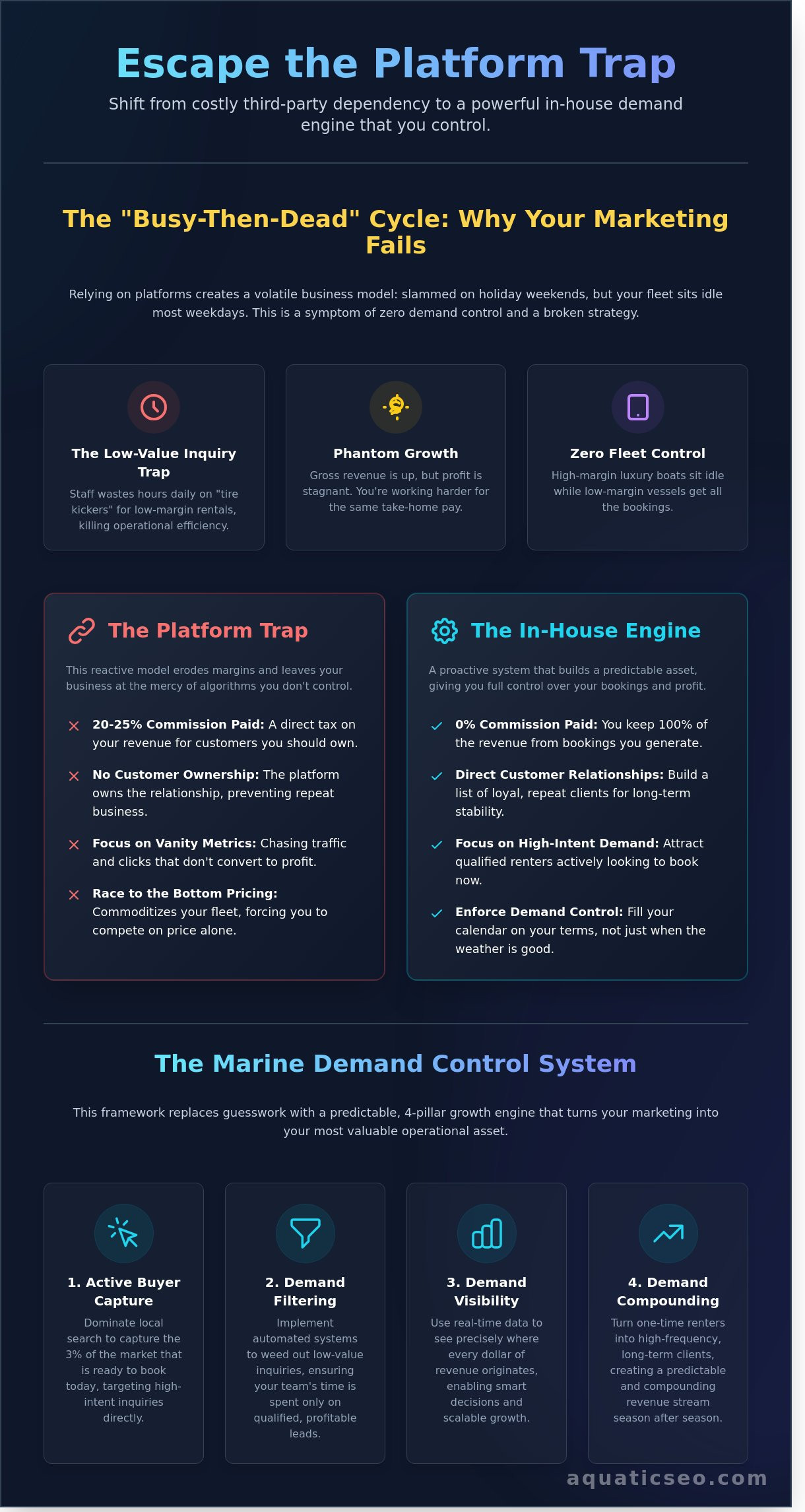
Most boat rental operators treat marketing like a lottery. They spend money on generic ads, post daily on Instagram, and hope the phone rings with a qualified lead. This isn’t a strategy; it’s a gamble that leaves your schedule at the mercy of the algorithm. The Marine Demand Control System is a framework designed to replace this uncertainty with a predictable growth engine. It treats your marketing as an operational asset rather than an expense.
This system is built on four distinct pillars: Active Buyer Capture, Demand Filtering, Demand Visibility, and Demand Compounding. By focusing on these stages, you stop chasing “vanity traffic” and start generating auditable revenue. Control is the most important word in your vocabulary because it’s the difference between a business that runs you and a business you run. In a seasonal industry where a few bad weeks can kill your annual margin, having a system you can dial up or down is vital.
- Active Buyer Capture: Dominating the 3% of the market ready to book today.
- Demand Filtering: Automatically removing low-value inquiries before they reach your team.
- Demand Visibility: Using real-time data to see exactly where every dollar of revenue originates.
- Demand Compounding: Turning one-time renters into high-frequency, long-term clients.
Active Buyer Capture: Finding the 3% Ready to Book
Only 3% of your market is ready to swipe a credit card right now. The other 97% are just browsing, dreaming, or researching for a trip six months away. When you are figuring out how to market a boat rental business, you must ignore the dreamers and focus exclusively on the buyers. High-intent marine keywords are those containing location + boat type + ‘rental’ or ‘charter’.
If you operate in the Florida Keys, you don’t care about someone searching for “best fishing spots.” You care about the person searching for “Key West center console rental” or “Islamorada luxury yacht charter.” Positioning your fleet as the obvious choice for specific use cases, such as bachelor parties on a double-decker pontoon or tournament-ready offshore fishing trips, ensures you capture these high-intent buyers immediately. You aren’t selling a boat; you’re selling the specific outcome the buyer is already looking for.
Filtering Inquiries to Protect Your Time
More leads often lead to more operational headaches if they aren’t the right kind of leads. If your sales team spends all day answering questions for $150 hourly slots that you don’t even offer, your marketing is failing. Demand Filtering is the process of disqualifying low-budget or high-maintenance inquiries before they ever touch your calendar. This allows your team to focus their energy on $1,000+ full-day bookings or multi-day charters.
Use automated systems to vet potential renters by asking for group size, boating experience, and budget upfront. Improving your local visibility shouldn’t mean a flooded inbox of tire-kickers; it should mean a streamlined pipeline of qualified prospects. By enforcing these filters, you protect your margins and keep your staff focused on high-value operations. If you’re tired of wasting time on leads that don’t convert, it’s time to install a system that does the heavy lifting for you.
The Platform Trap: Why Depending on Third-Party Sites Erodes Your Margins
Relying on GetMyBoat, Boatsetter, or TripAdvisor for 90% of your bookings is a dangerous operational gamble. These platforms offer a seductive shortcut to volume, but they extract a heavy price that most operators fail to calculate correctly. When you list your fleet on a third-party site, you aren’t building a business; you’re renting a customer from a tech company that can evict you at any moment. These aggregators commoditize your hard-earned reputation, forcing you to compete on price rather than the quality of your vessels or the expertise of your captains.
The risk of de-platforming is a silent threat to your stability. If a platform decides to change its algorithm tomorrow, your lead flow could drop by 60% overnight without warning. We have seen operators lose half their seasonal revenue because a single disputed review triggered an automated account suspension. When you don’t own the platform, you don’t own your future. True Demand Control requires moving away from these fickle intermediaries and establishing a direct line to your high-value clients.
The Economics of Platform Dependency
The math of third-party bookings is brutal for your bottom line. Most platforms charge commissions ranging from 15% to 35% per booking. On a $1,200 full-day rental, you might lose $420 before you even account for fuel, insurance, or maintenance. This “Middleman Tax” eats your profit margins and prevents you from reinvesting in your fleet. Furthermore, these sites intentionally hide customer data, preventing you from building a remarketing list for the following season. Every time a customer re-books through the platform instead of calling you directly, you are paying for that lead twice.
- Loss of Identity: You become “the guy with the 24-foot Yamaha” instead of a premium local brand.
- Price Wars: Platforms encourage users to sort by “lowest price,” which triggers a race to the bottom.
- Data Silos: You lose access to email addresses and booking patterns that drive long-term business value.
Transitioning to a Direct-to-Consumer Model
To scale sustainably, you must treat third-party sites as a “top-off” tool for mid-week vacancies rather than your primary engine. Learning how to market a boat rental business independently allows you to capture high-intent traffic before it ever reaches an aggregator. By investing in a high-performance website and localized SEO, you position your business as the authority in your specific harbor or marina. This strategy ensures that when a local boater searches for a “yacht charter near me,” they find your direct booking engine first.
Owning the customer journey means you can implement your own Marine Demand Control System. This involves Controlling Demand by capturing lead data and using it to drive repeat bookings through direct incentives. A direct-to-consumer model allows you to enforce your own cancellation policies and security deposit requirements without a third-party mediator siding with the customer. When you master how to market a boat rental business on your own terms, you keep 100% of your margins and build an asset that has actual resale value. Direct bookings aren’t just about saving on commission; they are about securing the operational independence of your marine business.
Building an In-House Demand Engine: From Local Visibility to Qualified Inquiries
Most owners treat marketing as a seasonal chore. They throw money at Google Ads in May and hope the phone rings by July. This isn’t a strategy; it’s a gamble. To truly master how to market a boat rental business, you must replace hope with a system that generates qualified inquiries on autopilot. We call this our Marine Demand Control System. It moves your business away from vanity traffic and toward predictable, high-margin bookings that keep your fleet moving.
Implementing this system involves a series of critical steps:
- Step 1: Dominate Local SEO Beyond Google Maps. Generic boat rental keywords are often too broad to be profitable. You need to dominate the specific harbor, marina, or waterfront district where your fleet is docked. Data shows that 76% of high-intent renters search for “near me” terms while they’re physically in their vacation destination. Use original photography of your actual vessels at local landmarks like the Haulover Sandbar or the Chicago Playpen. Stock photos are a red flag for high-end clients; they want to see the specific 2023 Boston Whaler they’re paying $900 to rent, not a generic catalog image. Managing your reviews is equally critical. A single unresolved 1-star review regarding a “dirty bilge” or “stalling outboard” can cost you $10,000 in lost seasonal revenue.
- Step 2: Create Content that Converts with the Specialized Test. If your blog post could apply to a rental shop in the Midwest as easily as a yacht charter in Miami, delete it. Generic content is a tax on your budget. High-value renters don’t care about “top 5 reasons to go boating.” They want to know the “Best anchorages in Biscayne Bay for groups of 12” or the “Legal requirements for bareboat vs. captained charters in Florida.” Proving this expertise filters out the “tire-kickers” and attracts clients who value your operational knowledge. Accuracy is your best sales tool. When you explain the liability differences between a bareboat agreement and a commercial charter, you establish immediate authority that a generalist agency can’t replicate.
- Step 3: Implement a fleet-aware booking engine. Your software must do more than take credit cards. It needs to sync with your maintenance logs and service yard schedule. If a 50-foot Sea Ray is down for an engine refit, your system should automatically pull it from the inventory to prevent the “dead weeks” caused by overbooking errors.
- Step 4: Use Demand Compounding. It costs five times more to acquire a new renter than to keep an old one. Use your database to turn July 4th one-timers into seasonal regulars. As of the 2024 season, operators using automated re-booking sequences saw a 22% lift in shoulder-season revenue by targeting their top 10% of past clients.
- Step 5: Audit your job flow. Not all bookings are equal. A 4-hour sunset cruise often requires the same cleaning and turnaround time as an 8-hour day trip but yields half the margin. Analyze your data to prioritize the most profitable mix of full-day or multi-day rentals. If your 28-foot center consoles are booked every Saturday but your 45-foot cruisers are sitting idle, your pricing or visibility is misaligned.
Stop settling for “more traffic” and start capturing more revenue. Learn how our Marine Demand Control System builds predictable growth for your fleet by focusing on qualified inquiries over vanity metrics.
Scaling Your Fleet Operations with a Dedicated Growth Partner
Most boat rental owners think they have a marketing problem. They actually have a demand control problem. If your phone rings constantly with “tire kickers” asking for your cheapest hourly rate, your current strategy is failing your bottom line. You need a partner who understands the massive psychological gap between a high-ticket yacht charter and a standard boat rental. Marketing a $4,000 sunset cruise on a luxury motor yacht requires a completely different approach than a $500 pontoon rental for a family outing. If your agency doesn’t know the difference, they are wasting your budget on low-intent traffic that clogs your sales funnel.
The reality of learning how to market a boat rental business effectively is moving past the trap of “getting clicks.” Any generalist agency can buy Google Ads traffic or post pretty pictures on Instagram. A growth partner focuses on capturing and filtering demand so your staff spends time closing bookings, not answering basic questions. This is the distinction between an agency that “does SEO” and a partner that installs a Marine Demand Control System to dominate your local waters. You want a predictable, auditable flow of inquiries that allows you to maintain 30 percent or higher profit margins even during the shoulder season.
What to Look for in a Marine Marketing Partner
Stop listening to vague promises about “going viral” or “ranking #1.” These are vanity metrics that don’t pay for your fuel, insurance, or slip fees. You need to evaluate a partner based on their systems, not their sales pitch. Ask a potential partner these three questions to see if they are operators or just vendors:
- Do they have a proprietary system for the marine industry, or are they practicing on your dime?
- Can they demonstrate exactly how they filter out low-value inquiries before they reach your inbox?
- Do they report on your bottom-line profit and booking volume, or just “impressions and reach”?
If they can’t explain the specific nuances of the marine buyer journey, they aren’t a partner. A true specialist understands that how to market a boat rental business involves more than just visibility. It requires a system that prioritizes high-margin bookings over raw traffic volume. Look for a partner who treats your marketing spend like a capital investment with a measurable, auditable return.
Taking Control of Your Business Flow
The biggest relief for any fleet operator is a predictable, auditable job flow. When you stop wondering where next week’s bookings are coming from, you can finally focus on scaling your operations. Specialized marketing provides the stability needed to invest back into your business. This might mean adding a new 50-foot cruiser to your fleet or upgrading your dockside facilities to improve the customer experience. A controlled demand system removes the “busy weeks followed by dead weeks” cycle that kills marine business growth.
This isn’t about “getting your name out there” or building brand awareness for the sake of it. It’s about enforcing a system that captures active buyers and ensures your boats are on the water earning revenue. If you are tired of generic agencies that don’t know a transom from a tri-toon, it is time for a different approach. You deserve a partner who is as focused on your margins as you are.
Take Command of Your Fleet’s Schedule
Most operators let the weather or a third-party platform dictate their bank account. You can’t scale a $3M charter operation on 35% commission fees and “hope” for bookings. Real growth happens when you own the inquiry and the data. Our proprietary Marine Demand Control System replaces the “busy-then-dead” cycle with a predictable flow of high-value clients who book directly.
We focus exclusively on $300k to $5M marine operators who are tired of agency fluff and want operational stability. Learning how to market a boat rental business isn’t about chasing vanity metrics; it’s about dominating the specific channels where your 5-star guests are already searching. We’ve helped partners stabilize their revenue and stop the 40% seasonal revenue dips that kill momentum. It’s time to stop being a passenger in your own marketing and start driving the boat.
Stop wasting leads and start controlling your demand with Aquatic SEO
Your fleet is ready for more. Let’s make sure your schedule stays as full as your fuel tanks.
Frequently Asked Questions
How long does it take to see results from boat rental SEO?
Expect to see initial movement in 90 days, with full authority building over 180 days. SEO is a long-term asset, not a quick fix like a Facebook ad. You’re building a digital moat around your local harbor. By month six, your cost per acquisition typically drops by 40% compared to paid channels. We focus on capturing high-intent searchers who are ready to book, not just vanity traffic.
Is Google Ads or SEO better for a new boat rental business?
Use Google Ads to bridge the 180-day gap while your SEO matures. Paid search provides immediate visibility for how to market a boat rental business during your peak season. However, relying solely on ads kills your margins. A balanced system uses ads for instant volume and SEO to secure 70% of your bookings at a near-zero marginal cost over time. It’s about stability, not just clicks.
How do I compete with huge platforms like GetMyBoat?
Stop trying to outspend them on broad terms. You win by dominating hyper-local searches and offering a white glove experience those platforms can’t replicate. These platforms take 15% to 30% of your margin and own your customer data. Our system ensures you own the relationship and the data. This allows you to bypass third-party fees and keep 100% of the booking revenue for your own fleet.
What is a Demand Filtering System and why does my charter business need one?
A Demand Filtering System is a protocol that qualifies leads before they reach your phone. It stops you from wasting 10 hours a week on tire-kickers who can’t afford a $2,500 day-rate. By implementing specific friction points and qualification forms, you ensure your sales team only speaks to high-net-worth individuals. It protects your margins and your schedule, ensuring you only hunt the big fish.
Do I need a separate marketing strategy for yacht charters vs. small boat rentals?
A $500 pontoon rental is a commodity; a $10,000 weekly yacht charter is an experience. You can’t market them the same way. Small rentals require high-volume, automated booking systems. Yacht charters require relationship-based Demand Visibility and high-touch nurturing. Mixing these strategies confuses your brand and attracts the wrong clientele. This leads to operational friction and lower profitability across your entire marine business.
How much should I spend on marketing for my boat rental business?
Allocate 7% of your gross revenue if you want to maintain your current position, or up to 15% if you’re looking to dominate a new territory. For a business doing $1,000,000, that’s a $70,000 annual investment. Don’t view this as an expense; it’s the fuel for your Marine Demand Control System. If your marketing doesn’t return at least a 5x return on spend, your system is broken.
Can I market my boat rental business during the off-season?
Off-season is for Demand Compounding. You should be securing bookings for next season and capturing lead data while your competitors go dark. We see 25% of annual bookings occur during the quiet months for operators who maintain visibility. Use this time to clean up your SEO and build an email list of past guests. This ensures your calendar is 50% full before the May season starts.
What are the most profitable keywords for the marine industry?
Profitable keywords aren’t just boat rentals. They’re luxury catamaran charter Miami or private sunset cruise Key West. These high-intent phrases signal a buyer ready to spend. When you learn how to market a boat rental business effectively, you stop chasing high-volume vanity keywords. You start targeting the 5% of searches that represent 80% of your actual profit. Focus on intent, not just traffic volume.