
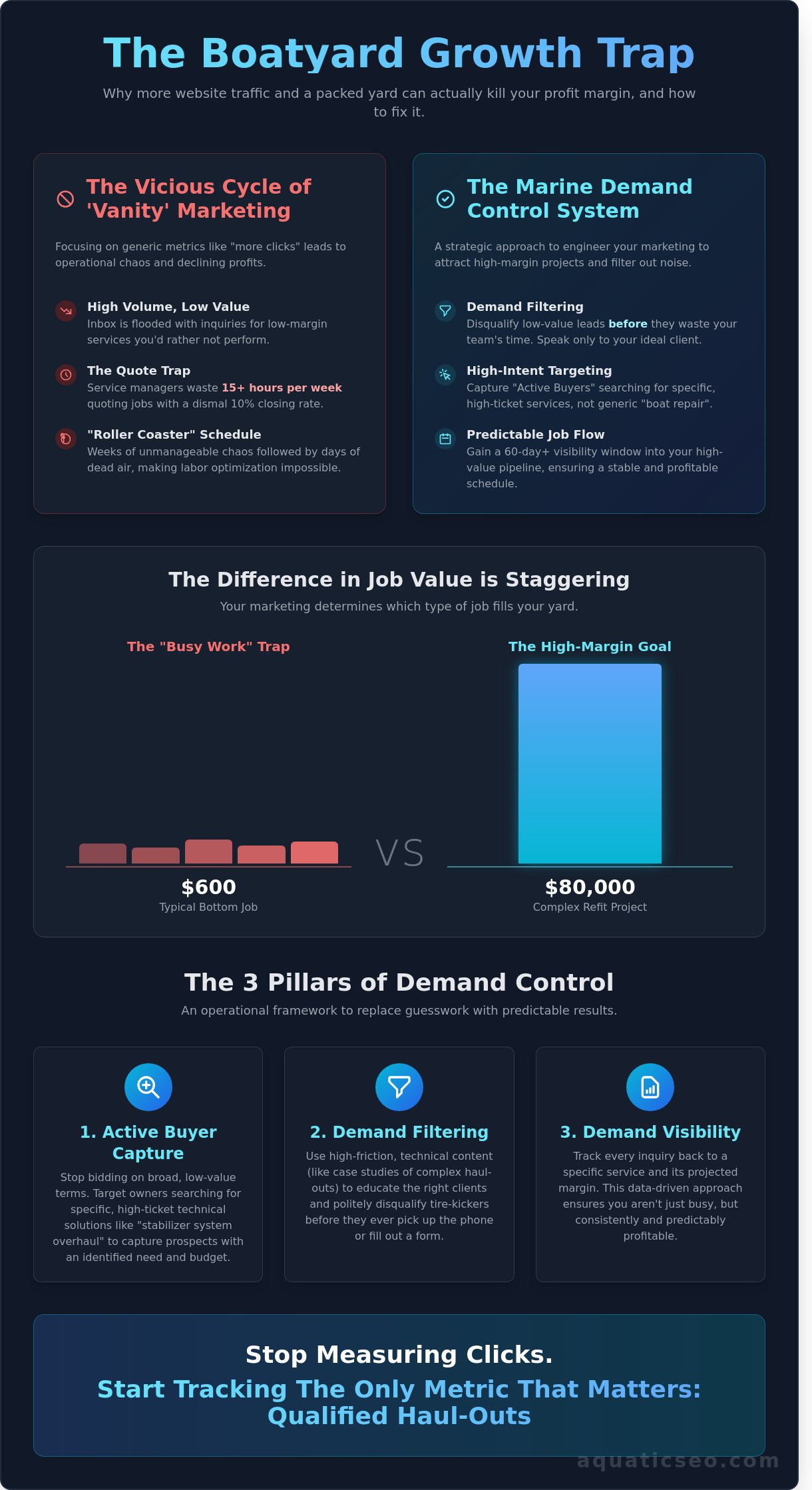
Most boatyard marketing strategies are built to fail because they prioritize “more” over “better.” If your lift is clogged with $600 bottom jobs while $80,000 refit inquiries sit in your inbox, your current approach is actually costing you money. You didn’t build a service yard to chase low-margin busywork that burns out your techs and leaves your schedule in a state of feast or famine.
You already know that a packed yard is meaningless if the job mix is wrong. You’re likely skeptical of generic agencies that promise “clicks” but can’t tell a sportfish from a center console. We agree that vanity metrics don’t pay the overhead or keep the travelift running during the off-season.
This article will teach you how to move beyond basic traffic and implement a system that captures high-value projects while filtering out the distractions. We’re going to show you how to gain total control over your job flow, ensuring every haul-out contributes to a higher profit margin and a stable, predictable schedule.
Key Takeaways
- Identify the “Boatyard Growth Trap” where increasing revenue often leads to declining margins and unstable production schedules.
- Deploy specialized boatyard marketing strategies that prioritize high-value refit inquiries over vanity traffic and low-margin service distractions.
- Dominate local search by optimizing for high-intent technical capabilities, such as travel lift capacity and specific shipyard services.
- Stop measuring success by generic clicks and start tracking the only metric that matters for your bottom line: qualified haul-outs.
- Audit your current job mix to realign your digital presence, ensuring you speak exclusively to the high-margin clients your yard actually needs.
The Boatyard Growth Trap: Why More Traffic Often Kills Your Margin
Your revenue is climbing, but your stress is peaking and your net profit is flatlining. This is the Boatyard Trap. It occurs when your boatyard marketing strategies focus on “more” instead of “better.” Most yard owners think they have a lead problem when they actually have a qualification problem. You don’t need more people asking for prices; you need the right people asking for your specific expertise.
Generic agencies chase “Vanity SEO.” They show you graphs of rising website traffic and keyword rankings. But traffic is a liability if it isn’t filtered. If 90% of your new inquiries are for $500 trailer repairs, your service manager is wasting four hours a day on quotes that will never move the needle. True growth requires a marketing strategy built on Demand Control. This means engineering your digital presence to attract high-margin refits while making it difficult for low-value tire-kickers to take up your time.
The Difference Between a Marina and a Boatyard
A marina is a landlord business. Success there is about occupancy and recurring slip fees. A boatyard is a high-stakes contractor business. You sell specialized labor and technical skill. Marketing a yard like a marina is a recipe for operational disaster. Filling your hardstand with low-margin, high-headache projects prevents you from capturing “Active Buyers” for technical services like hull extensions or complex electrical overhauls. You want a yard full of $50,000 projects, not a graveyard of $1,000 distractions.
Symptoms of a Broken Marketing Strategy
If your phone rings constantly with owners asking “how much for a bottom paint” on a 22-foot center console, your system is broken. You likely experience “the roller coaster”: three weeks of unmanageable chaos followed by ten days of dead air where your techs are sweeping floors just to stay busy. This inconsistency kills your margin because you can’t optimize your labor schedule. Common boatyard marketing strategies often ignore this operational reality.
- High Volume, Low Value: Your inbox is full of inquiries for services you’d rather not perform.
- Schedule Volatility: You lack a 60-day visibility window into your upcoming high-value pipeline.
- The Quote Trap: You spend 15 hours a week quoting jobs that have a 10% closing rate because the leads aren’t qualified.
To fix this, you must implement Demand Filtering. Demand Filtering is the process of disqualifying low-value leads before they reach your desk. By the time a prospect speaks to you, they should already understand your value and be ready to pay for your specific level of service. This isn’t about being “found” by everyone; it’s about being the only choice for the owners who actually sustain your business.
The Marine Demand Control System: Filtering High-Value Refits from Noise
Most boatyard owners treat marketing like a net thrown into a dark ocean. They hope to catch a 60-foot sportfish refit but usually end up with a tangled mess of 18-foot outboard repairs that kill shop floor efficiency. The Marine Demand Control System replaces this guesswork with an operational framework. It’s a three-pillar method designed to stabilize your schedule and protect your margins. Effective boatyard marketing strategies don’t just generate volume; they enforce a standard for who is allowed to take up your service manager’s time.
Pillar 1 is Active Buyer Capture. We stop bidding on broad terms and start targeting owners searching for specific, high-ticket solutions. Pillar 2 is Demand Filtering. This uses technical, high-friction content to educate the right clients and disqualify the tire-kickers before they ever pick up the phone. Pillar 3 is Demand Visibility. We track every inquiry back to a specific service and its projected margin. A solid business plan for a service yard depends on this level of data to ensure you aren’t just busy, but profitable.
Capturing High-Intent Refit Inquiries
Generic terms like “boat repair” are a waste of your budget. These searches are often performed by price-shoppers looking for the cheapest hourly rate. We focus on long-tail keywords such as “marine electrical refit” or “stabilizer system overhaul.” This captures owners who have already identified a major need. By building authority through technical case studies of complex haul-outs, you position your yard as a specialist. If you’re the only yard in a 100-mile radius documenting Garmin glass cockpit integrations or Yanmar repowers, you aren’t competing on price anymore. You’re competing on expertise. Our growth partnership models prioritize these high-margin technical jobs over routine maintenance.
The Mechanics of Demand Filtering
Your service manager shouldn’t be an unpaid consultant for every boat owner in the county. We implement “Self-Selection” content that sets clear expectations. This includes pricing guides for common refits and detailed service scopes that outline exactly what your yard does and does not handle. If a prospect isn’t willing to read a three-minute guide on your haul-out process, they won’t be a good client during a six-month refit.
We also deploy automated intake forms that require technical details up front. In 2023, data showed that yards using technical intake forms reduced “dead-end” inquiries by 42%. By asking for engine serial numbers, hull material, and specific project goals before the first call, you filter out the noise. This protects your team’s time for quoting the $50,000 to $250,000 projects that actually move the needle for your annual revenue. These boatyard marketing strategies turn your website into a digital gatekeeper that only lets through qualified, high-value opportunities.
Local SEO for Boatyards: Dominating High-Intent Service Searches
Local SEO is the digital front door for captains and owners in transit. When a vessel experiences a mechanical failure or needs an emergency haul-out, the search is immediate and high-stakes. They aren’t looking for generic boating tips. They’re searching for “75-ton travel lift near me” or “mobile marine mechanic.” If your yard doesn’t appear in the top three results, you don’t exist to that customer.
Implementing local SEO for the marine industry is the first step in our Marine Demand Control System. It moves your business away from seasonal guesswork and toward operational stability. By dominating local search, you capture high-value inquiries exactly when the demand is highest. This isn’t about vanity rankings; it’s about filling your work bays with qualified projects.
Mobile boat owners drive 82% of local service discovery. These users are often on the water, dealing with immediate technical needs. Effective boatyard marketing strategies focus on these micro-moments. You must optimize for specific technical capabilities like “bottom painting,” “fiberglass repair,” or “diesel repower” to ensure you’re the first solution they see. We prioritize these high-intent keywords because they lead to immediate haul-outs rather than tire-kicking inquiries.
Optimizing Your Google Business Profile for Service
Your Google Business Profile (GBP) functions as a technical spec sheet for your yard. Upload high-resolution photos of your travel lift, clean work bays, and specialized equipment. Captains need visual proof that your facility can handle their tonnage and beam. Use the “Products” feature to list specific services like sandblasting, rigging, or engine repowers rather than generic descriptions.
Manage your reviews with a focus on technical expertise. A review praising your “friendly staff” is nice, but a review detailing a “complex stabilizer repair completed on schedule” is a conversion tool. Respond to every review to show you’re an active, accountable operator. This level of detail is essential when you create a marketing plan designed to win high-margin service contracts.
Targeting the Right Geographic Radius
Transient boaters moving through coastal corridors like the ICW or the Great Loop represent a massive revenue opportunity. These owners often have immediate needs and high budgets. You must create location-specific landing pages for every major inlet or town within your service area. This captures traffic from boaters who are 20 miles away but heading in your direction.
A 50-mile radius is the standard for boatyard SEO to ensure you capture both local residents and passing traffic. This radius allows you to dominate your immediate territory while pulling in vessels from smaller marinas that lack your heavy-lift capabilities. Integrating these local tactics into your broader boatyard marketing strategies ensures a steady stream of qualified inquiries. We focus on these geographic triggers because they lead directly to signed work orders and improved margins.
Stop wasting resources on broad-reach advertising that ignores your local geography. If you aren’t visible to the boat 10 miles offshore with a leaking stuffing box, you’re leaving money on the table. Our system ensures your yard is the only logical choice for every vessel within your operational reach.
Common Boatyard Marketing Mistakes: Why Your Agency is Costing You Money
Most generalist agencies treat a boatyard like a local retail shop or a dry cleaner. This is a fundamental error that drains your budget and leaves your service bays empty. Effective boatyard marketing strategies must account for the high-stakes, technical nature of marine maintenance. If your current provider focuses on “brand awareness” while your 80-ton Travelift sits idle, they don’t understand your business. You don’t need more eyes on your brand; you need more hulls in the slings.
Mistakes in this industry are expensive. When an agency measures success by clicks instead of haul-outs, they ignore the reality of your operations. A click from someone looking for “cheap boat parts” is worthless to a yard that specializes in major refits. We see four recurring failures that kill growth in the marine sector:
- Treating the yard like a generic business: Marine customers have different buying triggers than retail shoppers. They prioritize technical capability and schedule reliability over flashy discounts.
- Misaligned metrics: Clicks don’t pay the mortgage. If your agency can’t track a lead from a search query to a signed work order, they’re guessing with your money.
- Seasonal stagnation: Failing to update content for seasonal demands is a common profit killer. If you aren’t pushing winterization 60 days before the first frost, you’ve already lost the season.
- Ignoring influencers: The “buyer” isn’t always the owner. Marine Surveyors and Captains often decide which yard gets the contract. If your marketing doesn’t speak to these professionals, you are invisible to the biggest projects.
The Vanity Metric Trap
Raw traffic numbers are often a smokescreen for poor performance. An agency might show you a report with 10,000 monthly visitors, but if those people are searching for “cool boat wallpapers,” your ROI is zero. This creates a massive overhead drain. Low-quality inquiries force your service manager to waste hours on the phone with “tire kickers” who can’t afford your shop rate. In 2023, we audited a yard that spent $4,000 on Google Ads that generated 200 clicks but zero refit inquiries. They were targeting “boat repair” instead of “yacht hull delamination repair.”
Ignoring Niche Terminology
Precision is your strongest trust signal. When a copywriter uses “boat rental” to describe a $10,000-a-week yacht charter, they destroy your credibility instantly. Marine business owners and captains spot this “agency speak” immediately. Using technical terms like “osmosis treatment,” “running gear calibration,” or “IPS drive service” proves you are a specialist. Generalist agencies avoid these terms because they don’t understand them. This creates a credibility gap that no amount of “holistic” marketing can bridge. You need a partner that speaks the language of the yard, not the language of a marketing textbook.
Stop settling for generic traffic and start building a system that delivers qualified boatyard inquiries that actually convert into billable hours.
Implementing a Demand-Driven Strategy: Expected Results and Next Steps
Most boatyard owners treat their marketing like a wide net, hoping to catch anything that swims. This approach fills your yard with low-margin “nuisance” work that eats up your lift time and exhausts your crew. To scale, you must transition to a demand-driven model that prioritizes your bottom line over raw shop volume.
Step 1: Audit your current job mix to identify your highest-margin services. Don’t look at gross revenue; look at net profit per man-hour. You’ll likely find that 20% of your jobs, such as major engine repowers or complex structural fiberglass repairs, generate 80% of your actual profit. Identify these “gold” services immediately.
Step 2: Realign your website content to speak only to those high-value buyers. Stop using generic phrases like “full-service boatyard.” If you want 60-foot sportfish refits, your content must detail your specific experience with cold-molded construction or specific propulsion systems like IPS drives. High-value owners don’t want a generalist; they want a specialist who understands their specific vessel’s quirks.
Step 3: Deploy the Marine Demand Control System to filter incoming inquiries. This is where you stop being a passive recipient of leads. By implementing specific qualifying questions in your digital intake process, you can automatically sort the $100,000 refit from the $500 gelcoat chip. This system ensures your service manager only spends time quoting jobs that fit your ideal profile.
Step 4: Monitor “Qualified Inquiry” counts rather than raw traffic stats. Rankings and clicks are vanity metrics that don’t pay the mortgage. Effective boatyard marketing strategies focus on the number of owners with the right boat, the right budget, and the right timeline who contacted you this month. If your traffic goes down but your qualified inquiries go up, you’re winning.
What Success Looks Like for a Boatyard
When these boatyard marketing strategies are executed correctly, your operational stress drops as your margins rise. You should expect a 3-month lead time on major refit projects, giving you the stability to plan your labor and parts procurement in advance. You’ll see a significant reduction in “dead time” during the shoulder seasons because your pipeline is filled with long-term projects rather than just seasonal rushes. Your average invoice value will increase because you’ve stopped underpricing your expertise to compete with the “shade tree” mechanics down the creek.
Your Next Move as an Operator
Stop acting like a landlord who just rents out space and start acting like a specialist growth partner. Your yard is a high-performance machine; it’s time your marketing reflected that level of precision. Evaluate your current marketing spend against actual job-flow stability. If you’re still paying for “impressions” without seeing a steady stream of high-margin inquiries, you’re subsidizing an agency’s learning curve at the expense of your own growth.
It’s time to take control of your schedule and your profitability. Stop guessing and start implementing a system built for the marine industry. Your next step is to get an objective look at your current digital footprint and see where your profit is leaking out.
CTA: Request a No-BS Marine Marketing Analysis
Stop Chasing Volume and Start Protecting Your Margins
Most boatyards fall into the trap of equating more leads with more profit. If your current boatyard marketing strategies just dump generic traffic into your inbox, you’re likely losing 15 to 20 hours a week on unqualified inquiries while $50,000 refits go to competitors. You don’t need a marketing agency that brags about clicks. You need a system that filters for high-value work and enforces a stable, predictable schedule.
By dominating local high-intent searches and implementing a strict demand control protocol, you can end the cycle of busy weeks followed by dead weeks. Boatyards using a filtered system often see a 30% increase in average repair order value within the first 90 days. It’s about ensuring every boat on your hard is a high-margin job that fits your specific operational capacity. We focus on qualified inquiries over vanity traffic because we understand the real-world challenges of marine contractors.
Get the Marine Demand Control System for your Boatyard
Your yard has the capacity for greatness; it’s time to fill it with the right work.
Frequently Asked Questions
How is boatyard marketing different from marina marketing?
Marina marketing focuses on real estate metrics like occupancy rates and slip renewals for long-term tenants. Boatyard marketing is about selling technical labor hours and maximizing shop throughput. You aren’t just selling a space; you’re selling the specialized expertise of your techs and the capacity of your 75-ton lift to move high-margin projects through the yard.
Does my boatyard really need SEO if I already have a waitlist?
A waitlist is a liability if it’s filled with low-margin work that clogs your service bays. Implementing targeted boatyard marketing strategies allows you to replace $1,500 seasonal maintenance jobs with $60,000 refits. SEO isn’t just about volume; it’s about gaining the visibility needed to cherry-pick the most profitable projects from a larger pool of inquiries.
What is the best way to get more refit and repair leads?
You must document and display your technical authority through specific project galleries. Owners of 60-foot sportfishers don’t care about generic marketing claims; they want to see the 2023 repower you completed or the complex electrical overhaul you finished last month. Showing real-world proof of your yard’s craftsmanship builds the trust necessary to close six-figure repair contracts.
How much should a boatyard spend on digital marketing?
High-performing yards typically reinvest 5% to 8% of their gross annual revenue into growth and demand systems. If your yard generates $3 million annually, a monthly budget of $12,500 to $20,000 ensures you dominate local search results and maintain a consistent pipeline. This investment protects your business from the “quiet weeks” that erode your annual margins.
Can marketing help my boatyard find more qualified technicians?
Marketing is your most effective recruitment tool for attracting ABYC-certified technicians and master carpenters. Top-tier talent wants to work in a yard that handles prestigious vessels and maintains a professional, organized operation. By showcasing your high-value projects and shop culture, you position your yard as the premier employer in your region.
How do I stop getting low-value inquiries for small boat repairs?
You must use demand filtering to disqualify leads that don’t fit your business model. We implement specific intake forms that require vessel length, engine make, and project scope before your team ever answers a call. If your sweet spot is vessels over 45 feet, your website should state that clearly to eliminate the 70% of inquiries that waste your service manager’s time.
What is a Marine Demand Control System?
The Marine Demand Control System is our proprietary framework that replaces “vague marketing” with operational certainty. It’s a four-pillar approach that captures active buyers, filters out low-value leads, and ensures your yard stays at 90% capacity with high-margin work. We don’t focus on vanity metrics like clicks; we focus on the stability of your production schedule and the growth of your bottom line.