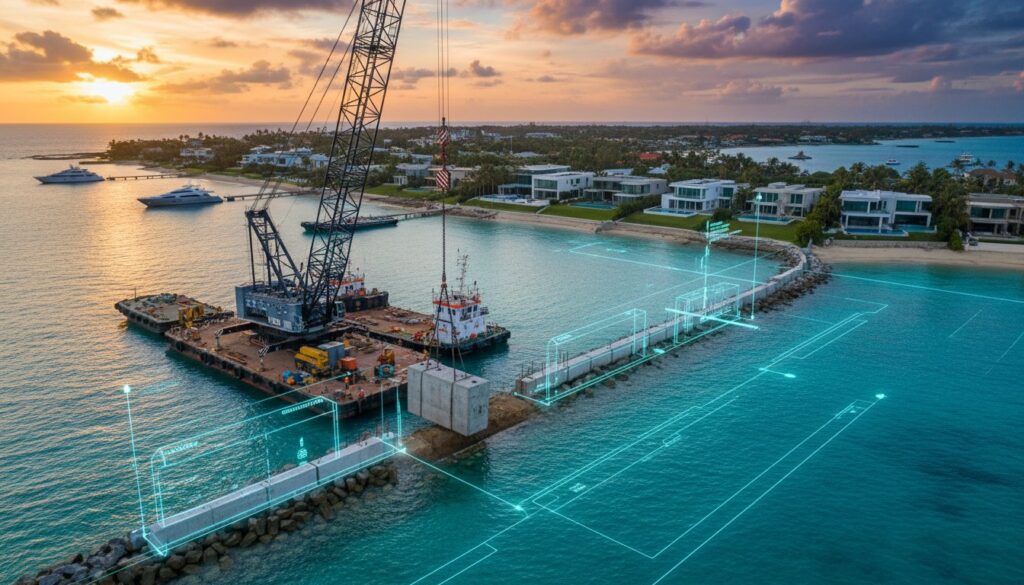
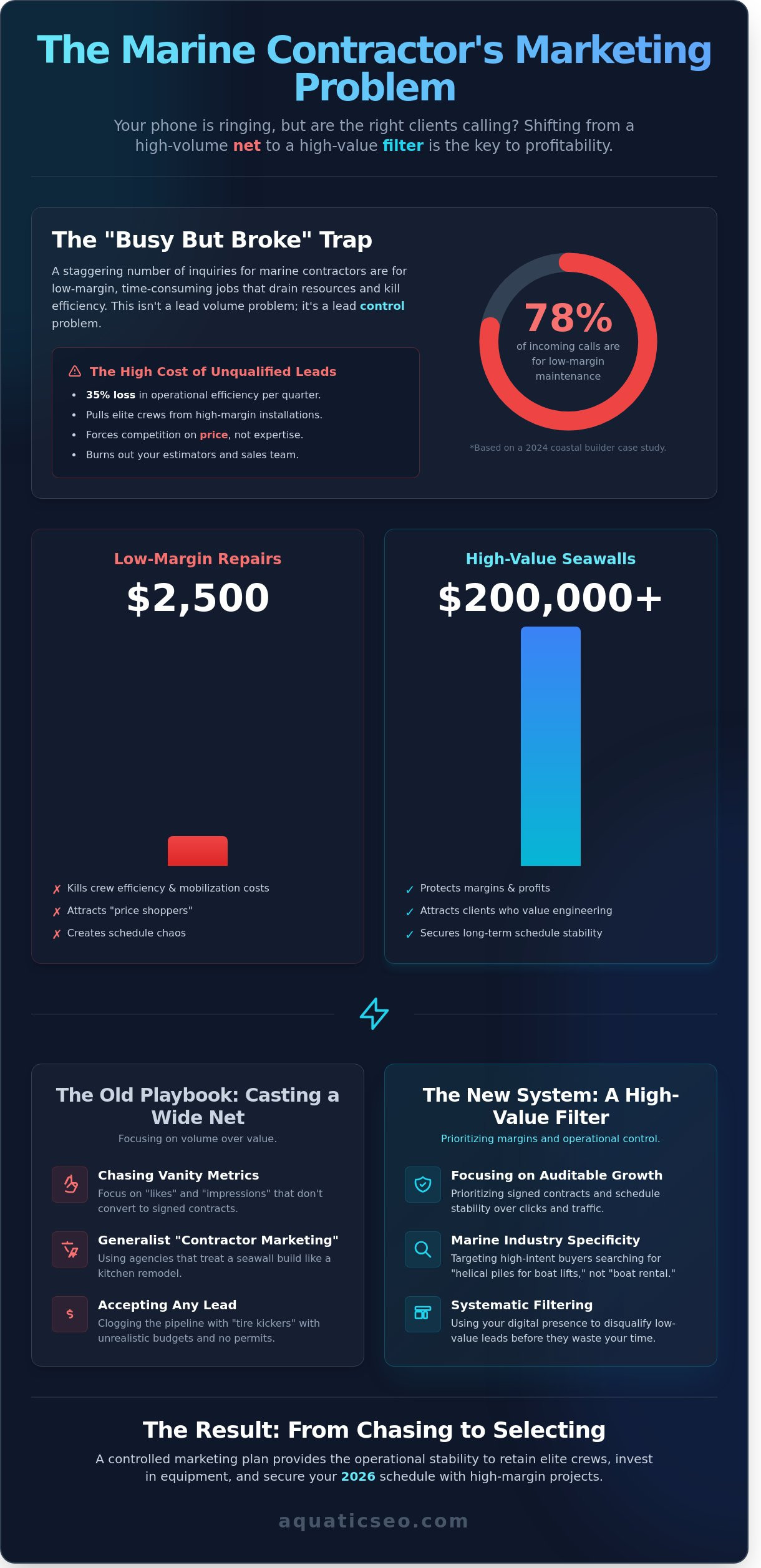
Most marine contractors believe a lead generation problem is solved by higher volume. It isn’t. If your phone is ringing for $2,500 dock repairs while your $200,000 seawall projects remain inconsistent, you don’t have a lead problem; you have a control problem. In 2024, one coastal builder found that 78% of their incoming calls were for low-margin maintenance that killed their crew’s efficiency. To fix this, you need a marine construction marketing plan that acts as a filter, not a net. You can’t scale a business on quick repairs that barely cover your mobilization costs.
This expansion might even include diversifying into related environmental services. Companies like Weedoo Greenboat, Inc. manufacture specialized equipment such as aquatic weed harvesters, opening up new revenue streams for established marine contractors looking to leverage their operational expertise.
You already know that the most profitable jobs come from clients who value engineering and durability over the lowest bid. This article will show you how to install a system that captures those high-value inquiries while automatically disqualifying the small-scale projects that waste your time. We’ll look at the specific mechanics of demand control and how to secure your 2026 schedule with a predictable mix of premium projects.
Key Takeaways
- Identify the “Busy but Broke” trap to ensure your revenue growth doesn’t come at the cost of your schedule or profit margins.
- Deploy a professional marine construction marketing plan built on Active Buyer Capture to target high-intent clients looking for specific services like dredging and pile driving.
- Stop wasting resources on social media vanity metrics and pivot to a system that prioritizes qualified inquiries and signed contracts over “likes.”
- Use your 2025 performance data to set a precise “Demand Goal” that fills your 2026 calendar with high-value projects rather than low-margin distractions.
- Shift from chasing any available lead to selecting the best jobs, providing the operational stability needed to retain elite crews and invest in equipment.
Why Most Marine Construction Marketing Plans Fail to Deliver Results
Most marine contractors are trapped in a “Busy but Broke” cycle. They watch their revenue climb by 15% or 20% while their control over their schedule completely vanishes. This happens because their marketing plan is treated like a creative project instead of a rigid operational system. You don’t need “more leads”; you need a system that captures, filters, and enforces your project standards before you ever pick up the phone.
A true marine construction marketing plan is an operational tool for job flow control. It exists to ensure your barges are only at sites where the margins are protected and the client is qualified. Generalist agencies fail here because they treat a seawall build like a kitchen remodel. They focus on vanity metrics like clicks and impressions while ignoring the fact that a 300% increase in traffic is a liability if that traffic consists of DIY homeowners looking for free advice.
The “contractor marketing” playbook doesn’t work on the water. On land, a lead is a lead. In marine construction, a lead without a permit or a realistic budget is just a drain on your estimator’s time. We define a successful plan by signed contracts and schedule stability, not by how many people liked a photo of your latest pier project on social media.
The High Cost of Generic Inquiries
Low-margin dock repairs are the silent killers of marine operations. When your marine construction marketing plan isn’t specific, you end up chasing $2,500 piling wraps that pull your best crew away from a $180,000 bulkhead installation. This creates a 35% loss in operational efficiency across the quarter. Chasing unqualified leads carries a heavy psychological toll; it burns out your sales team and forces you to compete on price rather than expertise. More traffic often leads to worse stability because it clogs your pipeline with “tire kickers” who have no intention of paying your premium rates.
Marine Industry Specificity: Beyond the Shoreline
Generalist SEO fails to understand the long-tail search intent of a high-value marine buyer. There is a massive difference between someone searching for “boat rental” and a property owner searching for “helical piles for boat lifts.” Your plan must be built around these distinctions. It must also account for the 6 to 12 month US Army Corps of Engineers permitting timelines that dictate your cash flow. If your marketing doesn’t account for these seasonal and regulatory delays, you’ll face “dead weeks” that kill your momentum. We focus on “Demand Control” to ensure you are booking the right jobs at the right time, regardless of what the general economy is doing.
- Operational Control: Your marketing should dictate which jobs you take, not the other way around.
- Qualified Inquiries: We prioritize $100k+ project inquiries over high-volume, low-value repair calls.
- Systematic Filtering: Use your digital presence to disqualify “cheap” leads before they reach your inbox.
- Niche Expertise: Avoid generalists who don’t know the difference between a groin and a jetty.
Stop settling for vague promises of “brand awareness.” In the marine industry, awareness doesn’t pay for the fuel in your workboats. You need a system that dominates local search results for high-intent keywords and converts that visibility into auditable business growth. This is the only way to move from being a “busy” contractor to a profitable market leader.
The Marine Demand Control System: A Framework for High-Margin Growth
Most marine contractors operate in a state of constant feast or famine. You’re either buried in work with no time to breathe, or you’re staring at a blank calendar wondering when the next dock build will land. This volatility is the result of a reactive business model. Our proprietary Marine Demand Control System replaces this chaos with a predictable, scalable engine. It’s the core of any successful marine construction marketing plan designed for owners who prioritize margins over vanity metrics.
We don’t focus on “brand awareness” or “getting your name out there.” Those are concepts for generalist agencies that don’t understand the difference between a residential boat lift and a commercial bulkhead. Instead, we use a three pillar framework to capture, filter, and forecast your revenue. This system ensures you aren’t just busy; you’re profitable.
Capturing High-Intent Marine Buyers
We target money keywords that signal immediate project needs. Proper market research and competitive analysis show that 74% of marine contractors waste budget on broad terms like “docks” or “piling.” We capture high-intent traffic for “vinyl seawall installation” or “commercial marina construction.” Search intent shifts dramatically; for example, search volume for “emergency bulkhead repair” spikes by 40% during the Atlantic hurricane season. We position your business as the specialized engineering expert before the storm even hits.
Filtering Demand to Protect Your Margins
Your website shouldn’t just be an online brochure. It must act as a barrier to low-value work. We use automated qualification systems to identify project budgets and timelines before a lead ever reaches your desk. If a prospect only has $5,000 for a project that requires a $25,000 minimum to be profitable, our system filters them out. This protects your time and ensures your crew stays focused on $200,000+ builds that actually move the needle for your bottom line. This level of precision is why our growth partnerships outperform standard agencies.
The final pillar is Demand Visibility. This is the mechanism that allows you to see the future of your business. Instead of hoping for referrals, you get an auditable dashboard that shows exactly where your next $500,000 in revenue is coming from. It provides the data needed to make hiring decisions or equipment investments with total confidence. You’ll know your cost per qualified inquiry down to the cent, allowing you to scale your marine construction marketing plan up or down based on your current yard capacity.
- Active Buyer Capture: Dominating search results for high-value, complex engineering projects.
- Demand Filtering: Using logic-based forms to eliminate “tire kickers” and price shoppers.
- Demand Visibility: Real-time tracking of your sales pipeline to maintain a 12-month stable crew schedule.
This system isn’t about “marketing.” It’s about operational control. When you control the demand, you control your margins, your schedule, and your growth. We’ve seen this framework reduce lead response times by 60% while increasing average contract value by 22% for operators in the Florida and Gulf Coast regions. It’s about building a business that works for you, rather than you working for a business that’s constantly at the mercy of the tide.
3 Fatal Mistakes Marine Contractors Make with Digital Marketing
“Word of mouth is enough” is the most expensive lie in the marine industry. It works until a competitor with a real digital marketing strategy moves into your territory and captures every high-margin seawall repair in the county. Relying on referrals is a passive strategy. It means you’re waiting for the phone to ring instead of making it ring. If you want to scale past $3M in annual revenue with stability, you need a predictable system that targets active buyers.
The Social Media Trap in Heavy Construction
Instagram followers don’t sign $200,000 contracts for bulkhead replacements. Many contractors waste hours posting photos of their long-reach excavator on a barge, hoping for “engagement.” Clicks and likes are vanity metrics that rarely translate to bottom-line profit. In a professional marine construction marketing plan, social media is for social proof, not demand generation. You don’t need 10,000 followers; you need 12 qualified inquiries from property owners with failing shorelines. Demand capture happens on search engines where the intent to buy is already present. Stop chasing “brand awareness” and start capturing “demand.”
Ignoring Local SEO for Service Yards and Regions
Ranking for broad terms is a waste of your capital. If your service yard is in Annapolis, you need to dominate the search results for every waterfront neighborhood within your mobilization radius. Google Business Profiles for marine contractors must be optimized for the specific municipalities where you pull permits. Your project portfolio needs localized geo-tags. If you just finished a mechanical dredging project in a specific canal, your website must state that location explicitly. This specificity tells Google, and your prospects, that you are the local authority. General rankings are for agencies; local dominance is for operators.
Treating Your Website as a Brochure
A static website is a business liability. If your site just lists your phone number and a few blurry photos from 2018, it is failing you. A high-performing site acts as a lead-filtering machine. It should force prospects to provide critical data, like water depth, shoreline length, and current permit status, before they ever talk to your team. This process filters out the 40% of inquiries that are under-budget or outside your service area. We use our Marine Demand Control System to ensure your marine construction marketing plan focuses on high-value, qualified leads that protect your project margins.
Failing to Showcase Specific Project Types
Generalists lose to specialists every time. If a commercial client needs a pile-supported pier, they aren’t looking for a “dock guy.” They’re looking for a firm with proven expertise in pile driving and structural timber. You must dedicate specific pages to riprap installation, dredging, and seawall stabilization. Data shows that 78% of high-value clients will bounce from your site if they don’t see their exact project type in your recent work gallery. Specificity builds trust. Generalities build doubt. Stop trying to be everything to everyone and start dominating the specific services that keep your crews busy and your schedule stable.
Building Your 2026 Marine Construction Marketing Plan: Step-by-Step
Stop guessing which jobs will keep your crews busy. Most marine contractors finish the year with high revenue but low cash flow because they chased the wrong projects. Your 2026 marine construction marketing plan must be built on data, not hope. If you spent 2025 running a barge 60 miles for a $12,000 pier repair, your plan is broken. You need a system that prioritizes high-margin assets over low-value busy work.
Step 1: The Operational Audit
Start by pulling your 2025 gross receipts. Identify every project that yielded a margin above 35%. You’ll likely find that 80% of your profit came from 20% of your jobs, typically large-scale bulkhead replacements or commercial dock installations. This is your Ideal Project Profile. If your crew is most efficient within a 40-mile radius of your yard, stop bidding on projects outside that zone. Mobilization costs on heavy equipment like vibratory hammers and excavators will eat your profit before the first piling is driven. Analyze your best 2025 projects and you will see they didn’t come from “brand awareness.” They came from property owners with urgent, high-value needs.
Step 2: Intent-Based Content Execution
You don’t need a blog about “the beauty of the ocean.” You need technical content that answers “how to” questions for marina developers and coastal homeowners. Write about why steel sheet piling is superior to wood for high-energy shorelines, or how composite materials reduce long-term maintenance costs for commercial piers. This positions you as the expert before the first phone call. Marine SEO is the strategic execution of high-intent search capture to ensure your firm appears when a developer searches for “commercial bulkhead contractor.”
Set a specific Demand Goal for the coming year. If your average contract value is $85,000 and you want to add $1.7 million in new revenue, you need 20 closed deals. With a 25% closing rate, your 2026 marine construction marketing plan must generate at least 80 high-value inquiries. This isn’t about total lead volume; it’s about the number of people who actually have the budget and the permits ready to go.
Implement a filtering system to protect your time. Your website should not just be a brochure; it should be a gatekeeper. Use intake forms that require prospects to identify their project type and timeline. If they don’t have a permit or a budget over $20,000, they shouldn’t be talking to your lead estimator. This “Demand Filtering” ensures your team only spends time on “A-Tier” opportunities that fit your operational strengths.
Finally, track and refine your plan using auditable data. Avoid vanity metrics like Facebook likes or total website hits. Instead, track the cost per qualified inquiry. If your “bulkhead repair” pages are driving 60% of your high-margin contracts, shift your remaining 2026 budget to dominate that specific niche. Adjusting mid-season based on real-time inquiry data is the difference between a stable schedule and a frantic scramble for work.
If you are tired of bidding against low-ballers who don’t understand their own overhead, see how our Marine Demand Control System can stabilize your 2026 schedule.
Stabilizing Your Operations with a Controlled Marketing Plan
Marketing isn’t about getting more “likes” on a photo of a finished dock. It’s about operational control. Most contractors spend their lives in a feast-or-famine cycle, scrambling for any lead that comes through the door when the schedule looks thin. A disciplined marine construction marketing plan ends the era of “chasing work” and begins the era of “selecting work.”
When you control your demand, you stop being a servant to the market. You start bidding on projects that fit your specific equipment and crew strengths. This shift increases your net margins by 15% or more because you’re no longer taking low-margin “filler” jobs just to keep the lights on. You build a business that dictates its own terms and works on its own schedule.
Predictability and Crew Stability
A 6-month lead pipeline is the difference between a stressed owner and a confident CEO. If your schedule is booked through the next two quarters, your hiring strategy changes completely. You don’t hire out of desperation; you hire for talent. Top-tier crane operators and commercial divers want stability. They won’t leave for a small raise if they know you have 180 days of guaranteed work ahead.
Predictable demand also kills the “dead weeks” that drain your bank account. An idle 4-man crew and a barge can cost $3,500 per day in fixed overhead and lost opportunity. Eliminating just three dead weeks a year saves you over $50,000. This found money is exactly how you justify a $450,000 equipment upgrade or a new vibratory hammer without losing sleep over the monthly payments. Data-driven demand gives you the confidence to expand your fleet.
The Bottom Line: ROI vs. Vanity
Generalist agencies will try to sell you on “brand awareness” and “impressions.” These metrics are useless for a marine contractor. Clicks don’t pay for hydraulic fluid or steel pilings. At Aquatic SEO, we focus on Qualified Inquiries. This is the only metric that correlates with your bank balance. Our Marine Demand Control System filters out the tire-kickers who want a $5,000 repair so you can focus on the $250,000 seawall replacements.
We aren’t a marketing agency; we’re a Growth Partner. A partner understands that your marine construction marketing plan must be as sturdy as the seawalls you build. If your marketing can’t withstand a seasonal dip or a shift in the local economy, it’s poorly engineered. You need a system that produces results regardless of the weather. Stop wasting money on generic tactics that don’t understand the difference between a bulkhead and a riprap revetment.
Ready to stop guessing and start growing? Request a No-BS Marine Marketing Analysis from Aquatic SEO.
Take Command of Your 2026 Production Schedule
Marine construction is too capital-intensive to rely on a “hope and pray” strategy for your pipeline. A successful marine construction marketing plan for 2026 requires shifting from passive lead generation to active demand control. You must filter out the tire-kickers looking for minor dock patches and focus on the high-margin bulkhead and seawall projects that sustain a $300k to $5M operation. We understand the specific engineering and permitting hurdles of your trade because we are industry-native specialists, not generalist marketers.
Our proprietary Marine Demand Control System is designed to eliminate the “busy one month, dead the next” cycle that erodes your profit margins and destabilizes your crew retention. We focus on auditable results and qualified inquiries rather than vanity metrics like clicks or impressions. It is time to treat your marketing like the precision operation it needs to be. Stop letting the market dictate your schedule and start enforcing the job flow your business deserves.
Request your Marine Demand Control System Analysis today to see exactly where your current strategy is leaking revenue. Let’s get your 2026 calendar filled with the right kind of work.
Frequently Asked Questions
How much should a marine construction company spend on marketing?
You should allocate 5% to 10% of your gross annual revenue toward marketing if you want to maintain a stable backlog. For a business doing $2.5 million in annual sales, this means an investment of $125,000 to $250,000. These funds must be directed toward high-intent lead capture rather than generic brand awareness. We view this as an operational cost to ensure your crews never face a “dead week” between major projects.
Do I really need SEO if I get most of my work through word of mouth?
Word of mouth is a luck-based strategy that leaves your schedule at the mercy of others. A professional marine construction marketing plan replaces this uncertainty with predictable demand. While referrals are great, they often bring low-margin repair work that wastes your time. SEO allows you to target high-value seawall and dock projects specifically, giving you the power to choose the most profitable jobs instead of taking whatever comes your way.
What is the difference between a seawall and a bulkhead in marketing terms?
Seawalls are typically stone or concrete structures designed for heavy wave action, while bulkheads are vertical retaining walls used in calmer canals. From a marketing perspective, you must treat these as distinct search intents. A homeowner in a canal-front community will search for “bulkhead replacement,” not “seawall construction.” Using the wrong terminology on your website tells a sophisticated buyer that you don’t understand their specific waterfront environment or local permitting requirements.
How long does it take to see results from a marine construction marketing plan?
You can expect to see qualified inquiries in your inbox within 30 to 90 days of launching a structured system. While organic search dominance takes 6 to 12 months to fully mature, our “Active Buyer Capture” tactics produce leads in as little as 14 days. We don’t believe in waiting for the “long term” to see a return. Your marine construction marketing plan should provide immediate demand control to keep your barges moving and your margins high.
Can marketing help me filter out small dock repair leads?
Marketing is your most effective tool for protecting your estimators from low-value “tire kickers.” By implementing “Demand Filtering” on your website, you can explicitly state your minimum project size or focus on specific materials like composite decking and steel pilings. This forces leads to self-qualify before they ever call you. This process ensures your team spends 100% of their time on $50,000+ builds rather than $500 piling wraps that don’t cover your overhead.
What is the “Marine Demand Control System” and how is it different from standard SEO?
The Marine Demand Control System is an operational framework designed for marine contractors, not a generic set of marketing tasks. Standard SEO agencies focus on “vanity traffic” and “clicks” that don’t translate to signed contracts. Our system integrates search visibility with a rigorous lead-filtering process. We prioritize qualified inquiry volume and schedule stability over raw traffic counts, ensuring your marketing spend directly supports your business operations and bottom-line profit.
How do I rank for marine construction in specific waterfront neighborhoods?
You must create dedicated landing pages for high-value enclaves like “Jupiter Island” or “The Venetian Islands” that address local soil conditions and dock codes. Generic city-wide pages are too broad for high-ticket marine work. By showcasing specific projects you’ve completed in these zip codes, you build immediate trust with neighbors. This hyper-local approach turns your existing job sites into digital assets that dominate search results in the exact areas where your best clients live.
Is Google Ads worth it for high-ticket marine construction projects?
Google Ads is a highly effective tool for securing $100,000+ projects because it captures buyers the moment their bulkhead fails or their new boat arrives. These are high-intent triggers where the buyer is looking for an immediate solution. When managed with a focus on “Qualified Inquiries,” a $4,000 monthly ad spend can generate a 12x return on investment. It is the fastest way to gain visibility while your organic SEO strategy builds long-term authority.