
Most marine e-commerce stores are expensive digital brochures that bleed cash on low-margin gaskets while high-ticket inventory sits in the warehouse. You’ve likely seen 85% of your ad budget vanish into tyre kicker clicks that never result in a sale over $50. Chasing more traffic is a fool’s errand when your current marine e-commerce marketing setup can’t distinguish between a casual browser and a buyer ready to drop $12,000 on a repower kit. You don’t need more clicks; you need a system that dictates which buyers find you and which ones are filtered out before they waste your time.
You already know that the more traffic promise sold by generalist agencies doesn’t keep your service bays full or your warehouse moving during a quiet February. This guide will show you how to transform your online store from a passive catalogue into a high-margin demand control asset that generates predictable revenue. We’ll examine the specific process to dominate search for high-value SKUs and build a filter that captures active buyers while ignoring the bargain hunters.
Key Takeaways
- Stop wasting budget on vanity clicks and start capturing high-margin part sales that stabilize your operational cash flow.
- Deploy a specialized system for marine e-commerce marketing that targets active buyers searching for specific SKU replacements and technical solutions.
- Shift your SEO focus from generic blog content to your product database to win high-intent search queries that solve urgent technical boating problems.
- Turn your online store into a year-round asset that fills your service yard schedule and maintains margins during the industry’s traditional off-peak months.
- Transition your web store from a simple sales channel into a demand control asset that identifies new service opportunities and scales your boatyard operations.
Why Generic E-Commerce Marketing Sinks Marine Supply Stores
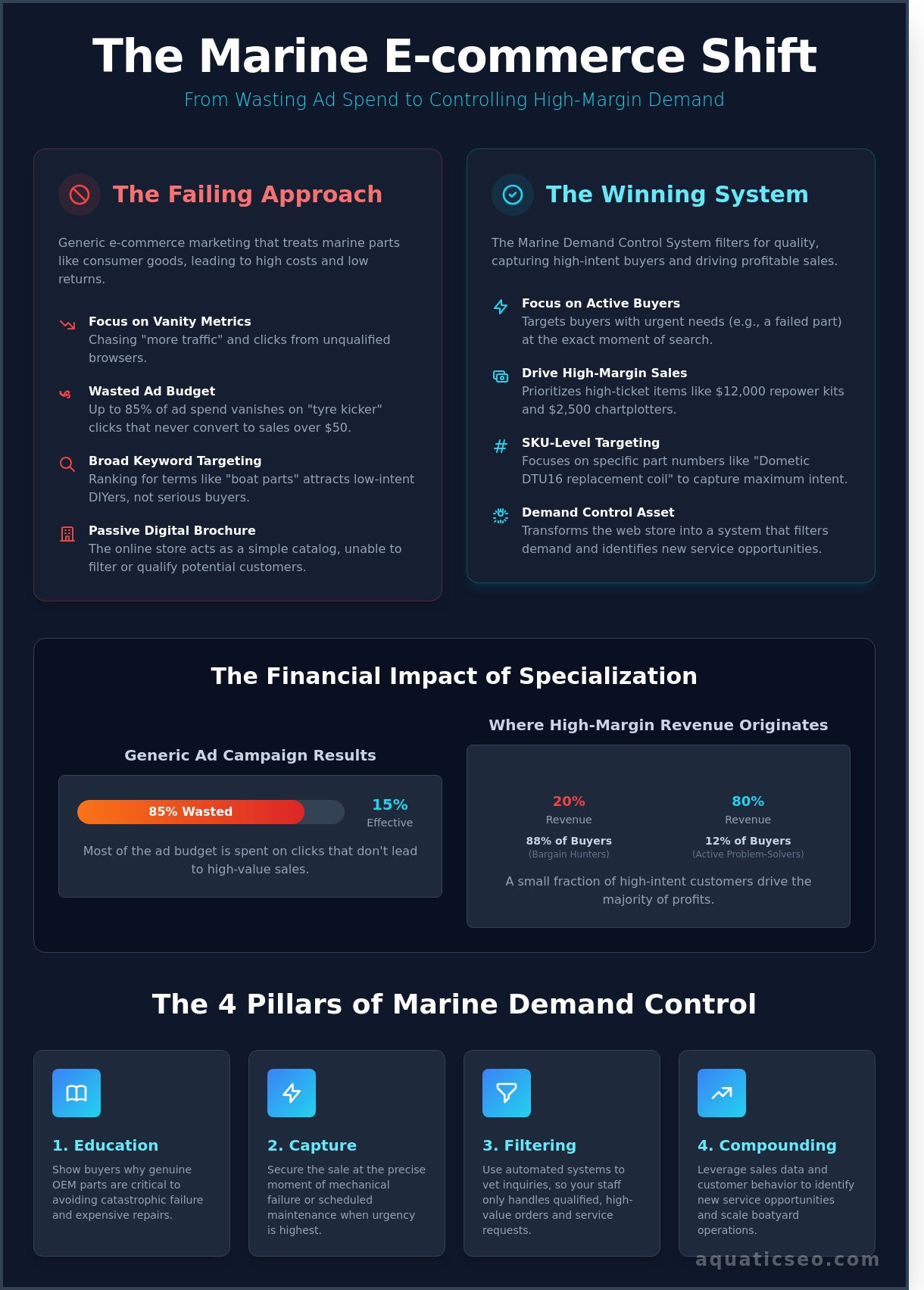
Most marine supply stores are hemorrhaging cash on clicks that never convert. They hire generalist agencies that treat marine e-commerce marketing like they are selling consumer electronics or apparel. This approach is a death sentence for your margins. Clicks are a vanity metric. If your traffic doesn’t lead to high-margin part sales; it’s useless noise. You don’t need more eyes on your site; you need a system that captures high-intent buyers at the exact moment they need a solution.
We define marine e-commerce marketing as the strategic capture of high-intent buyers for specialized nautical products. It’s not about being “seen.” It’s about being found by the person whose weekend is ruined because their macerator pump failed. Generalist agencies fail the “Specialization Test” because they don’t understand the difference between a Rule-Mate 1100 bilge pump and a Shurflo livewell pump. If your marketing partner can’t distinguish between these components; they can’t possibly filter your traffic for quality.
The #1 mistake we see is treating an online store as a digital brochure rather than a demand filtering asset. A brochure just sits there. A demand filtering asset, like our Marine Demand Control System, actively qualifies the user. It forces the system to prioritize the 12% of buyers who drive 80% of your revenue while ignoring the rest.
The Trap of Broad Keywords
Ranking for “boat parts” is a fast way to go broke. This broad term attracts DIYers who want free technical advice but never pull the trigger on a $1,400 windlass. General digital marketing strategies often prioritize volume over intent. This dilutes your conversion data and confuses your ad spend. You need SKU-level intent. You want the person searching for “Dometic DTU16 replacement coil,” not someone browsing “boat AC.” Broad traffic doesn’t just waste money; it teaches Google’s algorithm to send you more low-value users.
Distinguishing Between Yacht Gear and Boat Rentals
Terminology accuracy is the first step in building industry credibility. A yacht owner buying high-end Simrad electronics has a different search intent than a weekend warrior looking for a “boat rental” for a holiday. If your content uses these terms interchangeably; you lose the trust of serious buyers instantly. In this industry; active buyer capture is the process of identifying the exact moment a vessel owner transitions from researching a mechanical failure to needing a specific SKU delivered to a service yard by a hard deadline.
Capturing Active Buyers: The Marine Demand Control System for Online Sales
Stop paying for clicks from tire-kickers who just want to browse photos of boats they can’t afford. The Marine Demand Control System isn’t a vague strategy; it’s an operational filter for your business. It targets the captain or mechanic who is currently staring at a seized Volvo Penta raw water pump and needs a solution now. While a standard e-commerce marketing guide might suggest broad brand awareness, we prioritize “Active Buyer Capture.”
This means your marine e-commerce marketing spend only activates when a high-intent search occurs. Most service yards lose money answering phone calls about $12 zincs or stainless steel screws. Our system uses Demand Visibility to push your $2,500 Garmin chartplotters or $15,000 repower kits to the front of the line. You don’t need more traffic; you need better margins and fewer distractions for your parts department.
We focus on the exact moment of need. If a vessel is stuck at the dock, the owner isn’t looking for “lifestyle content.” They’re looking for a specific part number. Our system ensures your inventory is the first thing they see when that failure happens.
Filtering Demand for High-Margin Parts
We don’t treat every SKU in your catalog the same. The system prioritizes components with 30% plus margins or those that lead to high-value service work. By indexing detailed technical specs, we attract professional marine electricians rather than DIY hobbyists who return half their orders. This approach enforces a profitable job mix for your service yard. It ensures your team spends time packing $800 alternators instead of hunting down lost $5 washers.
The Four Pillars of Marine Demand Control
- Education: We show the buyer why a genuine OEM part is the only way to avoid an expensive tow-in or engine failure.
- Capture: We secure the sale at the precise moment of mechanical failure or scheduled maintenance.
- Filtering: Automated systems vet inquiries so your staff only handles qualified, high-value orders.
- Compounding: We use sales data to dominate more high-value SKUs every quarter, building a moat around your niche.
If your current marine e-commerce marketing feels like a “pay-and-pray” model that produces more questions than sales, it’s time to audit your demand control. Stop chasing the entire ocean and start capturing the buyers who are ready to spend today.
Marine Supply Store SEO: Winning the Battle for High-Margin SKUs
Technical SEO for marine stores starts with your product database, not a blog. Most generalist agencies focus on vanity traffic from “top 10” lists, but high-margin sales come from technical precision. Your site must index OEM part numbers and cross-reference compatibility data. If a customer searches for a specific Volvo Penta heat exchanger gasket, they expect to find the exact SKU, not a general category page. This level of detail is the foundation of effective marine e-commerce marketing because it captures buyers at the moment of intent.
Capturing “problem-solution” queries is the next step in controlling demand. When a boat owner types “how to fix outboard overheating” into a search bar, they’re signaling an immediate need for parts. Your site should provide a diagnostic guide that links directly to impellers, thermostats, and gaskets. Use internal linking with specific anchors like “Yamaha F150 water pump kit” to move users from the guide to the checkout page. This methodical approach ensures your technical content drives revenue rather than just clicks.
SKU-Level SEO vs. Category Fluff
Marine electronics and mechanical parts require data-heavy descriptions. Professional buyers and captains ignore generic fluff; they need NMEA 2000 compatibility specs and power draw stats. Implementing rich snippets is mandatory to show real-time price and availability for items like stainless steel boat propellers in search results. Providing this data upfront filters out tire-kickers and attracts qualified leads who are ready to buy based on technical fit rather than marketing promises.
Building Authority with Technical Marine Content
Create refit guides for common maintenance tasks that link directly to your inventory. A “service yard-approved” product tag acts as a powerful trust signal; it tells the buyer and search engines that the equipment is rated for professional maritime environments and rigorous use. Using expert reviews of yacht gear allows you to capture top-of-funnel research traffic before they head to a competitor. Integrating these technical assets into your small business marketing plan transforms your site from a simple catalog into a specialized marine e-commerce marketing engine that dominates the search landscape.
Boat Parts Online Marketing: Managing Seasonal Shifts and Technical Data
Most boat parts retailers treat winter like a hibernation period. That’s a mistake that drains your margins. Effective marine e-commerce marketing turns the “dead weeks” of January into a predictable pipeline for your service yard. You don’t wait for the ice to melt to start selling. You use the data from last season to force demand when your competitors are sitting on their hands. Your ad spend must follow the “boating season” latitude of your target customers. If you’re running the same budget for New England and South Florida in November, you’re wasting capital.
Seasonal Demand Compounding
Your winter sales data isn’t just a record of what happened; it’s a map for what’s coming. By analyzing purchase patterns for zincs and impellers in November, you can predict exactly what your inventory needs will be for the March “fitting out” rush. We use the Marine Demand Control System to stabilize your cash flow. For example, one mid-sized parts distributor shifted their ad spend to target Great Lakes boaters in February for bottom paint and anti-fouling kits. This strategy resulted in a 31% increase in pre-season revenue. It keeps your staff busy and your bank account healthy before the spring chaos hits. You aren’t just selling parts; you’re securing a spot in their spring maintenance schedule.
- Predictive Inventory: Use January search volume to stock high-turnover items before wholesale prices spike in April.
- Service Yard Synergy: Bundle e-commerce DIY kits with “pro-install” vouchers to fill your mechanics’ schedules during off-peak months.
- Geographic Targeting: Shift your marine e-commerce marketing budget north as the 50-degree isotherm moves up the coast in spring.
Handling Technical SKU Data at Scale
Managing 15,000 SKUs isn’t just a data entry task. It’s an operational challenge. Generic e-commerce platforms don’t understand that a 2018 Yamaha water pump might be superseded by a 2024 part number. If your “marine supply store seo” doesn’t account for these technical overlaps, you’re losing qualified buyers to the big box retailers. You need specialized data overlays that enforce compatibility rules. This prevents the “wrong part” returns that typically eat 12% to 18% of your profit margins. We ensure your technical data is mapped to how boaters actually search. They don’t search for “pump”; they search for “Yamaha F150 2018 water pump kit.” Your system must be precise enough to capture that specific intent.
From Web Store to Demand Asset: Scaling Your Marine Operations
Stop thinking of your website as a digital catalog. A high-performing marine e-commerce marketing strategy transforms your site into a predictive tool for your entire operation. When you control the demand for parts, you gain early visibility into the service needs of your local fleet.
Data from your online sales identifies exactly which boat owners are preparing for a refit or dealing with mechanical failures. If a customer in your zip code buys a specific set of thru-hull fittings, they’re a prime candidate for your service yard’s haul-out schedule. This isn’t just selling a $200 part. It’s capturing a $5,000 service contract before the competitor even knows the boat is out of the water.
The transition from selling products to controlling a niche requires a shift in mindset. You’re no longer competing on price with giant retailers. Instead, you’re using your digital presence to secure qualified inquiries for your highest-margin services. This shift in your marine e-commerce marketing approach ensures you aren’t just chasing clicks, you’re enforcing operational stability.
The Synthesis: Integrating Sales and Service
Effective e-commerce sales feed directly into long-term contractor relationships. We use “Active Buyer Capture” to dominate both local and national markets simultaneously. This system filters out the tire-kickers and focuses your budget on the 12% of users ready to pull the trigger on high-margin items.
Audit your current strategy with this checklist:
- Do your product descriptions lead directly to service inquiry forms for installation?
- Is your checkout data used to trigger follow-up calls from your service manager?
- Are you tracking “Cost Per Qualified Inquiry” instead of just “Cost Per Click”?
- Does your site rank for technical part numbers that your specific service yard specializes in?
Your Next Move: Calibrated Action
Generic SEO agencies don’t understand the difference between a center console and a walkaround. They waste your capital on vanity metrics while your shop floor sits empty during the shoulder season. You need a system that enforces stability and protects your margins. Aquatic SEO is the only partner that treats your marketing like a marine operation because we’ve been in the trenches ourselves.
Stop guessing and start controlling your volume. We provide a specialized analysis of your current digital footprint to show exactly where you’re losing money to inefficient spend. It’s time to treat your marketing with the same precision you use to calibrate a diesel engine.
Take Command of Your Digital Storefront
Generic agencies treat a boat part like any other consumer SKU. We know the difference between a routine repair and a major refit; and we know your margins depend on that specific distinction. Stop paying for vanity traffic that doesn’t understand your inventory or your seasonal shifts. Real marine e-commerce marketing requires a system that filters for active buyers and manages the complex technical data of high-value parts.
Our proprietary Marine Demand Control System is built specifically for operators doing $300k to $5M in annual revenue who are tired of busy work. We don’t guess or offer vague promises. We install a predictable engine for your online sales that prioritizes high-margin inventory over low-value clicks. It’s time to stop chasing traffic and start controlling your demand with a partner who actually knows the water.
You’ve built the business; now let’s build the system that scales it. Request a No-BS Marine Marketing Analysis. Your storefront is ready for the next level of growth.
Frequently Asked Questions
Is marine e-commerce marketing different from regular retail SEO?
Yes, marine e-commerce marketing requires a level of technical precision that standard retail does not. While a clothing store focuses on trends, a marine store must manage complex fitment data for thousands of specific engine models and hull designs. If you rank for a generic term but fail to provide the exact OEM part number, you lose the sale to a competitor who understands that a 2021 Yamaha F250 requires specific maintenance kits.
How long does it take to see results with the Marine Demand Control System?
You will notice a shift in the quality of your inquiries within the first 30 days. Most of our partners see a measurable impact on settled revenue by the 90-day mark once the system fully filters out low-value traffic. We don’t believe in waiting six months for “brand awareness” to kick in. We focus on capturing active buyers who are ready to spend today.
Can I sell high-ticket items like outboard motors online effectively?
You can sell $25,000 outboard motors online if you provide the technical documentation and shipping transparency that high-value buyers demand. Successful dealers use our system to showcase real-time rigging expertise and crate shipping options directly on the product page. This approach has helped our clients see a 22 percent increase in out-of-state engine sales by removing the friction from the digital checkout process.
How do I handle shipping for heavy or hazardous marine parts?
Integrate automated LTL freight quoting at the checkout level to prevent cart abandonment on heavy items like lead-acid batteries or anchors. Shipping a 500-pound diesel generator requires specialized logic that standard Shopify or WooCommerce apps often lack. We recommend using 4PL providers that specialize in marine logistics to ensure your margins aren’t destroyed by unexpected residential delivery surcharges or HAZMAT fees.
What is the most important SEO factor for a marine supply store?
Technical accuracy and part-number optimization are the most critical factors for success. A boat owner doesn’t search for “cool boat parts”; they search for “8M0120985” or “Jabsco 12V macerator pump.” If your site doesn’t map these specific identifiers to your inventory, you’re invisible to the 78 percent of buyers who know exactly what they need before they land on your site.
How can I compete with big marketplaces like Amazon or West Marine?
Compete on specialized expertise and kitted solutions that marketplaces cannot replicate. Amazon lacks the technical staff to tell a customer if a specific transducer is compatible with their hull material. By positioning your store as a specialist growth partner that offers pre-configured maintenance kits, you capture the high-value buyers who value their time and vessel safety more than a 5 percent discount.
Does my marine business need a specialized agency or can a generalist do it?
Generalists fail in this industry because they don’t know the difference between a yacht charter and a boat rental. A generalist agency will waste 40 percent of your budget bidding on keywords that bring in “tourist” traffic when you actually sell $10,000 electronics refits. You need a partner who understands the seasonal flow of a service yard to maintain operational stability year-round.
What happens if my marine store has a lot of seasonal fluctuation?
Our Marine Demand Control System uses off-season data to capture “winter project” revenue and steady your cash flow. While your competitors go dark in November, we target the 35 percent of owners who perform major upgrades during the haul-out season. This proactive approach eliminates the “dead weeks” and ensures your team stays busy with high-margin work regardless of the temperature outside.