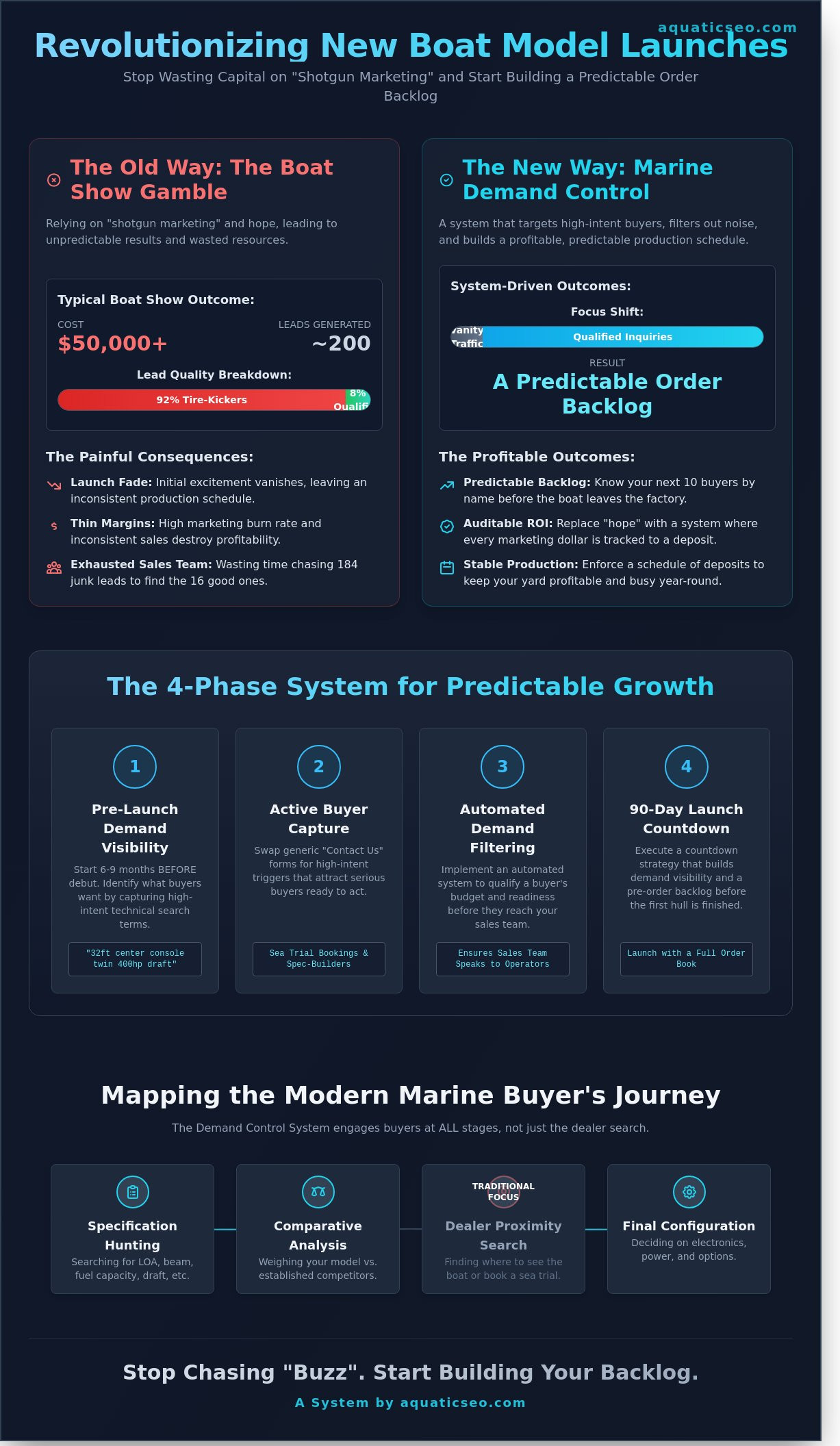
Most manufacturers burn $50,000 on a single boat show only to walk away with 200 leads where 92% are tire-kickers who will never sign a contract. It’s an expensive way to exhaust your sales team and clutter your CRM with junk data. A profitable marketing plan for a new boat model shouldn’t rely on the hope that a qualified buyer wanders into your booth during a four day event; it requires a system that targets high-intent buyers long before they step on a dock.
You’ve likely seen the “launch fade” where initial excitement for a 2026 release vanishes by month three, leaving your production schedule inconsistent and your margins thin. I’m going to show you how to install a Marine Demand Control System that ignores vanity traffic and focuses exclusively on capturing qualified inquiries. We’ll break down the strategy to dominate search results for your specific niche and build a predictable backlog of orders that keeps your yard stable year-round.
Key Takeaways
- Stop wasting capital on “shotgun marketing” and broad boat shows that prioritize vanity brand awareness over a filled production schedule.
- Identify the specific search phrases high-intent buyers use during the research phase to validate hull design and amenity preferences before you start the build.
- Build a marketing plan for a new boat model that swaps generic lead forms for high-intent triggers like sea trial bookings and custom spec-builders.
- Install an automated demand filtering system to qualify a buyer’s budget and readiness, ensuring your sales team only speaks with serious operators.
- Execute a 90-day countdown strategy that builds demand visibility and a pre-order backlog before the first hull hits the water.
Why Most New Boat Launches Fail (and the ‘Buzz’ Trap)
Most manufacturers treat a marketing plan for a new boat model like a high-stakes gamble. They dump $120,000 into regional boat shows and broad digital ads, hoping the “buzz” translates into a full production schedule. It rarely does. This shotgun marketing approach fails because it lacks an auditable tracking system. You can’t run a 15-bay service yard or a multi-line manufacturing plant on “maybe.”
Brand awareness is a vanity metric. It doesn’t pay the shipwrights or stabilize your overhead. In the 2026 market, the gap between an enthusiast and an Active Buyer has widened. An enthusiast spends hours scrolling through your lifestyle photography. An Active Buyer is looking for specific draft depths, fuel burn data, and delivery windows. If your marketing doesn’t filter for intent, you’ll face “dead weeks” where your production line sits idle while your burn rate stays constant. This inconsistency destroys margins and forces owners to take “any” deal just to keep the lights on.
The Cost of Chasing Vanity Metrics
High website traffic often masks low-margin inquiries. In a marine context, vanity traffic consists of “tire-kickers” looking at boat photos instead of technical specs. If 90% of your traffic comes from people who can’t afford a $400,000 center console, your sales team is wasting time on dead-end leads. The Buzz Trap is the pursuit of clicks over contracts.
- Vanity Traffic: 10,000 visitors looking at “Top 10 Sunset Cruises” blog posts.
- Qualified Demand: 50 visitors downloading the 2026 rigging guide and engine options.
- The Result: High traffic with zero deposits creates a false sense of security that ends in a quiet Q4.
Moving from Agency-Speak to Growth Partnership
We aren’t a marketing agency. We’re an operational growth partner. Traditional agencies use “holistic” fluff to hide a lack of results. We reject that. We focus on systematic demand control. Our Marine Demand Control System replaces the “hope and pray” method with a predictable flow of qualified buyers. This isn’t about getting your name out there; it’s about enforcing a schedule of deposits so your yard stays profitable year-round. We don’t talk about “synergy.” We talk about production stability and auditable ROI.
Phase 1: Pre-Launch Demand Visibility and SEO Strategy
Most manufacturers wait until a hull is finished to start their marketing. This creates a revenue lag that kills margins and creates inventory pileups. A successful marketing plan for a new boat model begins six to nine months before the physical debut. We use search data to identify exactly what your buyers want before you finalize the build sheet.
Capturing Search Intent Early
High-intent buyers do not search for vague “lifestyle” terms. They search for specific technical specs like “32ft center console twin 400hp draft” or “dual console with air conditioned berth.” By ranking for these technical queries early, you establish authority before competitors even announce their 2026 lineups. This is a core component of SEO for the Marine Industry that converts browsers into buyers.
Your technical content should act as a robust product launch strategy by validating hull design features through search volume. If 40% of your target audience is searching for “joystick docking for catamarans,” your pre-launch content must highlight that specific engine configuration. This is not about “awareness.” It is about capturing active demand that already exists in the market.
Mapping the 2026 Marine Buyer Journey
The 2026 buyer journey follows four distinct stages: Specification Hunting, Comparative Analysis, Dealer Proximity Search, and Final Configuration. Generic boat trader listings fail because they only capture the third stage. You lose the opportunity to influence the buyer’s criteria during the initial hunt. Our system ensures you dominate “best [boat type] 2026” queries long before the boat shows.
- Specification Hunting: Buyers search for LOA, beam, and fuel capacity to see if the boat fits their slip or range needs.
- Comparative Analysis: They weigh your new model against established 2025 competitors using head-to-head search terms.
- Dealer Proximity: Identifying where the first 10 hulls will be delivered for sea trials.
- Final Configuration: Using technical whitepapers to decide on electronics packages and power options.
Demand Visibility means knowing your next 10 buyers by name before the boat leaves the factory. We build “Active Buyer” lists by offering high-value technical data, not just glossy brochures. If you want to see how this fits into a larger Marine Demand Control System, you can review our process for filtering high-value inquiries.
Phase 2: The Active Buyer Capture System
Active Buyer Capture is the process of filtering intent at the first click. Most agencies brag about “reach” or “impressions” while your sales team starves for a real conversation. We don’t care about the dreamer who wants a desktop wallpaper of your hull. We care about the operator who needs a 32-foot center console that won’t beat their kidneys to pieces in a 4-foot chop. Your marketing plan for a new boat model must prioritize high-intent triggers that force a prospect to identify as a buyer or move on.
Engineering High-Conversion Landing Pages
A landing page isn’t a brochure; it’s a filtration device. To move a $500,000 asset, your page must provide the raw data that serious buyers crave. Stop using “Contact Us” as your primary CTA. It’s a weak, non-committal invitation to a black hole. Instead, use “Request Sea Trial Slot” or “View Available Production Dates.” These require the user to acknowledge the reality of a purchase timeline.
- Technical Schematics: Provide detailed CAD-style overlays, not just pretty photos.
- Performance Data: List GPH at specific cruise speeds (e.g., 28 knots) with 50% fuel and 100% water.
- Build-Slot Transparency: Show exactly which month the next available hull will be completed.
- Deck Configurator: Let them choose between a fishing-first or family-focused layout.
- Maintenance Access Points: Show photos of the bilge and wiring harnesses. Operators buy what they can fix.
Targeting the $300k to $5M Revenue Buyer
When you speak to a yacht charter owner, you aren’t selling a lifestyle. You’re selling a business asset. Your copy should focus on “blue water capability” rather than “ocean-ready” to signal industry fluency. Explain how the hull design reduces fatigue for a captain working 150 days a year. If the boat is for a private recreational buyer in this revenue bracket, focus on stability and schedule reliability. They have limited time; they need to know the boat is ready when they are.
Your presence on YachtWorld or BoatTrader must remain secondary to your owned system. These platforms are search engines for used inventory, not launch pads for new models. When you rely on third-party sites, you lose the ability to track the buyer’s journey from the first ad click to the final sea trial. Use your Marine Demand Control System to own the data, capture the lead, and enforce a follow-up process that doesn’t depend on a third party’s algorithm. Your marketing plan for a new boat model is only as strong as the data you own.
Phase 3: Implementing a Demand Filtering System
Your sales team shouldn’t talk to every person who fills out a form. In a high-intent marketing plan for a new boat model, volume is a vanity metric that erodes your margins. If your brokers spend 15 hours a week answering basic specs for window shoppers who lack the liquidity for a down payment, your operation is inefficient. You must enforce a qualified-only inquiry flow to keep your best closers focused on high-value contracts.
Stopping the Tire-Kicker Influx
Most boat dealers fail because they treat every lead as a win. We use a Marine Demand Control approach to score inquiries based on technical readiness and financial capacity. To filter out the 60% of traffic that will never buy, your forms must include these three specific questions:
- Current vessel ownership: Are they trading up from a center console, or is this their first hull?
- Storage logistics: Do they have a secured slip or a trailer-ready vehicle for this specific dry weight?
- Liquidity timeline: Is the purchase planned for this season or is it a multi-year research project?
This approach isn’t about being exclusionary; it’s about protecting your schedule. You can read more about What is a Demand Filtering System? to see how this logic keeps your sales floor efficient and your staff focused on closing.
The Role of AI in Demand Filtering
AI shouldn’t be used for generic customer service. It’s a technical triage tool. We deploy AI support systems that handle 24/7 inquiries regarding draft, beam, and engine configurations. These systems are programmed with industry-native vocabulary. They know “starboard” from “right side” and can explain the benefits of a stepped hull versus a deep-V without human intervention.
By analyzing the depth of these technical questions, the system identifies “sea trial ready” leads. When a prospect spends 10 minutes discussing fuel flow rates at cruise speed or specific outboard torque curves, the AI flags them for immediate human follow-up. This ensures your team only heads to the service yard or the dock for buyers who have already been vetted by the data. You stop being a tour guide and start being a closer.
Stop wasting time on unqualified leads and start dominating your territory with our Marine Demand Control System today.
Executing the Launch Strategy: From Debut to Backlog
Execution is the point where most manufacturers lose their margins. They build a superior hull but treat the marketing plan for a new boat model as a series of disconnected social media posts. A successful launch doesn’t aim for “awareness”; it aims for a production schedule that is sold out 18 months in advance. We replace vague hope with the Marine Demand Control System to ensure your debut translates into auditable bank deposits.
Stop measuring success by how many people stopped to look at your display. General boat shows are often a drain on overhead, filled with “tire kickers” who will never sign a contract. You need to pivot your focus toward qualified events where the audience has been filtered for intent and liquidity. If your marketing doesn’t result in a stack of signed dealer allocations before the first boat hits the water, your strategy has failed.
The 2026 Boat Launch Timeline
- Step 1: 90 days out. We initiate Technical SEO and spec-teasers. We don’t show the whole boat; we show the data points that active buyers crave. This includes fuel burn charts, deck layouts, and storage capacities. We target the 15% of the market currently searching for specific performance metrics.
- Step 2: 60 days out. We open the “Dealer Allocation” waitlist. This creates a controlled environment where dealers must commit to hull slots based on documented retail demand. It shifts the power dynamic from the dealer to the manufacturer.
- Step 3: 30 days out. We launch targeted sea trial invitations. These aren’t open to the public. We only invite leads who have passed through our demand filtering system, ensuring your captains spend time with buyers, not sightseers.
Compounding Your Launch Success
The first 10 hulls are your most valuable marketing assets. Most builders deliver the boat and move on. We use these early adopters to dominate search results for “owner reviews” and “real-world performance.” When a prospect in 2027 searches for your model, they shouldn’t find your polished brochure; they should find a wall of third-party validation from the first 10 owners. This is the essence of Demand Compounding.
By turning your initial delivery cycle into a content engine, you turn those 10 hulls into 50 orders. We track every interaction from the first click to the final commission payment. If you’re tired of “agency speak” and want a partner who understands that a marketing plan for a new boat model must be tied to your production capacity, it’s time to change your approach. Stop settling for vanity metrics and start enforcing stability in your sales funnel.
Ready to stop guessing and start controlling your production backlog? Request a No-BS Marine Marketing Analysis and see how we build systems that work as hard as your boats do.
Stop Chasing Buzz and Start Booking Your Backlog
Your next launch doesn’t need more “likes” or vague press releases that fail to move the needle. A successful marketing plan for a new boat model relies on capturing high-intent buyers 6 to 12 months before delivery. You need to shift from passive hope to active demand control by identifying visibility gaps and filtering out the tire-kickers who drain your sales team’s time. This ensures your production slots are filled by serious buyers rather than empty leads.
We specialize in helping marine businesses with $300k to $5M in revenue move past the “dead weeks” that often follow a big debut. Our proprietary Marine Demand Control System is built for operators who value qualified inquiries over vanity metrics. We provide a results-backed guarantee for qualified inquiries because we understand the operational stakes of your production schedule. It’s about stability, not just noise.
Stop wasting money on ‘buzz’ and start controlling your demand. Request your No-BS analysis today.
You’ve built a superior vessel; now it’s time to build the predictable growth your business deserves.
Frequently Asked Questions
How much should I budget for a new boat model marketing plan?
You should budget between 10% and 15% of your projected first year revenue for a new boat model marketing plan. If you aim to sell $5,000,000 worth of a new center console model, a $500,000 investment covers high-end asset production, search dominance, and lead filtering. Spending less often results in “quiet launches” where inventory sits on the lot and accumulates floor plan interest charges.
Is a digital marketing plan better than attending major boat shows?
Digital marketing is more efficient because it generates demand 365 days a year, whereas boat shows are expensive three day spikes. A 20×40 booth at the Fort Lauderdale International Boat Show can cost $60,000 before you even ship the hulls. A digital system captures the 85% of buyers who research online before ever stepping on a dock, ensuring your show appointments are with qualified buyers instead of tire-kickers.
Can I use the same marketing plan for a center console and a luxury yacht?
No, because the buyer journey for a $200,000 fishing rig differs fundamentally from a $4,000,000 motor yacht. Center console buyers focus on performance specs and immediate delivery, while yacht buyers require 6 to 18 months of nurturing and lifestyle positioning. Your marketing plan for a new boat model must reflect these distinct sales cycles to avoid wasting ad spend on the wrong audience profile.
How long does it take to see results from a new boat launch strategy?
You’ll see qualified inquiries within 30 days of activating our Marine Demand Control System. While organic search authority takes 4 to 6 months to fully mature, our paid search and targeted capture systems identify active intent immediately. By day 90, your dealer network should report a 25% increase in high-intent showroom visits compared to previous launch cycles.
What happens if our dealer network already handles our marketing?
Relying solely on dealers means you lose control over your brand’s narrative and lead quality. Dealers often prioritize the easiest sale, which might be a used trade-in rather than your new 2026 model. By running an independent high-intent launch system, you hand-deliver “hot” leads to your dealers, which forces accountability and ensures your newest hulls move first.
How do I know if my marketing leads are actually qualified buyers?
We use a multi-step Demand Filtering System to separate “dreamers” from “buyers” before they ever reach your sales team. This involves specific friction points like budget confirmation and “time-to-buy” questions within the lead capture flow. In 2024, our clients saw a 40% reduction in “junk” leads by implementing these filters, allowing them to focus on the 3% of the market ready to sign a contract.
Is SEO effective for a boat model that hasn’t been released yet?
SEO is critical for unreleased models to capture “early-bird” search traffic before your competitors enter the space. We build “coming soon” authority pages 6 months before the hull hits the water to index for the primary keyword and long-tail searches. By the time the official launch event happens, you already own the top search results, preventing third-party review sites from stealing your traffic.
Can a Demand Filtering System work for smaller boat manufacturers?
Small manufacturers benefit most from Demand Filtering because they have the least amount of time to waste on unqualified inquiries. If you only build 12 hulls a year, you can’t spend 4 hours a day talking to people who can’t afford the slip fees. A specialized system ensures your limited sales resources focus only on high-value prospects, which protects your margins and keeps your production schedule stable.