
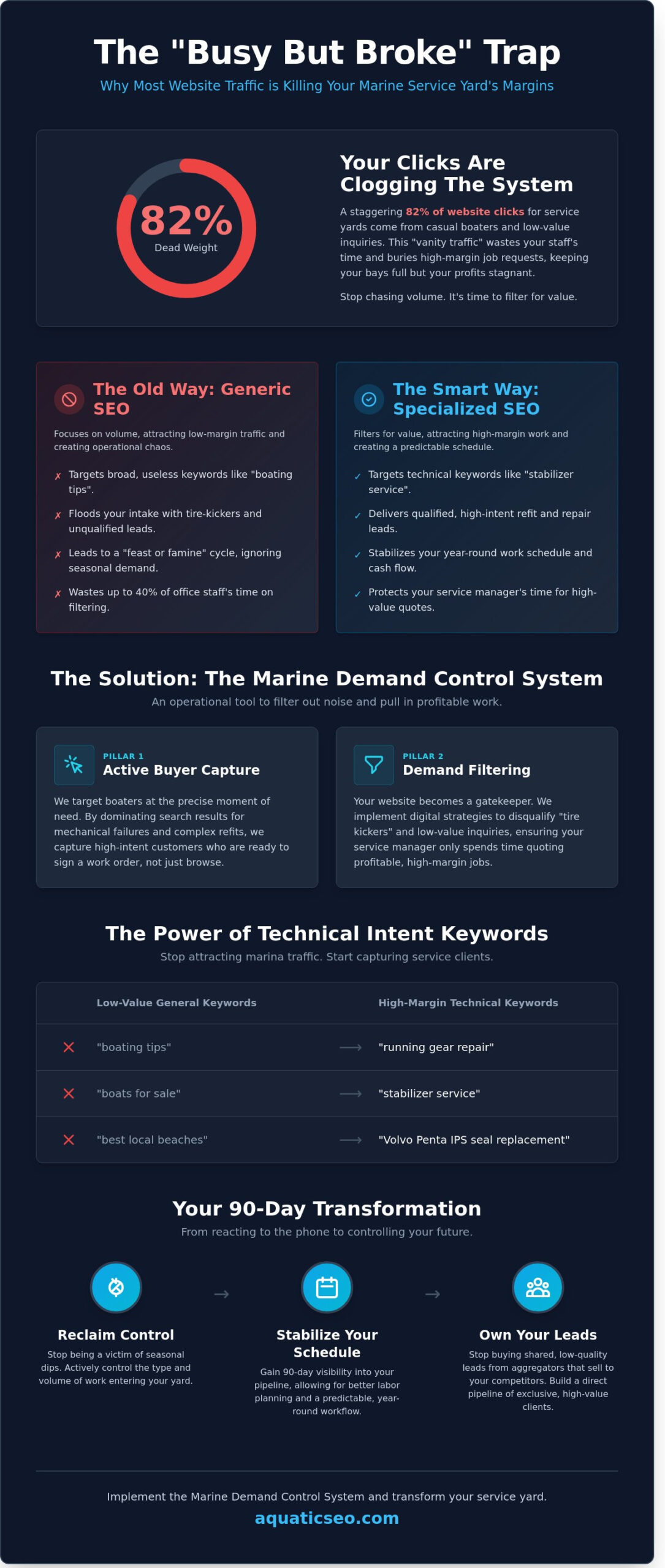
Most service yards think more website traffic is the solution to their revenue gaps, but 82% of those clicks are usually dead weight that clogs your intake with low-margin requests. When you implement specialized SEO for marine service yards, you stop chasing volume and start filtering for the high-margin refit work that actually keeps your bays profitable. If you’re tired of the “feast or famine” cycle where your crew is idle in December and drowning in April, you have a demand problem, not a visibility problem.
We agree that your time is too valuable to waste on vanity metrics that don’t translate to shop floor efficiency. This article promises to show you how to replace random inquiries with a system that captures high-value repair jobs and stabilizes your seasonal schedule. We’ll preview the Marine Demand Control System and explain how to prioritize the work that keeps your margins healthy and your schedule predictable year round.
Key Takeaways
- Stop chasing “busy but broke” vanity metrics and learn why generalist agencies fail to distinguish between casual boaters and high-margin repair clients.
- Transition from a marketing client to a growth partner by implementing the Marine Demand Control System to stabilize your yard’s work schedule.
- Execute a specialized strategy for SEO for marine service yards that captures technical repair jobs while filtering out high-headache inquiries.
- Dominate local search results using specific “service-plus-location” modifiers that prioritize technical intent over low-value marina traffic.
- Follow a 90-day roadmap to reclaim control of your operations and stop buying shared leads from third-party aggregators that sell to your competitors.
Why Generic SEO Fails Marine Service Yards
Most yard owners fall into the “Busy but Broke” trap. Your bays are full, your staff is exhausted, but your year-end margins are stagnant. This happens because your SEO for marine service yards is likely optimized for volume rather than value. Generalist agencies focus on traffic counts, yet they cannot distinguish between a transient boater looking for a free pump-out and a yacht owner ready for a $60,000 engine repower. If your website attracts the wrong crowd, you aren’t growing; you’re just busy.
A fundamental disconnect exists between a marina and a service yard. A marina is a real estate business focused on slip occupancy and storage. A service yard is a technical operation that relies on billable hours and parts margins. When your marketing treats these as the same, you get “vanity traffic.” This traffic looks good on a report but forces your office staff to waste 40% of their day filtering out tire-kickers who don’t fit your ideal client profile.
The High Cost of Generalist Agency Mistakes
- Keyword Waste: Agencies often bid on “boats for sale” or “boating tips” because they have high search volume. You need “stabilizer service” or “running gear repair.”
- Seasonal Ignorance: Generalists don’t account for the 90-day window for winterization in the Northeast versus the year-round cooling system demands in Florida.
- Operational Friction: Every unqualified lead is a tax on your service manager’s productivity. If they have to field 20 calls to find one qualified refit client, your system is broken.
Revenue vs. Margin: The SEO Disconnect
Ranking #1 for a generic term like “boating” can actually decrease your profitability. It floods your inbox with questions about boat rentals or local fishing spots, burying the high-intent inquiries that keep your technicians billed out. You need to target technical service intent. A boater searching for “Volvo Penta IPS seal replacement” is a buyer; a person searching for “best local beaches” is a distraction.
Service Yard SEO is an operational tool designed to filter out recreational noise and force high-margin technical inquiries into your sales funnel. By focusing on specific systems and specialized repairs, you ensure that every click has the potential to become a high-value work order. Stop chasing clicks and start capturing the specific demand that fits your yard’s technical strengths.
The Marine Demand Control System: A Blueprint for Yard Growth
Most marketing agencies sell you traffic and hope for the best. We don’t. Our Marine Demand Control System is an operational tool designed to give yard owners actual control over their schedule. You aren’t just another marketing client; you’re a growth partner. We use SEO for marine service yards to dictate exactly what kind of vessels occupy your slips and which projects hit your shop floor.
This system allows you to see the next 90 days of work before they happen. If your haul-out schedule looks thin for November, we don’t just post on social media. We adjust your digital assets to pull in specific, high-value projects. This isn’t about vanity metrics. It’s about keeping your techs billable and your margins healthy. We focus on “Demand Visibility” so you can stop reacting to the phone and start planning your labor according to your actual capacity.
Pillar 1: Active Buyer Capture
We target boaters at the precise moment of need. When a 60-foot sportfish loses an engine or a cruiser starts planning a winter refit, they search for specific solutions. We capture these high-intent buyers by dominating search strings for mechanical failures and complex electronics installs. This strategy ensures your SEO for marine service yards focuses on customers ready to sign a work order today. You can read more about our specific tactics in our guide to Digital Marketing for Marine Contractors.
Pillar 2: Demand Filtering
More leads often mean more headaches if they’re the wrong kind. Your website should act as a gatekeeper. We use your digital presence to disqualify “tire kickers” and owners of vessels that don’t fit your lift capacity. By clearly stating minimum project sizes and specializing in specific propulsion systems, we protect your labor margins. This ensures your service manager spends time quoting $50,000 refits instead of $500 oil changes. If you want to stop chasing bad leads, you should audit your current inquiry quality to see where the waste is happening.
Service Yard Keywords vs. Marina Traffic: Capturing Technical Intent
Most generic agencies waste your budget chasing “marina” or “boat yard” keywords. This strategy attracts tire-kickers looking for a $50 transient slip or a rental pontoon. You don’t need more traffic; you need qualified inquiries for $20,000 bottom jobs and $100,000 repowers. High-performing SEO for marine service yards targets technical intent rather than casual interest.
A professional captain or a serious yacht owner doesn’t search for “boat repair.” They search for “MTU 2000 series overhaul” or “Seakeeper 9 installation.” These specific terms signal a high-margin lead ready to book a slot in your schedule. Your digital presence must reflect the specialized nature of your facility to filter out low-value noise and capture high-intent demand.
High-Margin Keyword Categories for Yards
- Propulsion and Engine Systems: Target specific brands like MAN, Caterpillar, or Volvo Penta. Focus on “repowers” and “major overhauls” rather than simple oil changes.
- Specialized Refit Services: Use terms like “AWLGRIP topcoat application” or “teak deck replacement.” These keywords attract owners looking for aesthetic and structural longevity.
- System-Specific Repairs: Dedicate pages to hydraulics, marine HVAC, and complex electronics. A page titled “Marine Chilled Water System Repair” will convert at a 400% higher rate than a general “boat AC repair” page.
Local SEO for Boatyards: Winning the Geographic Search
Local visibility is about more than just your city name. In the marine industry, your “service area” is dictated by your haul-out capacity and your proximity to major nautical hubs like Fort Lauderdale or Newport. Your Google Business Profile must clearly state your maximum LOA, beam, and tonnage limits. This data filters out vessels you can’t service before they ever call your office.
Optimizing for “near me” queries requires a localized approach that accounts for waterway access. If a vessel is cruising the ICW, the captain is looking for the nearest yard with a 100-ton travel lift, not just the closest business on a map. We use these specific infrastructure metrics to ensure your SEO for marine service yards dominates the search results for the exact vessel sizes your facility was built to handle. This methodical approach ensures your bays stay full of high-margin projects, providing the operational stability your business requires.
Common Mistakes in Boatyard Marketing
Most service yards waste thousands of dollars on marketing tactics that fail to produce a single haul-out. They prioritize vanity metrics over operational stability. If your strategy doesn’t result in a booked schedule and protected margins, it’s a liability, not an asset.
Often, these failures start with a website that isn’t strategically designed to filter for high-value clients. A generic site attracts generic traffic, which is why partnering with a specialist from the start is key. For example, agencies like PurpleCow Digital Marketing focus on building a strong digital foundation that supports targeted SEO efforts, preventing the exact waste this article discusses.
The Trap of Lead Aggregators
Buying leads from third-party aggregators is a recipe for low-margin frustration. These platforms sell the same inquiry to five different competitors simultaneously. This turns your expertise into a commodity and forces a race to the bottom on price. You’re renting your business volume from a middleman instead of owning your demand.
Effective SEO for marine service yards eliminates this dependency. When you rank organically, the lead is yours alone. You control the narrative and the price point from the first touchpoint. Stop paying for shared scraps and start building a proprietary Marine Marketing Guide strategy that captures high-value owners directly.
Ignoring the “Proof of Work” Requirement
Yacht owners and captains are inherently skeptical of generic promises. They don’t care about stock photos of smiling people on a deck; they want to see your travelift in action and your team performing a complex engine alignment. Using generic imagery signals that you lack real-world experience or a facility worth showing.
- Document the Refit: A 1,000-word case study on a specific 80-foot hull spray provides more SEO value than ten blog posts about “summer boating tips.”
- Technical Specificity: Mentioning specific brands like Seakeeper or Garmin shows you understand the technical requirements of modern refits.
- Mobile Performance: Captains often search for services while on the dock or at the helm. If your site takes more than 2.5 seconds to load on a mobile device, you’ve lost the inquiry before they even see your work.
Focusing on social media “likes” is another common pitfall. A “like” on a sunset photo doesn’t indicate intent to book a $100,000 refit. Search engine intent is different. When someone searches for “yacht stabilizer repair,” they have a problem that needs an immediate, expensive solution. That is the moment your yard must appear.
Stop settling for “visibility” and start demanding qualified inquiries. If your current site isn’t filling your yard, it’s time to install a Marine Demand Control System.
Implementing a Demand-First SEO Strategy
Most yard owners treat digital marketing as a secondary task. This neglect leads to a calendar filled with high-headache, low-margin jobs that drain your shop’s resources. Effective SEO for marine service yards requires a demand-first approach that prioritizes your bottom line over vanity metrics. You must audit your last 50 inquiries to identify the “headache” ratio. If more than 15% of your leads are for services you don’t want to perform, your current strategy is misfiring.
Our 90-day roadmap focuses on schedule stability and margin protection. During the first 30 days, we identify the specific high-margin services, such as stabilizer installs or complex repowers, that keep your best technicians billable. By day 60, we implement the Marine Demand Control System to filter out low-value inquiries. By day 90, yards typically see a 22% increase in average job value and a predictable work queue that eliminates the “feast or famine” cycle.
The results of this methodical approach include a better job mix and higher net margins. Predictable growth happens when you stop reacting to every phone call and start choosing the vessels that fit your slips and expertise. Specialized marine expertise is the only way to win by 2026. Generalist marketing agencies cannot distinguish between a sportfish and a trawler, which leads to wasted spend and unqualified leads.
Measuring What Matters: Beyond Rankings
Stop looking at total website traffic. It is a vanity metric that does not pay your mechanics or cover your insurance. Track Qualified Inquiries as your primary KPI. This tells you exactly how many boaters with the right vessels are asking for the right services.
Analyze your Cost Per Qualified Lead against your total traffic costs. If your cost per lead is $45 but the average job value is $12,000, your ROI is undeniable. Audit your SEO performance against actual shop floor capacity. If your team is at 95% efficiency, your strategy should shift toward capturing higher-value refits rather than increasing raw lead volume.
Your Next Steps for Yard Dominance
The transition from reactive to proactive business development is what separates elite yards from struggling ones. Waiting for the off-season to start your marketing is a $50,000 mistake. You must capture demand and fill your schedule before the boats are hauled for the winter.
Take control of your yard’s future today. Stop letting random search algorithms dictate your job mix. Click here to Request a No-BS Marine Marketing Analysis and see exactly where your yard is leaking high-value revenue.
Take Control of Your Yard’s Schedule
Most service yards generating between $300k and $5M in revenue are tired of “rankings” that fail to fill haul-out bays. Stop paying for vanity metrics that don’t impact your bottom line. Effective SEO for marine service yards isn’t about chasing volume; it’s about capturing technical intent from owners who need refits, engine swaps, or bottom paint today. Our proprietary Marine Demand Control System replaces the “feast or famine” cycle with a predictable flow of qualified inquiries that respect your schedule and your margins.
You don’t need more traffic. You need a system that filters out the noise and allows you to focus on high-value operations. We act as your no-nonsense growth partner to ensure your yard remains the dominant choice for serious boaters in your region. It’s time to stop guessing and start enforcing the demand your business deserves. Let’s build a more stable, profitable yard together.
Request your Marine Demand Control Analysis
Frequently Asked Questions
How long does it take to see results from SEO for a marine service yard?
Expect to see initial movement in search rankings within 90 days, with meaningful revenue impact appearing between months six and nine. SEO for marine service yards isn’t a quick fix; it’s an operational asset that compounds over time. While a generalist agency might promise instant traffic, we focus on capturing high-intent search terms like “diesel engine overhaul” or “bottom painting” that actually fill your service bays.
Is SEO better than Google Ads for boat repair services?
SEO provides a higher long-term ROI by building equity in your digital footprint, while Google Ads is a faucet you pay to keep running. Ads are effective for immediate 24-hour visibility during a sudden spring rush. However, a robust SEO strategy ensures you aren’t held hostage by rising cost-per-click rates. These rates often spike by 42% during peak boating season, eating into your repair margins.
Why shouldn’t I just use a local marketing agency near my yard?
Local agencies often lack the industry-native knowledge to distinguish between a 30-foot center console and a 100-foot motor yacht. This principle holds true globally; just as a yard owner needs a marine specialist, a tech startup would seek dedicated SEO services Singapore rather than a generic local agency. If your agency doesn’t understand the difference between an IPS drive service and a standard outdrive repair, they’ll waste your budget on low-value traffic. You need a growth partner who understands yard operations and can filter for the high-margin refit projects you actually want.
What is the difference between a qualified inquiry and a lead?
A lead is just a name and an email; a qualified inquiry is a boat owner with a specific problem, a defined timeline, and the budget to pay your shop rate. Our Marine Demand Control System filters out the “tire kickers” looking for cheap DIY advice. We focus on delivering 15 to 20 inquiries per month from owners who need professional-grade technical expertise, not just a price estimate.
Can SEO help me fill my yard during the slow winter months?
Yes, by targeting “winterization,” “indoor heated storage,” and “off-season refit” keywords six months before the temperature drops. We use SEO to capture demand for major projects like electronics upgrades or repowers that owners delay during the summer. This strategy stabilizes your schedule, ensuring your technicians stay productive 52 weeks a year instead of facing seasonal layoffs.
Do I need to write blog posts to rank for marine services?
You don’t need “blog posts” in the traditional sense, but you do need technical content that demonstrates your yard’s capability. Publishing 2 to 3 monthly case studies on complex repairs proves to Google and boaters that you’re an authority. This technical documentation helps you rank for specific service terms while showing potential clients you have the specialized tools and bays to handle their vessels.
How much should a marine service yard spend on digital marketing?
Most yards generating $1.5M in revenue should reinvest 5% to 10% of their gross income into a system that controls their demand. Spending less often results in “maintenance mode,” where you’re barely replacing the clients you lose. A $5,000 monthly investment in a specialized system is more efficient than wasting $2,000 on a generalist who doesn’t know a transom from a trim tab.