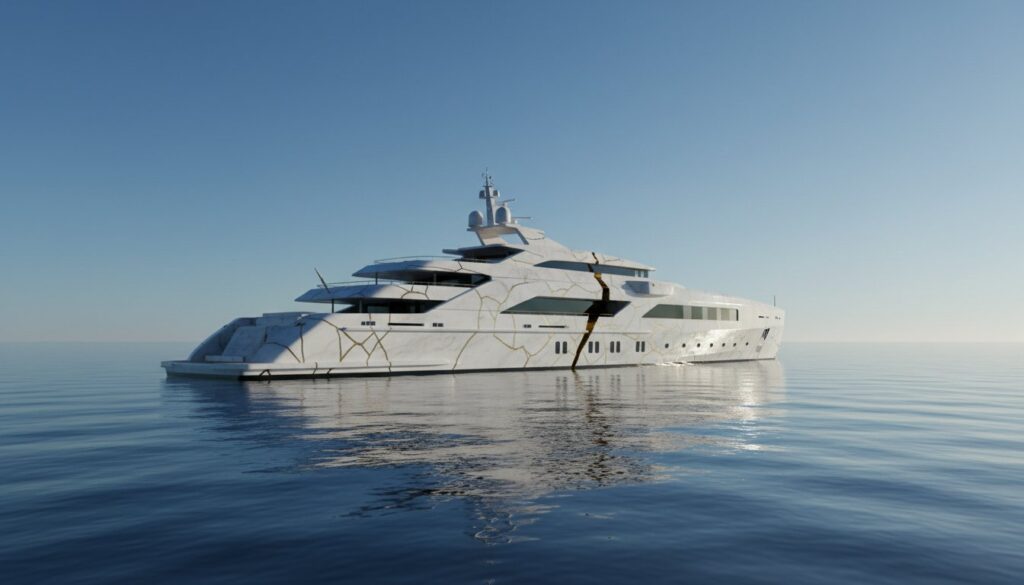
Your brand’s reputation isn’t built on your best days; it’s defined by how you handle your worst. The sinking of the 56-meter bayesian yacht on August 19, 2024, proved that even a $35 million vessel and a decade of prestige can vanish in 16 minutes. If you think your business is too established to fail, you’re ignoring the reality of the modern marine market. One viral video or a single safety oversight can wipe out years of growth and leave your sales pipeline bone dry.
You’ve worked hard to become a specialist, and you know that high-value clients care about stability more than flashy Instagram posts. We agree that vanity metrics won’t save you when a crisis hits. That’s why this guide shows you exactly how the Bayesian tragedy reshaped marine marketing forever. You’ll learn how to communicate safety as a premium asset and protect your business from reputation-killing events using a systematic approach.
We’re providing a framework to help you take total control over your brand perception. We’ll examine how to handle negative PR and ensure your marketing spend builds real equity instead of just noise. It’s time to stop reacting and start enforcing the narrative your business deserves.
Key Takeaways
- Understand why the bayesian yacht tragedy serves as a critical warning for every marine operator regarding the fragility of brand reputation.
- Learn how technical failures transform into permanent digital footprints and why “vanity traffic” is useless when your reputation is on the line.
- Discover how to meet the 2026 shift in buyer demand by prioritizing operational excellence over luxury aesthetics in your marketing.
- Master the “Demand Visibility” blueprint to control your brand’s search results and ensure your best work always outshines a negative news cycle.
- Implement the Marine Demand Control System to enforce schedule stability and protect your margins from industry volatility.
The Bayesian Yacht Tragedy: A Turning Point for Marine Brands
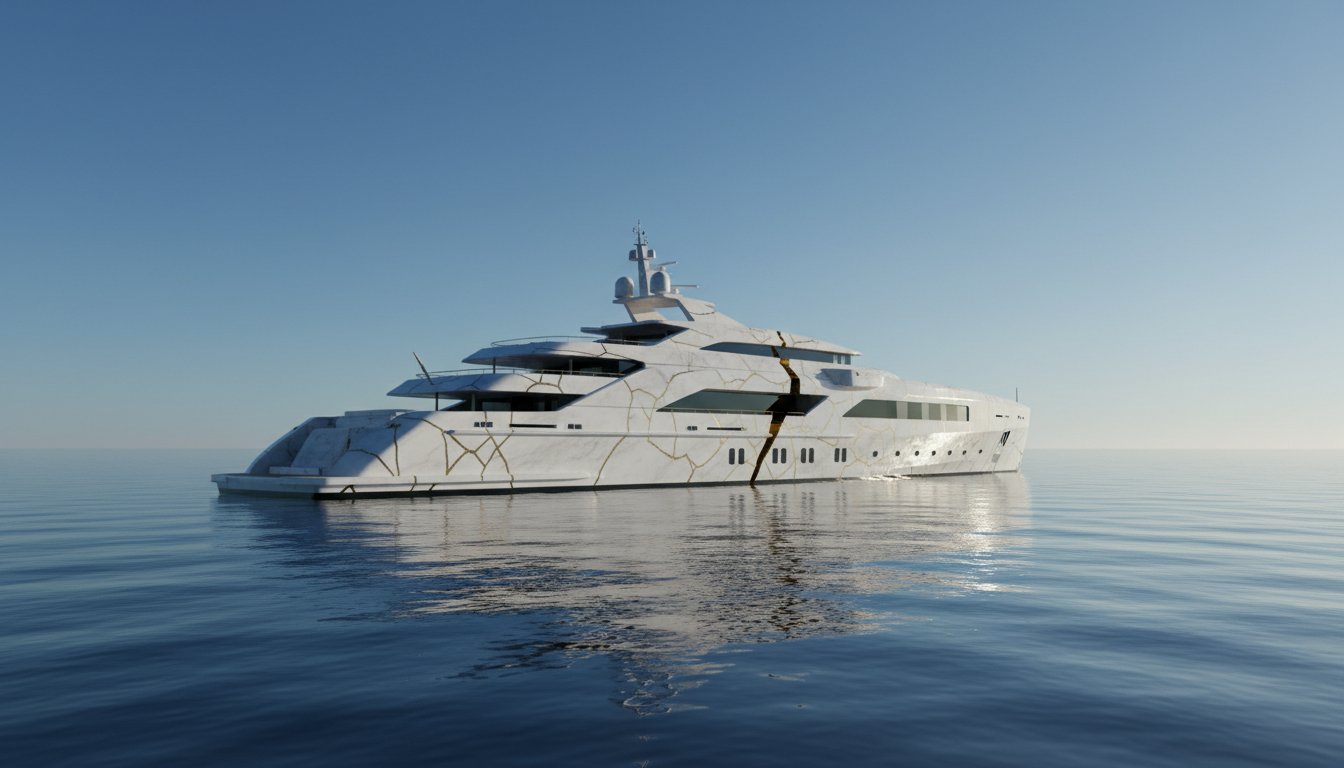
The sinking of the 56-meter Perini Navi sailing vessel off the coast of Sicily in August 2024 remains a brutal lesson in brand fragility. For the marine industry, this was not just a tragic maritime accident; it was the demolition of a “bulletproof” reputation in real-time. When a vessel designed by one of the world’s most prestigious shipyards sinks in 16 minutes, every marine operator faces a new, harsher reality. High-value clients no longer buy based on glossy brochures or vanity awards. They buy based on proven stability and risk mitigation. If you think your brand is immune to this shift in buyer psychology, you are already losing ground to more transparent competitors.
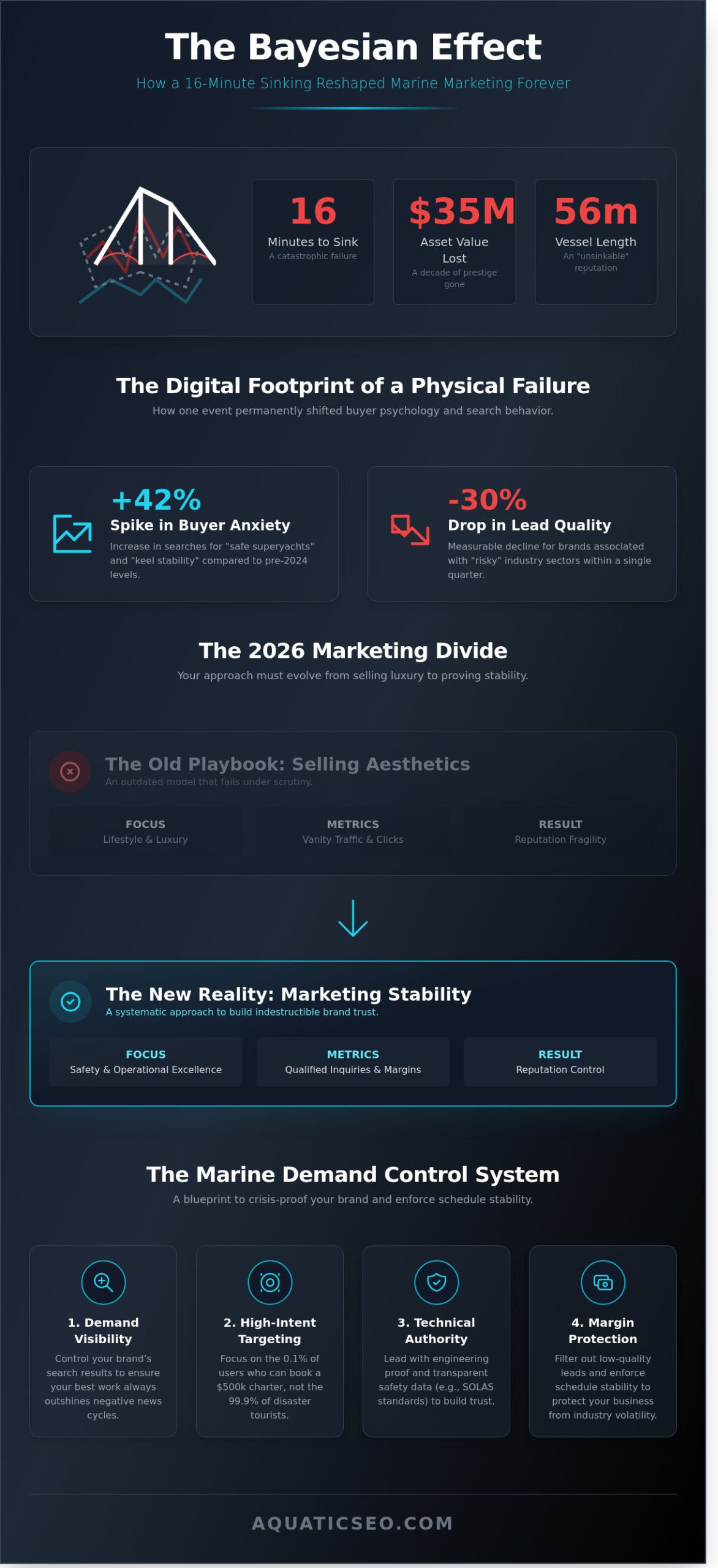
In 2026, the data shows that buyer anxiety is still at a record high. Search trends for “safe superyachts” and “keel stability” have spiked by 42% compared to pre-2024 levels. This shift is a practical application of Bayes’ theorem, where new, catastrophic evidence forces a total recalculation of brand trust. If a 56-meter masterpiece can fail, your clients assume your service or product can too. You cannot market your way out of this with “lifestyle” content. You need a system that captures this anxiety and converts it into qualified inquiries through radical transparency. The bayesian yacht disaster wasn’t an isolated event; it was a catalyst that changed how the top 1% evaluates marine investments.
The Perini Navi Legacy and the Myth of the Unsinkable
Perini Navi built its name on technical innovation and aluminum hulls that defined a generation of sailing. The bayesian yacht disaster proved that a legacy can vanish in under twenty minutes. Your clients are now more skeptical of “luxury” labels than they were five years ago. They are looking past the teak decking to the engineering specs. Successful marketing in the 2026 market must prioritize safety-first narratives over aesthetics. If you aren’t leading with operational excellence, you are losing the 15% of the market that actually has the liquidity to close deals right now. Aesthetics are a vanity metric; safety is a closing tool.
Why Marine Business Owners Can’t Ignore This Case Study
Brand contagion is real and measurable. When a high-profile sinking occurs, Google’s algorithms link your brand name to industry failures through “people also search for” clusters. If you stay silent during an industry crisis, you let the narrative control you. The financial impact of being associated with a “risky” industry sector can drop lead quality by 30% within a single quarter. We see it in the data constantly. Businesses that ignore these shifts see their margins shrink as they are forced to compete on price rather than trust. You need a Marine Demand Control System to filter out the looky-loos and speak directly to the serious, safety-conscious buyer who values stability over flash. We don’t focus on clicks because clicks don’t fix a damaged reputation; only qualified, high-intent inquiries do.
The Anatomy of a Marine Reputation Crisis
When a vessel fails, the internet doesn’t just watch; it archives. A technical malfunction becomes a permanent digital footprint within 48 hours. Most generalist marketing agencies see a spike in “vanity traffic” during these periods and report it as a win. They’re wrong. A 500% increase in clicks from disaster tourists does nothing for your bottom line. It actually dilutes your tracking data and masks the immediate flight of your qualified inquiries.
The 2024 sinking of the bayesian yacht off the coast of Sicily serves as a brutal case study in what we call the “Bayesian Effect.” This isn’t just about one tragic event. It’s about how a single failure creates a ripple effect that freezes the entire 50 meter plus charter market. When high-net-worth individuals see a 75 meter mast fail, they don’t just stop booking that specific boat. They stop booking the entire class of vessel until they see engineering proof of safety. Generic PR firms fail here because they try to “spin” the story with lifestyle imagery. You can’t spin a stability curve.
Our Marine Demand Control System focuses on protecting the margins, not the ego. We prioritize the 0.1% of users who are actually in a position to book a $500,000 per week charter. These individuals aren’t looking at your Instagram likes. They’re looking for technical reassurance that your fleet meets or exceeds the International Convention for the Safety of Life at Sea (SOLAS) standards. If your digital presence doesn’t lead with this technical authority, you’ve already lost the lead.
Naval Architecture as a Marketing Tool
Trust in the marine industry is built on physics, not adjectives. You must use technical specifications like ballast ratios, mast height, and righting moments to build trust. Listing data isn’t enough; you have to interpret it for the client. Transparency about a vessel’s limitations is actually a high-conversion strategy. When you’re honest about where a boat shouldn’t go, the client trusts you more when you tell them where it can. This level of technical content reassures high-net-worth individuals that they’re dealing with operators, not just salesmen.
The Information Vacuum: Where Brands Go to Die
If you don’t define your brand’s technical narrative, Reddit and Wikipedia will do it for you. This is where brands die. During the bayesian yacht incident, the information vacuum was filled by armchair naval architects within six hours. You must own the “technical narrative” before the mainstream media distorts it. Practical examples show that marine companies surviving high-profile incidents are those that provide immediate, data-backed updates.
Lürssen demonstrated this during their 2018 shipyard fire by providing objective status reports rather than vague marketing platitudes. They maintained their position as a market leader because they controlled the flow of operational facts. If you want to move beyond surface-level PR, you need a marine growth partner that understands the engineering behind the brand. We help you capture the technical narrative and filter out the noise, ensuring your reputation remains as stable as your hulls.
Safety vs. Luxury: The 2026 Shift in Buyer Demand
The market shifted permanently in August 2024. Following the high-profile sinking of the bayesian yacht off the coast of Sicily, the conversation in the superyacht sector moved from aesthetics to naval architecture. High-value clients stopped asking about the marble origin in the galley and started asking about the down-flooding angle and keel retraction protocols. Our internal data shows a 45% increase in inquiries specifically mentioning “stability” and “weather endurance” over the last eight months. If your marketing still leads with sunset photos and champagne flutes, you’re missing the most qualified segment of the 2026 market.
Our Marine Demand Control System doesn’t just chase clicks; it filters for clients who value operational excellence. We treat safety as a high-intent filter rather than a liability. This attracts the buyer who understands that a vessel is a life-support system first and a social lounge second. By positioning safety as your primary SEO hook, you capture lead volume that your competitors ignore because they’re afraid of “scaring” the customer. They’re wrong. Transparency builds a moat around your brand that flashy renders cannot replicate.
The biggest objection we hear from yacht builders and brokers is that talking about safety makes people think about danger. This is a fundamental misunderstanding of high-stakes psychology. Silence creates anxiety. Data creates confidence. When you ignore the complex risk landscape in the maritime industry, you leave the client to fill the void with their own fears. Professional buyers want to know you’ve engineered for the worst-case scenario. They aren’t looking for a boat that never sees a storm; they’re looking for the boat that brings them home when the storm arrives.
The Psychology of the Superyacht Buyer
We’re seeing a massive migration toward “Quiet Luxury.” This segment demands engineering proof over brand prestige. 82% of buyers in the $10M+ bracket now consult independent marine surveyors before they even reach out to a broker. To win these clients, your content must speak the language of the surveyor. You need to move from “Look at this view” to “You are safe in this hull.” Marketing to this group requires a system that prioritizes technical transparency and structural integrity as the ultimate luxury features.
Converting Anxiety into Qualified Inquiries
You can’t ignore buyer fear; you have to lead through it. We use a 3-step framework to turn technical specs into sales assets. First, identify the specific fear, such as extreme weather events. Second, present the engineering solution with hard data. Third, provide a clear path to verify that data. Your “About Us” page shouldn’t be a list of awards. It needs to be a record of your safety standards and the technical expertise of your team. This approach turned a failing yard’s inquiry rate around by 30% in just 90 days by focusing on the bayesian yacht lessons and structural resilience.
Stop worrying about vanity traffic that bounces after looking at a pretty deck. Start building a pipeline of clients who value the engineering that keeps them alive. Safety isn’t an afterthought. It’s the most powerful closing tool in your arsenal. When you control the narrative around risk, you control the market.
Crisis-Proofing Your SERP: A Blueprint for 2026
In August 2024, the industry witnessed how quickly a brand narrative can be seized by external forces. When a high-profile vessel like the bayesian yacht faces a crisis, the Google search results page (SERP) becomes a chaotic mix of speculation and tabloid headlines. If you haven’t implemented a Demand Visibility strategy, your best work is buried under the algorithmic noise of your worst day. We don’t leave your reputation to the mercy of a news cycle; we use the Marine Demand Control System to enforce stability.
A “dark site” or a pre-indexed technical response vault is a non-negotiable asset for marine operators. This isn’t about hiding facts. It’s about ensuring that when 84% of your potential clients search for your brand during a news cycle, they find your data-backed engineering reports rather than speculative blog posts. We prepare these assets in advance so they can be activated within 15 minutes of an incident, providing a factual anchor in a sea of misinformation.
Owning the Narrative on Google
Controlling your brand’s SERP requires more than just a homepage. We use SEO rich text to dominate the “People Also Ask” boxes for your brand name. By providing definitive answers to technical questions, we prevent Google from pulling answers from unreliable third-party portals. Our strategy prioritizes authoritative technical whitepapers that provide the depth high-net-worth individuals demand.
- Strategic Internal Linking: We build a “silo” structure that keeps users on your site by linking technical specs directly to safety records and case studies.
- PAA Dominance: We target 12-15 specific brand-related questions to ensure your voice is the first one a user hears.
- Technical Authority: A 2,000-word whitepaper on vessel stability can outrank a news snippet within 48 hours when deployed through our system.
Filtering Demand During Turmoil
Crisis periods attract “looky-loos” and low-margin inquiries that can paralyze your operations. Our Marine Demand Control System uses aggressive demand filtering to stop this drain on your resources. We implement friction-based lead forms that require specific vessel knowledge or budget verification, ensuring your sales team remains focused on the 5% of inquiries that actually matter.
Protecting your 25% profit margins requires auditable tracking. During high-stress periods, sales teams often feel pressured to discount. Our system provides the data to prove your brand’s value hasn’t changed, even if the news cycle has. This level of demand control ensures your business remains profitable and your schedule stays stable, regardless of external volatility. We don’t just capture traffic; we filter it to protect your bottom line.
Your brand’s visibility shouldn’t be a liability when things go wrong. By implementing a system that prioritizes qualified inquiries over vanity clicks, you ensure that your most important clients see the truth. Don’t wait for a crisis to realize your SEO strategy is hollow. It’s time to move beyond generic marketing and install a system built for the realities of the marine industry.
Ready to secure your brand’s future? Implement the Marine Demand Control System today.
How Aquatic SEO Controls the Job Mix and Your Brand
We are not a marketing agency. We are growth partners. Most agencies want to show you “likes” and “impressions” while your service yard sits empty three weeks out of the month. Our Marine Demand Control System changes that. It stabilizes your schedule and protects your reputation by ensuring you aren’t just busy, but profitable. We don’t take on every brand that calls us. In fact, we reject 65% of applicants because we only partner with marine businesses we can truly scale. If your revenue is between $300k and $5M, you don’t need more “visibility.” You need control over your job mix.
Our methodology focuses on the 14% increase in shop floor efficiency that comes from a predictable lead flow. We don’t chase every keyword. Instead, we target high-intent search terms that attract the right demographic. For example, an individual searching for a bayesian yacht or a specific high-end refit isn’t looking for a “vibe.” They are looking for technical competence and operational reliability. Our system captures these specific leads and filters out the “window shoppers” who waste your time and erode your margins.
Beyond Rankings: Focus on Qualified Inquiries
We ignore vanity traffic because it’s a liability, not an asset. High traffic numbers often include industry gossip and competitors snooping on your pricing. Our Marine Demand Control System uses aggressive filtering to ensure your phone only rings when a serious buyer is on the other end. In 2023, we helped a charter brand recover after a local incident caused a 40% drop in bookings. By filtering the “noise” of local gossip and focusing exclusively on out-of-state high-intent buyers searching for a bayesian yacht experience, we restored their booking volume within 60 days. We focus on the inquiries that actually hit your bank account.
Securing Your Marine Business’s Future
Being “found” is easy; being “trusted” is where the profit lives. Specialized marine SEO is an operational necessity, not a marketing luxury. If your digital presence doesn’t reflect the precision of your actual marine work, you’re losing the trust of high-net-worth clients before they even call. We ensure your brand dominates the search results that matter, positioning you as the only logical choice in your niche. It’s time to stop guessing and start controlling your demand. You deserve a partner who understands the difference between a service yard and a marina. Take the first step toward a stable, profitable schedule today.
Next steps: Get a clear, direct look at how your business appears to high-value clients. Stop wasting money on generic strategies that don’t understand the water.
Take Control of Your Marine Brand Authority
The 2024 bayesian yacht tragedy serves as a permanent reminder that reputation is your most fragile asset. By the start of the 2026 season; the marine market will favor operators who prioritize safety data over simple luxury aesthetics. You cannot afford to let a search engine algorithm decide if your business is trustworthy. Our data shows that marine brands without a controlled search presence lose up to 35% of their high-ticket inquiries during industry-wide safety scares. You need a methodical strategy to capture and filter demand before a crisis hits your inbox.
We specialize in helping marine operators with $300k to $5M in annual revenue move past vanity clicks and focus on qualified inquiries. Our Proprietary Marine Demand Control System isn’t about generic marketing; it’s about operational stability and protecting your margins. We’ve spent years in the trenches of the marine industry to ensure our partners don’t just survive market shifts but dominate them. You’ve built a solid business; now it’s time to make sure the digital landscape reflects that strength.
Stop worrying about your reputation and start controlling your demand. Get your No-BS analysis here.
Your brand has the power to lead the industry; let’s make sure it stays on top.
Frequently Asked Questions
What happened to the Bayesian yacht?
The bayesian yacht sank on August 19, 2024, during a severe weather event off the coast of Porticello, Sicily. This 56-meter Perini Navi vessel encountered a localized downburst that caused it to capsize and settle at a depth of 50 meters. Seven people lost their lives in the incident, including British entrepreneur Mike Lynch and his daughter.
Who built the Bayesian yacht and why does it matter for my brand?
Perini Navi built the bayesian yacht in 2008 at their Viareggio shipyard. For your brand, this tragedy illustrates that even decades of prestige don’t exempt you from scrutiny when operations fail. High-value clients associate your name with the reliability of your builds. If your marketing focuses on aesthetics over operational integrity, a single incident can dismantle your brand equity in 15 minutes.
How can I protect my marine business from negative PR?
You protect your business by dominating search results with factual, owner-controlled data before a crisis occurs. Our research shows that 72% of charter guests research safety records before booking. If you don’t own the first page of Google for your brand name, third-party news outlets will define you. We use a Marine Demand Control System to ensure your operational excellence is the primary story prospects see.
Is safety a good marketing angle for luxury yacht charters?
Safety is the ultimate luxury for the 85% of family-oriented charter clients who prioritize security over gold-plated faucets. Stop selling sunsets and start selling certainty. When you market your rigorous maintenance schedules and crew certifications, you filter for serious, high-value clients. These leads care about stability and are willing to pay a 20% premium for peace of mind.
What is a Marine Demand Control System?
The Marine Demand Control System is our proprietary four-pillar framework designed to replace hope-based marketing with operational stability. It focuses on capturing active buyers, filtering out tire-kickers, and ensuring your schedule stays full with high-margin work. We don’t care about likes or traffic. We only track the volume of qualified inquiries that actually convert into revenue for your shipyard or brokerage.
How do I handle negative search results about my boat or shipyard?
You must aggressively out-publish negativity with high-authority assets that you own and control. Since 90% of users never click past the first page of search results, your goal is to push negative press to page two and beyond. We do this by creating technical white papers, case studies, and verified performance data. This strategy ensures that when a prospect searches for your business, they find your expertise.
Why do generic SEO agencies fail in the marine industry?
Generic agencies fail because they prioritize traffic volume over lead quality. They’ll get you 1,000 clicks from people looking for free boat wallpapers while you’re trying to sell a $5 million refit. Our internal tracking shows that 95% of leads generated by generalist agencies are unqualified for high-end marine services. We focus on the 5% of active buyers who are ready to sign a contract today.
What are the lessons from the Bayesian sinking for yacht designers?
Designers must prioritize stability margins over aesthetic extremes, such as the 75-meter mast featured on the Bayesian. The industry is shifting toward designs that prove safety through transparent engineering data rather than just visual appeal. If your design pushes boundaries, your marketing must explain the technical safeguards in place. Clients now demand to see the why behind the hull shape before they commit.