Your online store is built, but the customers are missing. You’re spending on marketing, but the connection between that spend and your revenue is broken or, worse, nonexistent. This isn’t a traffic problem; it’s a system failure. Most ‘experts’ treat the two halves of your business as separate disciplines. They are wrong. The relationship between e commerce and digital marketing is the single most critical system for online sales-one is the engine, the other is the high-octane fuel. When they aren’t engineered to work together, you get wasted ad spend, unqualified traffic, and zero control.
This is not another list of vague marketing tips. This is a no-nonsense guide to building an integrated growth machine. We will provide a clear, systematic plan to attract qualified buyers who are ready to purchase, choose the right marketing tactics for your specific products, and build a reliable way to measure the direct ROI of your efforts. By the end, you will have a blueprint to take absolute control over your sales pipeline and drive predictable, profitable growth.
Key Takeaways
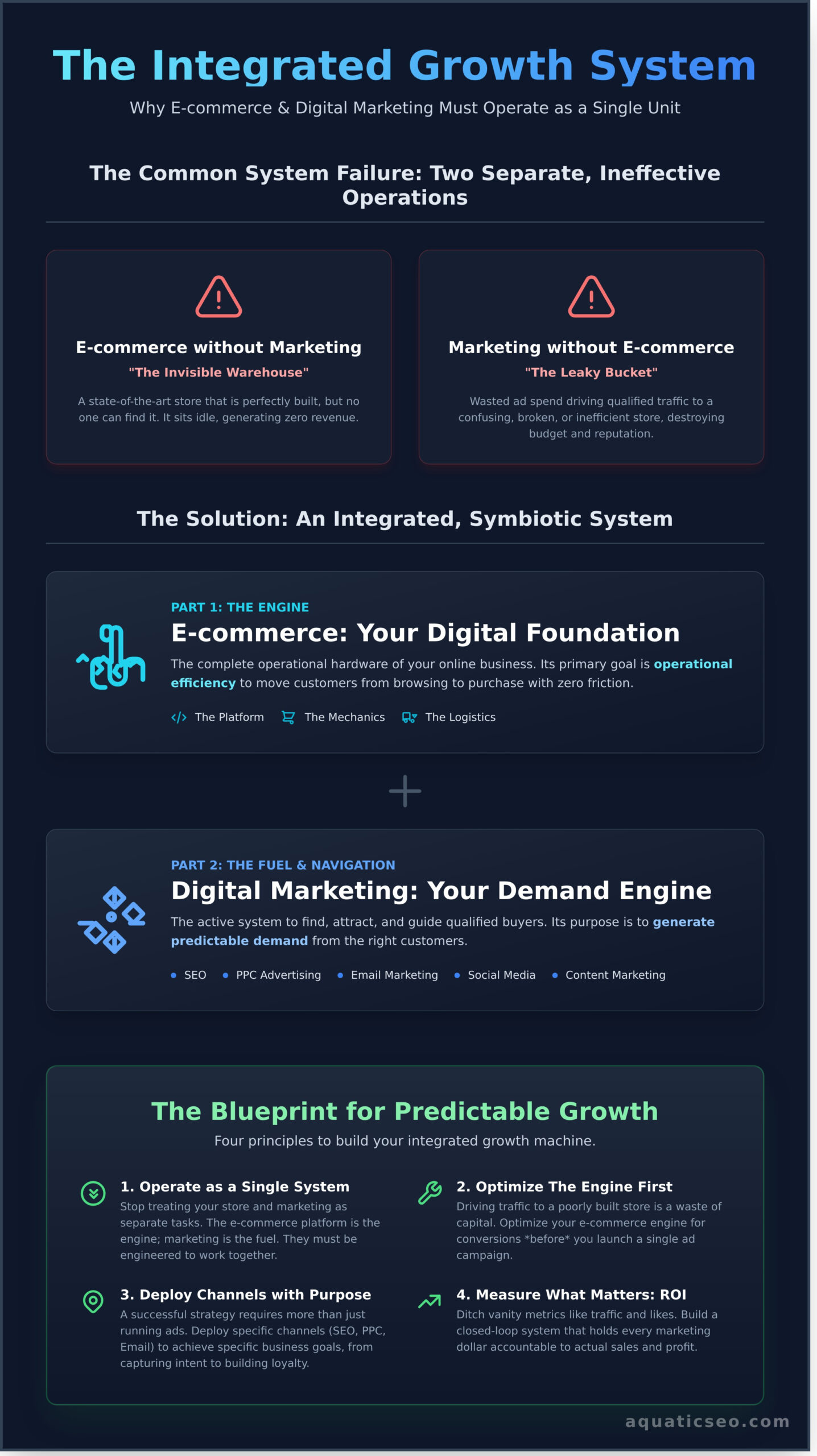
- Stop treating your store and marketing as separate tasks. Learn to operate them as a single system where your e-commerce platform is the engine and your marketing is the fuel.
- Driving traffic to a poorly built store is a waste of capital. Discover how to optimize your e-commerce engine for conversions before you launch a single ad campaign.
- A successful strategy for e commerce and digital marketing requires more than just running ads. Learn to deploy specific channels to achieve specific business goals, from capturing intent to building loyalty.
- Ditch vanity metrics like traffic and social media likes for good. We show you how to build a closed-loop system that holds every marketing dollar accountable to actual sales and profit.
The Symbiotic System: Why You Can’t Have One Without the Other
In the marine industry, success is built on reliable systems. Your approach to online sales should be no different. Too many businesses treat their website and their marketing as separate, unrelated tasks. This is a critical operational error. A functional online sales operation requires a fused, symbiotic system of e commerce and digital marketing. One part is the engine; the other is the fuel and navigation. Without both working in perfect concert, you’re dead in the water.
The core problem is simple: a state-of-the-art e-commerce store with zero marketing is an invisible warehouse. It may be perfectly built, but no one will ever find it. Conversely, best-in-class marketing that drives customers to a broken, confusing, or inefficient online store is like burning cash for fuel only to steer your boat into the rocks. You waste money and destroy your reputation. The only solution is an integrated approach-a true Sales Control System.
E-commerce: Your Digital Foundation
Think of e-commerce as the complete operational hardware of your online business. It is the vessel itself. This foundation is not just a website; it’s the entire transactional process designed to move a customer from browsing to a completed purchase with zero friction.
- The Platform: Your website or online storefront.
- The Mechanics: The shopping cart, inventory management, and payment gateway.
- The Logistics: Order processing, shipping, and fulfillment integration.
The primary goal here is operational efficiency. A customer must be able to find a part, add it to their cart, and pay for it seamlessly. Anything less is a leak in your hull.
Digital Marketing: Your Demand Engine
If e-commerce is the boat, digital marketing is your GPS, fish finder, and throttle. It’s the active system you use to find, attract, and guide qualified buyers to your digital foundation. This discipline covers all online promotional activities. The field of Digital marketing is broad, but its purpose is singular: to generate predictable demand from the right customers.
- Search Engine Optimization (SEO)
- Pay-Per-Click (PPC) Advertising
- Email Marketing
- Social Media Marketing
- Content Marketing
The objective is not just “more traffic”-it’s driving qualified inquiries from buyers who need what you sell. Anything else is just noise.
How They Work Together: A Simple Analogy
Imagine your e-commerce site is a custom-built, high-performance offshore fishing boat-perfectly designed and equipped to handle a massive haul. But it’s sitting in the marina with no fuel, no GPS coordinates, and no intel on where the fish are biting. That boat is useless.
Now, imagine you have the best fishing charts, a full tank of fuel, and a state-of-the-art fish finder (your digital marketing). But your boat is a leaky dinghy with a broken motor (a poor e-commerce experience). You can find the fish, but you have no effective way to catch them.
You need both the high-performance vessel and the systems to navigate it to the right fishing grounds. That is the essential relationship between e commerce and digital marketing.
Step 1: Building an E-commerce Engine That Converts
Before you spend a single dollar driving traffic, your online store must function as a high-performance sales engine. Many marine businesses mistake a visually appealing website for a functional one. This is a critical error. Your focus must be on operational efficiency and a user experience (UX) engineered to convert visitors into paying customers. Forget the fluff; this is about building a system that predictably generates revenue.
A well-built store is the foundation of any successful e commerce and digital marketing campaign. Without it, you are pouring marketing dollars into a leaky bucket, attracting visitors who never complete a purchase.
Choosing the Right Platform
Your e-commerce platform is the chassis of your sales engine. The ‘best’ choice depends entirely on your operational needs, technical skill, and growth targets. For most marine businesses, the decision comes down to three primary options: Shopify for its unmatched ease of use, BigCommerce for its built-in features and scalability with large inventories, and WooCommerce for its total customization and control within a WordPress environment. Evaluate each based on its ability to integrate with your existing inventory and shipping systems.
Optimizing Product Pages for Sales
Product pages are where browsers become buyers. Each page must be a self-contained sales tool designed to eliminate doubt and drive action. This is not negotiable.
- High-Quality Visuals: Clear, high-resolution images from multiple angles and short demonstration videos are mandatory. Customers cannot touch the product, so you must provide absolute visual clarity.
- Benefit-Driven Descriptions: Don’t just list specs. Explain how that specific part or product solves a problem, improves performance, or makes a boater’s life easier.
- Upfront Information: Display clear pricing, shipping costs, and stock availability. Hidden fees are the fastest way to lose a sale. Your call-to-action (CTA) like “Add to Cart” must be prominent.
- Social Proof: Feature authentic customer reviews and ratings. This builds immediate trust and validates the purchase decision for new buyers.
Streamlining the Checkout Process
Cart abandonment is a symptom of a broken system. Customers leave for two main reasons: unexpected costs (like shipping) and unnecessary friction (like forced account creation or a confusing form). Your checkout must be simple, secure, and fast. Once this frictionless system is in place, you can confidently fuel it with traffic. While a comprehensive E-commerce marketing guide details how to attract qualified buyers, those strategies fail if your checkout process repels them. Prioritize a mobile-friendly, multi-step checkout and offer multiple payment options, including PayPal and all major credit cards, to maximize control over the final sale. To explore professional merchant services that can streamline this process, <visit Merchant Solutions Corp>(https://merchantsolutionscorp.com).
Step 2: Fueling the Engine with a Digital Marketing Toolkit
Once your e-commerce platform is built, it’s an engine without fuel. Driving qualified traffic-the kind that converts into profitable sales-requires a systematic approach. The common mistake is trying to be everywhere at once, wasting budget on channels that produce vanity metrics instead of revenue. A winning strategy for e commerce and digital marketing isn’t about using every tool; it’s about selecting the right tools for specific jobs and executing them with precision.
The goal is simple: engineer a system that consistently attracts, converts, and retains high-value customers. Each channel must have a clear purpose tied directly to a business outcome.
Search Engine Optimization (SEO): Capturing Active Buyers
SEO is your foundation for capturing customers with active purchase intent. When a boat owner searches for a “Yamaha F150 water pump kit,” you need to be the top result. This starts with relentless optimization of your product and category pages around the exact keywords your customers use. Technical factors like site speed and mobile-friendliness are not optional-they are critical operational requirements that directly impact sales and search rankings.
Pay-Per-Click (PPC) Advertising: Immediate, Targeted Traffic
While SEO builds long-term authority, PPC delivers immediate control and visibility. Google Shopping ads are non-negotiable, placing your products directly in front of buyers at the moment of decision. We then use retargeting ads to systematically bring back users who abandoned their carts, recovering otherwise lost revenue. This isn’t about just spending money; it’s about deploying a budget with strict ROI controls to ensure every dollar generates a profitable return.
Email Marketing: Your Most Profitable Channel
Your email list is your most stable and valuable marketing asset-one you own and control, immune to algorithm changes on social media or search engines. Building this list with strategic pop-ups and incentives is the first step. The real power comes from automated campaigns that work 24/7:
- Welcome Series: Nurture new subscribers toward their first purchase.
- Abandoned Cart Reminders: Recapture high-intent buyers.
- Post-Purchase Follow-ups: Drive repeat business and gather reviews.
Content & Social Media Marketing: Building a Brand and Audience
Content and social media are not about getting likes; they are about attracting top-of-funnel customers and establishing your authority. A blog post on “How to Winterize Your Outboard Motor” can attract potential buyers months before they need parts. The key is choosing social platforms where your customers-marina managers, boat captains, and serious hobbyists-actually spend their time. Every post and article must have one objective: drive qualified traffic back to your website to make a purchase.
Step 3: Measuring What Matters – Connecting Marketing to Revenue
A functional e-commerce site is only half the battle. The real work is turning digital activity into predictable revenue. Most agencies celebrate vanity metrics like traffic, clicks, and social media likes. We see these as operational distractions, a view shared by comprehensive digital marketing agencies like Five Channels. True control comes from measuring what actually impacts your bottom line: sales, margins, and profit. This requires a closed-loop system where every marketing dollar is accountable, allowing you to make data-driven decisions instead of expensive guesses.
Key Performance Indicators (KPIs) for E-commerce Growth
To gain control, you must track the right numbers. Forget vague reports and focus on these core operational metrics. Tools like Google Analytics, when configured for e-commerce, make this straightforward. Your focus should be on:
- Conversion Rate: The percentage of website visitors who complete a purchase. A low rate means you’re attracting the wrong audience or your site is failing to convert them.
- Average Order Value (AOV): The average dollar amount spent each time a customer places an order. Increasing AOV is a direct path to higher profitability without needing more traffic.
- Customer Acquisition Cost (CAC): The total cost of sales and marketing to acquire a single new customer. If this number is too high, your business is not sustainable.
- Customer Lifetime Value (LTV): The total revenue you can expect from a single customer account. The goal is simple: LTV must be significantly higher than CAC.
Attribution: Knowing Which Channels Drive Sales
Customers don’t just appear and buy. They might see a Facebook ad, search for a part on Google days later, and finally purchase after clicking a link in your email newsletter. This is the customer journey. Understanding which touchpoints contribute to a sale is called attribution. Using UTM parameters in your links allows you to precisely track campaign performance in Google Analytics, showing you exactly which of your e commerce and digital marketing efforts are driving real revenue.
Building a Simple Performance Dashboard
This isn’t about complex spreadsheets; it’s about clarity and action. On a weekly basis, track your core KPIs. The most critical calculation is the CAC to LTV ratio for each marketing channel (e.g., Google Ads, SEO, Email). This reveals which channels deliver profitable customers and which are just costing you money. The strategy is relentless: identify what works and double down. Cut the channels that don’t produce a return. This systematic process is how you gain stability and dominate your market.
Tired of guessing? Let us build your Marine Demand Control System.
From Engine and Fuel to a High-Performance Sales System
Your e-commerce platform is the engine, but it goes nowhere without the right fuel from digital marketing. The key is to stop treating them as separate tasks. A high-converting website paired with a strategic marketing toolkit is essential. Ultimately, success in e commerce and digital marketing isn’t about vanity metrics; it’s about a symbiotic system where every action is measured against real revenue and operational stability.
For marine businesses, this means moving beyond generic marketing campaigns. It requires a system built for control-one that delivers qualified inquiries, protects your margins, and creates predictable growth. We don’t build marketing campaigns; we build Demand Control Systems. Our specialized expertise in the marine industry ensures we re-engineer your entire sales machine for your specific market, focusing on higher margins, not just more traffic.
If you’re ready to stop guessing and start building a predictable sales pipeline, it’s time for a new approach. Book a No-BS Analysis to See How We Build E-commerce Systems for Marine Businesses. Take control of your growth today.
Frequently Asked Questions
What’s the first thing I should focus on: my e-commerce site or my digital marketing?
This is the wrong question. They are not separate tasks; they are two parts of the same sales system. A high-performance website without targeted traffic is a useless showroom. A digital marketing campaign sending qualified buyers to a broken or confusing site is a complete waste of capital. A successful marine e-commerce strategy requires building both components simultaneously to create a seamless, efficient path from search to sale, giving you control over your revenue.
How much should I budget for digital marketing for a new e-commerce store?
For a new marine parts store, a realistic starting point is 10-15% of your target revenue. Anything less makes it difficult to gain traction against established competitors. For example, if your goal is $30,000 in monthly sales, a budget of $3,000-$4,500 for a mix of paid ads and SEO provides the necessary fuel to capture market share. This isn’t an expense; it’s a direct investment in a stable system for e commerce and digital marketing.
Is SEO or paid advertising better for e-commerce?
Neither is “better”-they serve different operational goals. Paid advertising (PPC) delivers immediate, qualified traffic and sales data, which is critical for launching and testing product demand. SEO is the long-term asset that builds sustainable, high-margin revenue and reduces your reliance on ad spend over time. An effective system uses PPC to capture immediate demand while SEO builds a dominant market position for predictable, long-term growth and stability.
Do I need to be on every social media platform to succeed in e-commerce?
Absolutely not. Chasing every platform is a recipe for wasted resources and zero ROI. Your focus must be on dominating the channels where high-value marine customers actually search for and purchase parts-primarily search engines like Google. A targeted presence on a specialized boating forum or a relevant Facebook Group is far more valuable than posting content into the void on five different apps. Focus on qualified engagement, not vanity traffic.
How long does it take to see results from digital marketing for my online store?
Results have different timelines based on the channel. You will see measurable data and traffic from paid advertising campaigns within days or weeks, providing immediate feedback. SEO is an investment in your business’s core stability and market position. You should expect to see meaningful increases in qualified organic traffic and search rankings within 4-6 months. Anyone promising instant SEO domination is selling a fantasy, not a system for predictable growth.
What is the difference between e-commerce marketing and digital marketing?
Digital marketing is the broad set of tools used to reach customers online-like SEO, PPC ads, and email. E-commerce marketing is the specific application of those tools with one single objective: driving profitable sales through your online store. The critical difference is the metric for success. It’s not about getting more clicks or “likes.” It is about systematically converting qualified traffic into predictable online orders that improve your margins and operational stability.