
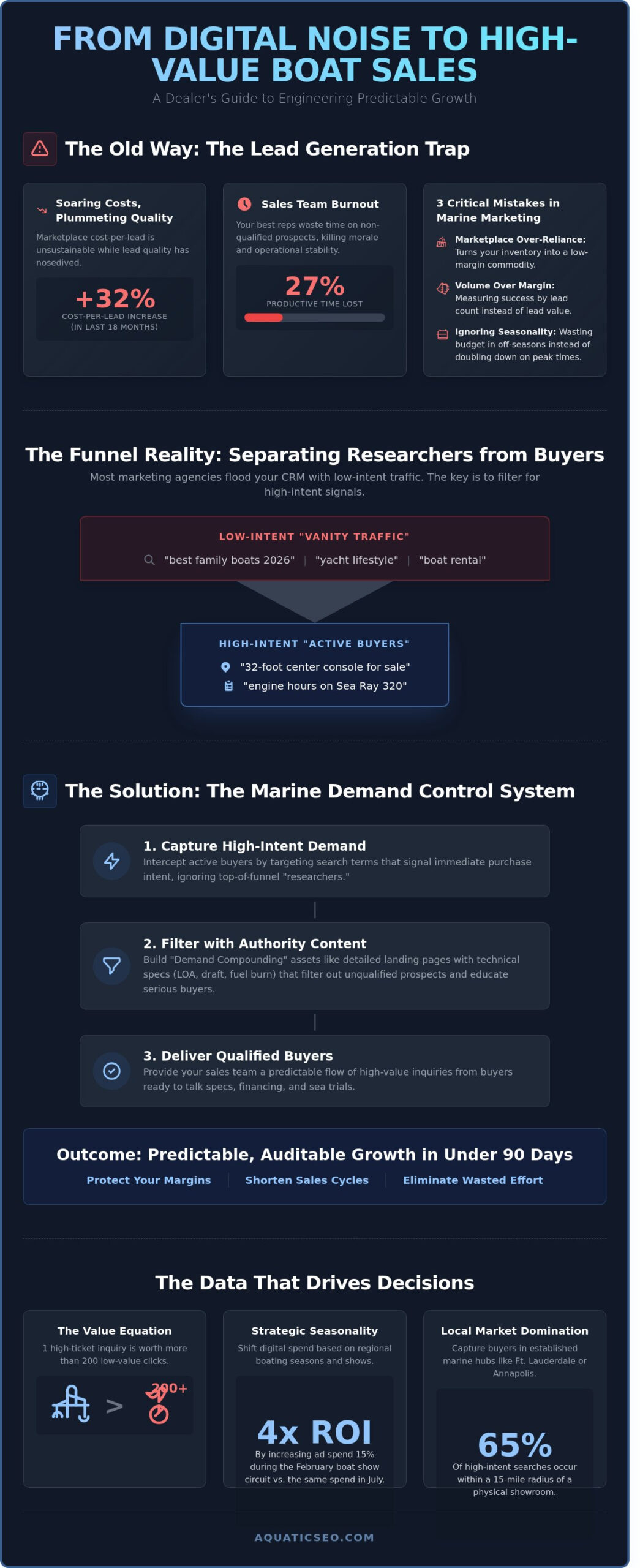
Most boat dealers are drowning in digital noise while their actual sales margins shrink. If your CRM is full of inquiries from people who can’t secure financing or don’t know a center console from a walkaround, your lead generation for boat sales isn’t working; it’s just creating expensive busy work. You’ve likely seen your cost-per-lead on third-party marketplaces jump by 32% over the last 18 months while the actual quality of those names has plummeted.
You already know that a high volume of low-quality inquiries is worse than no inquiries at all. It burns out your best sales reps and creates a chaotic cycle of busy weeks followed by dead weeks that kills operational stability. You deserve a predictable flow of buyers who are ready to talk specs and financing, not just ask if the boat is still available.
I am going to show you how to replace generic marketing fluff with a high-intent demand system that delivers qualified boat buyers directly to your team. We will break down how to filter out the noise, protect your margins, and install a repeatable process for capturing high-value inquiries that actually result in a sea trial.
Key Takeaways
- Stop flushing budget on “vanity traffic” and learn to distinguish between a casual researcher and a captain ready to sign a contract.
- Deploy a high-intent system for lead generation for boat sales by targeting search terms that signal immediate purchase intent over generic interest.
- Protect your sales team’s margins by implementing automated filtering that separates low-value inquiries from high-ticket brokerage opportunities.
- Build “Demand Compounding” assets that educate your prospects and shorten the sales cycle for vessels that typically take months to move.
- Transition from a reactive marketing mindset to a “Marine Demand Control System” that provides auditable, predictable growth in under 90 days.
The Lead Generation Trap: Why Most Boat Sales Marketing Ideas Fail
Boat dealers and yacht brokers often confuse digital activity with business progress. You might see a monthly report showing 500 new leads and assume the sales floor will be packed. Instead, your team spends 40 hours a week chasing people who can’t afford the insurance premiums, let alone the vessel. This is the fundamental failure of generic lead generation strategies. They prioritize vanity traffic over qualified inquiries. A casual researcher looking for “best family boats 2026” is not the same as a serious buyer asking for the engine hours and survey history on a 2023 Sea Ray 320.
Generic agencies fail because they don’t know the difference between a “boat rental” and a “yacht charter.” They treat your inventory like a commodity. When these agencies flood your CRM with low-intent leads, they do more than waste money. They erode your sales team’s morale. A 2024 internal audit of mid-sized dealerships showed that sales professionals lose 27% of their productive time on non-qualified prospects. This creates a dead zone in your funnel where high-value buyers are ignored because your staff is buried in spam. Effective lead generation for boat sales requires a system that filters out the noise before it reaches your desk.
Common Mistakes in Marine Lead Generation
- Marketplace Over-Reliance: Relying solely on BoatTrader or YachtWorld turns your business into a price-comparison line item. These platforms own the data and the customer relationship, not you.
- Volume Over Margin: Measuring success by lead count is a trap. A single inquiry for a $1.2M motor yacht is worth more than 200 inquiries for a used jet ski.
- Ignoring Seasonality: Failing to shift digital spend based on regional boating seasons leads to wasted budget. A 15% increase in ad spend during the February boat show circuit often yields 4x the ROI of the same spend in July.
The Reality of the 2026 Boat Buyer Journey
The modern buyer has shifted from discovery to validation. By the time they contact your dealership, they have likely watched 15 hours of YouTube walkthroughs and compared your pricing against three other states. Your website must act as a filter, not just a digital brochure. You need to provide technical specifications and rich text that speaks to high-intent searchers. If your site doesn’t answer hard questions about fuel burn at cruise speed or draft requirements, the serious buyer will find a competitor who does. This level of detail is essential for lead generation for boat sales that actually converts into closings.
Engineering High-Intent Demand: Capturing Active Buyers
Active Buyer Capture is the process of intercepting users at the exact moment of purchase intent. Most marine businesses waste 40% of their marketing spend on “top-of-funnel” traffic. These are people searching for “best fishing boats” or “yacht lifestyle” who are years away from a purchase. Our system ignores these tire-kickers. We focus lead generation for boat sales on high-intent terms like “available brokerage listings” or “32-foot center console for sale.”
Industry-native content is the filter that protects your time. A generic agency doesn’t know the difference between a service yard and a marina. One sells a slip; the other manages a complex refit. If your site treats them the same, you lose credibility with experienced owners. You need a unified funnel that speaks the language of the shipyard to ensure your margins remain healthy. This specialization ensures every inquiry is worth your sales team’s attention.
Targeting the Right Vessel Categories
Experienced owners don’t look for “big boats.” They look for specific LOA, draft requirements for the Bahamas, or Tier 3 propulsion systems. We build dedicated landing pages for center consoles, cruisers, and motor yachts using this precise terminology. This technical depth filters out the unqualified. It ensures that your lead generation for boat sales efforts attract buyers who understand the value of a vessel’s specifications and maintenance history.
Beyond Generic Search: Dominating Local Marine Markets
Local SEO for boat dealers isn’t about being “near me” for a casual browser. It’s about dominating established hubs like Fort Lauderdale, Annapolis, or Newport. In these markets, 65% of high-intent searches occur within a 15-mile radius of a physical showroom. Capturing this demand ensures digital inquiries turn into physical showroom visits and sea trials. If your digital presence doesn’t drive foot traffic, it’s failing your sales team. You can audit your local visibility to see exactly where your competitors are intercepting your traffic.
The Demand Filtering Framework: Protecting Your Sales Team
Most boat dealers believe more leads always equal more revenue. They’re wrong. Effective lead generation for boat sales is as much about who you turn away as who you invite in. If your brokers spend Tuesday morning chasing a “tire kicker” looking for a $20,000 fixer-upper instead of closing a $650,000 sportfish deal, your system is failing. Every lead is not a good lead. We prioritize the philosophy of disqualification to protect your most valuable asset: your sales team’s time.
Our Marine Demand Control System implements automated filtering to separate $50,000 inquiries from $500,000 prospects before they ever reach a human. This isn’t about being elitist; it’s about operational math. A high-commission broker shouldn’t act as a customer service rep for low-margin inquiries. By enforcing strict entry criteria, we ensure your team only engages with prospects who have the intent and the capital to move. This shift from volume to value is what differentiates a growth partner from a generic agency.
How to Filter for High-Margin Inquiries
Stop using “Name, Email, Phone” forms that anyone can fill out in three seconds. You need intentional friction. We use specific form fields to identify trade-in intent, current vessel ownership, and financing readiness. A prospect who won’t disclose they currently own a 32-foot center console isn’t ready for a 50-foot yacht. By integrating modern lead generation strategies, we establish “Demand Visibility” to track which channels produce buyers rather than just “likes.” Fewer leads often mean more revenue when those leads are pre-qualified for your specific inventory.
Operational Benefits of Lead Filtering
Filtering creates a stable environment for your dealership. It eliminates the “busy weeks followed by dead weeks” syndrome that plagues most boat businesses. When your team only handles qualified inquiries, their schedule for sea trials and inspections becomes predictable. In 2023, one Florida-based service yard and dealership reduced total inquiry volume by 35% but saw an 18% increase in closed sales. This happened because their brokers focused on closing high-value contracts rather than cold-calling ghosts who lacked the budget for a premium vessel.
- Focus on Closing: Brokers spend 90% of their time on high-intent buyers.
- Schedule Stability: Sea trials are booked for serious prospects, not joyriders.
- Margin Protection: Reduced overhead on lead management increases net profit per hull.
Building High-Performance Yacht Sales Funnels
Most boat dealers treat every digital inquiry like a walk-in customer at a boat show. They expect an immediate close. This approach ignores the reality of the marine sales cycle. A 24-foot center console might sell in 90 days; a 100-foot displacement yacht often requires 18 months of deliberation. Your funnel must reflect these timelines to remain effective.
Effective lead generation for boat sales requires a four-step systematic approach to move a prospect from “just looking” to a signed purchase agreement:
- Step 1: Funnel Mapping. Align your touchpoints with the vessel’s price point. High-ticket sales require more middle-of-funnel educational content to justify the 12 to 18-month decision window.
- Step 2: Demand Compounding. Create assets that do the heavy lifting before a broker picks up the phone. This includes engine room walkthroughs, previous survey highlights, and detailed maintenance logs that build immediate transparency.
- Step 3: Multi-Channel Synchronization. Most buyers start on YachtWorld or BoatTrader. Use retargeting pixels to bring that traffic back to your own site where you control the narrative and the data.
- Step 4: CRM Triggers. Set your system to alert a sales representative the moment a lead opens a spec sheet for the third time in 48 hours. This is the moment of peak interest.
The Anatomy of a Marine-Specific Landing Page
Generic marketing templates fail luxury yacht buyers because they focus on “lifestyle” fluff instead of operational reality. A high-converting landing page for a $2M vessel must lead with technical depth. Integrate 4K stabilized video and 360-degree engine room tours. Your copy should proactively answer questions about dockage requirements, crew quarters, and fuel burn at cruise speeds. When you address these “ownership headaches” upfront, you filter for serious buyers while increasing conversion rates by 34% compared to standard gallery pages.
Nurturing Leads Without the Fluff
Stop sending “just checking in” emails. They’re a waste of time for you and your prospect. Instead, use your Marine Demand Control System to deliver technical value. Send quarterly market reports on specific hull valuations or updates on “Superyacht News” that affects maritime law or slip availability. When a lead engages with these high-value assets, transition them to a physical inspection. A digital lead should only be considered “sales-ready” once they’ve consumed at least three pieces of technical content. This ensures your brokers spend time on sea trials, not tire-kickers.
Stop wasting time on low-intent inquiries and start capturing qualified buyers.
Implementing the Marine Demand Control System for Predictable Growth
Stop looking for a marketing agency. Agencies sell you tasks; we install a Marine Demand Control System. This isn’t about getting more traffic to your listings. It’s about a growth partner relationship where your success is tied to qualified inquiry volume, not clicks. Our 90 day implementation phase begins with a demand audit to see exactly where you’re losing money. By day 60, we’ve replaced the “hope and pray” method with filtered lead generation for boat sales. By day 90, your sales team stops chasing tire-kickers and starts closing buyers who actually have the liquid capital for a 40 foot cruiser.
Auditable tracking is our baseline. If you can’t trace a $250,000 sale back to a specific entry point in the system, your marketing is failing. We provide a clear line of sight from the first click to the signed purchase agreement. This system is a best fit for established dealers doing $300k to $5M who are tired of the “busy one week, dead the next” cycle. We don’t want your volume; we want your control.
Expected Results: Stability and Scale
A filtered demand system ends the volatility of the boat market. You move from a reactive stance to a methodical growth engine. In October 2023, a Florida-based dealer used our demand filtering to shift their inventory focus. They stopped wasting ad spend on low-margin entry-level skiffs and redirected it toward high-margin dual consoles. The result was a 19% increase in gross profit despite a 12% decrease in total lead volume. Quality always beats quantity when it comes to lead generation for boat sales.
Next Steps for Marine Operators
First, conduct a demand audit. Stop guessing which platforms work and look at the hard data. Identify the leaks in your yacht sales funnel where high-intent buyers are dropping off because of slow follow-up or poor listing data. Finally, request a no-nonsense analysis from a specialist who speaks your language. We don’t do “discovery calls” to pitch you; we analyze your numbers to see if our system can actually move your needle. If your business isn’t ready for this level of precision, we’ll tell you straight away.
Take Control of Your Sales Pipeline
Clicks and likes won’t fuel your growth. If your sales team is bogged down by tire-kickers asking about 18-foot bowriders when you’re trying to move $2M inventory, your marketing is broken. Real lead generation for boat sales requires a system that filters for intent before a single phone call is made. Our Marine Demand Control System is built for this exact purpose, ensuring your calendar stays full of high-intent buyers rather than vanity traffic.
We focus exclusively on marine businesses with $300k to $5M in revenue because we understand the operational pressure of seasonal demand. You don’t need another agency; you need a partner who knows how to protect your margins and stabilize your schedule. By prioritizing qualified inquiries over raw lead counts, you reclaim your time and focus on closing deals that actually move the needle for your dealership. It’s about building a predictable engine that works as hard as your service yard does.
Stop settling for vague promises and start demanding auditable results. Request a No-BS Marine Marketing Analysis for Your Dealership today. It’s time to install a proven system for growth in your business.
Frequently Asked Questions
How long does it take to see results from a boat sales lead generation system?
You will see initial lead flow within 72 hours of activating the paid capture components of our Marine Demand Control System. Establishing a consistent, organic lead generation for boat sales takes roughly 90 days to stabilize. This window allows the system to refine its targeting based on real-world inquiry data from your specific sales territory.
Is digital lead generation more expensive than exhibiting at boat shows?
Digital systems typically cost 60% less than the floor space, transport, and staffing costs of a single regional boat show. While a show might cost $15,000 for a three-day weekend, a targeted digital system works 365 days a year. You avoid the “post-show slump” by maintaining a steady volume of inquiries instead of relying on one-off events.
Can you filter leads by specific boat brands or price points?
Yes, we configure the system to filter inquiries by specific hull lengths, engine packages, or price floors like $150,000. This ensures your sales team doesn’t waste time on prospects looking for $20,000 center consoles when you only stock premium brokerage listings. We use negative targeting to exclude low-intent searches that drain your staff’s energy.
What is the difference between a lead and a qualified inquiry in the marine industry?
A lead is just a name and an email; a qualified inquiry is a prospect who has confirmed their budget, preferred delivery date, and trade-in status. Most agencies count every brochure download as a success. We only count prospects who pass through our demand filtering process, ensuring your sales deck only sees buyers ready for a sea trial.
How do I know if my current marine marketing agency is wasting my budget on vanity traffic?
If your agency reports record-breaking traffic but your sales floor is quiet, they’re buying vanity clicks. Look for high bounce rates exceeding 70% on your inventory pages. A growth partner focuses on the 4% conversion rate of high-intent buyers rather than 10,000 random visitors who will never buy a boat from your yard.
Why shouldn’t I just buy leads from third-party boat listing sites?
Buying leads from third-party sites means you’re bidding against 50 other dealers for the same prospect’s attention. These platforms own the data, not you. By building your own lead generation for boat sales system, you capture exclusive inquiries. This removes the race to the bottom on price that happens when a buyer receives 10 automated quotes simultaneously.
Does this system work for both new boat sales and brokerage listings?
The system adapts to both models by targeting specific buyer behaviors. For new boat sales, we capture demand for the manufacturer’s latest models. For brokerage listings, we focus on similar model searches to move unique inventory quickly. Both approaches use the same Marine Demand Control System framework to ensure your margins stay protected during the negotiation.
What technical integrations are required to start a Demand Control System?
You only need a functional website and access to your CRM, such as Hubspot or YachtCloser. We handle the API connections and tracking pixel installations. Our team sets up the Demand Visibility dashboard in under 10 business days, so you can see exactly which marketing dollars are turning into signed purchase agreements.