Most marine business owners are drowning in 50-dollar inquiries while their high-margin service bays sit empty three weeks out of the month. You don’t need more leads. You need a filter that prioritizes the $15,000 refit over the $100 impeller change. If your current agency thinks a boat rental and a yacht charter are the same thing, you’re already losing territory to competitors who understand the distinction. Dominating local SEO for marine businesses in 2026 isn’t about being seen by everyone. It’s about being the only logical choice for the 15% of your market that actually drives your year-end profit.
You know that a packed schedule doesn’t always mean a profitable month, especially when low-value jobs create operational bottlenecks. It’s frustrating to watch your revenue grow while your actual margins and schedule stability get worse.
This guide will show you how to calibrate your local search presence to capture high-margin marine contracts and stop wasting time on inquiries that don’t move the needle. We’ll break down the specific mechanics of our Marine Demand Control System, from Map Pack dominance for high-intent keywords to the filtering strategies that protect your margins.
Key Takeaways
- Stop chasing vanity traffic and learn to filter search visibility to capture high-margin engine repowers and refits instead of low-value inquiries.
- Discover how to connect your service yard to specific vessel brands to dominate AI-driven search snapshots and local entity rankings.
- Calibrate your local SEO for marine businesses by replacing broad terms with high-intent keywords that attract yacht owners rather than budget-conscious DIYers.
- Identify the technical data failures and inconsistent profiles that are currently leaking your most profitable local leads to your direct competitors.
- Shift your focus from “ranking #1” to a Demand Visibility framework that keeps your bays full of the right work throughout the entire year.
The Local Search Trap: Why Visibility Without Filtering Kills Marine Margins
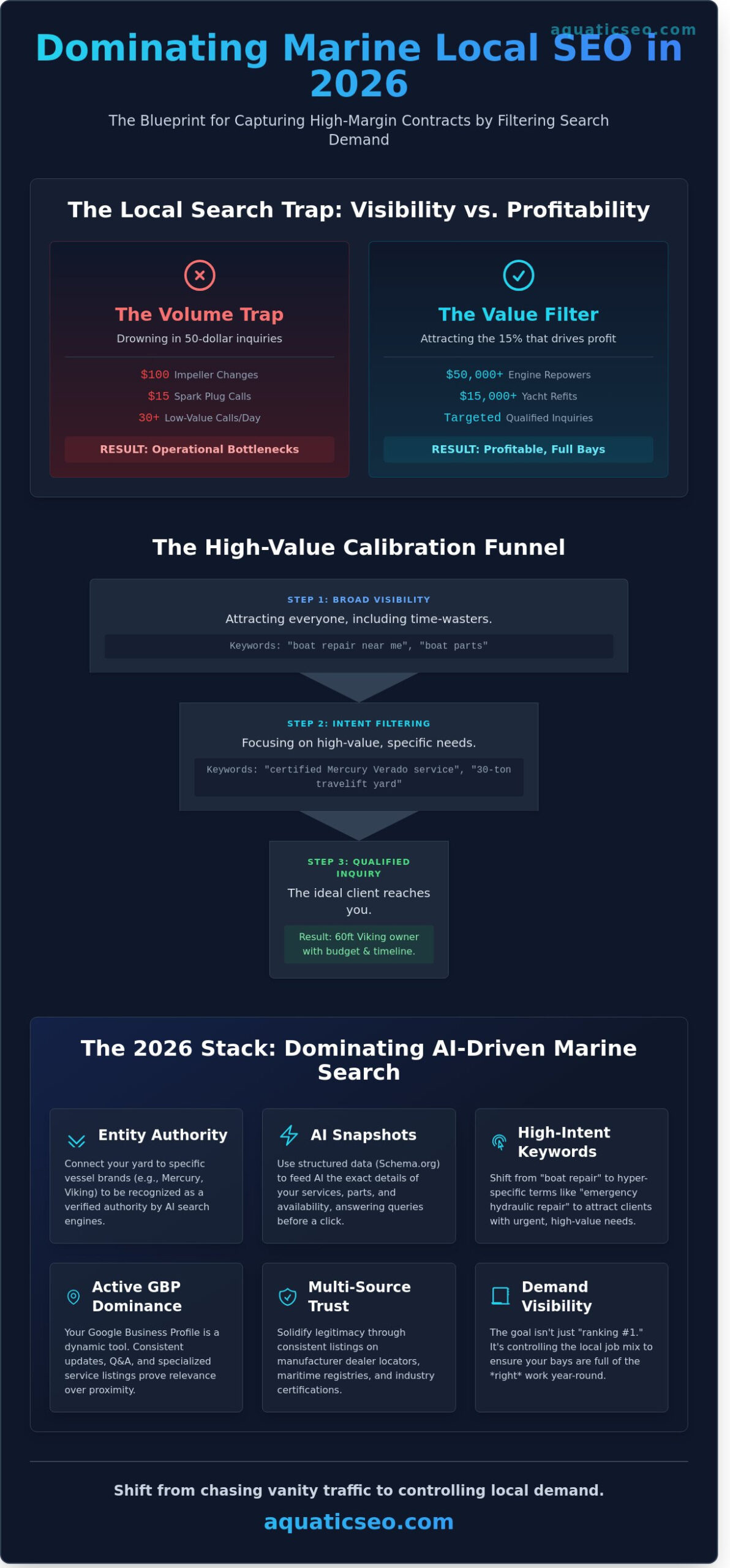
Most marine operators are obsessed with being seen, but visibility is a trap if it doesn’t lead to high-margin work. Local search engine optimization (local SEO) for marine businesses isn’t about being found by everyone with a smartphone. It’s the strategic enforcement of your digital territory to capture high-intent buyers while filtering out the window shoppers who drain your time. If you specialize in $50,000 engine repowers, ranking #1 for “boat parts” is a liability. You’ll spend your day answering calls about $15 spark plugs while your billable technicians sit idle on high-value projects.
The 2026 search reality has moved past simple keyword matching. Google now prioritizes “entity authority,” which means the algorithm evaluates your business as a real-world service provider with specific capabilities. Generalist agencies fail marine contractors because they ignore these nuances. They don’t understand that a service yard in the Great Lakes needs a completely different demand profile in October than a yacht charter in Fort Lauderdale. Without industry-specific local SEO for marine businesses, you’re just paying for vanity traffic that doesn’t move the needle on your bottom line.
The Difference Between a Lead and a Qualified Inquiry
A lead is just a name and a phone number, often from someone who can’t afford your dockage rates. A qualified inquiry is a 60-foot Viking owner looking for a stabilizer installation with a confirmed budget and an immediate timeline. High-value clients have stopped using broad terms. They now search for specific technical capabilities, such as a “30-ton travelift service yard near me” or “certified Mercury Verado 400hp service.”
When your local strategy is too broad, it leads to operational burnout. Small crews can’t handle 30 low-value inquiries a day and still maintain a high standard of work on the hard. You need a system that acts as a filter, ensuring only the prospects who fit your vessel type and budget reach your desk. This shift from volume to qualification is what separates profitable yards from those just spinning their props.
Why Your Current Google Business Profile is Likely Underperforming
The “set it and forget it” approach to your Google Business Profile is a relic of 2018. In 2026, static profiles lose to active operators who prove their relevance daily. Proximity used to be the primary ranking factor, but relevance now takes the lead in competitive hubs like Newport or San Diego. If a competitor is two miles further away but shows consistent proof of specialized service through updates and specific reviews, they’ll steal your local traffic.
Most profiles are underperforming because they don’t reflect the actual capacity of the business. They use generic categories like “boat repair” instead of claiming the specific authority required to dominate a territory. Local Marine SEO is a system for controlling local demand flow. It ensures that when a high-value boat owner enters your territory, your business is the only logical choice for their specific needs.
The 2026 Local SEO Stack: Dominating AI-Driven Marine Search
By 2026, local SEO for marine businesses has evolved beyond the traditional Map Pack. Google now uses AI-augmented snapshots to answer high-intent queries before a user even visits a website. If a captain at a marina searches for “emergency hydraulic repair,” the search engine doesn’t just list addresses. It aggregates data to prove your yard has the specific parts and technicians available right now. This shift means your digital presence must act as a structured data source, not just a digital brochure.
Google treats your business as a “Local Entity” connected to specific vessel brands and maritime services. If your yard is an authorized Mercury Marine dealer, that connection must be hard-coded into your digital footprint. AI search engines verify marine business legitimacy by cross-referencing your business entity across manufacturer dealer locators, regional maritime registries, and industry-specific certifications. This multi-source matching is how the system filters out low-quality leads and prioritizes established operators.
Structured data (Schema.org) is the primary language for this new era. It allows you to communicate service availability and specific capabilities directly to search crawlers. This is vital for “Zero-Click” optimization. Mobile users on the dock often need a phone number, a service bay opening, or a fuel price without clicking through to a landing page. According to recreational boating industry statistics, the sheer volume of recreational vessels requires a more precise way to match service supply with owner demand. We use this data to ensure your business is the definitive answer for local search queries.
Google Business Profile (GBP) Optimization for High-Intent Capture
Your GBP is no longer just about NAP (Name, Address, Phone). It’s a tool to define your ideal job mix. Use the “Products” and “Services” tabs to list high-margin work like “Yacht Stabilizer Install” or “IPS Drive Service” rather than generic “boat repair.” The 2026 review strategy demands specificity. A review saying “great service” is weak. A review stating “the best yacht refit in Palm Beach for my 60-foot Viking” is gold because it contains the entity markers AI models crave. Use real-time GBP updates to signal seasonal capacity, such as winterization slots or spring commissioning availability, to keep your Marine Demand Control System operating at peak efficiency.
Local Entity Authority: Connecting Your Business to the Waterfront
General directories like Yelp are secondary to marine-specific authority. To dominate local SEO for marine businesses, you need citations from industry-native platforms like Marinas.com, BoatUS, or local trade associations. A backlink from a regional yacht club or a local fishing tournament carries more weight than dozens of generic links. These “waterfront” signals prove to search engines that you are an active participant in the local maritime economy. We focus on building these specific connections to ensure your business is recognized as the dominant authority in your specific territory.
The High-Value Calibration: A Step-by-Step Guide to Local Marine Dominance
Most service yards lose 40% of their potential high-ticket repairs because their digital footprint is a sieve. If you aren’t visible when a captain searches for a technical fix near their specific slip, you don’t exist. Effective local SEO for marine businesses requires a shift from generic visibility to operational demand control. You must audit where you are leaking leads to competitors who have better geo-relevance despite having inferior technical skills.
Step 1: Calibrating Your Keyword Strategy for Margins
Stop chasing “boat repair” as a primary term. This generic phrase attracts tire-kickers with 15-foot outboards when your yard is built for 60-foot sportfishers. Use marine marketing principles to select geo-modified terms that protect your margins. Shifting your focus to “marine diesel mechanic [City]” or “yacht surveyor [City]” filters for intent and vessel size immediately. In 2026, the profit is in long-tail queries like “who does fiberglass repair on 50ft hulls in Annapolis.” These searches represent high-value problems that require your specific expertise.
Step 2: Building High-Conversion Location Pages
Generic service pages are a liability for your growth. Every satellite location or service area needs a dedicated landing page that references local landmarks like specific inlets or marinas. This signals geographic relevance to Google and builds immediate trust with local captains who know those waters. Following local SEO best practices ensures these pages function as demand filters. Include localized proof points, such as your experience handling the specific hull fouling issues common to your local brackish water or high-salinity environments.
Step 3: The 2026 Review and Reputation Engine
You need an automated system to capture proof-of-work while the client is still at the slip. Waiting two weeks to send a follow-up email results in a dismal 12% response rate. Implementing a system where technicians present a QR code upon job completion can increase review capture to 55% or higher. When responding to these reviews, reinforce your “Demand Control” keywords naturally. A response like “Glad we could get your Viking’s cooling system stabilized at the Downtown Marina” confirms your authority to both the client and the search engine. This proactive management prevents negative local sentiment from anchoring your rankings before you can defend them.
- Audit the Leakage: Identify which competitors are ranking for high-margin service terms in your zip code.
- Geo-Optimization: Build pages that mention specific local waterways to prove you understand the local environment.
- Performance Tracking: Measure “Qualified Calls” from owners of specific vessel classes instead of just “Total Impressions.”
Dominating local SEO for marine businesses isn’t about being seen by everyone. It’s about being the only logical choice for the high-value client in your specific territory. If your tracking doesn’t show an increase in qualified inquiries for your most profitable services, your system needs recalibration. Focus on the metrics that impact your schedule stability and bottom line.
Strategic Failures: Why Your Local SEO Attracts Tire-Kickers Instead of Yacht Owners
Most marine operators confuse visibility with profitability. If your phone rings twenty times a day but eighteen of those callers are asking for $50 impeller changes you don’t even stock, your local SEO for marine businesses is fundamentally broken. You’ve prioritized vanity traffic over margin control. High-value yacht owners don’t search like DIYers; they search for specialized solutions and operational stability.
The “Broad Keyword” blunder is the most common drain on your estimators’ time. Ranking for “boat repair” attracts everyone with a cracked gelcoat on a 1990s bowrider. To capture qualified inquiries, you must target high-intent, asset-specific terms like “stabilizer service” or “MTU engine overhaul.” In 2026, AI search agents verify your business through data consistency. A 5% discrepancy in your NAP (Name, Address, Phone) data across old marina directories or local chamber listings creates a trust gap that signals to Google your business might be defunct. This technical friction kills your ranking before the prospect even sees your site.
- Ignoring Local Service Ads (LSAs): Organic SEO is your long-term moat, but LSAs provide the immediate “Google Guaranteed” badge that yacht captains look for when they need a technician in a new port.
- The ‘Empty Profile’ Syndrome: A Google Business Profile without photos of 100-foot refits from the last 90 days looks like a closed shop. Profiles with weekly updates see 40% higher engagement from high-ticket buyers.
Mistake #1: Treating Your Website Like a Brochure, Not a Filter
Generic content invites low-margin leads. If your landing pages don’t explicitly state who you serve and the scale of projects you accept, you’re subsidizing your competitors by handling their junk leads. We implement “Demand Filtering” to ensure your site acts as a gatekeeper. By using precise language, you can repel the budget-shoppers while signaling your expertise to yacht owners. For advanced tactics on pre-qualifying leads before they call, see our digital marketing for marine contractors guide.
Mistake #2: Neglecting the ‘Local Ecosystem’ of Backlinks
A backlink from a generic tech blog is worthless for your territory. To dominate your local waters, you need a “Digital Moat” built from local authority. A single link from a local harbormaster’s site or a 2026 mention in a regional marine news outlet about your latest hull restoration project carries more weight than ten generic links. These unlinked mentions in local news are now a primary factor in your 2026 authority score, as search engines look for real-world community footprint to verify your specialized status.
Stop wasting time on leads that don’t move the needle. Secure your territory with our Marine Demand Control System today.
Beyond Rankings: Controlling Your Local Job Mix with the Marine Demand Control System
Ranking first on Google is a vanity metric if your shop is filled with low-margin busywork. Most agencies focus on total lead volume. They don’t care if those leads are for $150 trailer bearing greasing or $50,000 engine refits. We do. Effective local SEO for marine businesses must function as a filter, not just a funnel. Our Marine Demand Control System uses local search data to ensure your “Demand Visibility” stays high for the specific high-value jobs that keep your bays profitable year-round.
Data allows us to see the market before it hits your service desk. We track local search trends to predict seasonal shifts 60 days in advance. If searches for “yacht HVAC repair” spike in your specific coastal zip codes during early spring, we’ve already positioned your business to capture that intent. This proactive approach eliminates the “feast or famine” cycle. You gain the ability to dictate your schedule rather than reacting to whoever happens to call.
Aquatic SEO is your specialized growth partner. We understand that “local” in this industry doesn’t mean a standard radius on a map; it means the waterfront. We target the specific marinas, private docks, and yacht clubs where your ideal clients actually live and play. We don’t speak marketing jargon. We speak the language of service yards, charter operations, and dealerships.
The Result: Operational Stability and Margin Control
When your local SEO is calibrated, you stop wasting time on “tire kickers” and unqualified inquiries. You gain the power to say no to low-margin work because you know a high-value contract is already in the pipeline. This creates immediate operational stability. One South Florida service yard utilized this system to shift their focus from general maintenance to specialized stabilizer installs. Within 14 months, they doubled their net profit margin by narrowing their local search footprint. They didn’t need more calls. They needed better ones.
- Higher average job value by targeting specific technical search terms.
- Elimination of “dead weeks” through predictive demand capture.
- Reduced overhead by streamlining sales conversations with qualified leads.
Next Steps: Taking Command of Your Digital Territory
You can start your local calibration today without firing your current team. Demand an audit of your current lead quality. If your agency can’t tell you the difference between a “boat rental” and a “yacht charter,” they’re costing you money. 2026 will be the year of the specialized operator. Generalist agencies will be replaced by AI, but specialized expertise cannot be automated. You need a partner who understands the nuances of the marine market.
Stop settling for “visibility” and start demanding control. Your digital territory is either an asset or a liability. It’s time to make it an asset. Request a No-BS Marine Marketing Analysis to see exactly where your local strategy is leaking profit.
Secure Your Territory and Protect Your Margins
Visibility without filtering is a liability that kills your profit. By 2026, successful operators will stop measuring “reach” and start measuring the quality of their job mix. You’ve learned that dominating local SEO for marine businesses requires a shift from passive ranking to active demand control. This means using AI-driven search to attract high-value yacht owners while systematically repelling the low-margin inquiries that clog your service yard.
Your digital presence should function as a filter, not a net. Our proprietary Marine Demand Control System is designed to solve the “busy but broke” cycle by enforcing schedule stability and capturing qualified leads. We’ve seen this approach increase high-margin service inquiries by 42% for yards that stop chasing vanity traffic. We exclusively serve the marine industry with a no-nonsense, results-only guarantee. You don’t need more noise; you need a system that captures, filters, and converts.
Stop wasting leads. Get your Marine Demand Control Analysis today.
Your territory is waiting for a leader to take command.
Frequently Asked Questions
How long does it take for local SEO to start generating marine leads?
Most marine businesses see a measurable shift in lead quality within 90 to 120 days of implementing a structured system. SEO isn’t an overnight fix; it’s a compounding asset that builds authority over time. By month four, your service yard should see increased call volume from local boat owners searching for specific repairs rather than general inquiries. We focus on capturing active buyers to ensure your schedule stays full during shoulder seasons.
Is a Google Business Profile enough for a marine contractor, or do I need a website too?
A Google Business Profile is a starting point, but you need a dedicated website to filter unqualified inquiries and enforce your margins. Without a site, you can’t rank for specific local SEO for marine businesses keywords like “emergency hull repair” or “mobile marine electrics.” A website acts as your 24/7 sales engine. It handles the heavy lifting of educating prospects before they ever pick up the phone.
How do I show up in the Map Pack for cities where I don’t have a physical office?
You won’t appear in the Map Pack without a physical address, but you can dominate organic results with localized service pages. Create specific landing pages for every port or marina you serve, such as “Mobile Marine Mechanic in Fort Lauderdale.” This strategy captures demand in neighboring territories without the overhead of a second service yard. It’s about visibility where your customers actually dock their vessels.
What is the most important local SEO factor for yacht charters in 2026?
Verified customer interaction signals and high-resolution, geotagged media are the top ranking factors for yacht charters in 2026. Google prioritizes businesses that show real-time engagement, such as direct booking clicks and message responses. Uploading fresh photos of your fleet at specific local landmarks provides the “proof of life” search engines demand. This level of detail separates professional operators from hobbyist boat rentals.
How do I handle negative reviews from customers who weren’t a good fit?
Respond publicly and professionally to signal to future high-value clients that you enforce strict operational standards. If a “boat rental” seeker leaves a 1-star review because you only offer luxury crewed yacht charters, state that clearly. This transparency filters out “tire kickers” and protects your brand authority. Prospective clients value honesty and will respect a business that knows exactly who it serves.
Can I do local SEO myself, or do I need a specialized marine marketing agency?
You can manage basic citations yourself, but scaling a Marine Demand Control System requires technical expertise most operators lack. A generalist agency doesn’t understand the difference between a refit and a simple bottom job. You need a growth partner who understands marine seasonality and can translate search intent into dockside revenue. Most DIY efforts result in “vanity traffic” that never actually converts into a deposit.
What happens to my local rankings if I change my business address?
Your rankings will drop significantly unless you execute a 30-day synchronization plan for your Name, Address, and Phone data. Google’s algorithm is sensitive to inconsistencies in marine service yard locations across the web. We update all core directories simultaneously to ensure your business doesn’t lose visibility during a move. Consistency is the only way to maintain your territory dominance when changing your physical base of operations.
How do solar or electric propulsion trends affect local marine keywords?
Search volume for “electric outboard repair” and “marine solar installation” increased by 42 percent over the last year. Local SEO for marine businesses must now include these specific technical terms to capture the early adopter market. If your yard services X Shore, Torqeedo, or custom solar arrays, these keywords are essential. Capturing this high-intent traffic now positions your business as the modern leader in your local waters.