

The bill for your booth at the Hartford Boat Show is a hard, unavoidable number. Your return on that investment shouldn’t be a hopeful guess. For too many marine businesses, these events become expensive exercises in brand visibility, attracting crowds but failing to generate qualified, high-margin leads. You waste operational resources talking to hobbyists while serious buyers get lost in the noise, leaving you with no reliable system to convert the few good contacts you actually made. This isn’t just inefficient; it’s a direct threat to your profitability and operational stability.
This guide changes that. We are not talking about flashier banners or better giveaways. We are laying out a complete, actionable game plan-a system for pre-show targeting, in-booth qualification, and post-show conversion. You will learn how to take control of the chaos, filter out the tire-kickers, and turn your trade show investment into a predictable pipeline of high-value clients. It’s time to stop hoping for ROI and start engineering it.
Key Takeaways
- Move beyond passive attendance by launching a targeted pre-show campaign designed to have qualified buyers seek you out on day one.
- Structure your booth as a lead qualification system, engineered to filter out time-wasters and pull in high-value prospects.
- The most critical work begins when the show ends; execute a rapid follow-up system to convert qualified leads into closed contracts.
- Stop measuring your hartford boat show ROI with vanity metrics and learn to tie every dollar of your investment directly to generated revenue.
Beyond the Booth: Pre-Show Strategy to Attract Qualified Buyers
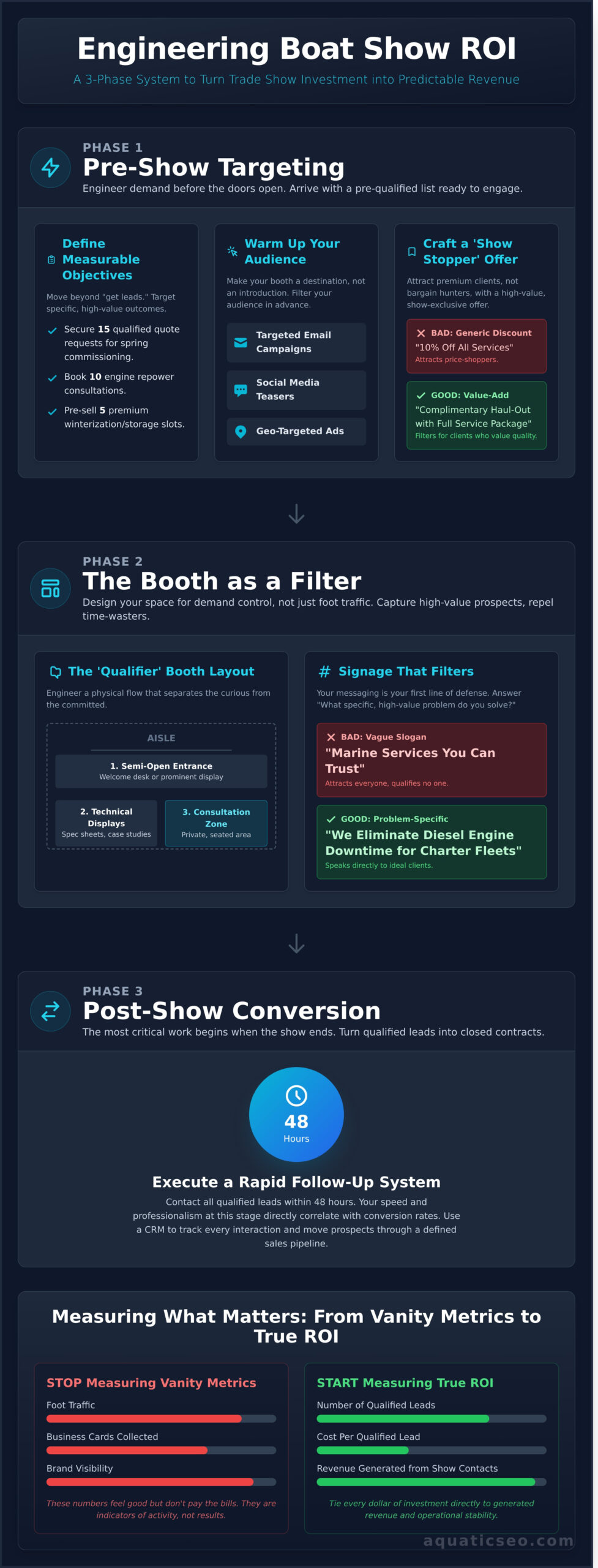
Most marine businesses treat a boat show as a passive event. They set up a booth, wait for foot traffic, and hope for the best. This is a direct path to wasted investment and minimal ROI. To win, you must shift your mindset: you are not merely attending the hartford boat show; you are launching a targeted operational campaign. The objective is to engineer demand before the doors even open, ensuring your ideal, high-margin customers seek you out intentionally, not stumble upon you by chance. A critical first step is understanding the boat show environment as a competitive arena where preparation dictates results.
Defining Measurable Objectives (Not Just ‘Get Leads’)
Forget vague goals like “get more leads.” This metric is meaningless to your operations and bottom line. Instead, define specific, measurable targets that directly impact your business stability and profitability. Your goals should be tied to real-world outcomes that fill your schedule with high-value work. For example:
- Secure 15 qualified quote requests for spring commissioning packages.
- Book 10 engine repower consultations.
- Pre-sell 5 premium winterization and storage slots.
Aligning your show goals with your annual growth targets transforms the event from a marketing expense into a strategic operational asset.
Pre-Show Digital Marketing: Warming Up Your Audience
Your booth should be the destination, not the introduction. Use digital channels to build anticipation and filter your audience weeks in advance. Deploy a multi-channel strategy to ensure you arrive with a pre-qualified list of prospects ready to engage. Focus your efforts on a system that includes launching a targeted email campaign to your existing list, using social media to tease your exclusive show-stopper offer, and running precise, geo-targeted ads aimed at qualified boat owners in the region surrounding the hartford boat show.
Crafting Your ‘Show Stopper’ Offer
A generic “10% Off” discount attracts bargain hunters, not premium clients. Your offer must act as a powerful magnet for your ideal customer profile. It should be an exclusive, high-value proposition available only at the show. Focus on value-adds that solve a real problem or enhance the customer experience, such as a complimentary haul-out with a full service package or priority scheduling for the busy spring season. This positions you as a premium partner and filters for clients who value quality over price.
Designing Your Booth for Demand Control, Not Just Foot Traffic
Most exhibitors at the hartford boat show focus on one thing: maximizing foot traffic. This is a critical error. Your booth is not a net for catching every passerby; it is a physical filtering system designed to capture high-value prospects and repel time-wasters. Every square foot of your space should be engineered for demand control, guiding qualified buyers into meaningful conversations while allowing unqualified lookers to pass by. This transforms your booth from a marketing expense into an operational asset that feeds your sales pipeline with stable, predictable, and high-margin work.
The ‘Qualifier’ Booth Layout
A strategic layout physically enforces your qualification process. Don’t create a wide-open space that invites casual wandering. Instead, engineer a flow that separates the curious from the committed. This system guides the right people toward a productive conversation.
- Semi-Open Entrance: Use a welcome desk or a prominent display to create an initial engagement point, inviting interest without being fully exposed.
- Consultation Zone: Designate a quieter, semi-private area with seating for deep, one-on-one conversations away from the aisle noise.
- Technical Displays: Showcase detailed spec sheets, engine cutaways, or case studies. This content naturally attracts serious buyers and bores those who aren’t your target client.
Signage That Repels Bad Leads and Attracts Good Ones
Your banners are your first line of defense against low-quality leads. Vague slogans like “Quality and Service” attract everyone and qualify no one. Your messaging must be a sharp, precise tool that speaks directly to your ideal client’s most urgent problems. This strategic messaging is a core component of effective pre-show planning for trade shows, where you define your ideal client before you even book the space. Your primary banner must answer one question instantly: “What specific, high-value problem do you solve?”
Bad: “Marine Services You Can Trust”
Good: “We Eliminate Diesel Engine Downtime for Charter Fleets”
Interactive Elements That Capture Data
The days of the fishbowl full of business cards are over. That’s a system for collecting contacts, not for qualifying leads. At an event like the hartford boat show, every interaction must be a data-capture opportunity. Implement systems that qualify prospects in real-time and integrate directly into your sales process.
- Qualifying Quiz: Use a tablet with a simple 3-4 question quiz to segment prospects by need, budget, and urgency.
- High-Value Digital Asset: Offer a “2024 Repower Buyer’s Guide” for download in exchange for a verified email address.
- Lead Capture App: Use a professional app to scan badges or input data, tag leads by interest, and schedule follow-ups on the spot.
Showtime Execution: Engaging High-Value Prospects
Your pre-show strategy is only as good as your team’s execution on the floor. At the Hartford Boat Show, the goal is not to collect a stack of business cards; it is to identify and engage high-value prospects who have real operational problems your business can solve. With exhibitors demanding stronger ROI, as confirmed by a recent event marketing report, a disciplined, systematic approach to every conversation is non-negotiable. Your booth staff are your most critical asset in this process-they must be trained to control the interaction and extract actionable intelligence.
Training Your Team to Be Consultants, Not Salespeople
Shift your team’s mindset from pitching products to diagnosing problems. Before the show, conduct role-playing sessions focused on asking structured, qualifying questions. Equip them with deep product and operational knowledge so they can speak with authority, not just recite features. Teach them to listen intently for operational pain points-like scheduling chaos, margin erosion, or inconsistent demand-which are the true gateways to a high-value sale.
The Art of the Qualifying Question
Standard greetings like “Can I help you?” invite a “No, thanks.” Instead, arm your team with diagnostic questions that open a real conversation. This is how you filter prospects and take control.
- Instead of a generic greeting, try: “What’s the biggest operational challenge you’re facing with your current boat?”
- Ask about their business: “What upcoming projects are causing the most strain on your service department?”
- Use their answers to segment them instantly, dedicating prime time to qualified leads and politely disengaging from casual browsers.
Systematizing Lead Capture for Flawless Follow-Up
Human memory is a liability in a high-traffic environment. A systematic process for data capture is mandatory for maximizing ROI. Use a digital lead capture form on a tablet with required fields to enforce discipline. Crucially, include custom fields for “Identified Pain Point” and “Agreed Next Action Step.” After every significant conversation, your staff must step aside and immediately record detailed notes while the context is fresh. This data is the fuel for a targeted, effective follow-up that converts leads into profitable customers.
The Post-Show Playbook: Turning Conversations into Contracts
The handshakes and business cards collected are just potential energy. The real work-converting that potential into profitable contracts-begins the moment you pack up your booth. Most businesses fail here, squandering their investment from the Hartford Boat Show with slow, generic follow-up. This is a critical operational mistake.
Speed is your primary weapon. Your first contact must happen within 24 hours. But a generic ‘Thanks for stopping by’ email is a wasted opportunity that signals you have no process. To turn interest into income, you need a disciplined, multi-touch system designed to build trust and demonstrate value.
Segmenting Your Leads Immediately
Your first action is to enforce order. Use your in-show notes to immediately segment every contact based on their qualification level. This isn’t just about organization; it’s about deploying your sales resources with precision.
- Hot Leads: They discussed a specific project, timeline, and budget. These contacts receive a personal phone call within one business day. No exceptions.
- Warm Leads: They showed genuine interest but have a longer decision-making timeline. They enter a value-driven email nurture sequence that educates them, not just sells to them.
- Cold Leads: They grabbed a brochure or made a casual inquiry. Add them to your long-term newsletter to stay top-of-mind without wasting active sales resources.
The Multi-Touch Follow-Up Sequence That Works
High-value clients require a methodical approach. This sequence is designed to move a prospect from a casual conversation to a qualified sales consultation.
- Day 1: A personalized email referencing the specific boat, service, or problem you discussed. Prove you were listening.
- Day 3: Provide tangible value. Send a relevant case study, a short guide, or a link to a resource that solves a problem they mentioned.
- Day 7: A direct phone call. The goal is not to close the deal, but to schedule a formal consultation to address their needs in detail.
Bridging the Gap Between the Show and Your Sales System
Random follow-up creates chaos and lost revenue. Every lead must be captured, tracked, and managed within a robust system. This is non-negotiable for controlling your sales pipeline. Ensure every lead from the Hartford Boat Show is entered into your CRM immediately, with clear ownership assigned for follow-up. Tracking this lead source is the only way to accurately measure long-term conversion rates and calculate true ROI. This is the difference between hoping for business and engineering it.
Need a system to manage demand? See how we do it.
Measuring What Matters: Calculating Your True Boat Show ROI
The show ends, the booth comes down, and the excuses begin. “We got great exposure.” “Foot traffic was high.” These are rationalizations for a lack of results, not measures of success. To justify the significant investment, you must connect every dollar spent at the Hartford Boat Show directly to the revenue it generated. Vague notions of “brand awareness” don’t pay your technicians or improve your margins. It’s time to measure what actually impacts your operations and profitability.
This data isn’t just for a report. It’s for making a clear, data-backed ‘go/no-go’ decision for next year.
Key Metrics Beyond Business Cards
A stack of business cards is a liability, not an asset. It represents follow-up work with no guarantee of return. Instead, you must focus on tracking metrics that signal real purchase intent and contribute to predictable revenue. Shift your focus from quantity to quality with these key performance indicators:
- Sales Qualified Leads (SQLs): Not just a name and email. An SQL is a contact who has been vetted against specific criteria-like budget, need, and purchase timeline-and is ready for a direct sales conversation.
- Pipeline Value Generated: The total potential revenue from all the SQLs you captured at the show. This gives you a forward-looking view of the show’s financial impact.
- Lead-to-Customer Conversion Rate: The percentage of your show-generated SQLs that ultimately become paying customers. This is the true test of your lead quality and sales process.
Calculating Customer Acquisition Cost (CAC)
How much does it cost to acquire a new customer from this specific event? The calculation is simple, but the insight is critical. Sum all your direct and indirect costs-booth space, staff wages and travel, marketing collateral, displays-and divide that total by the number of new customers you signed. If you spent $15,000 on the Hartford Boat Show and acquired 5 new clients, your show-specific CAC is $3,000. How does that compare to your other marketing channels?
Tying Show Leads to Final Sales
The final step is calculating your true return on investment. This requires a disciplined process and a CRM to track every show lead through your entire sales cycle. Once a deal closes, you can attribute that revenue and, more importantly, the gross margin back to the event.
The only formula that matters is: (Gross Margin – Total Show Cost) / Total Show Cost = ROI.
Using gross margin instead of revenue cuts through the noise and shows you the real profitability of the event. A high-revenue, low-margin client acquired at a high cost can actually hurt your business. This level of disciplined tracking moves you from gambling on events to making strategic investments. If you’re ready to build a system that enforces this kind of clarity across all your marketing, it’s time we talked.
Beyond the Booth: Systemize Your Boat Show Success
Your success at the hartford boat show isn’t determined by luck or the volume of foot traffic. It’s forged through a deliberate strategy-from pre-show targeting of qualified buyers to a disciplined post-show process that converts conversations into contracts. True ROI comes from having a repeatable system, not just a presence.
Hope is not a business strategy. Relying on a busy booth to fill your sales pipeline is a gamble that hurts your margins and operational stability. We are not a generic marketing agency; we are a growth partner for marine businesses ready to dominate their market. Our proprietary Marine Demand Control System is engineered to deliver a predictable flow of qualified inquiries, filtering out the vanity traffic so you only engage high-value prospects.
Stop Wasting Money on Hope. Get a Control System for Your Marketing.
It’s time to take control and make your next event your most profitable one yet.
Frequently Asked Questions
How much does it cost to exhibit at the Hartford Boat Show?
Costs vary based on booth size and location, typically from a few thousand to over $10,000. However, the booth fee is a fraction of your total investment. The real cost includes pre-show marketing, staffing, and, most critically, a robust follow-up system. Viewing this as a simple expense guarantees a loss. Treating it as a capital investment in your demand control system is the only path to a positive, measurable ROI.
Is the Hartford Boat Show worth it for a small marine service business?
The show is only “worth it” if you have a system to force a positive ROI. Simply showing up is a waste of capital. For a small service business, the Hartford Boat Show is an opportunity to generate high-margin demand, but only if you focus on booking qualified consultations, not just collecting names. Your goal is operational stability and predictable revenue, not a jar full of unqualified business cards from tire-kickers.
What’s the single biggest mistake exhibitors make at boat shows?
The biggest mistake is a complete lack of a system for lead qualification and follow-up. Exhibitors obsess over booth design but have no disciplined process to filter prospects, capture operational data, and execute immediate, automated follow-up sequences. This turns a major investment into an operational black hole with zero auditable ROI. It is a fundamental failure of process, not just a lack of presence on the show floor.
How can I stand out from the big boat manufacturers and dealers?
You don’t compete on budget; you dominate on expertise. Stop being a generalist. Your booth should solve one specific, high-margin problem, like “Expert Fiberglass & Gelcoat Restoration.” Use your messaging to filter out everyone except your ideal client. The goal isn’t to attract the crowd; it’s to capture the highly-qualified buyer who needs your specific solution and understands its value. This is how you control demand and protect your margins.
How soon before the show should I start my marketing?
Your pre-show campaign must activate 60-90 days out. This is not about posting “we’ll be there” on social media. It is a systematic campaign targeting your email list and specific local audiences with the clear objective of pre-booking appointments. You should arrive at the show with a schedule of qualified meetings already set. This ensures your time is spent closing deals with high-intent prospects, not just greeting casual browsers.
What’s a realistic goal for leads from a show like this?
Stop tracking “leads.” It is a worthless vanity metric that destroys sales efficiency. A realistic, operationally-focused goal is to secure 10-15 fully-qualified, pre-vetted consultations for your core high-margin services. The objective is not a high volume of contacts; it is a specific number of actionable sales opportunities that feed directly into your revenue forecast. Measure booked appointments and closed deals, not unqualified booth traffic.