For many marine businesses, the investment in the seattle boat show seattle wa is a high-stakes gamble. You spend a fortune on booth space and logistics, only to end up with a pile of brochures given to tire-kickers and a vague sense that you ‘had to be there.’ The conversations are endless, but the qualified inquiries are few, leaving you to question the true ROI of the entire event. Getting lost in the noise of hundreds of other exhibitors is a real, and costly, operational risk.
This ends now. This guide throws out the fluff and gives you a tactical system for taking control. Forget hoping for foot traffic; we’ll show you how to dominate your corner of the show floor. Stop collecting random business cards and start building a pipeline of high-margin, pre-qualified customers. It’s time to turn your expensive booth from a branding expense into a measurable, profit-generating asset. Let’s get to work.
Key Takeaways
- Reframe your presence at the seattle boat show seattle wa from a marketing expense into a predictable revenue-generating system.
- Dominate the show floor before you arrive by executing a pre-show digital strategy to engage high-value buyers in advance.
- Stop wasting time with tire-kickers by deploying a simple “demand filtering” script that instantly identifies qualified prospects.
- Capture the revenue lost to poor follow-up with a structured, multi-touch sequence that converts booth visits into closed deals.
Beyond the Booth: Why the Seattle Boat Show is a Critical Growth Lever
Most marine businesses view boat shows as a marketing expense-a necessary cost of doing business. This is a fundamental error in operational thinking. A major event like the seattle boat show seattle wa is not an expense; it is a strategic investment in demand control. In a digital-first world, the opportunity for direct, face-to-face interaction with high-intent buyers is a rare and powerful lever for growth. This is where you escape the noise of online advertising and engage directly with clients who are ready to make decisions.
While many businesses misunderstand the core function of what are boat shows, smart operators see them as a concentrated market. Whether you are a boat dealer moving inventory, a charter company booking seasons, or a service provider securing high-margin contracts, this event puts your operation in front of the right people at the right time.
Understanding the Attendee Demographics
The crowd at the Seattle Boat Show is not made up of casual browsers. These are serious Pacific Northwest boat owners, enthusiasts, and high-net-worth individuals with disposable income and a specific need. They are highly qualified prospects who arrive with project plans and open checkbooks. Many are deep in the buying cycle, using the show to make final comparisons and commit to major purchases before the season begins.
Setting Goals That Drive Profit, Not Just Foot Traffic
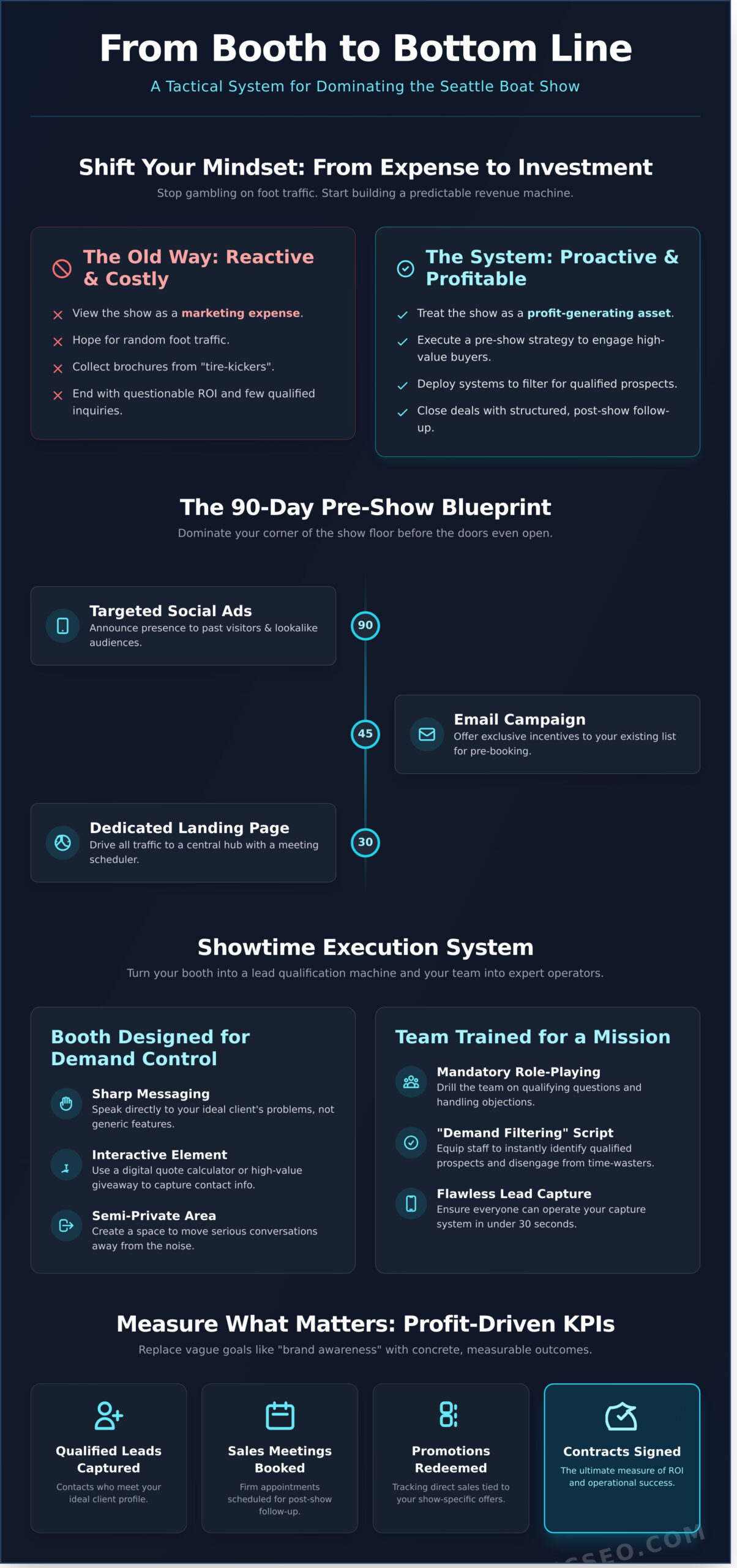
Vague goals like “brand awareness” or “getting our name out there” are useless metrics that don’t impact your bottom line. A successful show strategy is built on concrete, measurable outcomes. Your focus must be on profit-driven Key Performance Indicators (KPIs) that directly feed your operational stability.
- Number of qualified leads captured: Contacts who meet your ideal client profile.
- Sales meetings booked: Firm appointments scheduled for post-show follow-up.
- Show-specific promotions redeemed: Tracking direct sales tied to the event.
- Units sold or contracts signed: The ultimate measure of ROI.
This requires a show-specific sales funnel-a system designed to capture, filter, and convert leads on-site, turning foot traffic into predictable revenue.
Pre-Show Blueprint: Dominate Before the Doors Even Open
Most marine businesses treat boat shows as a reactive event. They show up, hope for foot traffic, and collect a stack of unqualified business cards. This is a direct path to wasted investment and operational chaos. A successful appearance at the seattle boat show seattle wa is not about luck; it is the result of a disciplined, 90-day pre-show campaign designed to manufacture demand and control your sales pipeline before the doors even open. The financial stakes are high, with credible marine industry sales data confirming the significant economic impact of these events. Your goal is to capture a predictable share of that revenue.
Your Digital Marketing Pre-Launch Sequence
Waiting until the week of the show is operational malpractice. You must warm up your target audience with a methodical digital campaign. This system builds awareness and filters for intent, ensuring the people who visit your booth are already considering a purchase. We deploy a simple, effective sequence:
- 90 Days Out: Launch targeted social media ads announcing your presence and booth number to past website visitors and lookalike audiences.
- 45 Days Out: Deploy an email campaign to your existing list, offering an exclusive show-specific incentive for pre-booking a consultation.
- 30 Days Out: Drive all traffic to a dedicated landing page on your website with clear details, the offer, and a meeting scheduler.
Designing a Booth for Demand Control
Your booth is not a showroom; it is a lead qualification machine. Every element must serve the purpose of filtering prospects and capturing high-value contacts. Forget generic banners. Your messaging must be sharp, speaking directly to the problems your ideal client faces. Integrate an interactive element-like a digital quote calculator or a high-value giveaway-that requires an email or phone number to access. Finally, design a semi-private area, even just two chairs and a small table, to move serious conversations away from the noise and toward a commitment.
Training Your Team for a Mission, Not a Meet-and-Greet
An untrained team will cost you tens of thousands in missed opportunities. Your staff must be equipped to execute a clear mission: identify, qualify, and capture. Before the seattle boat show seattle wa, conduct mandatory role-playing sessions. Arm them with a short list of non-negotiable qualifying questions. Drill them on handling common objections and politely disengaging from time-wasters. Ensure every single person can operate your lead capture system (whether it’s a tablet, app, or scanner) flawlessly in under 30 seconds. This is about operational excellence, not just friendly conversation.
Showtime Execution: A System for Capturing Qualified Demand
Success at a major event like the Seattle Boat Show Seattle WA is not a passive activity. It is the direct result of a system designed to control engagement and filter for high-value clients. While your competitors wait for prospects to approach them, your team must be executing a proactive plan. The goal is not to collect the most business cards; it is to leave the show with a pipeline of qualified, scheduled consultations that will directly impact your revenue and operational stability.
The First 10 Seconds: Engaging and Qualifying Visitors
Your team’s opening line determines whether they spend the next ten minutes with a serious buyer or a time-waster. Ditch “Can I help you?” for direct, open-ended questions like, “What project is at the top of your list for your boat this season?” This immediately filters for intent. Implement a simple A-B-C lead system: ‘A’ leads are ready to discuss specifics and should be booked for a consultation on the spot. ‘B’ leads are in the research phase and get added to a targeted follow-up sequence. ‘C’ leads are browsers; have a polite exit strategy to free up your team. Post-event analyses consistently show that exhibitors using these types of successful boat show strategies report higher lead quality and better ROI.
Technology at the Booth: Your Unfair Advantage
Manual lead capture is a bottleneck that costs you operational efficiency and qualified inquiries. A fishbowl for business cards is not a system; it’s a liability. Deploy technology to create a seamless process that impresses prospects and ensures zero lead leakage.
- Instant CRM Entry: Use tablets with a simple app or CRM form to enter lead data instantly and accurately. This eliminates errors and starts the follow-up process while you’re still at the show.
- QR Code to Consultation: Create a large QR code that links directly to your consultation booking page. This empowers ‘A’ leads to schedule a meeting on their own terms, locking in their commitment.
- Digital Portfolios: Showcase your best work with a high-resolution digital portfolio on a large screen or tablet. Dynamic visuals are far more compelling than static printouts and capture immediate attention.
Networking with Purpose: Beyond Your Booth
The most valuable connections at the Seattle Boat Show Seattle WA might not be with customers. Your booth is your base of operations, but the entire show floor is an opportunity. Walk the floor with a clear objective: identify potential strategic partners among non-competing exhibitors. A marine electronics installer or a canvas fabricator could become a powerful referral source. Attend any industry-specific networking events to connect with key players, and take time to analyze your competitors’ messaging. Understanding how they position themselves allows you to refine your unique value proposition centered on superior quality and operational control.
Post-Show Follow-Up: Turning Booth Visits into Bankable Revenue
The hard truth: most of the money you invest in exhibiting at an event like the Seattle Boat Show Seattle WA is wasted. Not because of a poor booth or a bad location, but because of a complete failure in post-show follow-up. A stack of business cards or a list of badge scans means nothing without a disciplined, systematic process to convert that interest into operational revenue. Stop leaving money on the table.
The moment the show ends, the clock starts ticking. Every lead you qualified-whether hot or lukewarm-must be immediately integrated into your primary CRM. This isn’t a task for next week; it’s a priority for the ride home. This action is the foundation of a follow-up system that actually works, turning booth traffic into stable, predictable income.
The Critical First 48 Hours
Speed and prioritization are non-negotiable for your most qualified prospects. Your ‘A’ leads-the ones ready to buy-expect immediate attention. Hesitation gives your competitors an opening. Your team must execute this sequence with precision:
- Within 24 Hours: Send a personalized ‘thank you’ email referencing your specific conversation. No generic templates.
- Day 1-2: Prioritize follow-up calls to all ‘A’ leads. Get a meeting on the calendar while their interest is at its peak.
- Connect on LinkedIn: Send a connection request with a short, personalized note to solidify the new relationship.
Automated Nurturing for ‘B’ and ‘C’ Leads
Not every visitor is ready to buy today. Your ‘B’ and ‘C’ leads are future revenue, and dropping them is a critical mistake. Instead, add them to a dedicated email nurture sequence that delivers value, not just sales pitches. Send them helpful guides or project case studies. This long-term strategy builds trust and ensures you are the first company they call when they are ready to act.
Measuring What Matters: True Show ROI
Forget vanity metrics like “cost per scan.” To understand the true operational impact of an event, you must track what actually contributes to your bottom line. A real growth partner focuses on auditable results.
- Cost Per Qualified Lead (CPQL): How much did it cost to get a conversation with a real, potential buyer?
- Sales Conversion Rate: What percentage of those qualified leads became paying customers over the next 6-12 months?
- Customer Lifetime Value (CLV): What is the long-term revenue generated from clients acquired at the show?
Answering these questions separates professional operators from hopeful amateurs. Stop guessing. Get a no-BS analysis of your marine marketing strategy.
From Boat Show Buzz to Bankable Revenue
Ultimately, your success at the seattle boat show seattle wa is not a matter of luck-it is a direct result of a disciplined, strategic system. It’s about building momentum long before the doors open, executing a precise plan to capture genuinely qualified demand on the show floor, and implementing a relentless follow-up process that converts booth visits into bankable revenue. This system is the difference between a busy week and a profitable quarter.
Stop treating the show as a game of chance. As marine industry specialists, we built our proprietary Marine Demand Control System to move your business beyond vague lead counts and vanity traffic. We focus on delivering qualified inquiries that protect your margins and bring stability to your operations. If you’re ready to take control and make this your most profitable show yet, the next step is clear.
Request a custom Marine Demand Control analysis for your business.
Frequently Asked Questions
Is exhibiting at the Seattle Boat Show worth the high cost?
The cost is only “high” if you lack a system to generate a positive return on investment. For businesses focused on attracting high-margin clients, the seattle boat show seattle wa is a critical operational opportunity. The value is not in just showing up; it is in executing a precise strategy to capture qualified inquiries that directly feed your sales pipeline. Without a concrete plan for lead capture and follow-up, the investment is wasted money.
How can a small marine business stand out against larger competitors at the show?
You do not outspend them; you out-strategize them. Large competitors often rely on sheer scale, which can feel impersonal. A smaller business wins by focusing on a specific niche-a specialized service, a unique product line, or superior technical expertise. Your booth must communicate this one core value proposition instantly. Instead of trying to be everything to everyone, focus on dominating your specific corner of the market. Clarity and specialization cut through the noise and attract qualified buyers.
What is the most effective way to capture leads at a busy event like this?
Ditch the fishbowl for business cards. The most effective method is a structured qualification process. Use a short digital form on a tablet that captures not just contact info but key operational data: What is their project timeline? What is their specific problem? This system filters out casual browsers and identifies high-intent prospects on the spot. This is not about collecting the most names; it is about capturing the right data to drive profitable follow-up.
How soon after the show should I start my follow-up process?
The follow-up process must begin within 24 hours. Waiting any longer allows the connection to go cold and gives faster-moving competitors a critical opening. Your system should be prepared in advance, with email templates and call scripts ready to deploy. Segment your leads based on the qualification data you captured at the show and prioritize the highest-value prospects first. Speed and precision in follow-up are non-negotiable for maximizing your event ROI.
What are the biggest mistakes marine businesses make when exhibiting at boat shows?
The biggest mistake is treating the show as a branding exercise instead of a lead generation operation. Businesses attend with no clear goal, no system for capturing qualified inquiries, and no plan for immediate follow-up. They focus on vanity metrics like booth traffic instead of the only metric that matters: qualified leads that convert into profitable sales. This lack of operational focus guarantees a negative return on what is a significant business investment.
How can I use digital marketing to support my in-person presence at the show?
Digital marketing should create a coordinated attack. Before the show, use targeted ad campaigns and email marketing to schedule appointments with high-value prospects at your booth. During the event, use geo-targeted social ads to drive foot traffic from qualified attendees already at the venue. After the show, deploy retargeting campaigns to stay in front of booth visitors, reinforcing your message and driving them toward a consultation. It is a system to control engagement from start to finish.