

Is your phone ringing off the hook while your margins get thinner? You’re fielding endless inquiries, yet your booking calendar swings from chaotic weeks to dead silence. The aggregators and brokers seem to own the search results, leaving you fighting for scraps. This cycle of inconsistent, low-quality demand is the single biggest threat to your operational stability and profitability.
Let’s be clear: this is not another fluffy guide for tourists on how to book a yacht charter. This is a no-nonsense operational manual for the business owners who need to win those bookings on their own terms. Forget vanity metrics and vague marketing advice. Inside, we will dismantle the exact systems required to build a predictable pipeline of high-value clients, filter out the tire-kickers automatically, and establish the market authority that gives you absolute control over your schedule. It’s time to stop chasing demand and start commanding it.
Key Takeaways
- Go beyond the brochure to identify the key operational levers that truly control your profitability and market position.
- Stop wasting resources on low-quality inquiries and learn to filter for high-margin, qualified clients from the start.
- Discover the non-negotiable digital assets required to build a “digital flagship” that captures and converts high-value bookings.
- Implement a proven system to move from unpredictable bookings to having complete control over your yacht charter demand and schedule.
Deconstructing the Yacht Charter Business Model
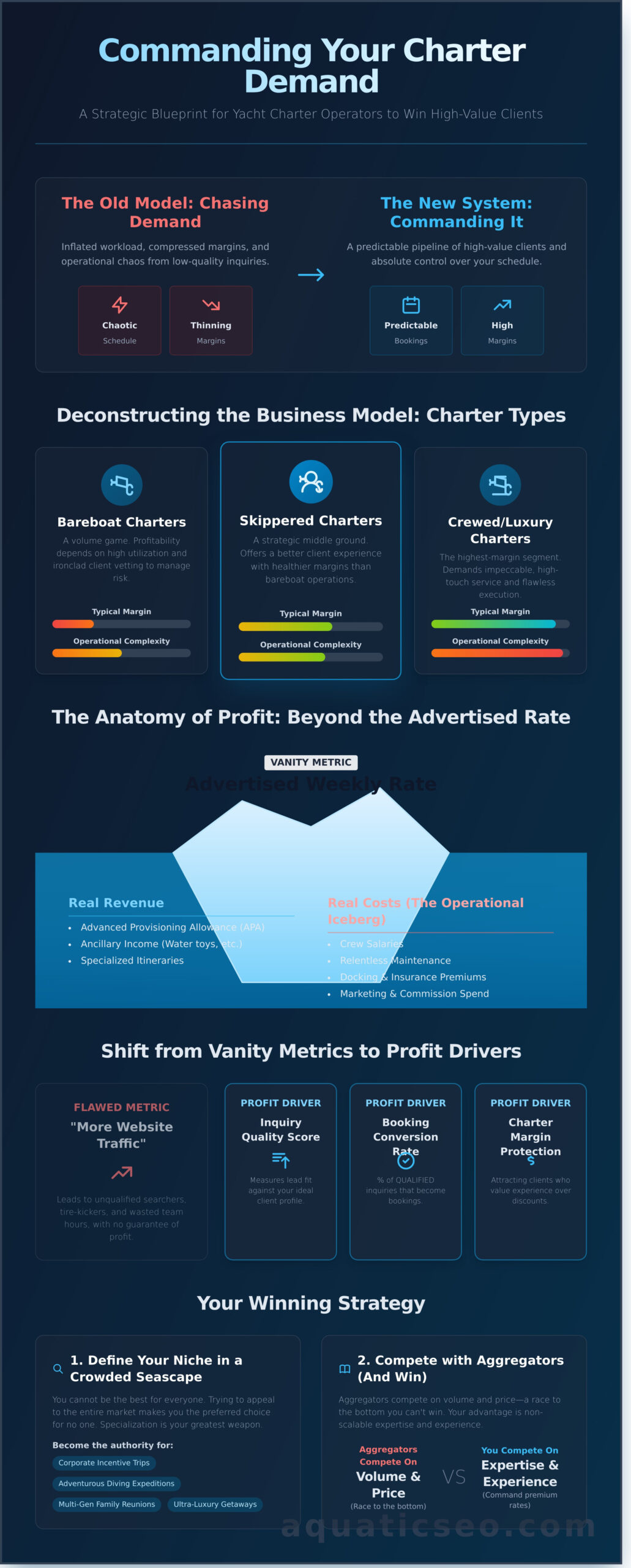
Effective marketing isn’t about glossy photos of sunsets; it’s about mastering the operational and financial systems that drive profit. To get your yacht charter business booked consistently with high-value clients, you must move beyond the brochure and deconstruct the model. Forget the destinations for a moment and focus on the numbers, the margins, and the operational levers that dictate success or failure.
Charter Types from an Operator’s Perspective
Every charter type presents a different operational challenge and margin opportunity. While many online resources cover the yacht chartering basics, they rarely analyze the business implications. Your marketing must align with the model you operate, not fight against it.
- Bareboat Charters: This is a volume game. Margins are typically lower, and profitability depends on high utilization rates and an ironclad client vetting process to manage risk and maintenance overhead.
- Skippered Charters: A strategic middle ground. You provide a better client experience with less operational complexity than a fully crewed charter, allowing for healthier margins than bareboat operations.
- Crewed/Luxury Charters: The highest-margin segment. This model demands impeccable, high-touch service and complex logistics. Success here is not about volume but about flawless execution and commanding premium rates.
The Anatomy of Charter Revenue and Costs
The advertised weekly rate is a vanity metric. True profitability is found in the details. Understanding your real margins per charter is the only way to build a stable, scalable business. Don’t confuse revenue with profit.
- Real Revenue: Look beyond the base rate to include the Advanced Provisioning Allowance (APA), broker commissions, and ancillary income from services like water toys or specialized itineraries.
- Real Costs: The operational iceberg includes crew salaries, relentless maintenance schedules, fluctuating docking fees, insurance premiums, and, critically, your marketing spend.
Mapping the High-Value Customer Journey
High-value clients aren’t lost by accident; they are lost by a lack of system and control. From their initial Google search to their post-trip review, there are critical digital touchpoints where you either capture them or lose them to a competitor. Most charter companies lose qualified leads during the transition from initial inquiry to booking. This is where vague interest overwhelms staff, and serious, high-margin clients fall through the cracks because there is no system to filter, qualify, and convert them effectively.
The Core Challenge: Winning Qualified Clients, Not Just Traffic
The yacht charter industry doesn’t have a lead problem; it has a qualification problem. Your inbox is likely filled with inquiries from price shoppers, dreamers, and mismatched prospects who drain your team’s time and energy. The old model of chasing “more leads” is broken. It inflates your workload, compresses your margins, and creates operational chaos.
Traditional marketing, focused on broad visibility and raw traffic numbers, fails in this high-stakes market. It treats every click as equal, ignoring the vast difference between a tire-kicker and a client ready to book a high-value, multi-day charter. The solution is to shift your entire business strategy from lead generation to demand filtering-a system designed to attract, engage, and convert only your ideal, most profitable clients.
Why ‘More Website Traffic’ is a Flawed Metric
Stop celebrating traffic spikes. Most of it is vanity traffic-unqualified searchers with no real intent to book. Every hour your team spends responding to a low-quality inquiry is an hour they can’t dedicate to a high-value client. It’s time to abandon superficial metrics and focus on what directly impacts your bottom line:
- Inquiry Quality Score: Measuring how closely an incoming lead matches your ideal client profile.
- Booking Conversion Rate: The percentage of qualified inquiries that result in a signed charter agreement.
- Charter Margin: Protecting your profitability by attracting clients who value experience over discounts.
Defining Your Niche in a Crowded Seascape
You cannot be the best yacht charter for everyone. Trying to appeal to the entire market makes you the preferred choice for no one. With the latest Yacht Charter Market Size & Growth reports showing a fiercely competitive landscape, specialization is your greatest weapon. Define who you serve best. Are you the authority on corporate incentive trips, adventurous diving expeditions, multi-generational family reunions, or ultra-luxury getaways? A clear niche simplifies every marketing decision and acts as a natural filter, attracting high-fit clients from the very first click.
A great example of this specialization is a boutique operator like Old Plank Sailing Adventures, which focuses on luxury private charters and aquatic expeditions. This clear focus allows them to attract a specific clientele and build a brand that stands apart from generic, volume-based competitors.
Competing with Aggregators (and Winning)
Large-scale charter aggregators compete on volume and price-a race to the bottom you can’t win. Your advantage is expertise and experience. The winning strategy is not to out-bid them, but to out-specialize them. Own your destination and niche with content that proves your authority. While they offer a directory, you offer a curated, unforgettable experience. By building a powerful direct-booking channel, you reduce reliance on commission-based platforms, take back control of your client relationships, and protect your margins.
Building Your Digital Flagship: The Non-Negotiable Marketing Assets
Forget optional extras and marketing fluff. Your digital presence is the operational engine of your business, working 24/7 to capture high-value demand. These assets are not about getting seen; they are about getting booked. They form a cohesive system designed to build trust, demonstrate undeniable value, and convert qualified prospects into profitable charters. Without them, you are simply hoping for business. With them, you take control.
Your Website: A Booking Engine, Not a Brochure
Your website’s sole purpose is to filter prospects and drive qualified inquiries. It must function as a high-performance sales tool, not a static digital catalog. Anything less is a waste of capital. Essential components include:
- High-Impact Visuals: Professional, recent photography and videography are non-negotiable. Show the vessel in its best light.
- Hard Data: Provide detailed yacht specifications, deck plans, and transparent pricing structures. Serious clients demand serious information.
- Trust Signals: Showcase your crew, sample itineraries, and client testimonials. Prove your operational excellence before they ever speak to you.
- Clear Calls-to-Action: Guide every visitor toward one goal: inquiry. Make it simple and obvious to take the next step.
Strategic SEO: Capturing Clients Who Are Ready to Book
Effective Search Engine Optimization for a yacht charter business isn’t about ranking for vanity terms; it’s about capturing clients with active commercial intent. This means targeting specific, high-value keywords that signal a readiness to book (e.g., ‘crewed motor yacht charter Bahamas’). A focus on local SEO allows you to dominate your home port, while a technically sound site ensures Google can see and serve your fleet to a global audience. This is how you fill your calendar with profitable bookings, not just your inbox with unqualified leads.
Content that Sells the Experience, Not Just the Yacht
Your content must move beyond specifications and sell the destination, the freedom, and the unparalleled service you provide. This is how you build desire and justify a premium price point. Focus on assets that create an emotional connection and build trust through transparency. Video walkthroughs provide a virtual tour that answers questions and eliminates friction. Detailed crew profiles transform your team from a line item into expert guides. Itineraries should not be a list of locations; they should be a narrative of the unforgettable experience you deliver.
The Marine Demand Control System for Charter Operators
General advice gets you general results. The marketing tactics discussed are powerful, but without a system to execute them, they only create more work and unpredictable revenue swings. This is where we move from theory to execution. The Marine Demand Control System is our proprietary methodology for installing predictable, high-margin growth into your business. It’s not another marketing plan; it’s a framework for operational control.
This system is designed to solve the core challenges of the yacht charter industry: inconsistent bookings, low-margin clients, and a schedule you don’t control. Here is how it works.
Step 1: Isolate and Define Your High-Margin Client
We begin by analyzing your past bookings to build a data-backed profile of your most profitable client. This isn’t a vague persona; it’s a precise blueprint that dictates every keyword we target and every piece of content we create. The goal is simple and direct: attract more of your best clients and actively repel the time-wasters and price-shoppers who drain your resources.
Step 2: Dominate Your Profitable Search Niche
Forget chasing broad, competitive keywords. Our targeted SEO strategy is designed to capture high-intent searchers actively looking for your specific offer. This isn’t about ranking for a generic term; it’s about owning the search results for “multi-day luxury catamaran charter in the BVI.” We build your digital authority so when your ideal client searches, you are the only logical choice.
Step 3: Convert Inquiries into Controlled Bookings
A flood of unqualified inquiries is a liability, not an asset. Our system helps you filter and prioritize incoming leads, ensuring your time is spent only on prospects who are a perfect fit. We structure your website and follow-up processes to answer critical questions upfront, pre-qualifying clients before they ever contact you. This allows you to gain control over your schedule by attracting bookings that fit your calendar, not the other way around.
Step 4: Measure Business Results, Not Vanity Metrics
We report on what actually matters to your bottom line. Forget about useless metrics like traffic, clicks, and rankings in a vacuum. Our focus is on tangible outcomes that drive your business forward. We track and report on:
- The number of qualified, high-margin inquiries.
- The total value of new bookings generated.
- Your direct marketing Return on Investment (ROI).
This is about accountability and real growth. Stop guessing. See how a system can bring control to your business.
Stop Chasing Traffic. Start Controlling Demand.
The path to a dominant yacht charter business is clear. It’s not about casting a wider net; it’s about building a better one. True success hinges on attracting qualified clients who value your service, not just generating vanity traffic. As we’ve covered, your digital assets are your flagship, but without a system to filter inquiries and enforce your standards, you’re navigating without a rudder.
That is the fundamental difference in our approach. We are marine industry specialists, not generalists. Our entire focus is on your operational control and profitability, not vague lead counts. The Marine Demand Control System is our proven process for turning your marketing from a cost center into a disciplined, profit-driving machine that delivers high-margin bookings predictably.
If you’re ready to stop guessing and start building a more stable, profitable operation, it’s time for a direct conversation. Request a No-BS Analysis of Your Charter Marketing and see what’s truly possible when you take command.
Frequently Asked Questions
How much should a yacht charter company budget for marketing?
Instead of a fixed percentage, focus on your cost-per-acquisition for a qualified booking. A smarter approach is to budget based on growth targets and operational capacity. If a marketing system can deliver profitable, high-margin charters consistently, the budget becomes an investment in controlled growth, not a blind expense. The right budget is one that allows you to dominate your specific market segment and fill your calendar with ideal clients, ensuring operational stability and predictable revenue.
Is SEO or social media more important for attracting charter clients?
This isn’t a fair fight. SEO is fundamentally more important for attracting qualified charter clients. Clients actively searching on Google for specific charter experiences have clear intent to book. Social media is primarily for brand awareness and audience engagement-it generates interest, not immediate, high-value demand. To control your bookings and margins, you must capture clients who are already looking for your service. SEO does this; social media hopes for it.
How can a small charter operation compete with large brokerage websites?
You don’t compete on their terms-you change the battlefield. Large brokerages are a mile wide and an inch deep. A smaller operation can dominate by being a specialist. Focus intensely on a specific location, vessel type, or charter experience, such as “luxury sailing charters in the BVI.” Your deep expertise and tailored content will attract highly qualified clients that massive, generic websites cannot effectively serve. Win your niche, and you control your market.
What are the most common marketing mistakes charter businesses make?
The biggest mistake is focusing on “being seen” instead of getting booked by the right clients. This leads to chasing vanity metrics like traffic and social media likes, which don’t pay the bills. The second critical error is the lack of a system to filter inquiries, wasting time on tire-kickers and low-margin prospects. This results in an unstable schedule and erodes profitability. Effective marketing isn’t about getting more leads; it’s about controlling demand from qualified clients.
How long does it take for SEO to generate qualified charter bookings?
Expect to see initial momentum in 3-4 months and significant, qualified booking inquiries within 6-9 months. SEO is not an overnight fix; it is the strategic construction of a demand-generation asset. While paid ads offer immediate visibility, they stop the moment you stop paying. A proper SEO system for your yacht charter business builds sustainable authority that consistently delivers high-intent clients, giving you long-term control over your booking calendar and client quality.
What is the single most important element of a yacht charter website?
The most critical element is a clear, frictionless path for a qualified prospect to submit a detailed inquiry. This isn’t just a “Contact Us” form. It’s a strategically designed system that captures essential details-desired dates, passenger count, preferred itinerary-to filter out unqualified traffic from the start. Your website is not a brochure; it is a tool to capture and qualify high-value demand. Everything else, from photos to vessel specs, exists only to support this primary function.