
Are your best boats sitting while you pay hefty fees to be just another listing in a crowded digital boat show? You’re fighting a losing battle, forced to slash prices to compete with dozens of other dealers for leads that rarely convert. This operational chaos isn’t a sign of a tough market; it’s a symptom of a broken system. The very boat trader online marketplace you depend on is designed to commoditize your inventory and erode your margins, one low-quality inquiry at a time.
This cycle of paying for inconsistent, low-value leads ends now. You are losing control over your brand, your sales process, and your profitability by outsourcing your lead generation to a platform that benefits from your price wars.
This guide isn’t another complaint about high commissions. It is a strategic blueprint to break free from the marketplace trap. We will expose the hidden operational costs of relying on these platforms and give you a proven system for generating a predictable flow of high-margin, qualified buyers directly to your business.
Key Takeaways
- Learn to reframe marketplace fees not as marketing costs, but as operational liabilities that directly erode your profit margins.
- Understand why over-reliance on any single boat trader online marketplace creates a high-risk dependency that kills your control over lead quality.
- Discover the critical difference between “renting” traffic from third parties and building an “owned” demand system that delivers qualified buyers to you.
- Get an actionable blueprint to build your own high-margin lead engine, giving you predictable sales and operational stability.
Why Every Marine Dealer Feels Trapped by the Online Marketplace Model
Let’s be direct: you feel like you have to be on platforms like Boat Trader. For the vast majority of boat buyers, the search starts and ends there. The consumer appeal is undeniable-a massive selection, instant price comparisons, and a single, familiar interface to browse inventory from hundreds of dealers.
This convenience for buyers creates an unavoidable gravity. You list your inventory because that’s where the eyeballs are. But so does every other dealer in your state. The result is a hyper-competitive digital boat show where your inventory becomes just another line item in a database. This is the fundamental flaw of the online marketplace model; it forces you into a game where the house always wins, putting your margins and operational stability at constant risk.
The Illusion of Easy Sales
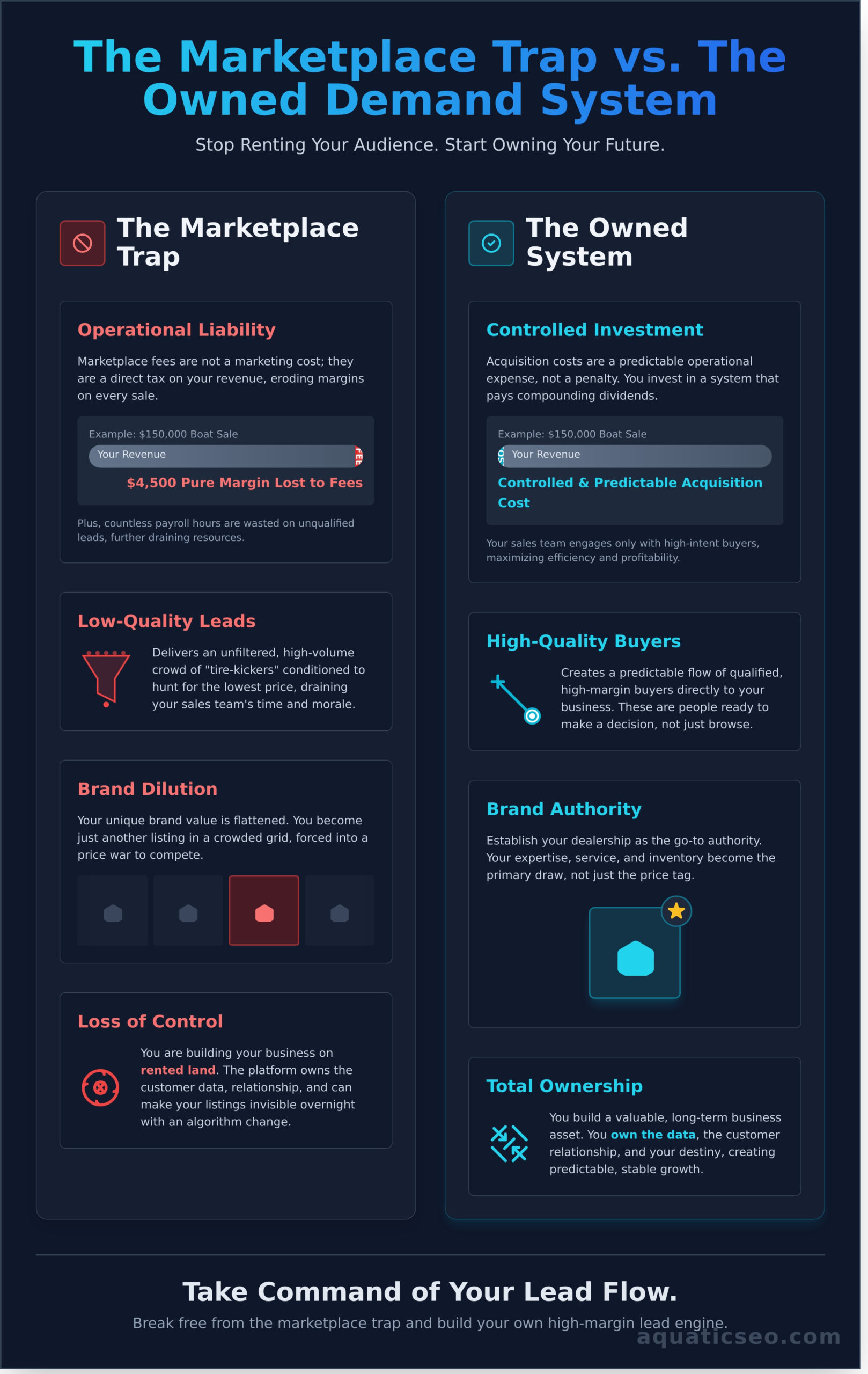
A boat trader online marketplace promises access to a huge audience. What it actually delivers is an unfiltered, low-intent crowd that drains your sales team’s time. Your staff wastes hours chasing tire-kickers and unqualified leads instead of engaging high-value buyers ready to make a decision.
The initial setup is deceptively simple, but gaining real visibility is a pay-to-play battle. To escape the bottom of the search results, you are forced to bid for premium placements and sponsored listings. This system trains your dealership to focus on volume, celebrating a high number of vague “leads” while ignoring the only metric that matters: the quality and profitability of each inquiry.
Understanding the Buyer’s Journey on a Marketplace
On these platforms, buyers are conditioned to hunt for the lowest price. The entire user experience is engineered to commoditize your boats and encourage a race to the bottom. Your decades of experience, superior service, and unique brand value are completely flattened, reduced to a handful of photos and a price tag that’s instantly compared against your competitors.
Worse, the platform owns the customer relationship. They capture the user data, control the communication channels, and stand between you and your potential buyer. You’re effectively renting an audience on their terms, with zero ability to build a direct, long-term asset for your own business. You get a temporary lead, but they keep the customer data.
The Hidden Costs: How Marketplace Dependency Erodes Your Margins
Most dealers view marketplace fees as a simple marketing expense. This is a critical mistake. These are not marketing costs; they are operational liabilities. Your dependency on any single boat trader online marketplace creates a systemic risk that directly attacks your profitability and stability. You are paying for access, but the true price is a loss of control over your margins and your future.
Direct Costs: Commissions and Fees
The most obvious damage is to your cash flow. You pay listing fees just to get in the game. You pay extra for “premium” placements to get seen. And you often pay final value or lead fees that punish you for your own success. On a $150,000 boat sale, a 3% fee structure costs you $4,500-pure margin, gone. Compare that to acquiring a qualified buyer through your own system, where the cost is a controlled, predictable operational expense, not a tax on your revenue.
Indirect Costs: The Margin Killers
The costs that don’t appear on an invoice are even more corrosive. These platforms create a “race to the bottom” on price. When your inventory is displayed next to ten nearly identical listings, the only lever you have to compete is the price tag. This is a direct assault on your margins.
Then there is the payroll drain. Your sales team wastes hours sifting through an endless stream of tire-kickers and lowball offers. Every minute spent on an unqualified lead is a minute not spent closing a deal with a serious buyer. This operational drag kills efficiency and morale. Your brand is diluted, reduced to just another tile in a grid.
Loss of Control: The Biggest Liability
The most significant risk is that you are building your business on rented land. You don’t own the customer experience, the data, or the relationship. You cannot build your most valuable long-term asset: a direct line to your past and future customers. The most successful direct-to-consumer brands build their empires on owning this relationship, a strategy any boat trader online marketplace actively prevents.
Worst of all, your entire lead flow is subject to their algorithm. A single, unannounced change can make your listings invisible overnight. This volatility makes predictable, stable growth impossible and puts your entire operation at the mercy of a platform that does not have your best interests at heart.
The Alternative: Shifting from Rented Traffic to an Owned Demand System
Relying solely on a boat trader online marketplace is like building your business on rented land. You pay for access, you follow their rules, and they can raise the rent or change the terms at any moment. This is ‘Rented Traffic’. You are a guest on their platform, competing with dozens of other dealers for attention from the same low-intent audience.
This power imbalance is not a theory; it’s a documented business risk. Major marketplaces have faced legal action for creating environments that penalize sellers and stifle competition, as seen in the FTC lawsuit against marketplace monopolies. The alternative is to build ‘Owned Assets’-your website, your brand, and your direct line to buyers. When a customer searches for your business by name, you control the conversation.
The objective is not to abandon marketplaces completely. It is to demote them from a necessity to a strategic choice. This requires a fundamental mindset shift: you must stop passively receiving leads and start actively engineering a flow of qualified inquiries. You take control of your lead quality and sales pipeline.
What is a ‘Demand Control System’?
A Demand Control System is an operational process, not a marketing campaign. It is designed to attract buyers who have specific, high-value problems that your business is uniquely equipped to solve. Its primary function is to filter out unqualified prospects, tire-kickers, and price-shoppers before they ever reach your sales team, protecting your time and operational focus.
The Three Pillars of Demand Control
Our system is built on a simple, effective foundation that moves buyers from search to sale with maximum efficiency. It is the engine that reduces your dependency on any single boat trader online marketplace.
- Pillar 1: Attract. We use specialized SEO to capture high-intent buyers actively searching for the specific boats and services you offer. This is not about getting more traffic; it’s about getting the right traffic.
- Pillar 2: Filter. Your website becomes an automated qualification tool. Through strategic content and clear intake processes, we ensure only serious, ready-to-act prospects make contact.
- Pillar 3: Convert. Your team engages with a smaller number of highly qualified leads. This shortens the sales cycle, protects your margins, and creates predictable revenue.
Blueprint: How to Build Your Own High-Margin Lead Engine
Relying on marketplaces is a reactive strategy that puts your margins and operational stability at risk. It’s time to stop waiting for whatever leads the platform sends and start building a system that gives you control. This is the operational framework for creating a predictable, high-margin lead engine for your dealership or brokerage.
This approach moves you from being a passive participant on a boat trader online marketplace to the active owner of your demand.
Step 1: Define Your Ideal, High-Margin Client
A marketplace delivers an unfiltered audience, forcing your team to waste hours sifting through tire-kickers and lowball offers. The first step to taking back control is to ruthlessly define who you actually want as a customer.
Which boat brand, service package, or price point delivers the highest profit for your business? Focus your entire marketing system on attracting that specific profile, not just “anyone who wants a boat.” This is the critical shift from volume to value.
Step 2: Turn Your Website into a Sales Asset
Your website is not an online brochure; it is your single most important sales asset. It must do more than show inventory. Its primary job is to build trust and filter out unqualified inquiries before they ever reach your inbox.
Key elements include:
- A clear value proposition that answers: “Why should I buy from you?”
- Case studies or testimonials that provide social proof.
- Intelligent contact forms that ask qualifying questions.
This is how you take back ownership of the customer journey, guiding qualified buyers directly to your sales team.
Step 3: Dominate Niche, High-Intent Keywords
You cannot outspend a major boat trader online marketplace on broad terms like “boats for sale.” Instead, you must dominate the specific, profitable searches that signal a buyer is ready to act. These are the searches your ideal clients use when they have moved beyond browsing.
Think “certified pre-owned Sea Ray dealer Florida” or “Viking yacht broker service.” Capturing this traffic attracts qualified buyers looking for a specialist, not a directory. This is the foundation of the Marine Demand Control System we build for our partners.
Take Command: Implementing a True Marine Demand Control System
The strategies outlined in this article are not theoretical. They are components of a proven system designed to put you in control of your sales pipeline. Relying on a boat trader online marketplace means you are a tenant on someone else’s platform, subject to their rules, algorithm changes, and fees. True operational stability comes from building a demand-generation asset you own.
Why Generic SEO Fails in the Marine Industry
Handing your growth to a general marketing agency is like asking a car mechanic to service a marine diesel. They don’t understand your business. They chase the same vanity metrics-clicks and traffic-that marketplaces promise, without connecting that activity to your operational reality and bottom line.
- They don’t understand your inventory turn, service bay capacity, or ideal customer profile.
- They report on “rankings” instead of qualified, high-margin inquiries that fill your schedule.
- Their goal is to keep you paying a retainer, not to build a stable, profitable operation for you.
The Aquatic SEO Difference: A Growth Partner, Not a Vendor
We are not another agency. We are marine industry specialists who install a system to give you command over your demand. This is the expert implementation of the blueprint you’ve just read. We work with operators who are ready to move beyond the limitations of the typical boat trader online marketplace and build a predictable, profitable future.
The system is built to deliver specific outcomes:
- We deliver qualified inquiries you control, not just anonymous website visitors.
- We help you reduce dependency on platforms that erode your margins with every lead.
- The result is a stable operation with predictable demand and improved profitability.
Stop renting attention and start owning your demand. It begins when you install a true Marine Demand Control System built for your operation.
Stop Renting Customers. It’s Time to Own Your Demand.
The path forward is clear. Continuing to rely on a boat trader online marketplace is a strategy for shrinking margins and lost control. You are not just listing boats; you are paying a toll to access customers that should be yours in the first place, forcing you into a race to the bottom on price.
The sustainable alternative is to build an asset you own: a high-margin lead engine. This isn’t about chasing vanity traffic. It’s about installing a system that delivers predictable, qualified inquiries and gives you operational stability, insulating your business from market volatility.
As specialists for the marine industry, we don’t run campaigns-we install permanent demand control systems. If you are ready to stop renting traffic and start owning your future, the next step is to get a clear picture of your current position.
Request a No-BS Analysis of Your Current Marketing Strategy.
Take command of your dealership’s growth. The control is yours.
Frequently Asked Questions
Is it still worth paying for premium listings on Boat Trader?
Premium listings on a boat trader online marketplace can be a useful tool for short-term visibility, but they are not a long-term strategy. You are paying to rent space on a platform you do not control, competing directly against dozens of others. Think of it as a supplemental tactic to capture existing demand while you build a system that generates exclusive, high-margin inquiries directly for your business.
Can my own website really compete with a massive online marketplace?
You are not trying to out-scale a massive boat trader online marketplace; you are trying to out-maneuver it. A marketplace casts a wide, generic net. Your own system is a precision tool, built to attract and convert only your most profitable clients. By focusing on a specific niche and buyer profile, your website becomes the dominant authority for those high-value customers, making the marketplace irrelevant to them.
How much does it cost to build my own lead generation system?
The cost is an investment in operational control. The real question is the cost of not having a system: unpredictable sales cycles, low-margin deals, and wasted time on unqualified leads. A properly built system is designed to increase your average transaction value and stabilize your schedule. This ensures the system delivers a clear return by improving your margins and overall business health.
How do I know if a lead is ‘qualified’ before my team spends time on it?
A lead is qualified through a systematic filtering process, not guesswork. We build intelligent intake forms on your website that ask critical questions about budget, desired timeline, and specific needs before the inquiry ever hits your inbox. This automatically screens out tire-kickers and price-shoppers, so your team only spends time on prospects who are genuinely ready and able to do business with you.
Should I stop listing on marketplaces completely?
No, you should not stop immediately. The goal is a strategic transition, not an abrupt halt. Use marketplaces to maintain a baseline of activity while your own demand control system is built and scaled. Once your owned asset consistently delivers superior, higher-margin leads, you can methodically reduce your marketplace spend. This process puts you back in control of your lead flow and profitability.
How long does it take to see results from a demand control system?
You will see an improvement in lead quality and initial flow within 60 to 90 days as we implement the capture and filtering mechanisms. The goal of complete demand control-where your sales calendar becomes predictable and stable-is typically achieved within 6 to 12 months. This is about building a permanent business asset that compounds in value, not chasing short-term traffic spikes.