

You’re spending a fortune on Google Ads, but your phone rings with tire-kickers and low-margin jobs. Every click feels like burning cash, and your marketing agency’s reports are filled with jargon that doesn’t translate to profit. This isn’t just bad luck; it’s a system problem, and it’s costing you money every single day. The silent killer of your ad budget is almost always a low google ad score. This single metric dictates whether Google shows your ad to serious buyers or window shoppers, and it directly controls how much you pay for each click.
Forget the fluff. This no-nonsense guide translates the Google Ads Quality Score into what you, a marine business owner, actually care about: operational control. We will give you the exact, actionable steps to stop wasting money, filter for high-margin jobs, and turn your Google Ads into a predictable system for generating qualified leads. It’s time to take command of your ad spend, attract the right customers, and gain real stability over your job flow.
Key Takeaways
- Understand that Quality Score is more than a metric; it’s your first line of defense against unqualified, time-wasting inquiries.
- Connect the dots between a high Quality Score and its direct impact on lowering your cost-per-job and stabilizing your schedule.
- Implement a practical, 4-step plan to improve your google ad score by aligning your ad structure with high-intent customer searches.
- Shift your focus from chasing a perfect score to building a reliable system that generates a consistent flow of high-margin work.
What is Google Ads Quality Score (And Why It’s Your First Lead Filter)
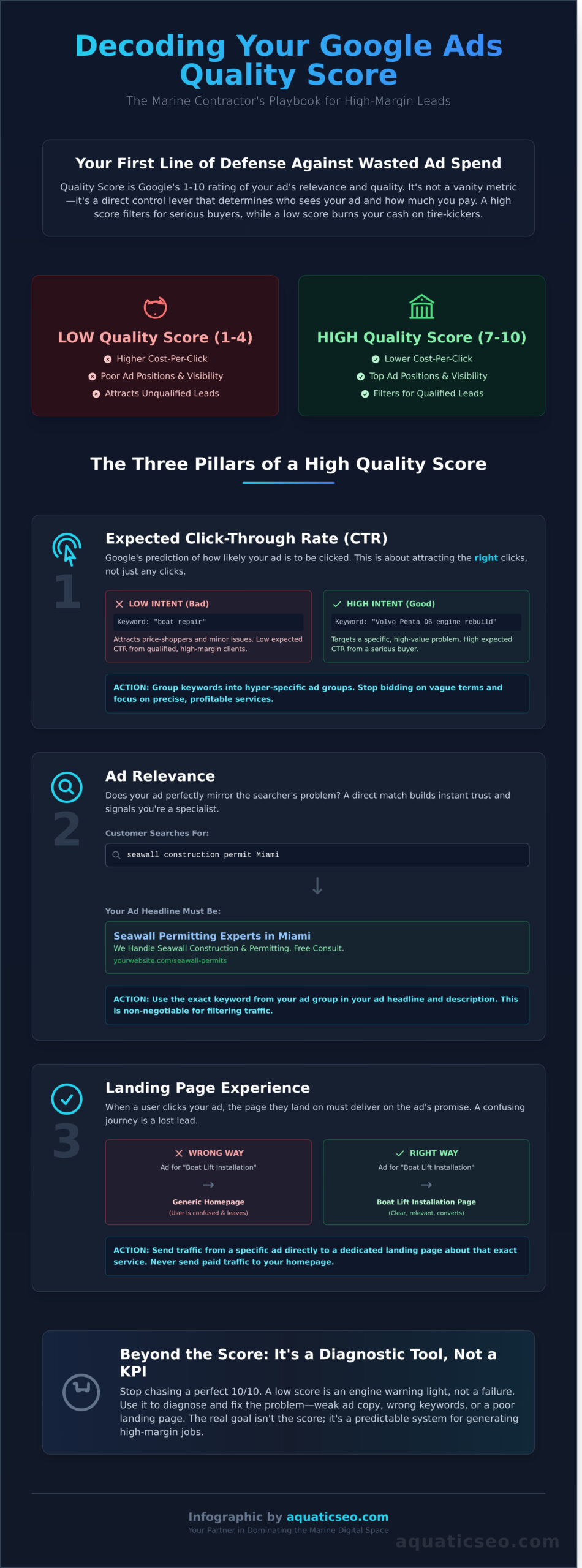
First, let’s get one thing straight: while many people search for the term ‘google ad score’, the official name is Quality Score. Think of it as Google’s rating of your ad’s overall relevance and quality, on a scale from 1 to 10. This isn’t a vanity metric for agencies to brag about; it’s a direct control lever on your ad spend and visibility.
A high score tells Google you are a high-quality solution for a searcher’s problem, and they reward you with lower costs and better ad positions. A low score means you’re burning cash showing the wrong ad to the wrong person-the opposite of the demand control needed for a stable, profitable marine business.
The Three Core Components, Explained for Business Owners
Your Quality Score is not a random number. It’s a calculation based on three core factors. You don’t need to be an expert, but you must understand the fundamentals:
- Expected Click-Through Rate (CTR): This is Google’s prediction of how likely someone is to click your ad when it’s shown for a specific keyword. It’s a measure of how compelling your ad message is.
- Ad Relevance: Does your ad directly relate to the keywords you’re bidding on? If someone searches for “fiberglass hull repair,” an ad about “general boat maintenance” is irrelevant and will earn a low score.
- Landing Page Experience: When a potential client clicks your ad, does the page they land on deliver on the promise? The page must be clear, relevant to the ad, and easy to navigate.
Why Google Cares: It’s Their Business Model
Google doesn’t reward you out of kindness. Their entire business model depends on giving users the best, most relevant answers to their questions. To understand their system, you have to understand what Quality Score is at its core: a mechanism to protect their user experience. High-quality, relevant ads are part of that experience. Ads that waste a user’s time are a liability. They systematically reward advertisers who help them and penalize those who get in the way.
Quality Score is a Diagnostic Tool, Not a KPI
This is where most marketing agencies get it wrong. They chase a perfect 10/10 score as the ultimate goal, wasting your time and money. Your Quality Score is not a Key Performance Indicator (KPI); it is a diagnostic tool. A low score is like an engine warning light-it tells you exactly where to look for a problem. Is your ad message weak? Is your landing page failing to convert? Use your Quality Score to diagnose and fix the system, then get back to focusing on the real goal: booking more qualified, high-margin jobs.
The Three Pillars of Quality Score: A Marine Contractor’s Playbook
Let’s move beyond theory. A high google ad score isn’t an abstract marketing goal; it’s a powerful operational tool. It acts as a filter, separating high-value clients from the low-margin, time-wasting inquiries that disrupt your schedule. Mastering its components means aligning your ads with the high-intent searches of qualified buyers who need your specific expertise.
Here’s the playbook for marine construction, yacht services, and boatyards.
Pillar 1: Expected Click-Through Rate (CTR)
This is about relevance, not volume. A high CTR from the wrong audience is a liability, not an asset. A general keyword like ‘boat repair’ will attract price-shoppers with minor issues. Its expected CTR for a qualified lead is low. In contrast, a specific search for ‘Volvo Penta D6 engine rebuild’ has a much higher expected CTR from a client with a serious, high-margin problem. Your job is to attract the second one exclusively.
Action: Group your keywords into hyper-specific ad groups. Stop bidding on vague terms and focus on the precise, profitable services you want to dominate.
Pillar 2: Ad Relevance
Your ad must act as a perfect mirror to the searcher’s stated problem. If a property manager searches for ‘seawall construction permit Miami’, your ad headline must scream ‘Seawall Permitting Experts in Miami’. A generic ‘Marine Contractor’ headline is invisible. This direct match signals that you are the specialist, not a generalist, instantly building trust and capturing the click from a serious buyer.
Action: Use the exact keyword from your ad group in your ad headline and description. This simple discipline is non-negotiable for filtering out unqualified traffic.
Pillar 3: Landing Page Experience
The #1 mistake that wastes ad spend is sending all traffic to your homepage. A click from an ad for ‘boat lift installation’ must go directly to a page exclusively about your boat lift installation services. Forcing a qualified lead to navigate your homepage to find what they need is a guaranteed way to lose them. As industry leader Search Engine Land explains, a coherent user journey is critical, and their guide on 4 steps to improve your Quality Score reinforces this principle.
Action: Create dedicated service pages that match your ad groups and ad copy. The page must fulfill the promise made in the ad, providing all necessary information to convert that specific, qualified inquiry.
How Quality Score Directly Impacts Your Margins and Job Flow
Let’s connect the dots. A high google ad score isn’t some abstract metric designed to please an algorithm; it’s a direct lever on your company’s bank account. This isn’t about vanity-it’s about building a more stable, profitable marine business with predictable job flow. The score directly influences your Ad Rank, which determines if your ad even shows up for a valuable search. Improving it is one of the highest-leverage activities you can perform in your paid advertising system.
The Ad Rank Formula: Win Better Positions for Less Money
Google’s auction isn’t a simple highest-bidder-wins game. It’s smarter. Ad position is determined by a simple formula: Ad Rank = Your Maximum Bid x Your Quality Score. This is your key to stop fighting a dollar-for-dollar battle with competitors who just throw money at the problem. A score of 8/10 with a $5 bid beats a competitor’s score of 4/10 with a $9 bid. You win the better position for nearly half the cost, shifting the competition from price to pure quality.
Slashing Your Cost Per Qualified Lead
Google actively rewards advertisers who provide a great user experience. A high Quality Score is your proof, and your reward is a literal discount on your cost-per-click (CPC). This isn’t a small change; a top-tier score can cut your click costs by up to 50%. This means every dollar you invest goes further, attracting more qualified customers who are actively searching for your high-margin services. It systematically lowers your customer acquisition cost and pads the margins on every job you book.
Dominating Your Service Area for High-Value Keywords
A superior google ad score directly increases your ‘impression share’-the percentage of time your ads appear when your most important keywords are searched. It ensures you are consistently visible when the most qualified customers are looking for services like gelcoat restoration or marine electronics installation. You capture the best leads before your low-score competition even gets a chance to show their ad. Not sure how your campaigns stack up? Get a no-BS analysis of your current campaigns.
Action Plan: 4 Steps to Improve Your Quality Score This Week
Theory is useless without action. This is a practical, operational checklist to improve your ads, not a list of vague marketing tips. Executing these steps will force you to clarify your ideal client and your core offer. This is the foundation of a system that filters demand and attracts high-margin work, not one that just generates more clicks.
A higher google ad score is simply the byproduct of a well-built system that delivers value to the right prospects. Let’s get to work.
Step 1: Perform a Keyword-Ad Group Audit
Your ad groups must be tight. A disorganized account with broad, mismatched keywords is the fastest way to kill your Quality Score and waste your budget. Your goal is extreme relevance.
- Enforce Structure: Limit each ad group to no more than 5-10 highly similar keywords. The more specific, the better.
- Divide and Conquer: Split vague groups like “marine services” into specific, high-intent groups like “dock piling repair,” “mobile marine mechanic,” or “fiberglass boat repair.”
- Cut the Dead Weight: Pause or remove any low-performing, irrelevant keywords. They are dead weight, costing you money and dragging down your account’s performance.
Step 2: Write Ad Copy That Attracts and Repels
Your ad copy must act as a filter. Its job is to attract your ideal customer and actively repel everyone else. Stop paying for clicks from tire-kickers and bad-fit inquiries who will never convert.
- Use Qualifiers: Add words like “Commercial,” “Certified,” “Luxury,” or “Vessels Over 50ft” directly into your headlines to pre-qualify prospects.
- State What You Don’t Do: An ad that clearly says “Commercial Vessel Repair Only” immediately saves you from wasting money on calls about jet skis.
Step 3: Match Your Landing Page to Your Ad
When a user clicks your ad, the landing page must deliver exactly what was promised. Any disconnect creates friction, kills conversions, and signals a poor experience to Google. This is a non-negotiable step for improving your google ad score.
- Match the Message: The headline on your landing page must directly reflect the headline of the ad they just clicked. No exceptions.
- Provide a Clear Path: The user should immediately see a prominent phone number to call or a simple contact form to fill out. Don’t make them hunt for it.
- Build Immediate Trust: Display photos of your completed work, relevant industry certifications (e.g., ABYC), and strong testimonials from real clients.
Beyond the Score: Quality is a System, Not a Number
Let’s be direct: your goal is not a 10/10 Quality Score. Your goal is a full schedule of high-margin work from qualified clients. Too many marine businesses get lost chasing vanity metrics, forgetting what actually impacts the bottom line. The score is not the prize; it’s a symptom.
A high Quality Score is simply the natural result of a well-run demand generation system. When your message, your audience, and your offer are perfectly aligned, Google rewards you. This is the core philosophy behind our Marine Demand Control System-focus on the inputs, and the right outputs will follow.
The Danger of Chasing a Perfect Score
Obsessing over the score itself is a critical error. An 8/10 score on a keyword like “custom yacht refit” that generates $50,000 jobs is infinitely more valuable than a 10/10 on a junk keyword like “free boat plans.” Don’t get distracted. The only metric that matters is the quality and margin of the lead generated. Focus on the business result, not the platform’s grade.
Making Quality Score Work for You, Not the Other Way Around
Instead of chasing the score, use it as a diagnostic tool. A low google ad score is a red flag. It’s Google telling you that your ad, your keywords, and your landing page are not connecting with a potential customer’s problem. The signal is clear: there is a disconnect in your marketing message.
The fix isn’t to endlessly tweak the campaign for a better grade. The fix is to solve the underlying business problem. Refine your message. Clarify your offer. Ensure your landing page directly answers the searcher’s intent. When you fix the core message, the score takes care of itself.
This is the difference between simply running ads and taking control of your demand. A system doesn’t chase metrics; it produces predictable outcomes. It’s time to stop worrying about the score and start building a system that delivers qualified inquiries and operational stability.
Ready to build a system that gets results? See how our Demand Control System works.
Your Google Ad Score is a Lever for Control-It’s Time to Pull It
Mastering your Quality Score is not about chasing a perfect number. It’s about building a system that filters out tire-kickers and brings in high-margin jobs. By focusing on ad relevance, landing page experience, and click-through rate, you directly lower your ad spend and increase your operational stability. A high google ad score is the outcome of a well-oiled machine that prioritizes qualified inquiries over vanity traffic.
If you’re done with agencies that promise clicks but deliver chaos, it’s time for a different approach. We are not another agency; we are a growth partner. Our Marine Demand Control System is designed to give you absolute control over your job flow, ensuring your ad budget translates directly into profitable work.
Let us show you exactly where your ad spend is leaking and how to fix it. Request a No-BS Analysis of Your Google Ads Performance.
The control you’ve been looking for is one click away.
Frequently Asked Questions
What is a good Google Ads Quality Score?
A score of 7/10 is the minimum acceptable benchmark. Anything lower signals a critical disconnect between your ad, your keywords, and your landing page, which wastes budget on unqualified traffic. We target scores of 8-10 to ensure every dollar is spent attracting high-margin clients for your marine business. The goal is operational efficiency and attracting qualified inquiries, not chasing vanity metrics like clicks or impressions.
How long does it take to improve my Quality Score?
Improvement is not about time; it’s about systematic action. With precise, targeted changes to ad relevance and landing page experience, you can see score increases in as little as a few days to a week. The key is implementing a system that enforces alignment between what a potential client searches for and the solution you present. Waiting and hoping for better results is not a strategy for controlling your lead flow or your schedule.
Why is my Quality Score low even if my click-through rate is high?
A high click-through rate (CTR) with a low score means you are effective at getting clicks but fail to deliver on the ad’s promise. This points to a severe breakdown after the click, usually on your landing page. Your page likely doesn’t match the ad’s message, which frustrates users and wastes your ad spend. Our system ensures total alignment from keyword to conversion, optimizing for qualified clients, not just empty traffic.
Can I see my Quality Score for the entire account or ad group?
No. Google reports Quality Score at the keyword level because it is a precise diagnostic tool, not an account-wide vanity metric. An ad group or account average hides the specific operational problems that are draining your budget. You must analyze scores keyword by keyword to gain granular control over your ad performance. Vague, aggregated data prevents you from making the decisions needed to dominate your market.
Does changing my bid affect my Quality Score?
Your bid amount does not directly influence your Quality Score components. However, a superior score gives you powerful operational leverage. A high Google ad score directly improves your Ad Rank, which can significantly lower your actual cost-per-click and secure better ad positions. The objective isn’t to outbid your competitors; it’s to out-optimize them with a more relevant, efficient system that drives down your client acquisition cost.
Is a 10/10 Quality Score even possible for my niche keywords?
Yes. A 10/10 score is not a myth; it is the direct result of a perfectly executed system. For specific marine keywords like “fiberglass boat hull repair” or “custom marine canvas installer,” achieving a perfect score is entirely possible. It demands absolute precision in aligning the keyword, ad copy, and landing page to the user’s intent. This is how you capture the most qualified inquiries and gain control over your niche.