
You’ve likely felt the frustration of a full inbox that results in zero signed contracts. It’s exhausting to chase prospects who disappear the moment you provide a quote. This article will show you how to stop wasting time on low-margin leads by implementing a system that captures high-intent marine buyers. We’ll break down the mechanics of automated qualification and how to generate a predictable flow of Qualified Inquiries while regaining control over the projects you accept.
Key Takeaways
- Learn what is a demand filtering system and how it functions as a defensive business asset to protect your team’s time from low-value inquiries.
- Discover how to use active disqualification to separate casual price-shoppers from high-intent buyers before they ever pick up the phone.
- Identify the specific “Ideal Fit” traits that allow you to prioritize high-margin projects over the low-value jobs that drain your resources.
- Shift your focus from generic lead volume to Qualified Inquiries to stabilize your revenue patterns and increase your profit per job.
- Explore the Marine Demand Control System, a proprietary methodology that replaces the “shotgun” approach of traditional agencies with surgical precision.
Defining Demand Filtering for Marine Operations
A demand filtering system is a methodical framework designed to identify and separate high-intent buyers from low-margin inquiries before they ever reach your sales team. When you ask what is a demand filtering system, you’re looking for a mechanism that prioritizes lead quality over volume to protect your operational capacity. Unlike generic marketing strategies that obsess over form fills, this approach ensures your staff isn’t bogged down by administrative noise. For Boat Dealers and Service Yards, this system acts as a specialized gatekeeper that rejects price-shoppers and redirects focus toward high-margin projects.
To understand Defining Demand Filtering in a professional context, you must first recognize the difference between a name in a database and a real business opportunity. A Qualified Inquiry is a prospect with both the specific intent to purchase and the financial health to book your service without haggling over standard rates. By implementing these filters, you stop treating every click like a potential sale and start treating your time as your most valuable asset.
Why Lead Volume is a Vanity Metric
High website traffic is often a trap for Marine Contractors. If your analytics show thousands of visitors but your shop floor is empty, those numbers are meaningless. Traditional agencies love to report on engagement counts because they’re easy to inflate, but these metrics rarely correlate with consistent job flow or revenue stability. Understanding what is a demand filtering system allows you to identify the tire kicker as the primary contaminant in your sales funnel. These individuals consume hours of technical consultation only to disappear when the invoice arrives; a high-volume approach just increases your cost of doing business.
Filtering for the Marine Industry
Effective filtering requires precision in terminology and intent. A Yacht Charter prospect seeking a crewed experience is fundamentally different from someone looking for a boat rental. If your marketing doesn’t distinguish between the two, you’ll burn your budget chasing low-value inquiries that your operation isn’t built to serve. Similarly, a Service Yard needs filters that target complex refits rather than the transient dockage inquiries handled by a marina. Chasing low-margin leads is a direct drain on the resources you need to secure high-value contracts.
The Three Stages of a High-Performance Filtering System
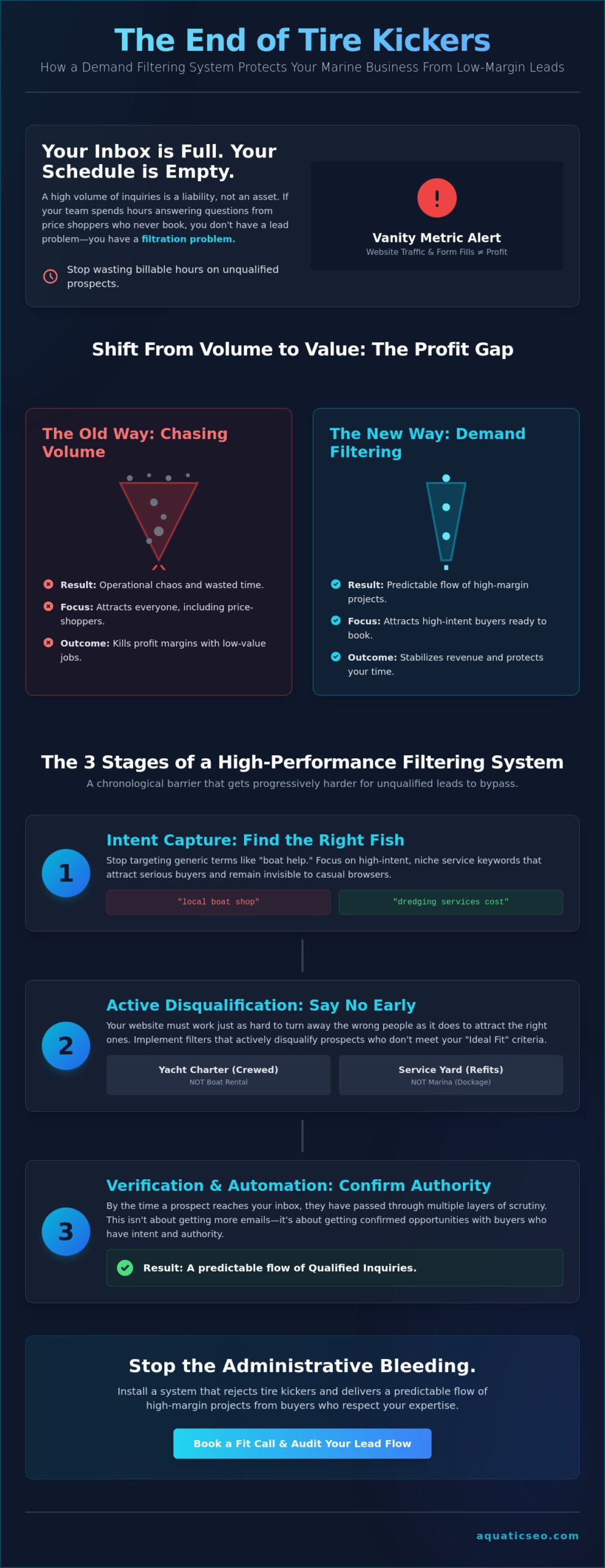
A high-performance filtering system operates in three distinct phases to ensure your sales team doesn’t waste time on low-value noise. When exploring what is a demand filtering system, you must view it as a chronological barrier that gets progressively more difficult for unqualified leads to bypass. This isn’t about being “friendly” to every visitor; it’s about being profitable. The process moves from capturing intent to active disqualification, ending with a verification step that confirms buyer authority.
This systematic approach replaces the chaotic “first come, first served” model that plagues most boatyards. By the time a prospect reaches your inbox, they’ve already passed through multiple layers of scrutiny. You aren’t just getting more emails; you’re getting better opportunities. If you’re ready to stop the administrative bleeding, you can book a fit call to audit your current lead flow.
Intent Capture: Finding the Right Fish
Generic search terms like “boat help” or “local boat shop” attract everyone from teenagers to window shoppers. You need to focus on precision by targeting niche services such as marine construction operations. A prospect searching for “dredging services cost” has a far higher intent than someone looking for “cool boats.” Specific terminology act as a magnet for high-value prospects while remaining invisible to casual browsers. Using Identifying High-Intent Marine Buyers as your strategy ensures your SEO is rooted in actual economic data rather than guesswork.
Active Disqualification: Saying No Early
Your website should work just as hard to turn away the wrong people as it does to attract the right ones. If you operate crewed vessels, your content must explicitly state why you are not a boat rental service for casual weekenders. Use price transparency or minimum project requirements as professional filters that drive away low-budget seekers before they can clutter your CRM. There’s an immense sense of relief in having a system that rejects bad fits automatically. It frees your team to focus on Qualified Inquiries that actually have the financial health to book a high-margin job.
Verification: Confirming Authority
The final stage involves intentional friction. Ask for specific vessel details, HIN numbers, or project timelines in your contact forms to separate serious buyers from the curious. If a lead isn’t willing to provide basic technical information, they’re rarely a high-intent buyer. This verification confirms they have both the authority and the urgent need to proceed with a professional contract. You’re no longer chasing ghosts; you’re managing a predictable pipeline of verified demand.
Qualified Inquiries vs. Lead Volume: The Profit Gap
Most marine businesses are drowning in work but starving for profit. A high-volume, low-filter approach creates an “Atelier” problem. You end up performing complex, custom work that’s chronically underpriced because you’re afraid to let any inquiry go. When you grasp what is a demand filtering system, you realize that every low-margin job you accept is a direct theft of resources from your high-value opportunities. If your crew is busy fixing an aging outboard for a price-shopper, they aren’t available to prep a 60-foot vessel for a high-margin yacht charter booking. You’re trading your limited operational capacity for pennies while the big fish swim past.
The Hidden Cost of Unqualified Leads
Dead-end inquiries are expensive. Calculate the time your best mechanics or top-tier salesmen spend on the phone with people who will never buy. These tire kickers disrupt your service schedule. They create operational chaos that ripples through your entire Service Yard. Every hour spent explaining technical specs to an unqualified prospect is an hour of billable time you’ll never recover. This is why many Boat Dealers feel busy but stay broke. They’re mistaking movement for progress and volume for value. You don’t need more emails; you need more Qualified Inquiries that respect your expertise and pay your full rate.
Stabilizing Your Job Flow
Demand filtering stabilizes your revenue by ensuring a consistent job mix of high-profit projects. It allows for surgical precision in scheduling maintenance and refits. You move from a reactive state of taking whatever comes in to an active state of selecting what pays best. This shift provides a psychological benefit. You’ll gain the confidence of knowing every inquiry in your CRM is a potential winner rather than a possible waste of time. By implementing a systematic approach, you regain control over your shop floor and your financial health. You can find more details on this methodology in our Marine Demand Control System guide. It’s time to stop chasing every splash and start targeting the wake that matters.
A robust system doesn’t just find buyers; it validates them. It ensures that the person asking for a quote has the financial health to sustain a long-term relationship with your brand. When you define what is a demand filtering system for your specific operation, you’re building a defensive asset. This asset protects your margins from the erosion caused by low-intent browsers and allows your team to focus on the craftsmanship that built your reputation.
Setting Your Filters: Identifying High-Intent Marine Buyers
You can’t filter effectively if you haven’t defined your “Ideal Fit” client. This process involves looking beyond the vessel and analyzing the owner’s urgency, technical requirements, and financial health. When you define what is a demand filtering system for your specific niche, you’re setting the rules for who gets to speak with your team. If you’re a Boat Dealer, your filters should distinguish between a buyer for a new $500,000 center console and someone browsing the pre-owned market for a project boat, especially since used boats accounted for over 78% of transactions in 2024.
Using “Industry-Native” language is your first line of defense. Generalist agencies don’t know the difference between a service yard and a marina, and your prospects can tell. When your content speaks with the authority of a seasoned operator, you signal to high-intent buyers that you understand their world. This immediately alienates low-value leads who are looking for the cheapest “boat guy” rather than a professional partner. It’s a deliberate strategy to ensure your staff only manages Qualified Inquiries that fit your operational strengths.
Terminology as a Filter
Precision in your vocabulary acts as an automatic barrier. Using the term “Yacht Charter” instead of “Boat Rental” immediately filters for individuals seeking crewed, luxury experiences rather than casual weekenders. For specialized maritime services like Cozumeldivehub, using precise terminology is essential to separate serious enthusiasts from casual inquiries. This simple shift in language targets a higher net-worth demographic and reduces the time you spend explaining why you don’t offer hourly rentals. Specificity is your greatest asset when attempting to capture demand from serious owners.
Technical language also attracts Marine Mechanics and Electricians who require expert-level support. If you use generic terms, you’ll attract generic problems that carry low margins. Correct industry definitions are the foundation of professional credibility and the primary way you verify intent in 2026. You want your marketing to act as a mirror that only reflects the needs of your ideal client base.
Form Optimization for Quality
Stop using “Quick Contact” boxes that only ask for a name and email. These invite low-intent clicks and automated spam that clutter your CRM. A high-performance system for a Marine Surveyor should ask for vessel type, location, and survey urgency to score leads immediately. If a prospect isn’t willing to spend sixty seconds providing vessel details, they aren’t ready to sign a contract.
Longer, more specific forms act as an intentional friction point. While generalists fear “losing leads,” you should welcome the disqualification of anyone who isn’t serious. You can audit your lead quality today to identify exactly where your current forms are failing you. Automated replies can then set expectations and provide pricing ranges, further disqualifying bad fits before they ever reach your keyboard. This ensures your sales team focuses entirely on high-margin projects that drive actual growth.
Implementing the Marine Demand Control System
The Marine Demand Control System is our proprietary methodology for capturing and filtering demand. It replaces the “shotgun” approach of generic agencies with a surgical focus on high-intent buyers who are ready to commit to high-margin services. When you ask what is a demand filtering system, you’re asking for a way to regain control over your shop floor and your schedule. We focus on the job flow and financial health of your marine business, not just clicks or impressions that lead nowhere. You can find more context on how we structure these outcomes in our Marine Marketing Ultimate Guide.
This system acts as a shield for your operational capacity. It ensures that your team isn’t distracted by low-value noise while high-margin opportunities are waiting for a response. By the time a prospect reaches your inbox, they’ve already been vetted for intent and financial health. You’re no longer a victim of market fluctuations; you’re a specialist operator with a predictable pipeline.
Precision Over Volume
We reject vanity metrics and engagement counts that don’t lead to revenue. If a marketing strategy results in a thousand website visits but zero Qualified Inquiries, it’s a failure of the system. Our methodology provides oversight and control over your job mix, ensuring you aren’t forced to accept low-margin work just to keep the lights on. We are the specialized partner for businesses that value quality over volume and profit over popularity. Understanding what is a demand filtering system allows you to stop playing the volume game and start playing the margin game.
Your Next Steps to Control Demand
Stop accepting every inquiry that hits your inbox. Start filtering for profit by identifying the projects that actually move the needle for your bottom line. You deserve a marketing partner that understands the difference between a marina and a service yard. Request a No-BS analysis of your current marketing waste to see exactly where your budget is being burned on tire kickers who will never book. It’s time to stabilize your revenue patterns and secure the financial health of your operation.
The transition from a generalist approach to a filtered system is the most significant move you can make for your business in 2026. It protects your crew from administrative burnout and protects your brand from the erosion of low-value work. Ready to stop wasting leads? Book a Fit Call with our team today.
Synthesis Summary
Demand filtering is a defensive business asset that treats your time as a finite resource. By the time a prospect speaks to you, they should already be disqualified or verified through a systematic framework of intent capture and active friction. This ensures every conversation has a high probability of conversion, allowing you to prioritize high-margin projects over the low-value noise that drains your resources.
Regain Control of Your Operational Capacity
Stop letting unqualified inquiries dictate your daily schedule. By now, you understand that what is a demand filtering system is actually a protective barrier for your profit margins. It’s the difference between a shop floor filled with low-margin busywork and a yard optimized for high-value refits and sales. You don’t need a higher volume of leads; you need a surgical focus on the Qualified Inquiries that respect your expertise and your rates.
We specialize in helping Marine Contractors and Yacht Dealers reject vanity metrics in favor of tangible revenue stability. Our proprietary Marine Demand Control System methodology ensures your job flow remains consistent and profitable. Stop burning your marketing budget on generic strategies that attract the wrong crowd. You can Request a No-BS Marine Marketing Analysis today to identify the waste in your current funnel. It’s time to reclaim your time and focus on the craftsmanship that built your reputation.
Frequently Asked Questions
Is a demand filtering system just another name for a CRM?
No, a CRM is simply a database for storing contact information; a demand filtering system is the strategic methodology that uses specific criteria to qualify or disqualify that data. While you might use a CRM to manage the workflow, the system itself is the logic that prevents low-value inquiries from reaching your sales team. It’s the difference between a storage bucket and a precision filter.
How does demand filtering differ from traditional lead generation?
Traditional lead generation rewards volume and focuses on engagement counts that often lead to administrative bloat and wasted time. In contrast, what is a demand filtering system is a defensive strategy that prioritizes Qualified Inquiries over raw numbers. It shifts your focus from how many leads you captured to how many of those inquiries have the financial health to book high-margin work.
Can a small yacht charter business benefit from a filtering system?
Small yacht charter operators benefit most because they often lack the administrative staff to handle constant price-shoppers. When you only have one or two vessels, every hour spent on a boat rental inquiry that doesn’t fit your crewed model is a direct financial loss. Implementing these filters ensures your limited calendar stays open for high-intent, high-margin guests who value professional service.
What happens if the system filters out a potentially good lead?
The system is designed to filter for your “Ideal Fit,” so a lead that refuses to pass through basic friction points is statistically unlikely to be a high-margin client. While you might occasionally miss a prospect, the time saved by disqualifying hundreds of tire kickers allows you to provide a superior experience to your best customers. It’s a trade-off that favors operational stability over desperate volume.
How long does it take to see results after implementing a demand filtering system?
You’ll see an immediate reduction in administrative noise and low-value emails within the first 30 days of implementation. The impact on your profit margins usually follows your typical sales cycle as your team spends more time closing high-intent prospects. By the second quarter, most marine businesses report a more predictable job flow and significantly higher employee morale.
Do I need to change my website to use a demand filtering system?
Yes, your website must evolve from a generic brochure into an active disqualification tool. This involves updating your terminology, refining your contact forms to score intent, and using “Industry-Native” language to signal your exclusivity. These changes transform your site into a 24/7 gatekeeper that protects your billable hours and filters out automated spam.
How much does it cost to implement a Marine Demand Control System?
The cost depends on the complexity of your current sales workflow and the volume of unqualified demand you currently manage. Instead of looking at the upfront investment, consider the financial cost of your team wasting hours every week on dead-end inquiries. Our focus is on the long-term financial health of your service yard or dealership rather than generic marketing fees.
Can I use demand filtering for my marine e-commerce store?
Absolutely, especially if you sell high-ticket items like marine electronics or propulsion systems that require technical support. A demand filtering system prevents your support team from being overwhelmed by “how-to” questions from people who bought elsewhere. It ensures your technical resources are dedicated to customers who are ready to invest in professional-grade equipment and installation services.