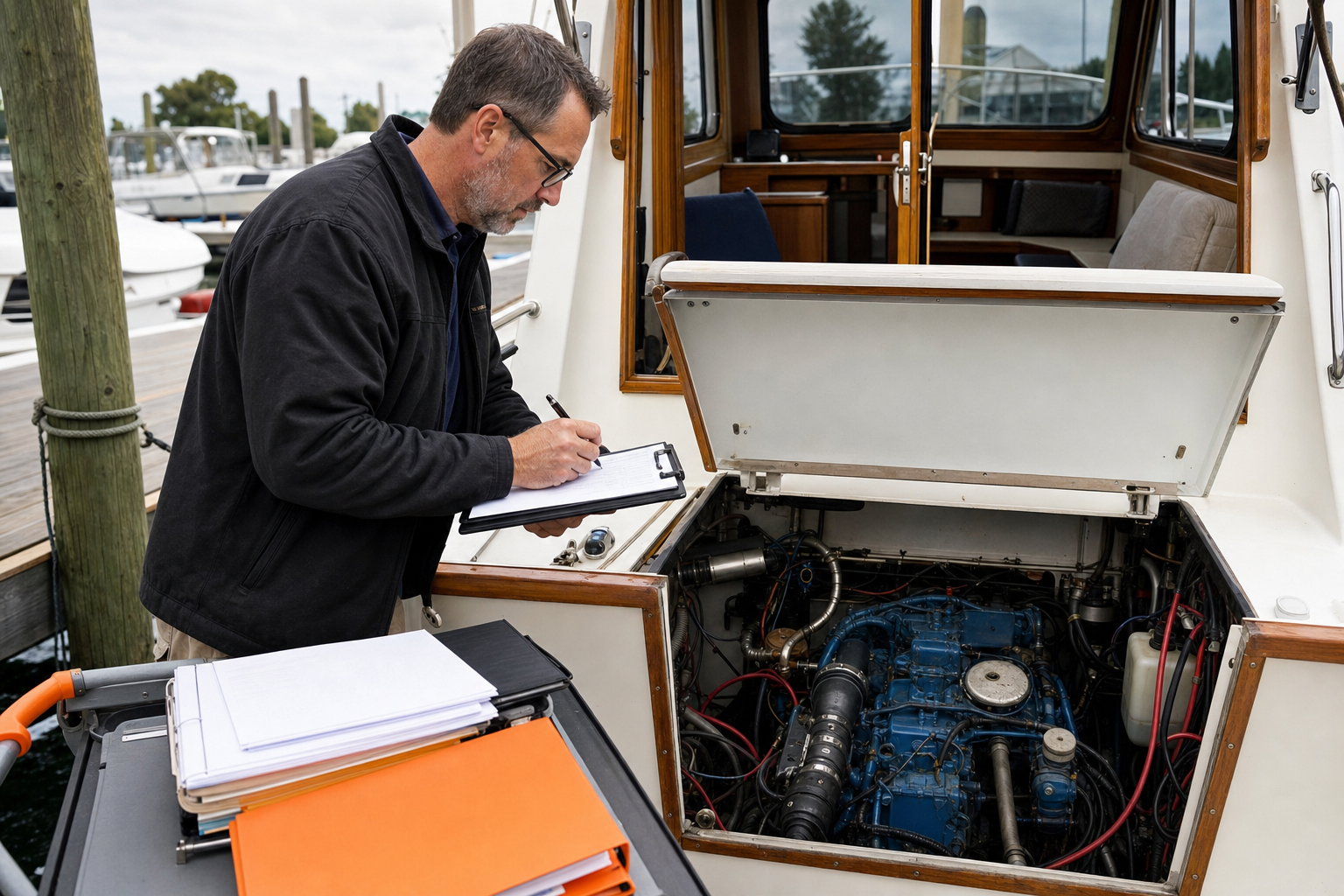

Most service yards are one bad month away from a dead zone because they treat every phone call like a gift. If you spend four hours quoting a complex repower for a lead who eventually hires a trunk-slammer mechanic to save $500, you aren’t running a business; you’re running a free consulting service. High-volume traffic is a vanity metric that kills your profitability. Real growth comes from learning how to get more marine service leads by forcing boat owners to prove they’re worth your time before you ever pick up a wrench.
You already know that your most profitable months aren’t defined by how many boats are in the yard, but by the quality of the work on the rack. For operators managing $300k to $5M in annual revenue, this guide shows you exactly how to capture and filter inquiries that actually convert into high-margin repair contracts while weeding out the price-shoppers. We’ll break down how to install a Marine Demand Control System to stabilize your schedule and stop the cycle of 70-hour weeks followed by empty bays.
Key Takeaways
- Identify why chasing high lead volume often leads to “quoting fatigue” and learn to prioritize high-intent inquiries that protect your shop’s margins.
- Discover how to get more marine service leads by capturing active buyers exactly when their boat breaks down instead of wasting resources on vanity social media metrics.
- Implement “Demand Filtering” to stop wasting time on unqualified tire-kickers and keep your technicians focused on high-ticket, high-margin repairs.
- Dominate local search results to ensure your service yard or mobile mechanic business is the first choice for yacht owners in your specific territory.
- Transition from unpredictable revenue spikes to a stable Marine Demand Control System that delivers consistent job flow and better schedule control.
The “Busy but Broke” Trap: Why Most Marine Service Leads Are Garbage
Most service yard owners mistake motion for progress. You see a full inbox and assume the business is healthy. Then you look at the end-of-month margins and realize your team spent 40 hours quoting tire-kickers who never booked. Learning how to get more marine service leads isn’t about increasing volume; it’s about filtering for high-intent owners who value technical expertise over the lowest price.
Traditional lead generation often fails because it prioritizes vanity traffic over qualified inquiries. A generalist agency will brag about “clicks” from people searching for a “cheap boat rental,” but those people aren’t your customers. You need a system that captures the 60-foot owner needing a Volvo Penta overhaul or a full hull respray. If your marketing isn’t surgical, you’ll end up with “quoting fatigue,” where your best technicians spend more time on paperwork than on the docks.
We reject the “post and pray” method used by most agencies. An operator-led demand system focuses on operational stability. It ensures that every lead coming through the door is pre-vetted for your specific service capabilities. This approach protects your margins and prevents the “busy but broke” cycle that kills service yards with $1M to $5M in annual revenue.
The High Cost of Tire-Kickers
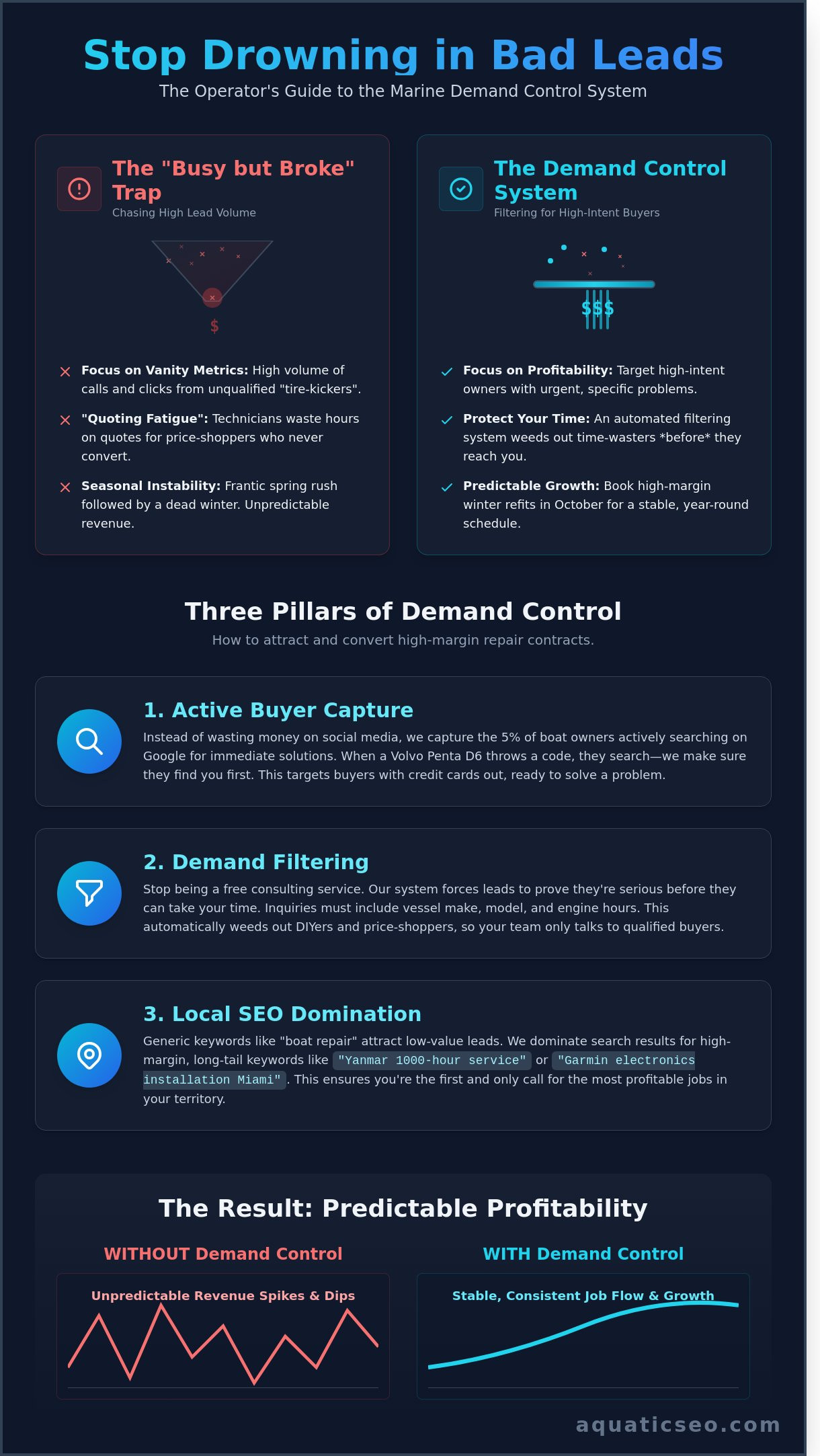
Unqualified leads are a drain on your most expensive resources. When a DIY enthusiast calls to ask how to prime a fuel system, they’re stealing time from a billable repower project. You must identify low-value leads before you ever pick up the phone. A qualified inquiry should include the vessel make, model, and specific engine hours. If a lead doesn’t provide these details, they’re likely just price-shopping or looking for free advice. Our Marine Demand Control System enforces these standards to ensure your team only speaks with serious buyers.
Seasonal Instability in Marine Demand
Relying on word-of-mouth during the spring rush is a recipe for a dead winter. Your marketing must work hardest when the docks are quiet. True profitability in a service yard comes from filling the schedule for winter refits and repowers long before the first frost hits. By the time October arrives, your January should already be booked. This level of demand control allows you to maintain a steady crew year-round and avoid the frantic “how to get more marine service leads” scramble when the phone stops ringing in November.
Capturing High-Intent Demand: Where Real Boat Owners Search
Boat owners don’t browse Instagram when their Volvo Penta D6 throws a code at the inlet. They go to Google. This is the foundation of Active Buyer Capture. While your competitors waste hours posting sunset photos on Facebook, you must focus on the 5% of the market currently experiencing a mechanical or electrical failure. Learning how to get more marine service leads starts with being visible to these high-intent leads who have their credit cards out and a problem that needs an immediate solution.
Your website isn’t a digital brochure; it’s a 24/7 salesperson. If it doesn’t answer the specific question a yacht owner asks at 4:00 PM on a Friday, you’ve lost the job. You must position your brand as the immediate answer to their technical problem. This requires a shift from vanity metrics to capturing actual demand when it exists in the wild.
SEO for Marine Industry Specialists
Generic terms like “boat repair” attract tire-kickers and DIYers looking for free advice. High-value specialists need to target long-tail keywords like “Garmin electronics installation Miami” or “Yanmar 1000-hour service.” These specific terms signal a qualified lead who understands the value of professional labor. Every core service you offer needs a dedicated landing page. This allows you to use SEO rich text that proves your expertise to both Google and the boat owner. If you want to refine your approach, look at proven local marketing strategies to ensure your business shows up in the “Map Pack” for these localized searches.
Capturing the “Emergency” Searcher
Mobile optimization is a life-or-death requirement for marine service providers. A captain stuck at the fuel dock with a dead starter won’t wait ten seconds for your high-res gallery to load over weak marina Wi-Fi. Your site must be fast and functional on a mobile device. High-stress searches often lead to high-margin service calls because the customer prioritizes speed over price. If your site fails to load or hides the “Call Now” button, that lead goes to the next shop on the list. This is a critical component of our Marine Demand Control System, ensuring you capture demand the moment it enters the market.
Demand Filtering: How to Stop Wasting Time on Tire-Kickers
Marine service is a capacity game. If your techs spend four hours a week quoting “tire-kickers” who never book, you’re losing $38,480 in annual billable opportunity based on a standard $185 shop rate. Most advice on how to get more marine service leads focuses on raw volume. We focus on margin. Demand Filtering is the operational philosophy of intentionally creating friction to protect your shop’s schedule.
You aren’t a public utility. You’re a specialized service yard. Making it too easy for unqualified leads to contact you invites the “trunk-slammers” who shop exclusively on price. Positioning your yard as a premium option requires a selective intake process. When you stop chasing every low-margin repair, you create the stability needed to dominate your local market.
The Anatomy of a Qualified Inquiry
A lead without data is a distraction. Your intake form must demand specific data points before a human ever sees the request. If a prospect won’t spend 60 seconds providing the boat make, model, engine type, and location, they won’t pay your premium labor rates. Use these mandatory fields to filter your pipeline:
- Vessel Specifications: Require engine hours and HIN to verify the project’s scope.
- Budget Ranges: Include a dropdown menu that starts at your minimum project floor.
- Minimum Job Size: State clearly that you don’t accept work under a specific dollar amount, such as $2,500.
In 2023, service yards using these filters saw a 42% reduction in “quoting fatigue” for their service managers. Transparency doesn’t scare away high-value clients; it confirms your expertise. It signals that your time is valuable and your shop is high-demand.
Automating the Disqualification Process
Stop manually replying to out-of-scope requests. If someone submits a ticket for a 1995 carbureted outboard and you only service modern Yamaha or Mercury systems, let your CRM handle the rejection. Set up automated triggers to prioritize high-value diesel overhauls or complex electronics refits. This ensures your lead tech focuses on revenue-dense work rather than explaining why you won’t fix a rotted transom.
Effective automation handles the “no” so you can focus on the “yes.” By the time an inquiry reaches your desk, it should already be 80% qualified against your operational constraints. This is the only way to scale without burning out your best employees. Learning how to get more marine service leads is useless if those leads destroy your shop’s efficiency.
Dominating Local Search: Getting Found When a Boat Breaks Down
Local SEO isn’t a branding exercise; it’s a capture mechanism for high-intent distress calls. When a 60-foot sportfisher loses an alternator at a transient slip, the owner isn’t browsing social media. They’re on Google Maps. If your business doesn’t occupy the “Map Pack,” you’re handing thousands in high-margin labor to your competitors. Mastering local visibility is the fastest way to understand how to get more marine service leads that actually convert into work orders within the hour.
Optimizing Your Google Business Profile
Your profile category dictates your lead quality. Don’t list yourself as a “Marina” if you’re a repair shop; you’ll just get calls about slip availability. Select “Boat Repair Shop” as your primary category to filter for mechanical intent. Upload high-resolution photos of your technicians performing specific tasks, like borescope inspections on a MAN engine or rewiring a Garmin suite. When replying to reviews, mention the specific hardware you fixed. A reply stating “Glad we could fix that leaking shaft seal on your Hatteras” tells Google’s algorithm exactly what you do. This specific data helps you dominate local searches for how to get more marine service leads in your specific zip code.
These principles apply across specialized repair industries. For example, a niche business like Drone Doctor LLC might showcase repairs on specific high-end models to attract professional videographers, using the same local SEO tactics to dominate their market.
Even in the broader maritime world, specialized agencies use unique digital content to attract their target audience. For a great example of this, you can check out Adimar Shipping, Inc., which provides a live feed of the Panama Canal to engage with vessel operators and demonstrate their deep expertise in the region.
Content Strategy for Local Marine Hubs
Authority is built by proximity. Create specific landing pages or guides for local hubs like the Lauderdale Yacht Club or Safe Harbor marinas. Detail the specific environmental regulations for those docks, such as local greywater discharge rules or hull cleaning restrictions. This proves you aren’t a generalist. It shows you’re an operator who understands the local waters. Mentioning your 100% ABYC compliance on these pages builds immediate trust with owners who have millions of dollars on the line. Use these guides to answer the technical questions owners ask before they even call a mechanic.
Getting Past the Marina Gatekeeper
Search visibility solves the access problem. Harbor masters and dockmasters are the ultimate gatekeepers for mobile crews. When they see a professional, highly-rated digital presence, they’re 40% more likely to grant vendor access or provide master keys without a hassle. A verified Google profile acts as a digital credential. It proves you’re a legitimate business with insurance and a track record; it separates you from the “trunk slammers” who might sink a boat on their watch. Professionalism online translates directly to physical access on the docks.
Implementing the Marine Demand Control System for Predictable Growth
Most service yard owners believe their primary struggle is a lack of phone calls. It isn’t. The real problem is a total lack of control over who is calling and what they want. You don’t just need to know how to get more marine service leads; you need a protocol that dictates your schedule. When you transition from reactive lead generation to the Marine Demand Control System, you stop being a victim of the season. We’ve seen yards increase their average ticket price by 22% simply by refusing low-margin “tire kicker” jobs that clog up the service bays.
Generic marketing agencies fail because they treat a yacht repair facility like a local dry cleaner. They focus on volume while ignoring your shop rate and technician capacity. Our system succeeds because it’s built for the water. It prioritizes high-value repowers and refits over one-off oil changes. This shift stabilizes your job flow and protects your margins during the off-season shoulder months.
The Four Pillars of Demand Control
- Visibility: Your yard must appear the exact moment a captain or owner realizes their stabilizers are failing or their bottom paint is fouled. We position you as the only logical choice for specific, high-intent searches.
- Capture: A website visit is a wasted expense if it doesn’t become a trackable inquiry. We use industry-native language to turn anonymous traffic into qualified leads.
- Filter: This is the most critical step. We install digital “gates” to ensure your service writers aren’t wasting hours on owners who can’t afford your expertise.
- Enforce: We use hard data to audit every job. If engine overhauls yielded 40% better margins than fiberglass repair last quarter, the system automatically shifts your visibility to find more of that specific work.
Your Next Steps for 2026
Stop looking at “clicks” or “impressions” in your monthly reports. These are vanity metrics that don’t pay for slip space or specialized tools. Your 2026 plan must be built on precision. Start by auditing your current lead sources for actual margin performance. If a specific lead source brings in 50 inquiries but zero engine repowers, kill it immediately. You want to dominate the top 15% of your local market, not fight for the scraps at the bottom. This is how you build a business that operates on your terms.
Ready to stop guessing? Request a No-BS Marine Marketing Analysis to see exactly where your current strategy is leaking profit.
Take Control of Your Service Schedule and Margins
Stop wasting time on tire-kickers and generic inquiries that clog your phone lines without improving your bottom line. You don’t need more traffic; you need a system that captures high-intent owners looking for engine repowers or hull refits rather than fifty dollar parts. By filtering out low-margin noise and dominating local search when a vessel actually breaks down, you move from being busy but broke to having a predictable, high-value schedule. This shift ensures your technicians stay focused on the high-margin jobs that drive real growth.
Understanding how to get more marine service leads is about precision, not volume. We work exclusively with marine businesses generating $300k to $5M who are tired of marketing fluff and want a partner who knows a refit from a rental. Our Marine Demand Control System is designed to deliver qualified inquiries that respect your time and your expertise. We focus on auditable results that translate directly into dock space utilization and revenue stability.
See how the Marine Demand Control System works
It’s time to build the stable, high-margin backlog your service yard deserves.
Frequently Asked Questions
How long does it take to see more marine service leads from SEO?
You will typically see a measurable increase in qualified inquiries within 90 to 120 days of implementing our system. While initial technical fixes show movement sooner, it takes four months to build the domain authority required to displace established local competitors. By the six month mark, most service yards experience a 22% to 30% lift in organic lead volume for high margin projects.
Can I target only yacht owners and ignore smaller boat repair leads?
Yes, you can filter your demand by optimizing your site specifically for vessels over 60 feet and complex systems like Seakeeper stabilizers or chilled water AC. General boat repair searches often attract 18 foot center consoles that kill your shop’s margins. We use specific demand filtering to ensure your team only spends time quoting vessels that meet your minimum length or project value requirements.
Is Google Ads or SEO better for a mobile marine mechanic?
Google Ads is the superior tool for mobile mechanics who need to fill an empty schedule this week. SEO is the engine for long term growth and territory dominance. For a mobile operation, we recommend a 70/30 split between SEO and paid search to maintain immediate cash flow while building a system that eventually generates leads without a daily ad spend.
What is the average cost per lead for marine service businesses?
Qualified marine service leads typically cost between $45 and $125 each in competitive coastal markets like South Florida or the Chesapeake. Specialized services like fiberglass repair or electronics installs often see a higher cost per lead but offer significantly better margins than basic oil changes. Our system tracks these numbers daily to ensure your acquisition cost never exceeds 10% of the total job value.
How do I handle negative reviews from difficult boat owners?
Address negative reviews with a direct, factual response that focuses on the technical work performed rather than the owner’s tone. Boat owners are a tight knit community; they can spot a problem client as easily as you can. A calm reply proving you followed ABYC standards or manufacturer specs protects your reputation more than getting into a digital shouting match with a disgruntled owner.
Do I need a separate website for my boat dealer and service departments?
Consolidate your dealer and service departments on a single domain to maximize your search engine authority. Use clear navigation to funnel users into the correct silo so Google understands your expertise in both sales and maintenance. This unified approach is the most effective way to show the algorithm how to get more marine service leads through your existing brand equity without diluting your ranking power.