
Stop celebrating “more traffic” when your service bays are empty three weeks out of the month. Most marine marketing agencies brag about hits, but 92% of that traffic will never book a $20,000 repower or a high-margin refit. You’re likely exhausted by “tire kickers” who don’t know a trim tab from a transducer. This isn’t a visibility issue; it’s a lack of demand control. If your website doesn’t actively filter out the noise, you’ll continue wasting time on low-value inquiries that kill your margins. Successful content marketing for the marine industry isn’t about being seen by everyone; it’s about being found by the right buyer.
You already know that one qualified inquiry for a seasonal maintenance contract is worth more than fifty random clicks on a blog post about “best fishing spots.” You need a system that speaks the language of a boat owner who values expertise over the lowest price. It’s time to stop guessing why your phone isn’t ringing with the right kind of work.
We’ll show you how to transform your website into a demand-filtering engine that captures qualified inquiries and drives high-margin jobs. This guide breaks down the specific system used to replace generic SEO with assets that stabilize your schedule and target the specific jobs that actually drive profit.
Key Takeaways
- Stop chasing vanity traffic and learn how to use content marketing for the marine industry to capture qualified inquiries that actually protect your margins.
- Transform your website from a digital brochure into a “Demand Filtering” engine that qualifies leads before they ever reach your service yard or sales desk.
- Apply the “Specialization Test” to identify generic marketing advice that fails to account for the unique seasonal cycles and buyer behaviors of the marine market.
- Build a system of “Demand Compounding” that turns every article into a permanent business asset, driving auditable revenue growth rather than just meaningless clicks.
Why Most Content Marketing for the Marine Industry Sinks Your Margins
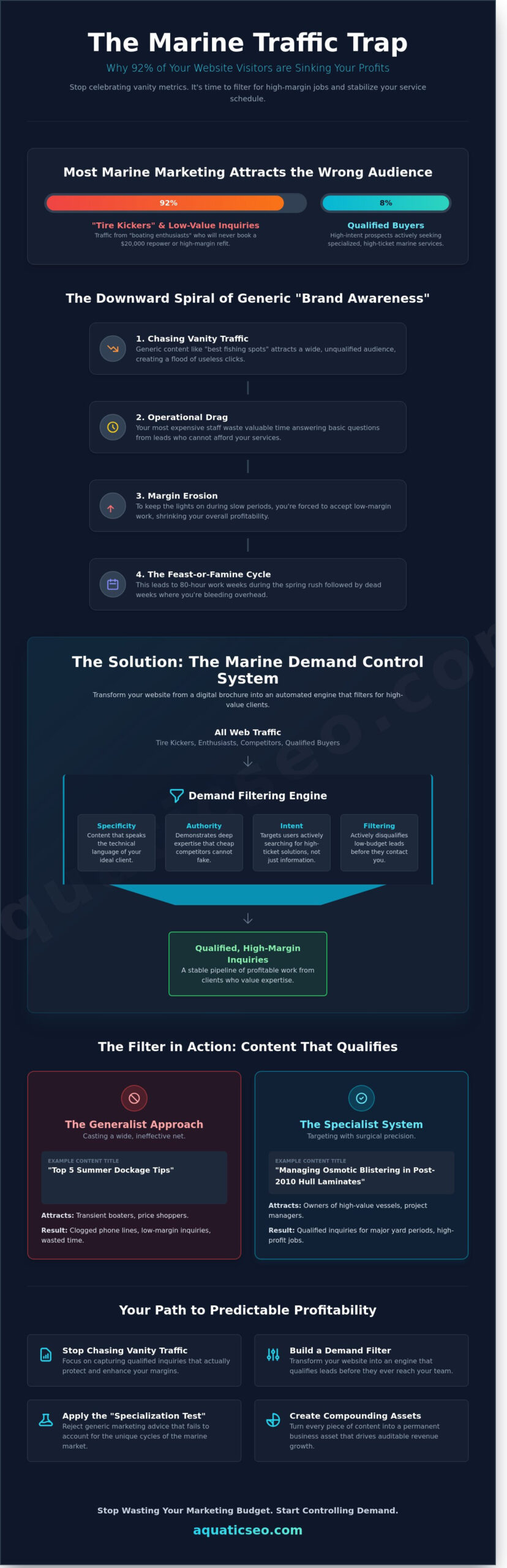
Content marketing for the marine industry isn’t about “getting your name out there” or building a digital scrapbook of pretty boat photos. It is a precise mechanism for Active Buyer Capture. Most agencies will brag about 10,000 monthly visitors while your service yard sits empty in November. Traffic is a vanity metric; bankable inquiries are the only data point that matters for your bottom line.
If your content attracts “boating enthusiasts” instead of “boat buyers,” you’re subsidizing a hobby for strangers. You don’t need more clicks. You need a system that filters for high-intent leads who can actually afford your $250,000 refit or $15,000-a-week yacht charter. Most content strategies fail because they prioritize volume over qualification, leading to a calendar full of “tire kickers” and zero schedule stability.
Generalist agencies fail because they treat a yacht brokerage like a local bakery. They don’t understand that a $2M vessel purchase has a different psychological profile than a $5 cupcake. This lack of specialization creates a feast-or-famine cycle. You face 80-hour work weeks during the spring rush followed by dead weeks where you’re bleeding overhead. This happens because you haven’t installed a system to control demand.
- The Vanity Trap: High traffic numbers often hide a 0% conversion rate for high-ticket services.
- Operational Drag: Unqualified leads force your most expensive staff to answer basic questions instead of closing deals.
- Margin Erosion: When you don’t control demand, you’re forced to take low-margin work just to keep the lights on.
The Failure of Generalist Brand Awareness
Staying “top of mind” is a strategy for soda brands, not for $1M+ marine businesses. Generalist agencies focus on entertainment rather than intent, which is an expensive mistake. Active Buyer Capture is the strategic deployment of content to intercept and convert prospects who are actively searching for high-ticket marine assets or specialized technical services. Stop trying to be famous and start being profitable.
The Cost of Misaligned Content
Generic blog posts attract low-margin “tire kickers” who clog your phone lines and waste your sales team’s time. This creates an operational nightmare where revenue grows but your actual profit margins shrink due to administrative bloat. Misaligned content forces your service yard to handle small-scale repairs instead of lucrative project work. You can learn how to fix this in our Marine Marketing: The Ultimate Guide to Attracting High-Value Clients.
The Marine Demand Control System: Engineering Content to Filter Demand
Effective content marketing for the marine industry isn’t about casting a wide net to see what sticks. It’s an engineering challenge. Our Marine Demand Control System is a proprietary growth framework that treats your website as a mechanical filter. It’s designed to capture high-intent buyers while systematically removing the noise that wastes your service manager’s time.
Content acts as the first layer of demand filtering for your business. Most agencies focus on “awareness,” which usually results in a flood of low-budget inquiries and tire-kickers. We focus on four pillars: Specificity, Authority, Intent, and Filtering. This shift moves your strategy from “Agency Speak” to “Growth Partner” logic, where we prioritize your shop’s capacity and margins over vanity metrics like page views.
Filtering Demand at the Source
Technical content is your best tool for disqualifying leads before they ever pick up the phone. If your content speaks the language of a $250,000 refit, you won’t spend your afternoon explaining why you don’t service 15-year-old outboards. Your content must be industry-native to establish immediate credibility with sophisticated owners.
Consider the distinction between a service yard and a marina. A marina might create content about “Top 5 Summer Dockage Tips,” attracting transient boaters looking for a cheap slip. A service yard using our system writes about “Managing Osmotic Blistering in Post-2010 Hull Laminates.” This specificity ensures you attract owners of high-value vessels who are ready to book major yard periods. You can audit your current content filter to see if you are accidentally attracting low-margin work.
Enforcing Schedule Stability
Seasonality is the silent killer of marine business margins. Targeted content allows you to fill specific gaps in your calendar by targeting “shoulder season” needs months in advance. By the time the November slump hits, your schedule should already be locked with winterization and indoor storage contracts generated by your summer content efforts.
We use “Demand Compounding” to build long-term visibility in niche markets like yacht brokerage or specialized engine repowers. Unlike paid ads that stop the moment you stop paying, these assets work 24/7 to maintain your lead flow. Precise content control leads to a predictable job flow that keeps your technicians 95% billable even during traditional industry lulls.
Niche-Specific Content: From Yacht Charters to Marine Service Yards
Effective content marketing for the marine industry fails when it’s built on generic templates. To dominate your local water, apply the Specialization Test. If your copy could apply to a luxury car dealership or a residential pool company, it’s garbage. High-intent buyers don’t search for “nice boats.” They search for specific technical specifications and operational proof. Your content must lead with precise terminology like LOA, draft, and stabilization systems to prove you aren’t just another generalist agency.
The strategy shifts drastically between high-ticket sales and recurring services. A $2.5 million brokerage listing requires content focused on depreciation schedules and engine hours. Conversely, a service yard needs content that emphasizes operational stability and margin protection for the owner. You’re positioning your business as the only specialized solution for a specific vessel class in your region. Using the right dialect signals to a boat owner that you’ve been in the trenches and understand their specific hull’s needs.
Yacht Charter Marketing: Booking High-Value Voyages
Stop confusing “boat rentals” with “yacht charters” in your copy. A rental is a self-driven day trip on a pontoon; a charter is a professional, crewed voyage. High-value clients searching for term charters expect details on crew-to-guest ratios and specific provisioning capabilities. Focus your content on the experience of a seven-day Exumas crossing rather than generic “trips on the water.” This distinction filters out low-budget inquiries and captures serious buyers looking for a managed experience.
Marine Construction and Service Yard Strategy
Service yards must prioritize technical expertise over lifestyle imagery. Your content should document complex repower projects, hull repairs, and electrical overhauls with surgical precision. Use case studies to show how a specific shaft alignment resulted in a 15% reduction in vibration at cruising speed. “Before and after” photos of a bottom job or a 500-hour service provide the logical proof that owners of $500,000 vessels demand. For more insights on technical positioning, read our guide on Digital Marketing for Marine Contractors.
Successful content marketing for the marine industry requires you to act as a filter. By using data-heavy content, like documenting a 22-day turnaround for a full hull repaint, you set clear expectations. This approach eliminates the “window shoppers” and attracts clients who value expert execution over the lowest price. It’s about demonstrating that you understand the 2026 demands of the water better than anyone else in your harbor.
The Specialization Test: Avoiding Generic Agency Pitfalls
Most marketing agencies are interchangeable. They use the same templates, the same tired promises, and the same lack of industry-specific logic. If you strip the logo off their pitch deck, you couldn’t tell if they’re selling to a yacht broker or a local dry cleaner. This is why most content marketing for the marine industry fails to produce a measurable return on investment.
We apply a simple “Specialization Test” to every strategy we develop. If the advice could apply to a plumber or a dentist, it’s generic trash that has no place in your business. We’ve banned words like “comprehensive,” “holistic,” and “cutting-edge” from our vocabulary. These are hollow placeholders used by generalists who don’t understand the difference between a service yard and a marina.
Aquatic SEO is not a fit for everyone. We turn away roughly 25% of inquiries because we only partner with businesses where our Marine Demand Control System can realistically deliver a 5x to 10x return. We are growth partners, not vendors. If your business model or margins don’t align with a high-performance system, we’ll tell you immediately rather than wasting your budget on “brand awareness” that doesn’t pay the bills.
Mistakes That Drain Your Marketing Budget
The “Top 10 Places to Boat” blog post is a classic trap. It generates vanity traffic from tourists and dreamers who will never spend a dollar with you. This fluff ignores the 180-day sales cycle of a high-end vessel. Generalist agencies also ignore seasonal demand cycles. Running a “spring tune-up” campaign in April is too late; your schedule should have been locked in by February using a pre-season demand capture strategy.
Content That Establishes Authority
To capture high-intent buyers, your content must read like a conversation between two industry veterans. We use specific technical standards, such as ABYC E-11 for electrical systems or MARPOL compliance, to prove expertise. This level of detail acts as a natural filter. A lead searching for “boat repair” is a tire-kicker. A lead searching for “NMEA 2000 backbone troubleshooting” is a qualified owner with an immediate problem and a high-limit credit card.
Stop wasting money on generic traffic and start capturing qualified inquiries that actually convert into revenue.
See how our Marine Demand Control System filters for high-intent buyers
The Bottom Line: Expected Results and Demand Compounding
Stop viewing marketing as a monthly bill and start seeing it as a business development asset. When executed correctly, content marketing for the marine industry creates a phenomenon we call Demand Compounding. Unlike paid ads that stop the moment you stop paying, a technical guide on hull maintenance or a breakdown of yacht ownership costs stays active. It captures high-intent buyers in 2025 just as effectively as it did the day you published it; it’s an asset that sits on your balance sheet and appreciates over time.
Success isn’t found in vanity metrics like “impressions” or “page views.” For a service yard or boat dealership, success is measured by auditable revenue growth and schedule stability. You’ll know the system is working when your sales team stops complaining about “tire-kickers” and starts handling inquiries from buyers who already understand your pricing and your process. This shift typically results in a 22% increase in high-margin project inquiries within the first six months of implementation.
Measuring What Matters for Marine Operators
Most agencies will hand you a report full of green arrows and “ranking increases.” We don’t care about that, and neither should you. You need to track the ratio of qualified inquiries against total traffic. If your traffic doubles but your service bays are still filled with low-margin “busy work” instead of $50,000 repower projects, your content is failing. You must calculate the impact of content on your job mix; the goal is to shift your schedule toward 80% high-margin operations.
The ROI of a Demand Filtering system is defined as the total value of recovered billable hours previously wasted on unqualified leads, plus the net profit from high-intent clients captured through organic search. It’s about filtering out the noise before it reaches your desk.
Next Steps for Your Marine Business
Your first step is to audit your current website for generic “agency speak.” If your content sounds like it was written by someone who has never stepped foot on a teak deck or handled a twin-engine docking, delete it. It’s actively hurting your credibility with sophisticated buyers who can spot a generalist from a mile away. You need to transition from “busy-work” marketing to a system that prioritizes margin and stability.
Don’t settle for another year of “busy weeks followed by dead weeks.” It’s time to install a predictable demand flow that works as hard as your best technician. Request a no-BS analysis of your current demand flow and let’s see where your system is leaking profit.
Secure Your Market Position with Demand Control
Stop bleeding margins on generic traffic that never turns into a signed contract. Effective content marketing for the marine industry requires more than just high volume; it demands a tactical system that filters out the noise and captures high-intent buyers ready to commit. Most agencies sell you on vanity metrics, but clicks and impressions won’t pay for your service yard technicians or slip fees.
We built the Marine Demand Control System specifically for businesses generating $300k to $5M in annual revenue. It’s a methodical approach designed to stabilize your schedule and protect your bottom line. We’re so confident in this framework that we offer a no-nonsense guarantee on the quality of inquiries hitting your inbox. If you’re a yacht charter operator or boat dealer tired of the feast or famine cycle, it’s time to switch from passive marketing to active demand engineering.
Request a No-BS Marine Marketing Analysis
Your operation is too specialized for a generalist approach. Let’s build the stability your business requires to dominate your local waters.
Frequently Asked Questions
Is content marketing for the marine industry different from SEO?
Yes, they serve different operational roles. SEO is the technical engine that drives visibility, but content marketing for the marine industry is the strategic messaging that captures and filters the buyer once they arrive. SEO gets them to the dock; content gets them on the boat. Most agencies focus on rankings alone, while a growth partner focuses on the high-intent buyers behind the search.
How long does it take to see results from a Demand Control System?
You will typically see measurable shifts in inquiry quality within 90 days. While organic search growth takes 6 to 12 months for peak performance, the Marine Demand Control System starts filtering out unqualified leads immediately. By day 45, your sales team should spend 30% less time on low-value inquiries, allowing them to focus entirely on high-margin charters or vessel sales.
Why should I focus on content if I already get word-of-mouth referrals?
Word-of-mouth is unpredictable and doesn’t scale your operations. Relying on referrals leaves you vulnerable to seasonal dips and market shifts beyond your control. Content marketing for the marine industry builds a predictable asset that works 24/7. It ensures that when a referral looks you up, they find a professional authority that justifies your premium pricing rather than a stagnant, outdated website.
What is the difference between a yacht charter and a boat rental in marketing?
A boat rental is a commodity transaction for a 20 foot center console, while a yacht charter is a high-ticket service involving a crew and custom itinerary. Marketing for rentals focuses on hourly rates and availability. Yacht charter marketing must sell the experience, the crew’s expertise, and the vessel’s specific amenities. Using rental keywords for a $5,000 day-charter attracts the wrong tax bracket every time.
Can content marketing help with seasonal dead weeks in the boat industry?
Yes, by capturing demand early and filling the calendar months in advance. Most boat dealers and charter ops wait for the phone to ring in July. A Demand Control System uses content to capture high-intent buyers in January and February. This strategy helped one Florida charter firm reduce their October dead zone by 42% through targeted destination guides published during the spring season.
Do I need to be a writer to succeed with marine content marketing?
No, you need to be a subject matter expert. Your job is to provide the ground truth about your fleet or service yard. A growth partner takes your industry knowledge and translates it into high-performing assets. We don’t need you to write; we need your 20 years of experience to ensure the content doesn’t sound like it was written by a landlocked intern at a generalist agency.
How do I know if my marketing agency is using vanity metrics?
If your reports focus on impressions, clicks, or keyword rankings without mentioning qualified inquiries or closed revenue, they’re using vanity metrics. A 50% increase in traffic means nothing if your margins are shrinking. Demand control focuses on the 5% of traffic that actually has the intent and capital to book a $10,000 service or buy a boat. Focus on bankable outcomes, not graphs.
What is the Specialization Test for marine marketing?
The test is simple: if the marketing advice could apply to a plumber or a lawyer, it fails. Marine marketing requires understanding hull types, seasonal migration, and Coast Guard regulations. If your agency doesn’t know the difference between a refit and a repair, they aren’t specialists. Our system is built specifically for the 1,200 unique variables that define the maritime business environment and buyer psychology.