
Your monthly newsletter is a waste of bandwidth that trains your best prospects to ignore you. Most dealers treat their database like a digital filing cabinet, occasionally dusting it off to blast generic updates that see a dismal 18% open rate. If you’re tired of seeing 80% of your list ignore your inventory while you pay $150 per lead to third party marketplaces, your strategy is broken. Effective email marketing for boat dealerships isn’t about “staying top of mind” with tire kickers. It’s about deploying a system that filters out looky-loos and forces high-intent buyers to raise their hands.
You already know that the months between major boat shows are often a slog, marked by inconsistent floor traffic and sales reps who waste hours chasing leads that never pick up the phone. It’s a frustrating cycle that eats your margins and creates operational instability. I’m going to show you how to transform that dormant list into a high-precision demand control tool that captures qualified buyers and accelerates inventory turnover. We’ll examine the specific sequences that move units and the exact filtering methods used in our Marine Demand Control System to keep your team focused only on high-intent inquiries.
Key Takeaways
- Stop wasting digital overhead on generic monthly newsletters and start using data-driven segmentation to match specific vessels with qualified buyers.
- Implement high-precision email marketing for boat dealerships by segmenting your database by vessel type and buyer lifecycle to ensure cruiser owners never see center console updates.
- Deploy the “Inventory Pulse” and “Service Surge” campaigns to move aged units without slashing margins and to fill your service yard during off-peak months.
- Filter out “tire kickers” using automated surveys that disqualify leads without the budget or slip availability, protecting your sales team’s time for high-value prospects.
- Execute a 90-day roadmap to clean your database and establish a demand baseline that prioritizes high-margin inventory and stabilizes your operational schedule.
Why Most Boat Dealership Email Marketing Fails to Drive Real Revenue
Most boat dealers treat their email list like a digital junk drawer. They send the same generic updates to a first-time center console buyer and a 50-foot motor yacht owner. This “spray and pray” approach is why your digital overhead climbs while your showroom floor remains quiet. Effective email marketing for boat dealerships isn’t about staying “top of mind.” It’s about controlling demand and protecting your margins.
Stop celebrating a 25% open rate if your sales team is still chasing tire-kickers. An open isn’t a deposit. A click isn’t a sea trial. If your current strategy focuses on these vanity metrics, you’re measuring activity instead of outcomes. You’re also likely training your audience to ignore you until you announce an “End of Season” fire sale. This habit forces you to compete on price alone; it’s a race to the bottom that no specialized operator should run.
The Death of the Monthly Newsletter
The monthly newsletter is a relic of the past. Sending a broad broadcast to 4,000 subscribers ignores the reality of buyer intent. A prospect who viewed a specific hull in your inventory yesterday needs a different message than a client who just brought their boat in for winterization. Most subscribers stop opening emails after the first 90 days because the content lacks relevance to their specific needs. We replace these stagnant broadcasts with intent-based triggers that fire based on real-time behavior. This ensures you’re reaching the right buyer at the exact moment they’re ready to move from the screen to the showroom.
Marketing Jargon vs. Marine Reality
Generic agencies talk about “brand awareness” because they can’t track a sale back to a specific email. In the marine industry, a “lead” is just a name; a “qualified inquiry” is a prospect with a verified budget and a clear timeline. Your CRM is likely full of the former. If your agency can’t explain how email marketing for boat dealerships should account for the February boat show rush or the July service slump, they’re hiding behind vague data. Our Marine Demand Control System focuses on auditable tracking, ensuring every email sent serves a clear operational purpose. We don’t care about clicks. We care about deposits.
The Marine Demand Control Approach to Email Segmentation
Generic newsletters are where high-margin leads go to die. If you are sending the same monthly blast to a first-time jet ski inquirer and a seasoned yacht owner, you are actively training your database to ignore you. Effective email marketing for boat dealerships requires a surgical approach to data. You must stop treating your list as a monolith and start treating it as a collection of specific vessel interests and lifecycle stages.
Segmenting by Vessel and Use Case
The Marine Demand Control System dictates that your data buckets must mirror the way boaters actually live. A buyer interested in a 32-foot center console for offshore tournaments has zero interest in the latest ballast tank technology for wake-surf boats. Sending irrelevant inventory doesn’t just waste a click; it damages your sender reputation and increases unsubscribe rates among your most qualified leads. Use these specific segments to maintain relevance:
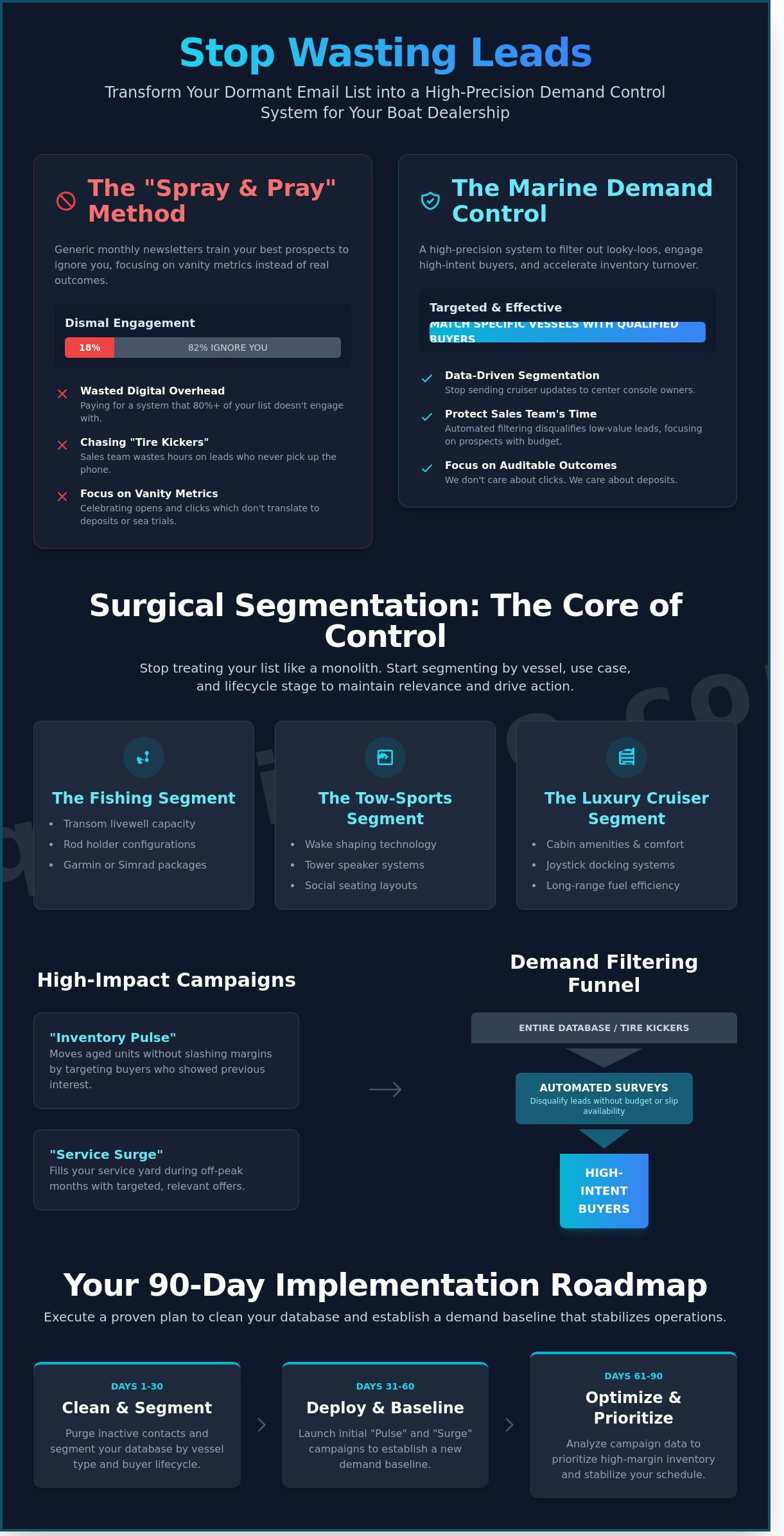
- The Fishing Segment: Focus on transom livewell capacity, rod holder configurations, and electronics packages from brands like Garmin or Simrad.
- The Tow-Sports Segment: Highlight wake shaping, tower speakers, and seating layouts designed for social interaction on the lake.
- The Luxury Cruiser Segment: Target these buyers with content regarding cabin amenities, joystick docking systems, and long-range fuel efficiency.
You should also use “Previous Purchase” data to predict the next upgrade cycle. A customer who bought a 21-foot bowrider in 2021 is statistically primed for a 25-foot upgrade by 2024. Your system should automatically move these contacts into an “Upgrade Path” segment 30 months after their initial purchase.
Trigger-Based Messaging
Automation allows your dealership to respond to buyer behavior in real time without increasing your sales team’s manual workload. Instead of waiting for a salesperson to remember to follow up, set up automated flows based on specific inventory interactions. If a lead views a specific Boston Whaler listing three times in 48 hours, the system should trigger a “New Arrival” alert for similar inventory or a notification of a price drop on that specific hull.
- Price Drop Alerts: Send these only to “watched” inventory leads to create immediate urgency.
- Geographic Filtering: Only send haul-out specials or winterization packages to clients within a 50-mile radius of your service yard or marina.
- Engagement Scoring: Assign points to every open and click. When a lead hits a specific score, they are moved from “Dreamer” to “Active Buyer” status for immediate sales intervention.
This level of precision ensures you only contact your list when you have something they actually want to buy. If your current strategy feels like a shot in the dark, it might be time to install a Marine Demand Control System to stabilize your sales pipeline. This methodical approach turns your email list into a predictable revenue driver rather than a digital filing cabinet.
4 High-Impact Email Campaigns for Boat Dealerships in 2026
Effective email marketing for boat dealerships isn’t about sending a monthly PDF of your inventory. It’s about deploying targeted strikes that solve specific operational bottlenecks. Use these four campaigns to stabilize your cash flow and protect your margins by moving away from generic blasts.
The Inventory Pulse Campaign
The Inventory Pulse is a precision tool designed specifically to slash floor-plan interest payments by liquidating units that have sat on the lot for more than 90 days. Stop leading with discounts. Instead, focus on the specific problem the boat solves, such as a shallow draft for skinny water fishing or a cabin layout that actually fits a family of five. Send a raw, three minute video walk-through to your segment of qualified leads. This builds more trust than a professional photoshoot because it shows the boat is real, ready, and exactly as described.
The Service Surge Automation
Your service yard shouldn’t fluctuate between chaos and silence. We use the Service Surge to level out your schedule during off-peak months like November and February. Trigger an automated sequence to owners whose warranties are expiring or who haven’t had a 100 hour service in six months. Offering a “winterization and storage” bundle in late September keeps your technicians billable when the showroom floor goes quiet. This ensures your operations remain profitable even when the seasonal sales cycle dips.
The VIP Boat Show Sequence
Generic invites like “Visit us at Booth X” are a waste of your database. A boat show is a high-pressure environment; you need to control the flow of your sales staff. Use your email marketing for boat dealerships to force prospects into pre-scheduled 15 minute walkthroughs before the gates even open. If a lead schedules an appointment but doesn’t show, trigger a “Sorry we missed you” video within two hours. This simple follow-up recovers approximately 22% of lost demand by offering a private sea trial the following week.
The Trade-In Appraisal Flow
Quality used inventory is the lifeblood of a high-margin brokerage. This flow targets your past buyers from three to five years ago. Don’t ask them to sell; ask them for an “Inventory Refresh Appraisal.” Tell them your Marine Demand Control System has identified a shortage of their specific model. This positions the dealership as the aggressor in the market. It allows you to capture high-quality trades before they ever hit a public listing site, keeping the entire transaction within your ecosystem.
Demand Filtering: Protecting Your Sales Team from Tire Kickers
For a boat dealership generating $2M to $5M in annual revenue, “more leads” is often a toxic metric. If your sales team spends 40 hours a month chasing unqualified inquiries for entry-level dual consoles you don’t even have in stock, your margins are dying. High-volume, low-quality lead flow creates a bottleneck that prevents your best closers from focusing on $500k center console sales.
Effective email marketing for boat dealerships isn’t about casting a wider net; it’s about tightening the mesh. Our Marine Demand Control System uses automated email surveys to enforce quality before a human ever picks up the phone. We ask the hard questions about liquid capital for $150k down payments or current slip availability in overcrowded local marinas. If a prospect doesn’t have a place to park the boat or the credit to buy it, they stay in the automated education loop. Your staff only handles “Late Stage” buyers ready for a sea trial.
Disqualification as a Growth Strategy
Credibility is built by telling the wrong buyer that a specific hull design won’t handle the chop in their specific region. We use friction-based forms in our email sequences to separate researchers from ready buyers. A simple question regarding “current boat ownership” or “intended use” can filter out 35% of low-intent noise instantly. This protects your reputation; you aren’t a high-pressure vendor, you’re the expert advisor who values the client’s time as much as your own. Handling low-margin inquiries through automated responses ensures you don’t burn your brand while prioritizing high-margin opportunities.
The Education-to-Execution Bridge
Serious owners want the truth about fuel burn at 4,500 RPM and the real cost of a 100-hour service on triple outboards. Transparency on the total cost of ownership (TCO) filters out those who can’t afford the lifestyle, leaving you with a list of qualified, educated prospects. This strategy for email marketing for boat dealerships shifts your business from a commodity shop to a growth partner. By the time a prospect speaks to a salesman, they’ve already seen the maintenance schedules and performance data. This results in a 20% faster closing cycle because the “discovery” phase happened in their inbox, not on your showroom floor.
Implementing the System: Your 90-Day Email Roadmap
The first 30 days of your roadmap are about stabilization and cleaning. Most boat dealers sit on a database where 35% to 45% of the contacts haven’t opened an email in over two years. These “ghost” leads destroy your sender reputation and push your inventory updates into the spam folder. You must stop paying for dead weight that actively hurts your deliverability.
Database Hygiene and Deliverability
A smaller, qualified list beats a bloated, generic one. If your open rates sit below 25%, your technical foundation is broken. You must verify your SPF, DKIM, and DMARC protocols immediately. These settings act as a digital passport for marine businesses, proving to mail servers that your dealership is a legitimate sender.
- The 12-Month Purge: Segment anyone who hasn’t engaged in a year and send one final, high-value offer.
- The No-BS Offer: Use a direct subject line like “Still looking for a [Brand] center console?” to trigger a binary response.
- Hard Deletion: If they don’t click, remove them. You want a list of active buyers, not a collection of digital dust.
Once the “dead wood” is gone, set your Demand Baseline. Identify your highest-margin inventory, like premium cruisers or specific service gaps in your yard during the off-season. Use email marketing for boat dealerships to point demand exactly where your dealership needs it most, rather than sending a generic “monthly update” that serves no operational purpose.
Measuring What Matters
Stop looking at “Cost Per Click.” It’s a vanity metric that doesn’t pay for floorplan interest. Effective email marketing for boat dealerships focuses on “Cost Per Qualified Inquiry” (CPQI). You need to track how many people actually requested a sea trial, a trade-in valuation, or a winterization quote after receiving an automated sequence.
Your CRM should link email activity directly to the final Bill of Sale. If a lead closes on a $350,000 brokerage listing, your system must show which nurture sequence they were in. This visibility allows you to move from manual, “spray and pray” sending to a self-sustaining demand engine that operates 24/7.
Integrating these efforts with the Marine Demand Control System provides cross-channel visibility. You’ll see how a lead captured via search matures through email before finally walking into the showroom. This isn’t about “staying top of mind”; it’s about enforcing a system that captures demand and filters out the tire-kickers.
Ready to stop wasting time on “marketing” and start driving revenue?
Turn Your Inbox Into a Predictable Revenue Engine
Most boat dealerships treat their email list like a digital junk drawer. You’ve seen why generic newsletters fail and how the Marine Demand Control System replaces fluff with 4 high-impact campaigns designed for 2026 buyers. By implementing our 90-day roadmap, you stop chasing every “is this still available” click and focus on qualified inquiries that protect your margins. This isn’t about sending more mail; it’s about enforcing a system that captures active buyers who are ready to move.
Effective email marketing for boat dealerships requires a no-nonsense focus on operations. We’ve delivered these results for marine businesses doing $300k to $5M in revenue by prioritizing schedule stability over vanity metrics. Your sales team deserves leads that are ready to sign, not just tire kickers who waste your afternoon. It’s time to stop guessing and start closing based on proven data.
Stop wasting leads and start controlling your demand. Get your Marine Marketing Analysis.
Your dealership is built on precision and performance; your marketing should be no different.
Frequently Asked Questions
Is email marketing still effective for high-end yacht sales?
Email is the most effective channel for yacht sales because it facilitates the long-term trust required for $500,000 plus transactions. A yacht buyer rarely makes an impulse purchase; they require a nurture cycle that often spans 12 to 18 months. By providing private walk-through videos and detailed survey results directly to their inbox, you stay top of mind without the high cost of repeated print advertising.
How often should a boat dealership send emails to its list?
You should send one high-value email per week to maintain consistency without hitting list fatigue. During peak buying months like March and April, increasing frequency to twice weekly helps move remaining prior-year inventory. This cadence ensures your email marketing for boat dealerships remains a tool for demand control rather than a source of annoyance that triggers unsubscribes.
What is the best way to get qualified leads for my boat dealership?
The most reliable way to capture qualified leads is through high-intent lead magnets like “2024 Center Console Price Guides” or “Off-Market Brokerage Lists.” Generic “Join our Newsletter” buttons fail because they offer no immediate value to a buyer. These specific offers filter for individuals who plan to purchase within the next 90 days, allowing your sales team to prioritize hot leads over casual browsers.
Should I buy an email list of boat owners in my area?
No, you should never buy an email list because it results in high bounce rates and can get your domain blacklisted by major providers. Purchased lists typically see open rates below 5%, whereas an organic list built through your website often sees 25% to 35% engagement. Focus on capturing the 15% of your current site traffic that is actively looking at your inventory pages instead.
How do I integrate my boat dealership CRM with email marketing?
Connect your CRM, such as IDS or BoatWizard, to your email platform using an API or a tool like Zapier to trigger automated follow-ups. When a lead views a specific 25-foot sportfish listing three times in 48 hours, the system should automatically send a personalized invite for a sea trial. This integration is a core component of a Marine Demand Control System, turning static data into active sales opportunities.
What kind of content should a marine service yard send to customers?
Service yards should send seasonal maintenance prompts and “Service Slot Alerts” to fill the schedule during slow periods like January or February. Send a specific offer for 10% off bottom painting or 100-hour engine service for bookings made during your “dead weeks.” This strategy stabilizes your labor margins and prevents the common “feast or famine” cycle that plagues most service operations.
How can I use email to increase my boat show ROI?
Increase your ROI by emailing your database a “VIP Preview” 72 hours before the show to book private walkthroughs of your flagship models. Pre-scheduled appointments close at a 35% higher rate than random walk-ins because they prioritize serious buyers over “tire kickers.” Following up with a “Show Recap” email within 24 hours of the event closing ensures you capture the 40% of sales that typically happen the week after the show.