
Most marine operators treat Google Ads like a slot machine, hoping that if they pump enough cash into marine paid search, a high-margin engine overhaul or a $50,000 yacht charter will eventually pop out. It’s a strategy that leaves your service yard full of tire-kickers and your budget drained by people looking for “free boat ramps” or “cheap rentals.”
You’ve likely felt the frustration of watching your ad spend climb while your booked revenue stays flat. You don’t need more traffic. You need qualified inquiries that fit your crew’s schedule and protect your margins.
I’ll show you how to use paid search as a precision tool to filter out low-margin inquiries and capture high-intent leads. We’ll examine the exact mechanics of our Marine Demand Control System to help you stabilize seasonal lead flow and generate a clear, auditable ROI on every dollar you spend.
Key Takeaways
- Learn how to isolate “money keywords” that target high-intent marine buyers at the exact moment they are ready to book or buy.
- Stop chasing vanity metrics and start using marine paid search as a precision demand valve to capture qualified inquiries for your service yard or dealership.
- Implement a Demand Filtering framework using negative keywords to block low-margin tire-kickers and protect your ad budget from operational waste.
- Master bidding logic for the “Spring Rush” and “Winter Layup” to ensure your schedule remains stable despite seasonal shifts in search behavior.
- Transition from “running ads” to managing a Marine Demand Control System that prioritizes margins and qualified leads over raw click volume.
What is Marine Paid Search and Why Do Most Campaigns Sink?
Marine paid search is a precision tool designed to capture active buyers at the exact second they decide to spend money. It is not a branding exercise or a way to get “exposure.” It is a mechanism for controlling demand. Most marine businesses fail in this arena because they fall into the “Traffic Trap.” Generic marketing agencies focus on click volume to justify their monthly retainers, but clicks don’t pay for fuel or dockage fees. If your agency is bragging about a 50% increase in traffic while your sales team is chasing ghosts, your campaign is sinking.
The stakes in the marine industry are higher than in almost any other sector. Keywords for high-end boat dealers or specialized service yards are expensive. A single misplaced click for a term like “yacht charter” can cost you $20 or more. Within the broader landscape of Search Engine Marketing, marine-specific campaigns require a level of surgical precision that generalists simply cannot provide. We focus on qualified inquiries that result in signed contracts, not vanity traffic that inflates your Google Ads dashboard.
The Difference Between Discovery and Intent
Social media is for browsing, but search is for buying. A casual boating enthusiast scrolls through Instagram to look at photos of 80-foot Vikings. A yacht buyer goes to Google because they’re ready to make a move. Our Marine Demand Control System ignores the “lookers” and prioritizes high-intent search terms. We target the mindset of a serious operator who needs a specific solution, ensuring your budget is reserved for the 5% of the market ready to transact right now.
Why Your Current Ads Are Attracting Tire-Kickers
If you don’t aggressively manage your keyword matching, you’re lighting money on fire. Broad match settings often invite “boat rental” seekers to click on ads meant for luxury “yacht charters.” These are two entirely different audiences with different budgets. Generic agencies fail to understand these nuances, often ignoring the “negative keywords” that filter out low-value traffic. When you ignore these filters, you pay a premium to talk to people who can’t afford your services. We enforce strict demand filtering to ensure every dollar spent targets a qualified prospect, protecting your margins from the cost of irrelevant clicks.
Active Buyer Capture: The Core of the Marine Demand Control System
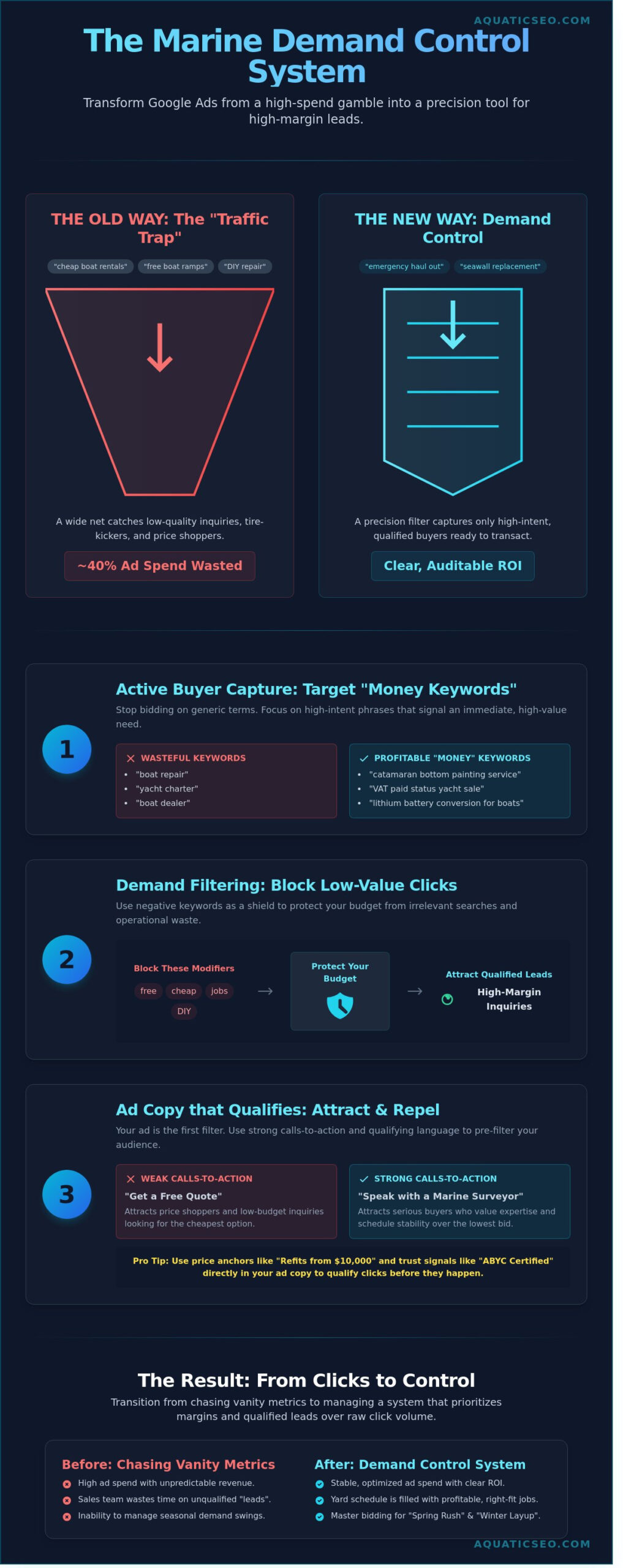
Active Buyer Capture is the first pillar of the Marine Demand Control System. It’s the process of intercepting high-intent prospects exactly when they’re ready to sign a contract. Most marine paid search campaigns fail because they target broad terms that attract tourists, hobbyists, and window shoppers. We focus on “money keywords” that indicate a specific, high-value problem needing an immediate solution.
For service yards, this means moving away from generic terms like “boat repair.” Instead, we target “emergency haul out” or “catamaran bottom painting.” These searches represent owners with a specific need and a deadline. Every click must be an investment in a potential job, not a donation to a search engine’s revenue. We’ve seen that failing to narrow this focus can lead to a 40% waste of total ad spend on non-converting traffic.
Targeting the Right Marine Sub-Sectors
Precision changes based on your specific operation. A marine electrician needs leads for NMEA 2000 electronics integration or lithium battery conversions. A marine construction operator needs $100,000 seawall replacements or dock piling repairs. Messaging for a luxury yacht sale must feel exclusive, using terms like “off-market listings” or “VAT paid status.” This is vastly different from a boat dealer pushing high-volume center consoles. You can see how we segment these strategies in our guide to digital marketing for marine contractors.
Crafting Ad Copy That Filters While It Attracts
Your ad copy is your first line of defense against wasted spend. Use price anchors to discourage low-budget inquiries. If your minimum project size for a refit is $10,000, state it. Mentioning “Authorized Dealer” or “ABYC Certified” immediately builds trust with serious owners while filtering out those looking for the cheapest “shade tree” mechanic. High-intent marine paid search depends on this immediate qualification.
Stop using “Free Quote” as your primary call-to-action. It’s a weak signal that attracts price shoppers. Use “Speak with a Marine Surveyor” or “Schedule a Yard Slot.” These CTAs attract serious buyers who value expertise and schedule stability over the lowest bid. Implementing these Paid Search Best Practices ensures your ads speak only to those who can afford your services.
Landing pages are where the conversion happens. A generic homepage is a lead killer. Every ad must point to a dedicated page that mirrors the searcher’s intent. If they searched for “seawall restoration,” the page must show seawall engineering, not a sunset photo of a marina. This creates the auditable lead flow required to scale your business. If you want to see how this fits into your specific operation, evaluate your current search strategy with our team.
Demand Filtering: Blocking Low-Value Inquiries Before They Cost You
Most marketing agencies focus on increasing your volume. We focus on protecting your profit. In marine paid search, every click from a “DIY boater” or a “cheap rental” seeker is a direct tax on your marketing budget. Demand filtering is the process of building a digital perimeter around your business to ensure you only pay for inquiries that can actually become high-margin jobs.
This isn’t about being seen by everyone. It’s about being invisible to the wrong people. When you stop paying for “vanity traffic,” your cost per acquisition drops and your lead quality skyrockets. We don’t want your phone ringing with people asking for advice on how to fix their own bilge pump; we want it ringing with yacht owners who need a repower or a full refit.
The Marine Negative Keyword Master List
If you run a professional service yard, certain search terms are toxic to your bottom line. Terms like “cheap,” “used parts,” and “DIY repair” attract leads that drain your time without ever hitting your shop floor. You must also distinguish between intent. A search for “boat rental” usually indicates a low-value tourist, while “private yacht charter” signals a high-intent client ready to spend.
- Block Unsupported Brands: If your yard only services inboards, your marine paid search campaigns must explicitly block terms like “outboard repair” or “Yamaha parts.”
- Filter for Quality: Use negative keywords to exclude “free,” “discount,” or “clearance” to keep your brand positioned as a premium provider.
- Intent Distinction: Block searches for “marina parking” if you are trying to sell “slips for sale.”
Geo-Targeting for Marine Service Yards
Broad geographic targeting is a recipe for waste. Instead of targeting an entire state, we use precise geo-fencing to capture demand where it lives. This means setting a tight radius around specific yacht clubs, marinas, or high-wealth waterfront postcodes. During peak season, you can target specific events like the Fort Lauderdale International Boat Show to reach owners while they’re actively thinking about their next upgrade. This level of precision is one of the essential Paid-Search Best-Practices that separates operators from amateurs.
Effective filtering does more than save money; it stabilizes your operations. When you stop the flood of low-value noise, your team spends their time on qualified inquiries. This leads to a predictable job flow and prevents the “feast or famine” cycles that plague many yards. You can learn more about aligning your digital presence with your physical operations in our marine marketing guide. By enforcing these filters, you ensure that your schedule stays full of the right work, not just any work.
Managing Seasonal Demand and Bidding Logic
The marine industry does not operate on a linear timeline. You deal with the “Spring Rush” where owners realize their engines won’t start in April, followed by the “Winter Layup” where boats sit idle. Most service yards fail because they react to demand instead of controlling it. Your marine paid search strategy must shift from defensive to aggressive as the window of intent narrows.
Waiting for the phone to ring in May is a recipe for low margins and stressed crews. Successful operators use bidding logic to dictate their schedule months in advance. If your shop is booked three weeks out, your ads should automatically pivot from quick repairs to high-margin refits. This is not about getting more clicks; it’s about enforcing a schedule that maximizes your shop’s hourly rate.
The Spring Commissioning Bidding War
Visibility is a commodity in March. Every competitor wakes up at once, which drives up CPCs by as much as 50% in some coastal markets. Don’t waste your budget on low-value inquiries when the schedule is already tightening. Focus your bidding logic on high-margin turnkey services like full electronics suites or total repowers rather than simple oil changes.
If you are exhibiting at the Seattle Boat Show, use paid search to capture intent from attendees researching vendors before they arrive. This allows you to dominate the digital space while your competitors are distracted by booth setups. Capturing a buyer during this high-intent state ensures you are the first name they look for on the floor.
Off-Season Strategy: Selling Winterization and Refits
Stopping ads in November is a strategic error that kills your Q1 revenue. While your competitors go dark to “save money,” you should pivot keywords from “emergency repair” to “vessel repower” or “major refit.” This is the core of Demand Compounding. By capturing leads for 200-hour services or hull extensions in December, you fill the shop floor for the months when others are struggling to keep the lights on.
- Shift Keyword Focus: Move from “boat repair near me” to specific, high-ticket projects like “stabilizer installation” or “teak deck replacement.”
- Utilize Demand Visibility: Track which off-season clicks turn into spring contracts to calculate your true ROI.
- Maintain Authority: Staying active in the winter proves to Google’s algorithms that you are a consistent, relevant authority in the marine space.
The logical proof is simple: 40% of high-ticket refit inquiries originate 90 days before the physical work begins. If you aren’t visible during the research phase, you won’t be in the running when the contract is signed. Pausing your marine paid search in the winter creates a lead vacuum that hits your bank account exactly when you need the cash flow most.
Ready to stabilize your service schedule? See how our Marine Demand Control System eliminates the dead weeks in your service yard.
Implementing the System: Moving from Clicks to Control
Traditional agencies treat your budget like a slot machine. They pull the lever and hope for “visibility.” We view marine paid search as a mechanical system. If your service yard has three open bays for the next two weeks, you don’t just want leads. You want three specific inquiries for high-margin repower projects or stabilizer installs. You need a system that understands the difference.
Choosing a marine digital marketing agency requires looking beyond their Google Ads certification. Software doesn’t know the difference between a high-value yacht charter and a low-margin boat rental. We do. By treating your ad spend as a demand valve, you can throttle volume up when the schedule is light and tighten the filters when you’re booked out six weeks. This isn’t “running ads”; it’s managing your inventory of billable hours.
Auditable tracking is the backbone of this control. We don’t report on “impressions” or “click-through rates” as primary metrics. We track the path from a search query to a signed work order. When you can see that a $2,500 ad spend resulted in $22,000 of high-margin labor, the marketing stops being an expense. It becomes a predictable tool for operational stability. You can expect a better job mix, higher margins, and the end of “dead weeks” that kill your cash flow.
Why We Reject the “Marketing Agency” Label
We’re growth partners, not vendors. Most agencies will take your money regardless of whether your business can actually handle the growth. We won’t. If your current scale doesn’t support our Marine Demand Control System, we’ll tell you. Our system is designed to filter out the tire-kickers and low-value inquiries before they ever reach your phone. We focus on operational stability so you can focus on the water. We prioritize your margins over our “lead counts.”
Your Next Steps to Demand Control
Start by auditing your current marine paid search campaigns for waste. Look for keywords like “cheap,” “used parts,” or “DIY” that often eat 20% to 35% of a marine budget without ever converting. A generic audit from a generalist agency won’t catch these industry-specific leaks. You need a specialized analysis that understands marine buyer behavior. Request a no-BS marine marketing analysis today to see exactly where your demand is leaking and how to fix it.
Take Command of Your Marine Demand
Operating a marine business between $300k and $5M means you can’t afford to treat your marketing budget like a donation to Google. Traditional agencies focus on vanity metrics like impressions and click-through rates. Our Marine Demand Control System ignores the fluff to focus on qualified inquiries that actually fill your service bays or book your yachts.
You’ve seen how filtering out low-value inquiries protects your margins and schedule stability. Effective marine paid search isn’t about getting more traffic. It’s about enforcing a system that captures active buyers while blocking the tire-kickers who drain your time. Whether you’re managing seasonal fluctuations or stabilizing a volatile booking calendar, the goal is total operational control.
Stop letting generic agencies test their way through your cash. It’s time to move from hope-based marketing to a methodical system built specifically for those who operate on the water. Request a No-BS Marine Demand Analysis
Your growth depends on precision, not volume. Let’s get to work.
Frequently Asked Questions
Is Google Ads better than SEO for a marine business?
Google Ads provides immediate demand control while SEO builds long-term authority. If your schedule is empty for next week, SEO won’t help you; a marine paid search campaign will. We use paid search to capture active buyers exactly when they’re ready to book a haul-out or purchase a vessel.
How much should a marine contractor spend on paid search?
Your budget depends on your local market’s competitive density and your specific revenue goals. Most successful marine contractors allocate between 5% and 10% of their annual gross revenue toward growth. If you’re in a high-density area like Fort Lauderdale, your cost per lead will be higher than a contractor in a smaller lake market.
What is the difference between a yacht charter and a boat rental in search terms?
The difference is defined by intent and service level. A yacht charter searcher expects a captained, high-end experience and has a higher budget. A boat rental searcher is usually looking for a self-drive pontoon or center console for a few hours. Mixing these up results in high bounce rates and wasted margins on unqualified traffic.
Can I target people currently located at a specific marina?
Yes, we use geofencing to target specific coordinates like a marina or service yard. This allows you to show ads to boat owners while they’re physically at their vessel. It’s an aggressive way to capture demand from people who already own boats and likely need maintenance, detailing, or repowering services.
How do I stop getting calls for “cheap boat parts” on my service ads?
You stop these calls by enforcing a strict negative keyword list and using phrase match instead of broad match. By excluding terms like “used,” “cheap,” and “DIY,” you filter out the bargain hunters. This ensures your marine paid search budget is only spent on high-value clients who value your technical expertise over the lowest price.
What happens to my ads during the winter off-season?
We don’t shut down; we pivot. During the winter, we shift focus from emergency repairs to long-term refit projects, winterization, and indoor storage. Maintaining a presence ensures your schedule stays full for the spring rush. This prevents the dead weeks that kill your cash flow during the off-season.
How long does it take to see results from a marine paid search campaign?
You’ll see traffic within 48 hours of the campaign going live. Qualified inquiries typically start hitting your inbox within the first 14 days. Our Marine Demand Control System usually reaches peak efficiency within 90 days as the data allows us to filter out low-performing keywords and focus on high-margin leads.
Why do I need a specialized marine marketing agency instead of a local generalist?
A generalist doesn’t understand the difference between a center console and a dual console. They’ll waste your budget on generic terms that bring in “looky-loos” rather than serious buyers. You need a partner who understands seasonal drafts, hull types, and the specific pain points of a service yard manager to ensure every dollar produces a return.