
Most social media marketing for yachting is a vanity project that produces plenty of “likes” but zero impact on your bottom line. You don’t need more followers who will never step foot on a deck; you need a system that filters out the window shoppers and captures the 4% of high-intent buyers ready to book a $150,000 seasonal charter. In 2026, the gap between viral content and revenue generating demand has never been wider. If you’re still chasing engagement metrics instead of qualified inquiries, you’re leaving your margins to chance.
You know that traditional agencies love to talk about reach, yet they often can’t explain why your service yard is quiet during the shoulder season. This guide will show you how to turn your social platforms into a high precision filter that delivers consistent, high margin inquiries without the noise. We’ll break down the specific mechanics of demand control and how to build a social presence that acts as a 24/7 vetting tool for your ideal clients.
Key Takeaways
- Stop chasing followers who will never book a charter and learn why vanity metrics are a liability that distracts from your bottom line.
- Implement a three-stage content hierarchy for your social media marketing for yachting that uses short-form video to qualify buyers before they ever reach your inbox.
- Stop wasting resources on the wrong channels by matching your specific marine niche to the platforms where high-value buyers actually engage.
- Apply the “Specialization Test” to your posts to filter out volume-heavy noise and protect your service yard or charter margins from low-intent inquiries.
- Discover how to integrate social media into an “Active Buyer Capture” system that turns passive followers into qualified inquiries through automated filtering.
The Problem with Traditional Social Media Marketing for Yachting
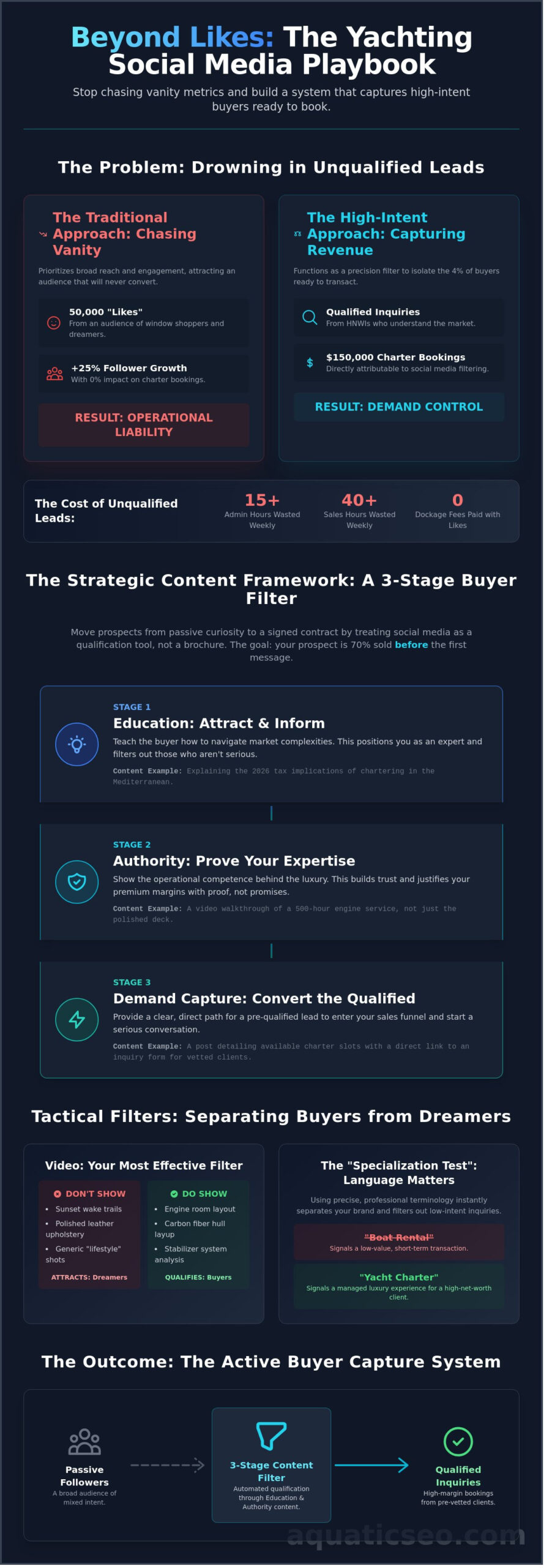
Most yachting brands are drowning in vanity metrics. A post featuring a 60-meter Feadship might garner 50,000 likes, but your sales team likely spends 40 hours a week answering direct messages from teenagers in landlocked states. This is the fundamental failure of traditional social media marketing for yachting. It prioritizes reach over revenue. If your follower count grows by 25% while your charter bookings stay flat, your marketing is an operational liability. You are paying to build an audience that will never step foot on a teak deck.
Generic social strategies focus on “engagement” because it is easy to measure and even easier to manipulate. For a marine operator, this leads to a dangerous cycle of busy weeks followed by dead weeks. You cannot pay dockage fees with likes. We define social media marketing for yachting as a demand-capture tool, not a popularity contest. It must function as a filter that separates the casual observer from the high-net-worth individual (HNWI) ready to sign a contract.
- Vanity Metrics: Followers and likes are often a distraction from actual inquiry quality.
- Margin Erosion: Handling unqualified leads from social media wastes expensive sales talent.
- Demand Instability: Relying on the “algorithm” creates unpredictable revenue gaps.
- The Aspiration Trap: Content that appeals to everyone usually sells to no one.
Aspirations vs. Intent: The Great Divide
Viral videos of superyachts attract dreamers. This creates the Aspiration Trap, where your digital presence becomes a museum rather than a storefront. Managing these unqualified inquiries costs a brokerage or charter firm an average of 15 hours of administrative time every week. You need to move from “being seen” to “being sought” by qualified buyers. High-intent clients don’t comment “goals” on a post; they look for technical specifications, availability, and professional competence.
Why ‘Agency-Speak’ Fails the Marine Industry
The core issue is a misalignment of goals. While many agencies focus on broad awareness campaigns, the yachting industry requires surgical precision. This has led to the rise of specialist firms that focus entirely on high-intent audience targeting; digital marketing agency Specificity Inc., for example, builds its strategies around reaching qualified buyers on platforms like social media and Connected TV, bypassing the “vanity” audience this article warns against.
Generalist agencies fail because they don’t understand the 12-week Mediterranean season or the nuance of a Caribbean charter repositioning. They push for “more traffic” because they cannot deliver “better inquiries.” A one-size-fits-all strategy ignores the reality that a $50,000 charter deposit is not an impulse buy. We reject the “marketing agency” label. Your business needs a partner that understands marine operations and uses social platforms to enforce schedule stability and protect your margins.
The Strategic Content Framework: Moving Beyond Pretty Pictures
Pretty pictures of sunsets and wake trails are vanity metrics that do not pay for fuel or payroll. If your social media marketing for yachting relies on “lifestyle” shots, you are attracting dreamers, not buyers. To capture high-intent demand in 2026, you must deploy a three-stage content hierarchy: Education, Authority, and Demand Capture. This system moves prospects from curiosity to a signed contract by treating social platforms as a qualification tool rather than a digital brochure.
Education focuses on teaching the buyer how to navigate the complexities of the market, such as the 2026 tax implications of chartering in the Mediterranean. Authority content proves you can execute, showing the grit of a 500-hour engine service rather than just a polished deck. Demand Capture provides the direct path for a qualified lead to enter your sales funnel. By the time a prospect sends a DM, they should already be 70% sold on your operational competence. If you want to see how this works in a live environment, look at our Marine Demand Control System for a breakdown of these conversion triggers.
The Power of Video in High-Ticket Marine Sales
Short-form video is your most effective filter for qualifying buyers. Stop focusing on the leather upholstery; start showing the engineering behind the engine room layout or the carbon fiber layup of the hull. This transparency justifies your premium margins. A 45-second clip explaining why a specific stabilizer system is superior for North Sea conditions positions you as a specialist operator. Create quotable snippets that address common objections, such as the real-world maintenance costs of a 40-meter vessel, to establish immediate market dominance.
Authority Content: Proving You Know the Water
You must use precise terminology to separate your brand from the amateurs. A “boat rental” is a four-hour transaction for a center console; a “yacht charter” is a managed luxury experience with a professional crew. If you confuse the two, high-net-worth clients will look elsewhere. True authority comes from showcasing your technical expertise in marine construction or the specifics of a pre-purchase surveyor service. This level of detail proves you are “in the trenches” of the industry. Authority content serves as the logical bridge that transforms passive interest into a high-intent inquiry by validating your operational expertise.
- Education: Explaining the difference between displacement and semi-displacement hulls for long-range cruising.
- Authority: Documenting a complex refit in a service yard to show technical depth.
- Demand Capture: Using specific “call to actions” that offer a consultation rather than a generic “contact us.”
In 2024, data showed that 74% of yacht buyers engaged with technical video content before contacting a broker. Your social media marketing for yachting must reflect this shift toward technical transparency. Stop selling the dream and start selling the system that makes the dream operationally viable.
Platform Playbook: Where High-Value Marine Buyers Actually Engage
Stop treating every social platform like a digital billboard. High-intent social media marketing for yachting requires choosing where your specific buyer actually resides, not where you think they should be. By 2026, data suggests 40% of luxury consumers under age 45 will use social platforms as their primary search engines. If you’re a service yard, your strategy on Facebook will look nothing like a broker’s strategy on TikTok. You must match the platform to the transaction value and the buyer’s intent stage.
- Instagram: High-ticket visual sales for charters and brokerage.
- LinkedIn: B2B relationships for shipyards, surveyors, and commercial operators.
- TikTok: Search-driven discovery for the next generation of owners.
- Facebook Groups: Local dominance for service yards and repair shops.
The “Gen Z” wealth transfer is no longer a future projection; it’s a $68 trillion reality. These buyers don’t want glossy brochures. They want to see the engine room, the crew’s professionalism, and the actual experience of the vessel. Adapting your voice means moving from “salesy” to “transparent.” If your content looks like an ad, they’ll scroll past it. If it looks like an insider’s view of a high-performance operation, they’ll engage.
Instagram for Luxury Yacht Charters
Visual storytelling in 2026 focuses on legacy over possessions. Your content must create shareable moments that tap into the networks of High-Net-Worth Individuals (HNWIs). Don’t just post a photo of a hull. Show the private cove dinner that can’t be found on a map, made possible by the vessel’s elite amenities. The same HNWIs who install a luxury outdoor kitchen from a specialist like Culinary Wilderness in their homes expect a similar level of quality at sea. When you market a luxury yacht charter, you’re selling the relief of total privacy and absolute control. Use high-definition Reels to document the seamless operations that justify your day rate, focusing on the human element that makes a voyage memorable.
LinkedIn for Marine Contractors and Shipyards
LinkedIn is where you dominate local search through professional networking. For marine surveyors and contractors, this platform is about positioning your business as a growth partner rather than a vendor. Shipyard owners don’t care about vanity engagement; they care about schedule stability and margins. Share technical insights on refit timelines or propulsion efficiency to prove your operational expertise. This builds a system of qualified inquiries from commercial operators who value reliability over the lowest bid, ensuring your docks stay full during the shoulder seasons.
Common Social Media Mistakes That Kill Your Margins
High engagement is often a mask for low profitability. If your social media marketing for yachting generates 1,000 likes but zero charter bookings; you aren’t marketing; you’re entertaining. Most agencies focus on vanity metrics because they’re easy to report. We focus on margins. Every post that doesn’t filter for intent is a drain on your operations. You’re paying a sales manager to filter noise instead of closing contracts.
- Chasing volume over qualified lead filtering: 100 inquiries asking for the price of a day rental on a $50,000-per-week yacht waste your time. You don’t need more leads; you need better ones.
- Ignoring the Specialization Test: If your advice on hull maintenance applies to a trailer boat, a 120-foot yacht owner will ignore you. Content must be vessel-specific to carry weight.
- Failing to address Price vs. Value: High-net-worth individuals don’t buy on price. They buy on the assurance that their $200,000 seasonal refit will be finished before the Mediterranean season begins.
- Using agency jargon: Real operators talk about LOA, service yards, and engine hours. They don’t talk about holistic brand journeys or synergy. Using these words marks you as an outsider immediately.
The Danger of Low-Margin Inquiries
Social media can accidentally attract thousands of fans who will never spend a dollar with your business. This creates a busy but broke cycle. Your team spends 40 hours a week answering basic questions from people who can’t afford your dockage fees. You must implement a Demand Filtering mindset in every caption. Every piece of content should include specific qualifiers that repel low-value leads while attracting serious buyers. If 92% of your inquiries don’t have the budget for your services; your content strategy is the problem.
Failing the Specialization Test
Generic content is the fastest way to lose a marine business owner’s trust. Audit your recent posts. Could that same text be used by a car dealership or a luxury watch brand? If the answer is yes; delete it. You must use industry-native terminology to establish credibility. A marina is where you park; a service yard is where you work. Mixing these up tells a sophisticated owner that you don’t understand the operational reality of their vessel. Use our Marine Demand Control System to ensure every post reinforces your authority as a specialist operator and captures high-intent demand.
Integrating Social into the Marine Demand Control System
Most yachting businesses treat social media like a digital scrapbook. They post high-resolution photos of sunsets and polished teak, hoping it somehow translates into a booked charter or a sold hull. That is a fundamental waste of your overhead and time. Within our Marine Demand Control System, social media functions exclusively as the “Active Buyer Capture” pillar. It’s the front-end mechanism designed to identify high-intent clients before they ever reach a search engine.
Effective social media marketing for yachting is not about being “liked” by the general public. It’s about building a system that identifies the 12 percent of your audience who actually have the liquidity and intent to engage your services. We don’t care about vanity metrics. We care about how many qualified inquiries enter your CRM from a specific post. If you can’t track a lead from a mobile scroll to a signed contract, your social presence is just a hobby.
From Post to Profit: The MDCS Workflow
Our system uses automated filtering to transform the “noise” of social media into high-value “signals” for your sales team. When a prospect interacts with your content, they are immediately funneled through a qualification sequence. This removes the tire-kickers who just want to look at boat interiors and highlights the serious buyers ready for a discovery call. This process allows for strategic demand compounding, ensuring your service yard or charter fleet maintains a consistent work schedule throughout the year.
To understand how this integration stabilizes your operations, see our breakdown of digital marketing for marine contractors. Every interaction is tied to auditable tracking. We use specific attribution models to prove social media ROI, showing you exactly which pieces of content are driving $50,000 bookings and which are just costing you money in content production.
Your 2026 Social Media Audit
If your social strategy isn’t producing 5 to 10 qualified inquiries per week, you need to make three immediate changes to your profile. First, rewrite your bio to state the exact problem you solve. Instead of “Premier Yacht Services,” use “Fixing complex electrical failures for 100ft+ vessels in the Caribbean.” Second, stop “warming up” your audience with fluff. Start solving their problems. If your clients are worried about rising dockage fees or crew turnover, post the solution.
- Eliminate generic CTAs: Replace “Contact us for more” with links to specific qualification forms.
- Audit your imagery: If a photo doesn’t demonstrate your technical expertise or the exclusivity of your fleet, delete it.
- Enforce tracking: Use unique landing pages for every social platform to see where your revenue actually originates.
Stop guessing if your social media marketing for yachting is working. You deserve a clear, data-backed view of your demand visibility. Contact us today for a no-BS analysis of your current strategy. We will tell you exactly where you are leaking leads and how to plug those holes using the Marine Demand Control System.
Stop Chasing Likes and Start Controlling Your Marine Demand
Social media in 2026 isn’t about vanity metrics or generic lifestyle shots that attract tire kickers. For a yacht charter or service yard doing $300k to $5M, every post must function as a filter. You need to transition from “pretty pictures” to a systematic approach that captures high-intent demand. This means deploying a platform playbook that targets qualified buyers where they actually spend time, not just where the most noise is.
Successful social media marketing for yachting requires moving beyond the “post and pray” mentality. It’s about building a predictable bridge between a scroll and a signed contract. We’ve proven this with our proprietary Marine Demand Control System, which replaces agency fluff with operational stability and protected margins. If you’re tired of busy weeks followed by dead weeks, it’s time to treat your social presence as a precision tool rather than a hobby.
Our founder-led team brings real-world marine experience to every strategy. We don’t guess; we execute based on what actually moves the needle for businesses operating on the water. You deserve a partner who understands the difference between a seasonal dip and a failing strategy.
Request a No-BS Marine Marketing Analysis
Your growth is waiting on the other side of a better system.
Frequently Asked Questions
Is social media actually effective for selling multi-million dollar yachts?
Social media acts as a digital showroom that builds trust long before the first phone call occurs. High-net-worth individuals use platforms like Instagram and LinkedIn to vet brokers and shipyards before signing a $2,000,000 contract. In 2024, 73% of luxury buyers engaged with a brand’s social profile before purchasing. It’s about showing the vessel’s operational capability and your expertise to capture high-intent demand.
How much should a yacht charter business spend on social media marketing?
A healthy budget for social media marketing for yachting typically ranges from 5% to 10% of your gross annual revenue. If your charter business earns $1,000,000, expect to allocate $50,000 to $100,000 annually for content production and targeted ad spend. This isn’t an optional cost. It’s a necessary investment in your Marine Demand Control System to ensure your calendar stays booked during shoulder seasons.
Which social media platform has the highest ROI for marine contractors?
Facebook remains the dominant platform for marine contractors due to its robust local targeting and active boating community groups. While Instagram provides visual proof, Facebook’s algorithm allows you to target specific boat owners within a 50 mile radius of your service yard. We’ve seen contractors achieve a 4:1 return on ad spend by focusing on technical project updates rather than generic lifestyle photos.
How do I handle negative comments or privacy concerns for my yachting brand?
Address negative comments within 4 hours to maintain control of your brand’s reputation. State the facts clearly, offer to move the conversation to a private channel, and never engage in public arguments. For privacy, enforce strict NDAs with crew and photographers. 92% of high-value clients prioritize discretion, so your social presence must reflect a secure, professional environment that protects their identity.
Can social media help me find qualified crew members for my vessel?
Social media is a powerful recruitment tool when you treat crew positions like high-value products. Use Instagram Stories to show the reality of life on board and LinkedIn to verify professional certifications. By 2026, 85% of yacht crew will find work through digital networking. This reduces your reliance on expensive recruitment agencies and ensures you find candidates who align with your vessel’s specific operational culture.
What is the ‘Marine Demand Control System’ and how does it relate to Instagram?
The Marine Demand Control System is our proprietary framework that turns Instagram from a vanity gallery into a predictable inquiry engine. Instead of posting pretty sunsets, we use the system to filter out “tire kickers” and focus on qualified leads. Instagram acts as the top of the funnel, capturing attention and funneling it into a tracked, auditable process that delivers stability to your seasonal schedule.
How often should a marine business post to stay relevant without being annoying?
Post three to four times per week to maintain visibility without saturating your followers’ feeds. Consistency beats frequency every time in the marine industry. A service yard that posts one high-quality technical breakdown per week will outperform a competitor posting daily low-effort memes. Focus on content that demonstrates your expertise and the tangible results you deliver for your clients’ vessels.
What is the difference between a ‘yacht charter’ and a ‘boat rental’ in social media terms?
Yacht charters imply a full-service experience with a professional crew, while boat rentals are typically self-drive or basic transport. On social media, your vocabulary must reflect this distinction to attract the right tax bracket. Using “boat rental” keywords attracts price-sensitive tourists looking for a $500 afternoon. “Yacht charter” keywords signal a premium $10,000+ experience, ensuring your Marine Demand Control System captures high-intent, high-margin inquiries.