Your team does exceptional work, yet you’re constantly forced to compete with low-cost operators. Your schedule swings between frantic weeks and dead weeks because your lead quality is a gamble. This isn’t a sales problem; it’s an authority problem. For over 140 years, one name has dominated the high-stakes world of marine engineering and superyacht construction by refusing to compete on anything but absolute authority: Blohm & Voss. Their legacy isn’t just about building iconic vessels; it’s a masterclass in creating a brand so powerful that it filters demand automatically, attracting only the most qualified, high-value clients.
This is not a history lesson. This is a strategic breakdown. We will dissect the systems Blohm & Voss used to enforce their market dominance and command premium margins. You will learn how to stop chasing unqualified leads and start implementing a framework of technical and brand authority. The goal is to make your business the only logical choice for the UHNW clients and complex projects that define a market leader. Forget competing on price; it’s time to control demand.
Key Takeaways
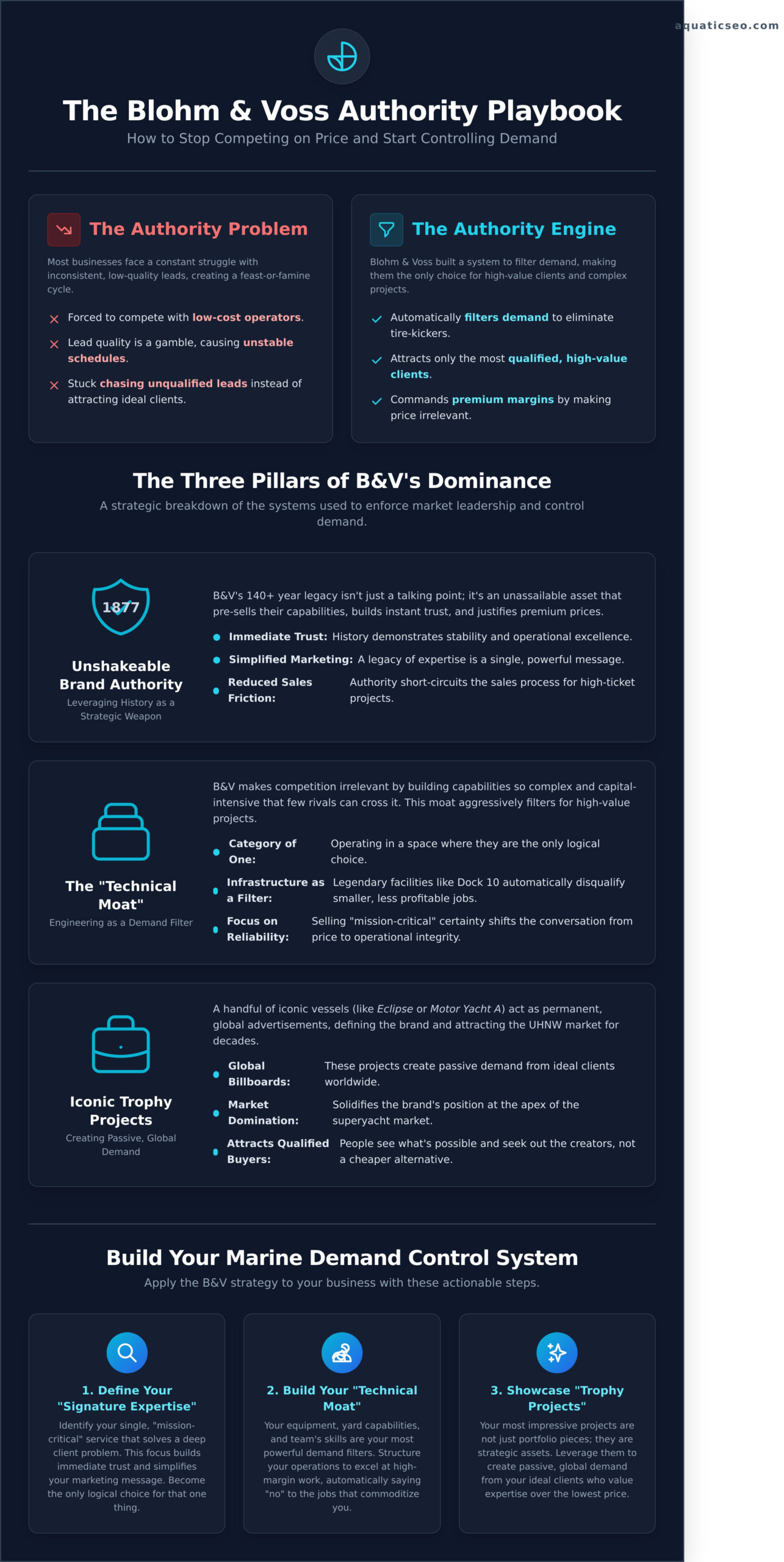
- Understand how to position your company’s history as a strategic asset to build unshakeable brand authority in your market.
- Discover the “Technical Moat” strategy used by Blohm & Voss to filter out low-margin work and attract high-value, complex projects.
- Learn how to leverage your most impressive “trophy projects” to create passive, global demand from your ideal clients.
- Get actionable steps to translate billion-dollar tactics into a system that attracts qualified buyers, not just more traffic.
The Power of Brand Authority: Why Blohm & Voss Remains a Marine Icon in 2026
When a government needs a frigate or a billionaire commissions a gigayacht, the name Blohm & Voss commands immediate respect. This isn’t about vague brand awareness; it’s about raw authority. For over 140 years, they have set the standard for German maritime engineering on an industrial scale. Their marketing lesson is simple and direct: Authority is the ultimate shortcut to lead quality, filtering out tire-kickers before they ever contact you.
Their history is not a dusty timeline; it is a strategic weapon that builds trust and justifies premium pricing. From their foundation in 1877, the company has shaped the Port of Hamburg and global naval power. This deep history, detailed in this Blohm & Voss historical overview, demonstrates a level of stability and operational excellence that new competitors cannot buy. It’s an unassailable asset that pre-sells their capabilities.
From Hamburg Roots to Global Naval Standards
Operating from their legendary Steinwerder shipyard, the company’s deep naval contracts provide a stable revenue floor. This financial bedrock, now as part of the NVL Group, funds the relentless innovation required for high-stakes projects. Their deliberate transition from general shipbuilding to highly specialized naval systems is a masterclass in market focus. They don’t try to be everything to everyone; they dominate a specific, high-value niche. This focus ensures operational stability and protects their margins from commoditization.
The Psychology of the Legacy Brand
The name recognition of Blohm & Voss functions as a powerful trust signal that short-circuits the sales process. For any high-ticket marine project, this heritage dramatically reduces sales friction and justifies premium pricing. Authority communicates reliability before a single conversation even happens. Your business can achieve a similar effect, not with 140 years of history, but by establishing a “signature expertise.”
- It builds immediate trust: Your specialty proves you understand the client’s problem deeply.
- It simplifies your marketing: You have one clear message, not a dozen weak ones.
- It attracts qualified buyers: Experts attract clients who value expertise over the lowest price.
This focus is what turns your brand into a magnet for qualified inquiries, not just more traffic.
Engineering as a Demand Filter: The B&V Technical Moat
Most marine businesses compete for jobs. Blohm & Voss engineers its operations to make competition irrelevant. They built a “Technical Moat”-a set of capabilities so complex and capital-intensive that few rivals can even attempt to cross it. This isn’t about being slightly better; it’s about operating in a category of one.
This moat aggressively filters demand. It eliminates tire-kickers and low-margin price shoppers, leaving only the highest-value, most technically demanding projects. Their 24/7 global service network isn’t a convenience; it’s an operational necessity that enforces client loyalty. When a system fails, the owner calls the only company they trust to fix it, anywhere in the world. This is the essence of Marine Demand Control: having capabilities no one else can match.
Filtering for High-Intent, High-Value Projects
Blohm & Voss doesn’t sell refit services; they sell mission-critical reliability. When you build or service a vessel like Motor Yacht A, which is one of the largest private yachts in the world, failure is not an option. This focus on certainty shifts the conversation from price to operational integrity. You stop being a vendor and become an essential growth partner whose expertise protects a nine-figure asset. What is the “mission-critical” service in your business? Identify it, own it, and build your marketing around it.
The Operational Stability of Specialization
Your infrastructure dictates your job mix. The legendary Dock 10 facility in Hamburg is a perfect example. It was built to accommodate the world’s largest vessels, automatically disqualifying smaller, less profitable jobs. By controlling their physical assets, B&V controls the type of work that flows in, ensuring high margins and operational stability. This is a powerful lesson: saying “no” to the wrong work isn’t about arrogance. It’s the first, most critical step to establishing authority and protecting your bottom line. Your equipment and yard capabilities are your most powerful demand filters.
Superyacht Icons: Dominating the Ultra-High-Net-Worth Market
For a shipyard like Blohm & Voss, a handful of projects define its brand for decades. Iconic vessels like Eclipse, A, and Dubai are not just yachts; they are global statements of engineering dominance. These “trophy projects” function as the most powerful marketing assets imaginable, generating passive, high-level demand from an untouchable client base.
This creates a powerful “Halo Effect.” When you prove you can build a floating metropolis with military-grade systems for a private owner, it sends an undeniable signal of capability to governments and commercial operators. The technical authority demonstrated on one superyacht directly validates your ability to execute complex naval or commercial contracts. It is the ultimate proof of competence.
The Eclipse Effect: Marketing Through Milestone Projects
When Eclipse was launched, it created a global media event that provided years of free, high-authority press. This wasn’t a paid ad campaign; it was a milestone that cemented the shipyard’s position as an industry leader. You can apply this same principle by packaging your most challenging project into “milestone content” that generates its own momentum and proves your expertise.
Milestone projects act as evergreen lead magnets by creating a permanent, searchable asset that proves your capability at the highest level.
Positioning for the Elite Marine Client
In the UHNW segment, the game shifts from marketing to reputation management. Discretion, privacy, and a documented history of flawless execution are the only metrics that matter. This is precisely why generic SEO fails to connect with owners of 100m+ vessels; they don’t search for shipyards, but their family offices, captains, and legal teams do.
Your strategy must target the specific, technical queries of these trusted advisors. Understanding this critical distinction is the core of effective Luxury Yacht Marketing: Attracting High-Value Clients.
Applying the B&V Strategy to Your Marine Business Operations
You don’t need a billion-dollar marketing budget to implement the core principles that drive Blohm & Voss. The strategy is not about scale; it’s about control. For a marine business doing $300k-$5M, this means abandoning the #1 misconception in the industry: “I need more traffic to grow.”
Growth doesn’t come from a wider net. It comes from a sharper spear. Just as B&V focuses exclusively on the ultra-wealthy, you must narrow your focus to dominate a profitable local niche. Stop trying to be everything to every boat owner. Instead, build a technical moat around the work you do best and that delivers the highest margins.
Controlling Your Demand Flow
Your website’s primary job is not to attract everyone, but to repel the wrong people. Use detailed service pages and specific contact forms that ask for hull numbers, engine models, and a description of the problem. This filters out “tire-kickers” before they ever waste your time on the phone. The result is “Demand Visibility”-a predictable flow of qualified inquiries that lets you forecast your schedule and revenue for the next six months, ending the feast-or-famine cycle for good.
Building Local Authority and Trust
Being the recognized expert for a specific engine, system, or hull repair in your harbor is more valuable than being a generalist. This is the local version of the Blohm & Voss reputation. You build this authority with industry-native content-not marketing fluff. Post a case study of a complex electrical refit or a detailed guide to winterizing a specific pod drive. This proves your expertise without saying a word. This is the foundation of a real digital strategy, a topic we explain in our SEO for the Marine Industry: A No-Nonsense Intro guide.
Building Your Own Marine Demand Control System
The operational precision that defines a superyacht from a builder like Blohm & Voss isn’t an accident. It’s the result of a fanatical commitment to control. We apply that same discipline to your client acquisition. Our Marine Demand Control System is the digital equivalent of that operational mastery, designed to give you command over your sales pipeline.
This system isn’t about casting a wide net. It’s about targeted interception. We position your business to capture high-intent buyers exactly when they are searching for your specific expertise. Instead of chasing leads, you attract clients who are already qualified and ready to engage.
The most critical component is our “Demand Filtering” process. More traffic is not the goal; better traffic is. We actively filter out the low-value inquiries, the price shoppers, and the tire-kickers that clog your operations and destroy your margins. This protects your team’s time and ensures you only speak with prospects who value your work and are prepared to pay for it.
It’s time to stop chasing vanity metrics and start enforcing market control. Your business deserves a predictable flow of high-margin work.
Why Generalist Agencies Fail Marine Contractors
Most marketing agencies celebrate “vanity traffic”-a flood of website clicks that look good on a report but translate into unqualified calls that waste your time. This digital noise clogs your operations and distracts you from profitable work. We see this as a critical failure.
You need a partner who speaks your language. A generalist doesn’t know the difference between a service yard and a marina, let alone the buying triggers of a superyacht captain. This ignorance leads to wasted ad spend and weak results. Our promise is simple: We deliver qualified inquiries, not just rankings.
Next Steps: Get Your Marine Business Analysis
Stop guessing if your marketing is working. Our No-BS audit process provides a clear, operational analysis of your current digital strategy. We pinpoint exactly where you are losing high-value clients to competitors and show you how to plug the leaks.
We identify the specific gaps in your demand control and provide a clear roadmap for dominating your service area. Take the first step toward predictable growth. Request your Marine Demand Control analysis today.
Your Legacy of Control: Applying the Blohm & Voss Model
The enduring power of Blohm & Voss isn’t found just in steel hulls; it’s in their system of market dominance. They built an engineering authority so profound it acted as a natural filter, forcing the world’s most demanding clients to seek them out. This is the ultimate form of demand control.
You don’t need a century-old shipyard to implement the same strategy. Your expertise is your authority. The key is building an operational system that translates that authority into a predictable flow of high-margin, qualified inquiries-ending the feast-or-famine cycle for good.
We install this exact system for marine businesses generating $300k-$5M in revenue. Our proprietary Marine Demand Control System is not about vague marketing promises; it’s about operational stability and profitable growth, backed by a no-nonsense, results-only guarantee.
Stop reacting and start commanding your market. Secure your Marine Demand Control System analysis and build your business with the precision it deserves.
Frequently Asked Questions
Who owns Blohm & Voss today?
Today, the German shipbuilder Lürssen Group owns Blohm & Voss. The acquisition was finalized in 2016, consolidating two of Germany’s most prestigious naval and yacht-building names. This move integrated the historic Hamburg shipyard into the larger Lürssen network, which focuses on the design and construction of luxury superyachts, naval vessels, and specialized ships. The shipyard now operates under the Lürssen name but retains its legendary heritage and location.
What are the most famous ships built by Blohm & Voss?
The shipyard is famous for both military and civilian vessels. In naval history, the battleship Bismarck is arguably its most recognized creation. In the world of luxury, the superyacht Eclipse held the title of the world’s largest private yacht for years and remains an icon of modern design. These vessels showcase the yard’s dual mastery of complex naval engineering and elite, high-specification luxury construction, a legacy that defines the Blohm & Voss brand.
Does Blohm & Voss still build private superyachts?
Yes, but the branding and operational focus have shifted. Since its acquisition by Lürssen, the historic Hamburg facility primarily focuses on the repair and refit of superyachts, naval ships, and cruise liners. While new superyacht construction is now consolidated under the Lürssen brand name, the expertise and facilities of the former Blohm & Voss yard are integral to these projects. The site remains a critical hub for maintaining some of the world’s most impressive vessels.
Where is the Blohm & Voss shipyard located?
The historic shipyard is strategically located in Hamburg, Germany. It sits on the south bank of the Norderelbe river, a branch of the Elbe river, within the Port of Hamburg. This prime location provides deep-water access to the North Sea, making it an ideal site for constructing, launching, and servicing large ocean-going vessels. Its prominent position in one of Europe’s busiest ports has been a key factor in its operational success for over a century.
How did Blohm & Voss influence modern naval architecture?
The company’s influence stems from its relentless engineering innovation. They were pioneers in adopting advanced welding techniques for ship construction, which allowed for stronger and lighter hulls compared to traditional riveting. They also contributed to the refinement of hull forms, including the bulbous bow, to improve vessel efficiency and stability. This constant push for operational superiority, rather than just aesthetics, set a standard for high-performance naval and civilian ship design.
Can a small marine business use the same branding strategies as Blohm & Voss?
You cannot directly copy a billion-dollar shipyard’s marketing budget. However, you can adopt their core strategic principle: an absolute focus on a specific, high-value client. Blohm & Voss never tried to be the cheapest or serve everyone; they built a brand that attracted clients who demanded the best. Your marine business can apply this by defining your ideal customer and building your marketing system to attract only that type of qualified buyer.
What is the “Marine Demand Control System” and how does it relate to industry leaders?
Industry leaders like Blohm & Voss don’t get swamped with unqualified inquiries. They control demand. The Marine Demand Control System is an operational approach we install in your business to do the same. It’s not a typical marketing plan; it’s a system to capture, filter, and convert only high-margin, qualified buyers. This gives you control over your sales pipeline and schedule, eliminating the frustrating cycle of being either too busy with low-profit jobs or completely dead.