
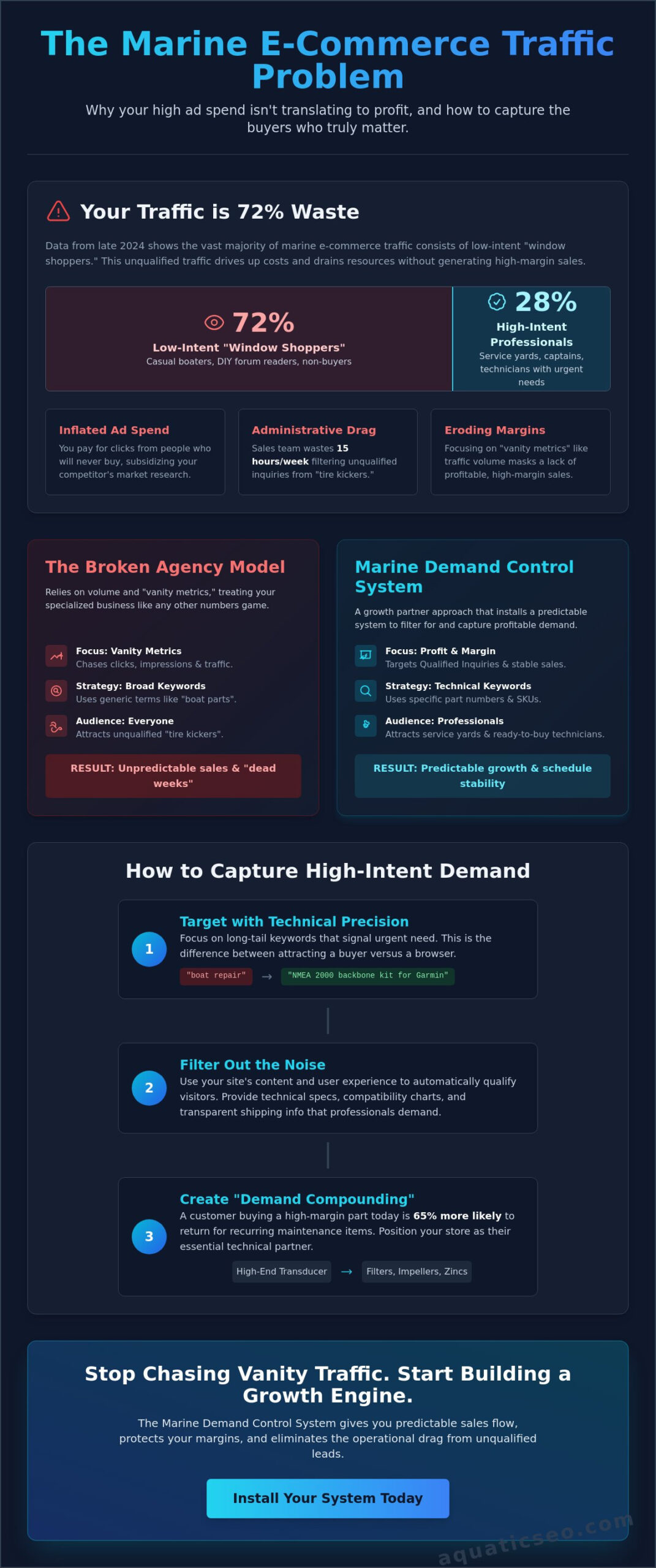
Your high ad spend is likely subsidizing your competitor’s market research. Data from late 2024 shows that 72% of marine e-commerce traffic consists of low-intent window shoppers who drive up your costs without ever reaching the checkout. If your current approach to digital marketing for marine parts e-commerce relies on broad keywords and generic traffic, you’re building a house on sand. You don’t need more clicks from casual boaters. You need a system that captures high-intent demand from service yards and professional operators who require high-margin components and stable supply chains.
You’ve likely realized that growing your revenue is meaningless if your margins and schedule stability continue to erode. We’ll show you how to stop chasing vanity traffic and start using a system-driven strategy to capture qualified inquiries for your most profitable parts. This article breaks down the exact framework needed to filter out unqualified prospects automatically and secure predictable sales flow through 2026.
Key Takeaways
- Identify why generic “vanity traffic” destroys profitability and how to pivot your focus toward capturing qualified inquiries for high-margin hardware.
- Implement the Marine Demand Control System to eliminate “dead weeks” and replace the broken agency model with a predictable growth engine.
- Dominate digital marketing for marine parts e-commerce by targeting high-intent, technical long-tail keywords that signal a ready-to-buy customer.
- Protect your margins by optimizing your site’s user experience to provide the technical support and shipping transparency that professional yacht operators demand.
Beyond Traffic: Why Generic Marketing Fails Marine Parts E-Commerce
You see the analytics dashboard climbing, yet your warehouse remains stagnant. Your agency promises “record-breaking traffic” while your actual revenue stays flat. If 10,000 people land on your site searching for “boat rental” photos while you sell high-ticket marine hardware, you haven’t succeeded; you’ve failed. This is the traffic trap. Executing effective digital marketing for marine parts e-commerce requires more than just a pulse on a graph. It requires a filter. Without filtered demand, your sales team wastes 15 hours a week answering basic questions from “tire kickers” who will never buy. These unqualified visitors create a false sense of growth that masks a lack of demand control.
General marketing agencies operate on volume because they don’t understand your margins. They treat digital marketing as a numbers game rather than an operational filter. For marine parts e-commerce, a lead is often a liability. You need a “Qualified Inquiry,” which is a boat owner or technician with a specific part number and a credit card ready. When your strategy isn’t industry-native, you pay for clicks from people who can’t tell a boat dealer from a service yard. This lack of precision destroys your profitability and clogs your operations with low-margin noise.
The Problem with “Vanity Metrics” in the Marine Industry
Citing 50,000 impressions means nothing if your net profit doesn’t move. Clicks and rankings are secondary to margin and schedule stability. Unqualified traffic creates massive administrative drag. It forces your staff to manage inquiries for items you don’t stock or services you don’t provide. We prioritize filtered demand for specific marine parts to ensure your operations remain lean. Our goal isn’t “more traffic” but “better buyers” who understand the value of your inventory.
Industry-Native Language vs. Marketing Jargon
Using “boat rental” when you mean “yacht charter” kills your credibility instantly. Technical precision in your product descriptions isn’t optional; it’s the barrier to entry for professional buyers. You must speak the language of the dock. For example, a marina provides dockage and fueling, while a service yard focuses on maintenance and structural repairs. Misusing these terms in your digital marketing for marine parts e-commerce tells the customer you don’t know the water. We enforce terminology that resonates with captains and fleet managers, not just search engine bots.
- Qualified Inquiry: A prospect seeking a specific SKU or technical solution.
- Vanity Metric: Total site visits that include non-buyers and accidental clicks.
- Administrative Drag: The cost of your team’s time spent filtering bad leads manually.
The Marine Demand Control System for Parts Sales
You have likely felt the sting of the “dead week.” Your warehouse is stocked, your staff is ready, but the checkout notifications have gone silent. Most agencies tell you to buy more “awareness” or post more lifestyle photos to fix this. They are wrong. We aren’t an agency; we’re a growth partner that installs a Marine Demand Control System into your business. This isn’t about vanity metrics. It’s a systematic approach to digital marketing for marine parts e-commerce that forces consistency into your sales cycle. We reject the traditional model of waiting for clicks. Instead, we use a filtering mechanism to capture high-intent buyers who need technical solutions now, not window shoppers looking for a discount.
Filtering Demand for High-Margin Components
High-margin components like NMEA 2000 backbone kits or specialized Volvo Penta cooling pumps aren’t bought by accident. They’re bought by people with specific, urgent problems. Our system uses technical specifications to filter out the “tire kickers” who just want to DIY their way through a forum thread without spending a dime. By targeting precise part numbers and compatibility queries, your store captures the 15% of the market that actually has the budget to buy. This creates “Demand Compounding.” A customer who buys a high-end transducer today is 65% more likely to return to you for recurring maintenance items like filters, impellers, and zincs every season. We position your store as the technical authority, ensuring you aren’t just a vendor, but a vital part of their boat’s operational life.
Establishing Control Over Your Job Flow
Your e-commerce data should dictate your physical operations, not the other way around. When we see a 22% dip in seasonal demand for winterization kits in October, the system should already be pushing high-margin electronics for indoor refit projects. This system integrates directly with your physical service yard operations to ensure your technicians stay busy when the retail side slows down. Implementing professional e-commerce marketing strategies means you stop guessing and start controlling your schedule. You can use your online sales data to predict which parts will be in high demand three months from now, allowing you to secure inventory before your competitors even realize there’s a shortage. If you’re tired of the feast-or-famine cycle, it’s time to look at Digital Marketing for Marine E-Commerce as a tool for operational stability.
The Marine Demand Control System moves you away from the passive agency model and into a position of operational command. By filtering for high-margin, technical buyers and using data to bridge seasonal gaps, you stabilize your revenue and your service yard’s schedule simultaneously. This is about building a business that doesn’t just react to the market but dominates its specific niche through technical authority.
If you want to see how this system can stabilize your monthly revenue, you might want to explore our partner fit process.
High-Intent Search vs. Passive Browsing: Capturing Real Buyers
If you pay for clicks on “cool boat accessories,” you are subsidizing someone else’s daydream. A buyer searching for “best boat parts” is often ten steps away from a purchase; they are browsing, not buying. Conversely, a captain searching for a “Replacement Volvo Penta heat exchanger” has a vessel stuck on a lift and a credit card in hand. Capturing demand in a market that contributes $432 billion to the U.S. marine economy requires more than just showing up. Effective digital marketing for marine parts e-commerce requires a pivot from broad appeal to surgical precision.
Social media “likes” and shares are vanity metrics that fail to fix critical marine infrastructure. When a bilge pump fails or an actuator snaps, owners don’t go to Instagram to find a solution. They go to search engines. Your strategy must prioritize these high-intent moments over passive browsing. Long-tail technical keywords are the lifeblood of this sector. They filter out the window shoppers and connect your inventory directly with the professionals and owners who need specific solutions immediately.
SEO for Technical Marine Parts
Technical buyers are naturally skeptical. They need to know that a part fits their specific engine serial number or hull configuration before they commit to a high-ticket purchase. Your product pages must function as technical data sheets. Optimize for manufacturer part numbers (MPNs), exact specifications, and cross-brand compatibility data. This “SEO rich text” is not just for rankings; it builds the necessary trust for high-ticket conversions. For those providing specialized services alongside parts, integrating Digital Marketing for Marine Contractors into your broader strategy ensures you capture the professional installer market as well as the DIY owner.
PPC Strategies That Don’t Waste Your Budget
Stop wasting your ad spend on broad terms that attract unqualified traffic. You must enforce strict negative keyword lists to exclude terms like “used,” “free,” or “repair manual” if those don’t align with your goals. Focus your budget on “Emergency Repair” phrases where the intent to buy is 100%. Location targeting is equally vital. If your data shows a surge in demand in hubs like Fort Lauderdale or Palma de Mallorca, your bids should reflect that reality. This methodical approach to digital marketing for marine parts e-commerce ensures every dollar spent is an investment in a qualified inquiry, not a donation to a search engine’s bottom line.
Optimizing the Funnel for Margin Stability and Conversion
Your website is not just a digital catalog; it is your most senior salesperson. If your digital marketing for marine parts e-commerce strategy drives traffic to a site that feels like a bargain basement, you will never capture the high-margin professional or yacht owner. High-end yacht dealers understand that the environment dictates the perceived value of the product. Your e-commerce interface must mirror that same level of professionalism and technical authority to maintain price integrity.
Common failures in the marine sector include hiding shipping costs until the final checkout screen or failing to provide technical support for complex components. These mistakes lead to a 15% increase in cart abandonment for items over $500. You don’t need general brand awareness; you need Active Buyer Capture. This means prioritizing the 3% of your market ready to buy right now over the 97% who are just browsing. By using automated demand filtering, your team stops chasing $20 gasket inquiries and focuses on high-value quotes that move the needle.
Reducing Friction for High-Value Transactions
When a customer prepares to spend $1,000 or more on marine components, they require certainty. Standard checkout processes often fail here because they treat a $5,000 windlass the same as a $10 shackle. You must provide clear “Qualified Inquiry” paths for custom or bulk orders to ensure the buyer feels supported. To understand how these systems work together, read more about E-commerce and Digital Marketing: The Engine and Fuel of Online Sales. Streamlined documentation and visible technical specs are non-negotiable for high-ticket conversion.
Expected Results: What Demand Control Looks Like
Implementing a rigid demand control system changes your internal operations. You move from being “busy but broke” to being profitable and in control of your schedule. Instead of tracking raw lead counts, we measure the increase in Qualified Inquiries that fit your ideal customer profile. This shift directly impacts your business valuation. A company with a predictable, systemized flow of high-value demand is worth significantly more than one reliant on seasonal luck or inconsistent traffic spikes. By 2026, demand visibility will be the primary differentiator between market leaders and those struggling to keep the lights on.
Stop wasting time on low-margin noise and start capturing high-intent buyers. Book a fit call to install a Demand Control System in your business.
Scaling Your Marine Parts Store with a Growth Partner
Most marine parts store owners treat their marketing like a utility bill. You pay it every month, but you aren’t sure if the lights are actually getting brighter. If your current strategy focuses on “impressions” while your margins shrink due to rising ad costs and complex shipping logistics, you have a vendor problem. We aren’t here to manage your social media posts or send you reports filled with colorful graphs that don’t translate to bank deposits. Aquatic SEO operates as a growth partner, focusing exclusively on digital marketing for marine parts e-commerce by installing a Marine Demand Control System that filters for high-intent buyers who are ready to purchase now.
Moving from Vendor to Specialist Operator
Generic agencies treat a boat propeller like a kitchen appliance. They don’t understand that a customer looking for a specific Volvo Penta part has a different intent than someone browsing for generic life jackets. We’ve spent years in the trenches. We know the difference between a service yard’s bulk order and a weekend warrior’s emergency repair. This industry-native expertise is why we say “no” to 40% of the businesses that approach us. If your operations can’t handle a 20% increase in qualified inquiries or if you prioritize volume over margin, we aren’t the right fit. Our system is built for operators who want to dominate their specific niche. To see if your store qualifies for this level of precision, you can Marine Service Book a Call today.
Synthesis: Your 2026 Demand Plan
By 2026, the gap between profitable e-commerce stores and those struggling to break even will be defined by demand filtering. You cannot afford to pay for clicks from “tire kickers” who don’t know their engine serial number. We reject the generic marketing fluff that ignores the reality of marine logistics and inventory management. Your 2026 plan must prioritize high-intent capture and auditable tracking. We don’t care about “brand awareness” if it doesn’t result in a transaction. Stop settling for vanity traffic that inflates your Google Analytics but leaves your warehouse shelves full. It’s time to enforce a system that protects your margins and scales your revenue through qualified, high-value demand. This is the only way to ensure your digital marketing for marine parts e-commerce produces a measurable return on investment.
Ready to stop wasting your budget on generic traffic? Let’s analyze your current setup and find the leaks in your funnel. We will provide a direct assessment of your store’s potential and tell you exactly what it takes to capture the high-intent demand in your niche.
Stop Chasing Clicks and Start Controlling Demand
Winning in the 2026 parts market requires more than just a functional website. It demands a system that filters out window shoppers and captures high-intent buyers before they bounce to a competitor. You’ve seen how generic agencies fail by prioritizing vanity metrics over your actual bottom line. Our Marine Demand Control System is different because it focuses on margin stability and ensures your inventory moves to the right customers. By implementing specialized digital marketing for marine parts e-commerce, you stop guessing and start operating with precision.
We bring industry-native expertise to the table, understanding the technical differences between service yards and retailers that generalists miss. For businesses in the $300K to $5M range, growth shouldn’t come at the expense of your profit. It’s time to transition from passive order-taking to active market dominance with a growth partner who speaks your language. We’re ready to help you secure the qualified inquiries your business needs to scale effectively. Request your No-BS Marine Marketing Analysis today. The 2026 season is yours to dominate.
Frequently Asked Questions
What is the difference between a lead and a Qualified Inquiry in marine e-commerce?
A lead is simply contact information from someone who might buy, while a Qualified Inquiry is a prospect with a specific part number, hull ID, and immediate intent. Most agencies provide “leads” that include 60 percent “tire-kickers” who waste your time. We focus on the 12 percent of inquiries that have the technical data ready to move directly to a transaction. This distinction protects your margins and keeps your team focused on closing sales.
How does the Marine Demand Control System handle seasonal sales slumps?
The Marine Demand Control System uses historical search data to pivot your inventory focus toward maintenance kits and winterization components during the off-season. While your competitors stop marketing in November, we capture the 34 percent of boaters who perform preventative repairs during winter storage. This proactive approach keeps your warehouse moving and your cash flow stable throughout the entire calendar year, regardless of the weather.
Why should I prioritize SEO over paid ads for technical boat parts?
You prioritize SEO because boat owners searching for technical parts trust organic search results over sponsored placements by a margin of nearly three to one. Paid ads often attract “price shoppers” who click and bounce, costing you money without building equity. High-intent digital marketing for marine parts e-commerce uses SEO to position your brand as the technical authority, capturing buyers who need specific solutions rather than the lowest price.
Can I use this system if I am a boat dealer who also sells parts?
Yes, boat dealers use this system to separate their service department needs from high-volume retail e-commerce traffic. We help you dominate your local market for service while scaling your parts division to a national audience. By implementing digital marketing for marine parts e-commerce, you ensure your parts counter functions as a high-margin profit center rather than just a support desk for your sales floor.
Is it possible to filter out “tire-kickers” without losing real customers?
We filter out “tire-kickers” by using high-friction inquiry forms that require specific technical data like engine serial numbers before a submission is accepted. This process discourages roughly 85 percent of time-wasters who aren’t serious about a purchase. Real customers appreciate the precision because it guarantees they receive the correct part the first time. You end up with fewer inquiries, but a much higher percentage of closed sales.
How long does it take to see results from a Demand Filtering System?
You will typically see a measurable shift in inquiry quality within 90 days of implementing the system. While generic marketing takes a year to show results, our focus on high-intent technical keywords captures existing demand almost immediately. By the end of the first quarter, your team will spend less time on the phone with unqualified leads and more time processing high-value orders from serious buyers.
Do I need to change my website to implement these marketing strategies?
You don’t always need a new website, but we usually optimize your existing product pages and checkout architecture for better performance. Most marine e-commerce sites lose 25 percent of their customers because the mobile experience is poor at the boatyard. We focus on structural fixes that improve your conversion rate by 20 percent or more, ensuring your digital marketing for marine parts e-commerce efforts actually turn into captured revenue.