
Most marine marketing agencies brag about lead volume, but volume is a liability when it forces your service yard manager to spend six hours a day answering basic questions from people who can’t afford a haul-out. If you’re fielding 50 calls a week but only booking three high-margin projects, your problem isn’t traffic. It’s a lack of friction. A high-precision marine business lead filtering system is the only way to stop the tire-kicker drain on your operational capacity. You need a mechanism that actively repels low-value noise so your team can focus on serious yacht owners and fleet contracts.
You already know that every minute spent explaining basic pricing to a non-buyer is a minute stolen from a profitable project. It’s frustrating to watch your schedule fluctuate between dead weeks and chaotic rushes while your margins shrink due to administrative bloat. We understand that more “leads” often just means more work for zero extra profit.
This guide shows you how to implement a high-precision filtering system that protects your time and reclaims 10 or more hours of your work week. We’ll examine exactly how to automate the disqualification process so your desk only sees inquiries ready to sign a contract.
Key Takeaways
- Stop the “busy-but-broke” cycle by quantifying exactly how much labor time your service yard or charter business loses to low-value inquiries.
- Implement a high-precision marine business lead filtering system to act as an automated gatekeeper that protects your margins from tire-kickers.
- Shift from a shotgun marketing approach to a rifle approach that prioritizes project fit and operational stability over raw inquiry volume.
- Identify your high-margin Ideal Client Profile and deploy specific “deal-breaker” questions to disqualify poor fits before they ever reach your schedule.
- Learn how to combine niche-specific SEO with aggressive filtering logic to transform generic contact info into high-value Qualified Inquiries.
The Hidden Drain: Why Unfiltered Leads Are Killing Your Marine Business
You are likely caught in the “Busy-But-Broke” trap. Your phone rings constantly, your inbox is full, and your crew is working overtime, yet your profit margins remain stagnant. This chaos stems from a fundamental misunderstanding of growth. Most owners believe that “more leads” equals more profit. In reality, a flood of unqualified inquiries acts as a parasite on your operations. Implementing a marine business lead filtering system is the only way to stop the bleeding. You must stop treating every inquiry as an opportunity and start treating your time as a finite resource that requires strict protection.
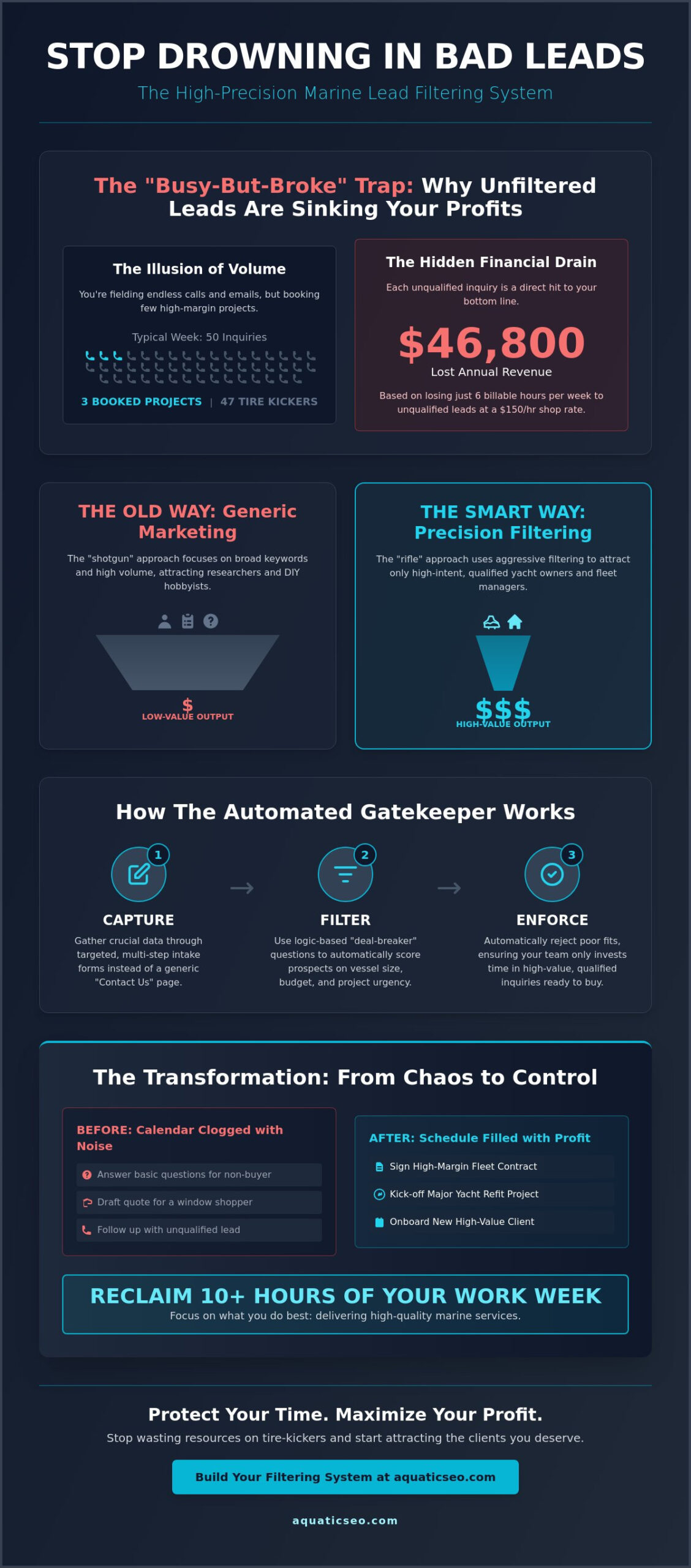
Every tire-kicker who requests a quote represents a tangible loss. For a service yard, one unqualified inquiry can pull a senior technician away from a billable refit for two hours of “consultation.” If your shop rate is $150 per hour, that’s $300 gone. Do this three times a week and you’ve lost $46,800 in annual billable revenue. Generic marketing agencies ignore these numbers because they only care about click-through rates. We focus on Demand Control because operational stability is the only metric that actually pays the bills.
The High Cost of the Wrong Inquiries
Low-margin estimates are the silent killer for marine contractors. When you spend six hours drafting a dock permit plan for a “window shopper,” you aren’t just losing time; you’re losing the chance to serve a high-value client. This disruption ripples through your entire workflow, causing delays for existing projects and frustrating your best customers. Service yards and boatyards often face the same bottleneck when generic inquiries clog their intake pipes. You need a system that enforces your standards before a human ever picks up the phone.
Why Generic SEO and Ads Flood You with Garbage
Most SEO strategies focus on broad, high-volume keywords that attract people at the very top of the marketing funnel. These are often researchers or DIY hobbyists, not high-intent buyers ready to sign a contract. This results in “vanity traffic” that looks impressive in a monthly report but fails at the bank. A marine-specific application is required at every touchpoint to ensure that only those with the budget and intent to buy can reach your team. Without a marine business lead filtering system, you are essentially paying for the privilege of being interrupted by people who will never buy from you.
What is a Marine Business Lead Filtering System?
A marine business lead filtering system functions as an automated gatekeeper for your sales team. It evaluates prospect intent, budget, and project fit before a human ever picks up the phone. Most marketing agencies focus on “leads,” which are often just names and emails from people who aren’t ready to buy. We focus on Qualified Inquiries. These are vetted opportunities that meet your specific criteria for profitability and operational capacity.
This filtering mechanism is a vital part of our Marine Demand Control System. It ensures your calendar stays full of high-margin work instead of low-value tire-kickers. To build this correctly, you must first define your target market to understand who belongs in your shop and who doesn’t. Without these boundaries, your team will spend 40% of their week chasing prospects who can’t afford your services.
The system relies on three core components:
- Capture: Gathering data through targeted entry points instead of generic contact forms.
- Filter: Using logic-based questions to score the prospect based on vessel size, budget, and urgency.
- Enforce: Automatically rejecting or redirecting those who don’t fit your business model, ensuring your team only speaks with buyers who are ready to close.
Qualifying Inquiries vs. Collecting Contact Info
A standard contact form is a bucket. It takes everything, including the trash. A multi-step qualification intake acts more like a sieve. While it might seem counterintuitive, adding a “barrier to entry” actually attracts high-value clients. Serious buyers respect a process that values their time and yours. They want to know you’re a specialist who doesn’t work with just anyone.
For boat dealers, this means asking for more than a phone number. You need to know if they have a trade-in, their financing status, and their specific model interest. If a prospect won’t take 60 seconds to provide this data, they aren’t ready to buy. You shouldn’t waste 30 minutes on a call to find that out. High-value yacht owners and commercial operators don’t want a generic experience; they want to know they are dealing with an expert.
The Role of Intent-Based Content
Your content should do the heavy lifting of filtering before a prospect even clicks your “Contact” button. Use pricing transparency and “Best Fit” descriptions to discourage low-margin prospects. If your service yard only handles vessels over 50 feet, state that clearly. This repels the small-boat owners who would otherwise clog your inbox. A marine business lead filtering system is a digital firewall for your sales calendar.
Stop chasing every notification that hits your phone. If you want to see how this fits your specific operation, you can explore our tailored systems.
Volume vs. Value: Comparing Generic Marketing to Demand Filtering
Traditional agencies rely on the “Shotgun Approach.” They blast your message across the internet; hoping something sticks. This creates a high volume of noise but very little signal. You don’t need 1,000 clicks if 990 of them are people looking for free advice or DIY tips. A precision-engineered marine business lead filtering system uses a “Rifle Approach” instead. It targets high-value prospects and ignores the rest. This shift in strategy directly impacts your bottom line.
Your profit margins suffer when you treat every inquiry as equal. Chasing a low-margin repair takes just as much administrative energy as booking a full seasonal refit. High-revenue marine businesses understand that schedule stability is a finite resource. They prioritize “Qualified Inquiries” because they know that every minute spent on a tire-kicker is a minute stolen from a high-paying client. You must distinguish between Lead Cost and Client Acquisition Cost (CAC). A cheap lead that never converts is a liability; a filtered lead that closes at a 40 percent margin is an asset.
The Agency Trap: Why More Traffic is Often Worse
Most agencies hide behind vanity metrics like click-through rates. They brag about “increased traffic” while your office manager drowns in unpaid administrative work. Increasing traffic without a filter is a recipe for operational burnout. This is especially dangerous for marine surveyors who cannot scale by simply working more hours. When your time is the product, every unqualified phone call is a direct hit to your hourly realization rate. Our system stops the bleeding by enforcing barriers before the phone ever rings.
Protecting Your Margins Through Strategic Disqualification
Saying “no” to the wrong prospect is a prerequisite for growth. Strategic disqualification preserves your team’s energy for jobs that actually move the needle. For marine mechanics, a “red flag” inquiry often sounds like an owner who bought their own parts and just wants “cheap labor.” For yacht charters, it’s the person haggling over fuel surcharges before they even see the boat. Filtering these out does more than save time. It builds a premium brand perception. In the luxury marine sector, being selective signals that your expertise is in high demand and your standards are non-negotiable.
How to Build a Lead Qualification Logic for Your Service Yard
Building an effective marine business lead filtering system requires you to stop treating every inquiry like a golden opportunity. Most inquiries are distractions that erode your profit margins and distract your crew from high-value work. You need a logic-based gatekeeper that separates high-value refits from low-margin tire-kickers before they ever reach your inbox. This isn’t about being exclusionary; it’s about operational efficiency and protecting your bottom line.
Step 1: Define Your “Must-Haves”
Analyze your last 12 months of invoices to identify which jobs actually moved the needle. If 80% of your profit comes from vessels over 40 feet, that is your new minimum threshold. You must clearly distinguish between a yacht charter that requires professional, crewed-level maintenance and a simple boat rental that might be a DIY project. For marine contractors, use location-based filtering to automatically reject jobs outside your primary service radius. Mobilization costs for distant sites often turn a profitable job into a break-even headache.
Step 2: Crafting the Intake Questionnaire
Your digital intake form needs 3 to 5 deal-breaker questions that prospects must answer before they can book a call. Ask for the vessel make, model, and year immediately. For marine mechanics, knowing it’s a 2024 Volvo Penta versus a 1988 carbureted inboard changes the entire scope of the project. Force prospects to select a budget range and a “Reason for Inquiry.” If a prospect selects “just looking for a price” as their primary intent, your system should flag them as a low priority compared to someone with an “immediate mechanical failure.”
Step 3: Automating the Gatekeeper
Implement conditional logic to route prospects based on their specific answers. If a lead indicates a budget below your $2,500 minimum threshold, your system triggers an automated disqualification email. This email doesn’t just say “no”; it provides a link to an FAQ page or a DIY guide. Automation removes the human error of your office manager “feeling bad” for a prospect and booking a consultation for a job that loses money. This marine business lead filtering system ensures that your calendar only contains qualified inquiries ready to sign a work order.
Stop letting unqualified leads dictate your daily operations and destroy your schedule stability. You can install a system that protects your margins and ensures your team only touches the jobs that maximize your yard’s throughput.
Capturing High-Intent Buyers with the Marine Demand Control System
Most marine business owners believe that a higher volume of inquiries is the only path to growth. This is a trap. If your intake process isn’t rigorous, more leads just mean more time spent on the phone with people who will never cut a check. Our Marine Demand Control System changes the math by installing a marine business lead filtering system that works before you ever pick up the phone.
We combine niche-specific SEO with an aggressive filtering logic that qualifies prospects based on their intent, budget, and project type. You don’t need 100 random clicks; you need five qualified inquiries from boat owners who understand your value. This system ensures your technicians stay on the floor and your sales team focuses on high-margin contracts rather than chasing tire-kickers who are just “price shopping.”
Beyond SEO: Controlling the Job Mix
Success isn’t just about being busy; it’s about being busy with the right work. Our system allows you to dictate the job mix. If your service yard makes its best margins on repowers rather than basic maintenance, we tune the demand to favor those high-value projects. This leads to the “Demand Compounding” phase, where your highest-quality clients become your strongest advocates, driving stable growth year after year. To see how this applies to your specific operation, you can book a call for a fit analysis today.
The Aquatic SEO Guarantee: Qualified Inquiries Only
We have no interest in vanity metrics like impressions or “likes.” These numbers don’t pay your slip fees or your payroll. Our “Industry-Native” positioning means we know the difference between a yacht dealer and a boat broker; we speak the language of your customers fluently. This expertise allows us to build trust immediately, positioning you as the specialist rather than a generalist.
Filtering is not about losing potential revenue. It’s about reclaiming your time and protecting your profit margins. When you stop chasing every lead, you finally gain the stability required to scale your operations without burnout. Audit your current inquiry flow tonight. If more than 30 percent of your calls are from unqualified prospects, your current marketing is actually costing you money.
Take Control of Your Service Yard Operations
You can’t afford to let unqualified inquiries dictate your daily schedule. Every hour your team spends answering basic questions for someone who won’t book a haul-out is an hour stolen from high-margin work. Implementing a marine business lead filtering system isn’t just a technical upgrade; it’s a defensive wall for your profitability. By moving away from generic agency tactics that prioritize raw lead counts, you gain total command over your shop schedule and your bottom line.
We specialize in building Marine Demand Control Systems for operations generating between $300K and $5M. We aren’t a generic agency that hides behind vanity metrics. We’re a no-nonsense growth partner focused on one thing: ensuring every inquiry that hits your inbox is worth your time. It’s time to stop the leak in your efficiency and start protecting your margins.
Let’s look at your current funnel and identify where the tire-kickers are getting through. Request a No-BS Marine Marketing Analysis and Lead Filter Audit today. You’ve built a solid business, and now it’s time to make it run with the precision it deserves.
Frequently Asked Questions
What is the difference between a lead and a qualified inquiry?
A lead is just contact data, while a qualified inquiry is a prospect who meets your specific operational criteria for budget, timeline, and vessel type. Most agencies report leads because they’re easy to generate through vanity traffic. We focus on qualified inquiries because they actually impact your bottom line. If a boat owner has a $5,000 budget for a $20,000 refit, they’re a lead, but they’ll never be a qualified inquiry.
Will a lead filtering system make me lose potential business?
No, it protects your time so you can close high-value deals instead of chasing dead ends. You aren’t losing business; you’re removing the 70% of noise that prevents you from serving your best clients. A robust marine business lead filtering system ensures your sales team spends 100% of their energy on prospects who have the intent and capital to sign a contract today.
How many questions should be in a marine lead qualification form?
Use four to six high-impact questions to balance friction with data collection. Asking for the vessel make, model, year, and specific service needs immediately separates serious owners from casual browsers. Data from 2023 shows that forms with fewer than three questions often result in a 40% increase in tire-kickers who waste your service manager’s time during peak season. Quality inquiries require specific inputs.
Can I use a lead filtering system for a yacht charter business?
Yes, filtering is essential for yacht charters to distinguish between “party boat” renters and high-net-worth charter guests. Your system should screen for guest count, catering requirements, and realistic budget expectations before any manual outreach occurs. This prevents your staff from spending 30 minutes on the phone with someone looking for a $500 bareboat rental when you only operate crewed luxury vessels with professional crews.
Do I need a high-end CRM to implement lead filtering?
You don’t need expensive software, but you do need a structured process that automates the initial gatekeeping. Most marine businesses succeed with basic tools as long as the logic behind the marine business lead filtering system is sound. The goal is an operational workflow that triggers different actions based on prospect input, whether that lives in a simple spreadsheet or a dedicated marine CRM platform.
How does filtering leads improve my marine business profit margins?
Filtering increases margins by reducing the cost per acquisition of your actual billable hours. When your team stops quoting 15 unqualified jobs for every one they win, your overhead drops and your closing rate climbs. Industry benchmarks indicate that focused sales teams can increase their effective hourly rate by 25% simply by eliminating the administrative burden of chasing low-intent tire-kickers who never intended to buy.
What happens to the leads that get disqualified by the system?
Disqualified leads are redirected to automated resources or lower-touch sales funnels. You don’t ignore them, but you stop giving them manual attention. You can send these prospects to a “Frequently Asked Questions” page or a partner who handles smaller vessels. This maintains your brand reputation in the local boating community without draining the resources required to service your primary, high-value yachting clients.
How do I know if my current marketing is attracting tire-kickers?
Your marketing is failing if your inbox is full but your schedule has gaps or your profit margins are shrinking. If 80% of your inquiries ask for your cheapest price or disappear after the first quote, you have a targeting problem. A lack of specific vessel data in your incoming inquiries is a primary indicator that your current strategy prioritizes vanity traffic over actual demand control.