
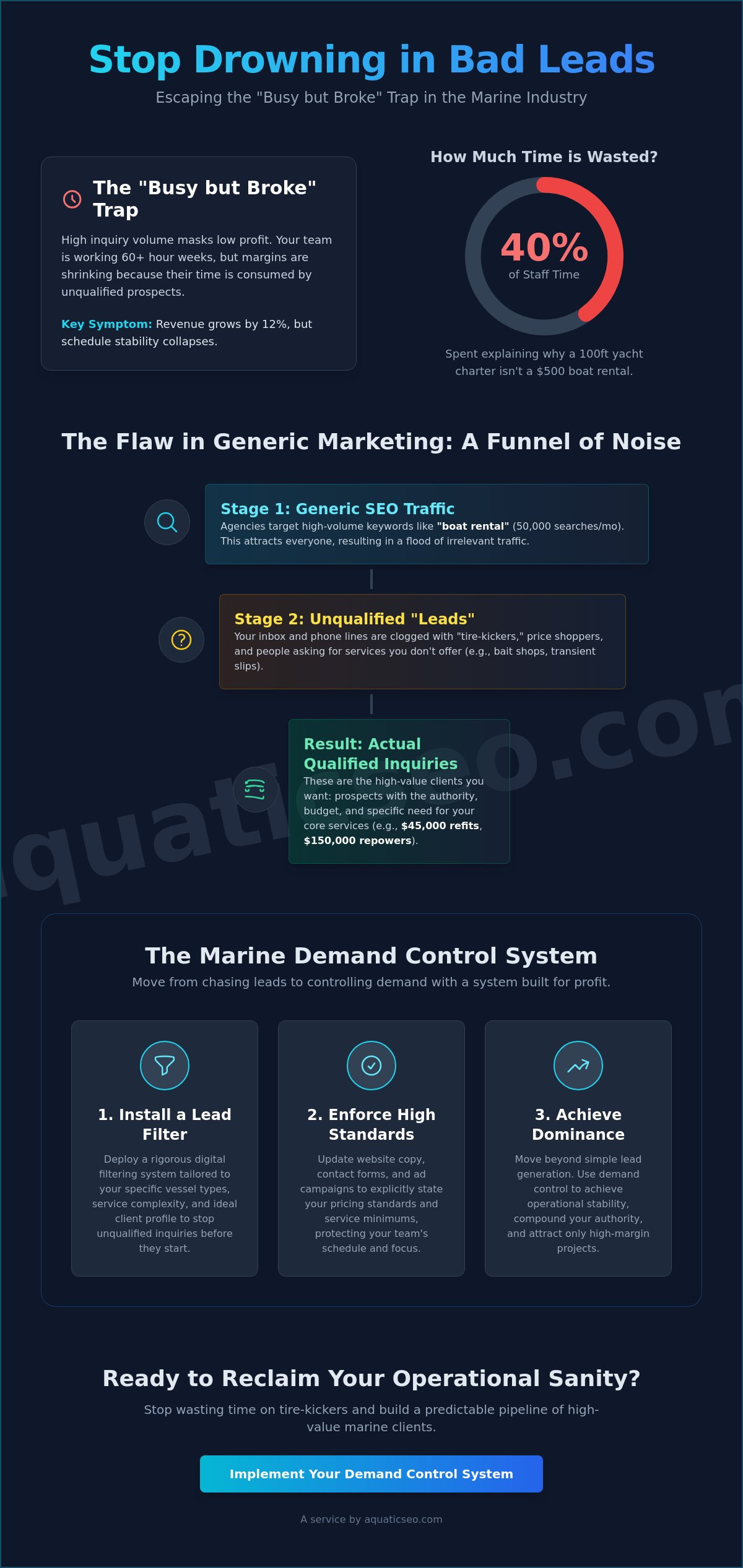
Most marine business owners believe more leads equals more revenue. They’re wrong. If your staff spends 40% of their week explaining that a 100 foot yacht charter isn’t a $500 boat rental, you don’t have a lead problem; you have a filtering disaster. High volume often masks low margins. Every hour spent on a tire-kicker is an hour stolen from a high-value client who actually respects your expertise. You must stop wasting time on unqualified marine leads if you want to stabilize your schedule and reclaim your operational sanity.
You know the frustration of a packed inbox that yields zero profitable jobs. It’s a drain on energy and a threat to your business stability. We promise to show you how to install a demand control system that filters out the noise and captures only the inquiries that protect your bottom line. This guide provides a direct look at the mechanics of demand filtering and how to enforce high-margin standards across your entire digital presence.
Key Takeaways
- Identify the “Busy but Broke” trap where high inquiry volume masks low profit realization and drains your operational capacity.
- Discover how to stop wasting time on unqualified marine leads by deploying a rigorous filtering system tailored to vessel type and service complexity.
- Expose the flaws in generic SEO strategies that flood your business with “boat rental” tire-kickers instead of high-value Yacht Charter inquiries.
- Learn to update your website copy to enforce your pricing standards and protect your schedule from unqualified prospects.
- Move beyond simple lead generation by using the Marine Demand Control System to achieve operational stability and demand compounding.
The Hidden Cost of ‘Busy Weeks’ and Unqualified Marine Leads
You are working 60 hours a week, yet your profit margins are shrinking. This is the “Busy but Broke” trap. It happens when your inquiry volume is high but your profit realization is low. You feel productive because the phone is ringing, but if those calls come from shoppers looking for the cheapest outboard repair while your crew should be billing out a $45,000 refit, you are losing money every minute. To scale in 2026, you must stop wasting time on unqualified marine leads that distract your team from high-value production.
The opportunity cost is staggering. Every hour your service manager spends chasing a tire-kicker is an hour stolen from a loyal client or a high-margin project. When your revenue grows by 12% but your schedule stability collapses, your lead flow is fundamentally broken. Generic marketing attracts “shoppers” who treat your service yard or boatyard like a commodity. It doesn’t attract the serious yacht owner who values technical expertise over a 5% discount. This misalignment turns your operations into a chaotic game of catch-up rather than a controlled growth engine.
Why Lead Volume is a Dangerous Vanity Metric
More traffic is a lie used by generalist agencies to hide a lack of results. If your inbox is full of “how much for a boat rental” when you only operate crewed yacht charters, that traffic is a liability. These low-quality leads clog your internal lead management system and exhaust your staff. A Qualified Inquiry is a prospect with the authority to make a decision, a realistic budget, and a specific marine need that matches your core services.
The Psychology of Chasing Every Lead
The fear of “dead weeks” is a poison that forces owners to accept low-margin jobs. This scarcity mindset prevents you from dominating your niche because your resources are always tied up in low-value work. You can’t secure $150,000 engine repowers if your bays are constantly filled with $800 “emergency” fixes for people you’ll never see again. Demand Control is the only antidote to this seasonal instability. It gives you the power to filter out the noise and enforce a schedule that prioritizes profit over mere activity. When you control the demand, you control the direction of your business.
Why Generic Marketing Agencies Flood Your Marine Business with Trash
Generalist marketing agencies live and die by vanity metrics. They want to show you a dashboard filled with big, green arrows pointing at 2,000 monthly visitors, but they never ask if those visitors can actually afford your services. This focus on raw volume is the primary reason you must stop wasting time on unqualified marine leads that do nothing but clutter your CRM and exhaust your sales team. When an agency doesn’t understand the marine industry, they treat your business like a local dry cleaner or a law firm, applying a “one-size-fits-all” strategy that ignores the technical nuances of your operations.
The flaw in generalist SEO is its obsession with high-volume keywords. An agency might rank your site for “boat rental” because it gets 50,000 searches a month. However, if you operate a crewed Yacht Charter business with a $15,000 weekly minimum, that keyword is toxic. You’ll spend your entire Tuesday answering calls from people looking for a $400 pontoon rental for a bachelorette party. This lack of industry-native precision turns your website into a magnet for the wrong crowd, forcing your staff to act as a manual filter for low-intent traffic.
Generic agencies also fail to distinguish between a Service Yard and a Marina. To an outsider, they both involve boats and water. To a business owner, they are entirely different operations. A Service Yard focuses on technical maintenance, refits, and engine overhauls; a Marina focuses on hospitality, dockage, and fuel. When your marketing fails to make this distinction, your service manager loses roughly 5 hours a week explaining to frustrated callers that you don’t have transient slips or a bait shop.
The Failure of Industry-Agnostic Lead Generation
Industry-agnostic agencies rely on “filler” content that speaks to everyone and resonates with no one. They use bland descriptions of “ocean sunsets” instead of addressing the specific pain points of a vessel owner facing a 1,000-hour engine service. This creates a massive gap between a “lead” and a qualified marine prospect. A lead is just a name and an email; a qualified prospect is someone who has the intent, the specific vessel type, and the capital to engage your services. You can learn more about identifying high-value targets in this Marine Marketing Guide.
The ‘Tire-Kicker’ Magnet: Keywords that Kill Margins
Low-intent keywords are margin killers. Phrases like “cheap boat repair” or “discount dockage” attract “tire-kickers” who will haggle over every line item on an estimate. These prospects consume your bandwidth and drive up your customer acquisition costs without providing the stability of high-margin work. Your website must act as a filter, not just a billboard. It should explicitly qualify visitors through technical language and clear service boundaries. To protect your schedule and your bottom line, you need a specialized Marine Digital Marketing Agency that builds systems to stop wasting time on unqualified marine leads before they ever reach your inbox.
The Marine Lead Filter: Distinguishing Qualified Inquiries from Tire-Kickers
Every minute your operations team spends on the phone with a dreamer who doesn’t own a boat is a minute stolen from a high-margin project. You must stop wasting time on unqualified marine leads by installing a rigid filtering system before the first conversation happens. Most marine business owners treat every ring of the phone as an opportunity, but in reality, 70% of those calls are resource drains that will never convert into a profitable work order. You need a system that identifies the difference between a high-net-worth owner and a weekend browser.
Vetting for Vessel Class and Intent
Distinguishing between a center console and a 100ft yacht at the inquiry stage is about more than just equipment size; it’s about operational alignment. High-value clients expect you to speak their language immediately. Using technical terminology like “LOA,” “draft requirements,” or “stabilization systems” in your intake forms acts as a natural barrier to low-budget shoppers. The Intent Gap is the measurable difference between a researcher asking “how much is a dock” and a buyer requesting “30 linear feet of vinyl sheet piling installation.”
A “Yacht Charter” inquiry requires a completely different vetting protocol than a “boat rental” request. While a rental is a simple transaction, a charter implies a crewed, luxury experience with complex itinerary and catering needs. If your marketing fails to make this distinction, you will drown in low-margin rental inquiries that clog your sales pipeline and frustrate your staff. You are not a commodity; your vetting process must reflect that exclusivity.
To provide an accurate quote, Marine Contractors need specific data points that go beyond a zip code. Your intake system should require information on bulkhead height, water depth at mean low tide, and current permit status. Gathering this data upfront ensures you only spend time on jobs that are physically and legally viable. For Service Yards and Boatyards, the “Authority and Budget” check is vital. You must confirm if the person inquiring is the owner, the captain, or a family member, because if they cannot authorize a $50,000 engine repower, they are not a qualified prospect.
The 4 Pillars of a Qualified Marine Prospect
- Pillar 1: Problem Specificity. A qualified lead says “my port engine is throwing a cooling code,” not “my boat won’t start.” Detailed problems indicate a serious buyer.
- Pillar 2: Authority. You must speak to the decision-maker. Verify if you are dealing with the vessel owner or a representative who has the checkbook.
- Pillar 3: Capability Alignment. Ensure the vessel fits your slips, your travel lift capacity, and your technicians’ specific certifications.
- Pillar 4: Timeline Urgency. A prospect who needs work done “sometime next year” is a lead you can nurture, but they shouldn’t jump the queue ahead of someone needing an emergency haul-out.
By enforcing these standards, you stop wasting time on unqualified marine leads and start focusing on the 20% of inquiries that generate 80% of your revenue. This isn’t about being “unfriendly” to the public. It’s about protecting your margins and ensuring your best clients get the attention they deserve.
How to Implement a Demand Filtering System that Protects Your Margins
Most marine business owners believe more leads equal more money. They’re wrong. If 75% of your phone calls come from people who cannot afford your shop rate or own boats you don’t service, you aren’t growing; you’re just drowning in administrative noise. To stop wasting time on unqualified marine leads, you must stop treating every inquiry as a priority. Implementation of a filtering system requires a shift from “catching everything” to “selecting the best.”
- Step 1: Audit your inquiry flow. Review your last 50 inquiries and categorize them by source. You will likely find that “trash” leads often originate from low-friction sources like Facebook Marketplace or generic contact buttons.
- Step 2: Update website copy to enforce standards. Do not hide your pricing or your service limitations. If you only handle repowers for vessels over 30 feet, state it clearly on your landing page.
- Step 3: Implement friction-based lead forms. Replace simple “Name and Email” fields with technical requirements. Ask for a Hull Identification Number (HIN), engine serial numbers, or specific photos of the damage.
- Step 4: Use automated Demand Filtering. Use logic-based software to sort inquiries before they hit your inbox. If a prospect selects a budget below your minimum, the system should automatically redirect them to a resource page rather than your calendar.
Adding Strategic Friction to Your Sales Funnel
Low friction is the enemy of high margins. When you make it “easy” for anyone to contact you, you invite the tire-kickers to waste your time. A harder form actually improves revenue because it ensures your sales team only speaks with committed boaters. Asking for a HIN or a specific engine model acts as a natural barrier. If a prospect isn’t willing to walk to their boat to get a serial number, they aren’t ready to spend $15,000 on a service contract. Our Demand Filtering Systems automate this hurdle, ensuring only the top 20% of inquiries reach your desk.
Enforcing Your Ideal Customer Profile (ICP)
You must define your “Perfect Job” versus your “Worst Job” to protect your schedule. For Marine Construction Operators, a perfect job might be a 200-foot bulkhead replacement, while a worst job is a single piling repair two hours away. When a “wrong-fit” lead arrives, decline them politely but firmly. Tell them you aren’t the right fit for their specific project size and offer a referral to a smaller shop. This keeps your reputation intact while keeping your crew focused on high-margin production. Stable job flow isn’t about saying yes to everyone; it’s about having the system in place to say no to the wrong ones.
Ready to stop chasing every lead and start dominating your specific niche? Book a fit call to see how we filter your demand.
Beyond Lead Generation: Dominating with the Marine Demand Control System
Marine business owners often fall into the trap of thinking more traffic equals more revenue. This is a false metric that leads to burnout and thin margins. You don’t need an agency that delivers a spreadsheet of names; you need a growth partner that installs a predictable operational framework. To stop wasting time on unqualified marine leads, you must transition from a passive vendor to a specialist operator who controls the market flow. The Marine Demand Control System is designed to do exactly that by prioritizing the quality of your schedule over the quantity of your clicks.
The 4 Pillars of the Marine Demand Control System
Our system isn’t a collection of tactics. It’s an operational standard built on four specific pillars that protect your time and your profit margins.
- Active Buyer Capture: We target prospects at the exact moment they’re searching for specific solutions, such as marine electrical repair or hull refits.
- Demand Filtering: This is where we kill the noise. We use automated friction points to ensure that only prospects with the right budget and boat type reach your inbox.
- Demand Visibility: This pillar allows you to see the future of your revenue. You’ll know exactly where your next high-value job is coming from, allowing you to staff up or order parts with 100% confidence.
- Demand Compounding: Unlike traditional ads that stop working the moment you stop paying, this pillar builds an organic asset. It ensures your boat dealership or service yard gains more authority every month, making future inquiries easier to close.
Synthesis: Taking Control of Your Marine Business
The goal of this guide is to shift your perspective. If you continue to value raw traffic, you’ll continue to see your technicians distracted by tire-kickers and your sales team frustrated by low-intent inquiries. Your schedule is the most valuable asset in your business. You must protect it with a system that enforces your standards before a prospect ever picks up the phone. By focusing on qualified inquiries, you stabilize your cash flow and reclaim your time.
It’s time to stop guessing and start operating with precision. If you’re ready to see how these pillars apply to your specific territory and service niche, we’re ready to show you. We don’t do fluff, and we don’t do vague promises. Let’s look at the data and build a plan that actually works for your bottom line.
Ready to fix your pipeline? Request a No-BS Marine Marketing Analysis today.
Take Command of Your Operations and Protect Your Margins
You didn’t build your marine business to spend your afternoons chasing tire-kickers who can’t afford your yard fees. For businesses generating between $300,000 and $5,000,000 in annual revenue, growth isn’t about more inquiries; it’s about better ones. You must stop wasting time on unqualified marine leads by installing a rigorous demand filtering system that protects your team’s capacity and your operational stability. Generic agencies will flood your inbox with vanity metrics. They don’t understand that a Service Yard operates on entirely different requirements than a Marina. Our Marine Demand Control System ensures your schedule remains filled with high-margin work rather than low-intent noise.
Stop letting unqualified traffic dictate your schedule. It’s time to enforce a standard that respects your margins and your industry expertise. You deserve a partner that knows the difference between a boat rental and a crewed yacht charter. By focusing on qualified inquiries, you reclaim the hours lost to dead-end phone calls and focus on high-value projects that actually scale your business. You’ve got the expertise to dominate your market; you just need the system to filter the path.
Stop wasting time and get a Marine Demand Control Analysis
Frequently Asked Questions
What is the difference between a lead and a qualified inquiry in the marine industry?
A lead is any raw contact information that enters your database, while a qualified inquiry is a prospect vetted against your specific operational requirements. In the marine sector, 70% of raw leads often fail to meet basic criteria like budget or vessel size. A qualified inquiry has already confirmed they own the right boat type and possess the intent to book a service within your specific window.
How can I stop getting calls for boat rentals when I offer yacht charters?
You stop these calls by enforcing strict terminology in your ad copy and utilizing negative keyword lists that exclude hourly or self-drive searches. If your site uses generic terms like boat trips, you will attract the $200 rental crowd instead of the $5,000 yacht charter client. Our system filters out these low-value searches before they ever click your link, saving your team hours of frustration.
Will adding more questions to my contact form decrease my total lead count?
Adding specific qualifying questions will decrease your total lead count but will increase your closing rate and profit margins. You must stop wasting time on unqualified marine leads who aren’t willing to spend 30 seconds identifying their vessel model or engine type. Data from 2024 shows that adding a Vessel Length field can reduce tire-kicker submissions by 40% while keeping high-value prospects engaged.
How much time should my sales team spend vetting a new marine lead?
Your sales team should spend exactly zero minutes vetting raw leads because your digital infrastructure should do it for them. If a prospect reaches a human, they must already be qualified through automated form logic or specific chat sequences. Manual vetting costs a typical $2M boatyard roughly $1,200 per month in wasted labor costs that should be spent closing high-margin deals instead.
Can a demand filtering system help me during the off-season?
A demand filtering system ensures you don’t fill your limited off-season schedule with low-margin filler work that blocks high-value refits. During the winter months, you need to be even more selective to protect your shop’s efficiency. Filtering allows you to prioritize the 20% of clients who generate 80% of your annual revenue, even when the total phone volume naturally decreases during the colder months.
Is it worth turning away a lead if I have an open slot in my boatyard schedule?
It’s absolutely worth turning away a bad lead because low-margin emergency repairs often lead to scope creep and payment delays. Accepting a sub-par job just to fill a slot creates a backlog that prevents you from saying yes to a high-value client who calls tomorrow. Maintaining 15% open capacity is often more profitable than filling every hour with headache projects that stall your operations.
What are the common red flags of a low-margin marine prospect?
Common red flags include an immediate focus on hourly rates rather than project outcomes and a lack of specific vessel maintenance records. Prospects who refuse to provide a Hull Identification Number (HIN) or who demand ballpark quotes over the phone are statistically 65% less likely to convert into profitable clients. These individuals usually consume the most administrative time for the lowest possible return on your investment.
How do I know if my current marketing agency is just sending me vanity traffic?
Your agency is sending vanity traffic if they report on impressions and clicks instead of qualified inquiries and closed revenue. If your website traffic increased by 50% last year but your service bay remains half-empty, you are paying for noise. You need to stop wasting time on unqualified marine leads and demand a system that tracks how many actual boat owners are entering your sales funnel.