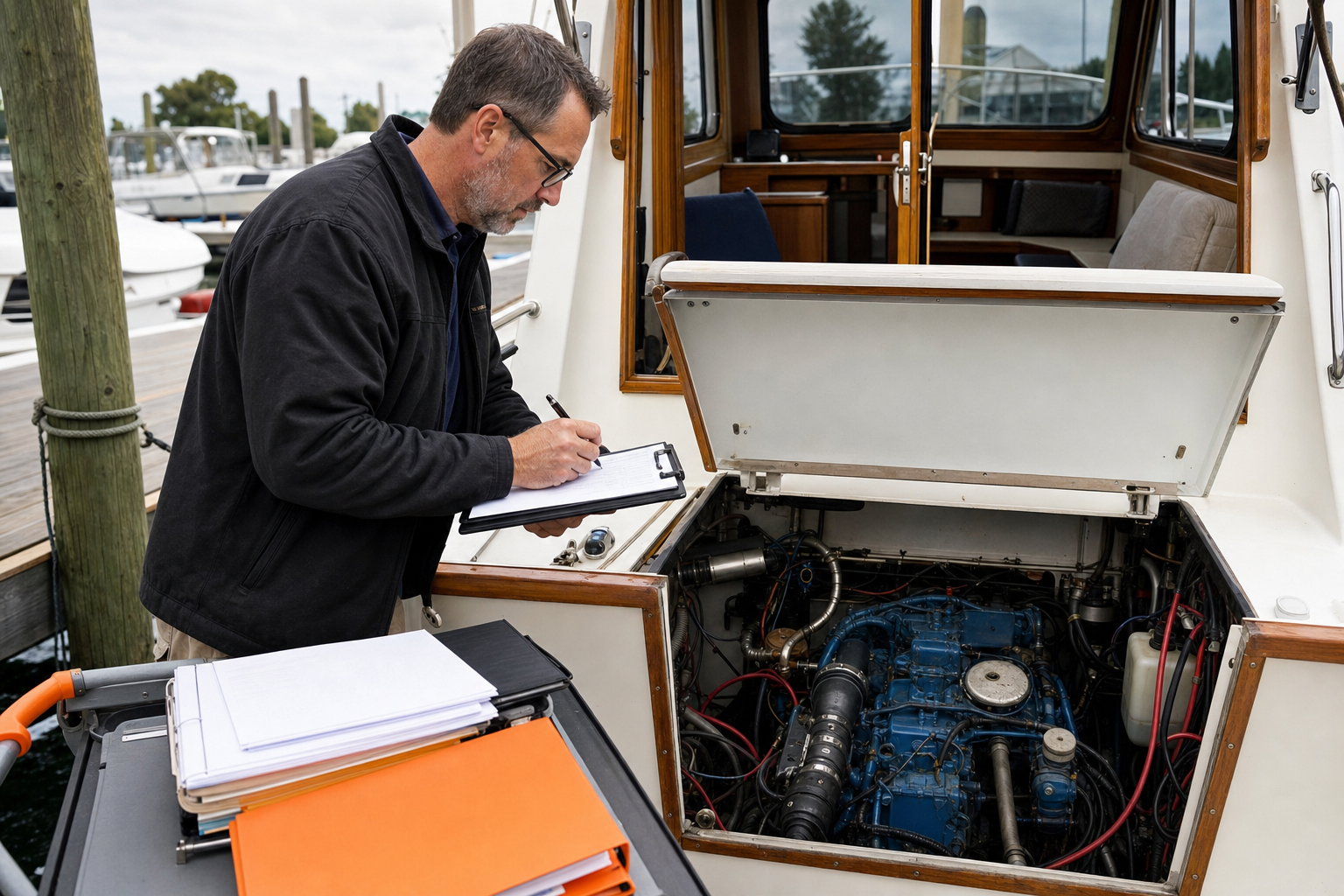

Stop paying for clicks that only bring in 18-foot outboards when your travel lift is rated for 70 tons. Most boatyard owners think more traffic equals more revenue, but a 300% increase in generic website visits usually just results in a front office buried under low-margin repair inquiries. You don’t need generic online advertising for boatyards; you need a system that filters for the specific 50-foot cruisers and high-value refit projects that actually stabilize your quarterly margins.
You know that a packed yard doesn’t always mean a profitable one, especially when your skilled technicians are stuck on “death by a thousand cuts” small-bore maintenance tasks. This guide will show you how to use precision advertising to stop the feast-or-famine cycle and start dictating exactly which hulls occupy your blocks. We’ll break down the mechanics of targeting high-intent owners and auditing your ad spend against actual work orders rather than vanity metrics.
Key Takeaways
- Stop paying for vanity clicks and start capturing high-intent maintenance demand that protects your yard’s margins.
- Master online advertising for boatyards by targeting specific vessel types to ensure your shop stays filled with high-margin refit work.
- Implement a Demand Filtering System to qualify inquiries automatically, protecting your service manager’s time from low-value “tire kickers.”
- Use a multi-channel strategy to eliminate seasonal “dead zones,” creating a stable, predictable schedule that keeps your crew productive year-round.
Why Generic Online Advertising for Boatyards Fails to Deliver Margins
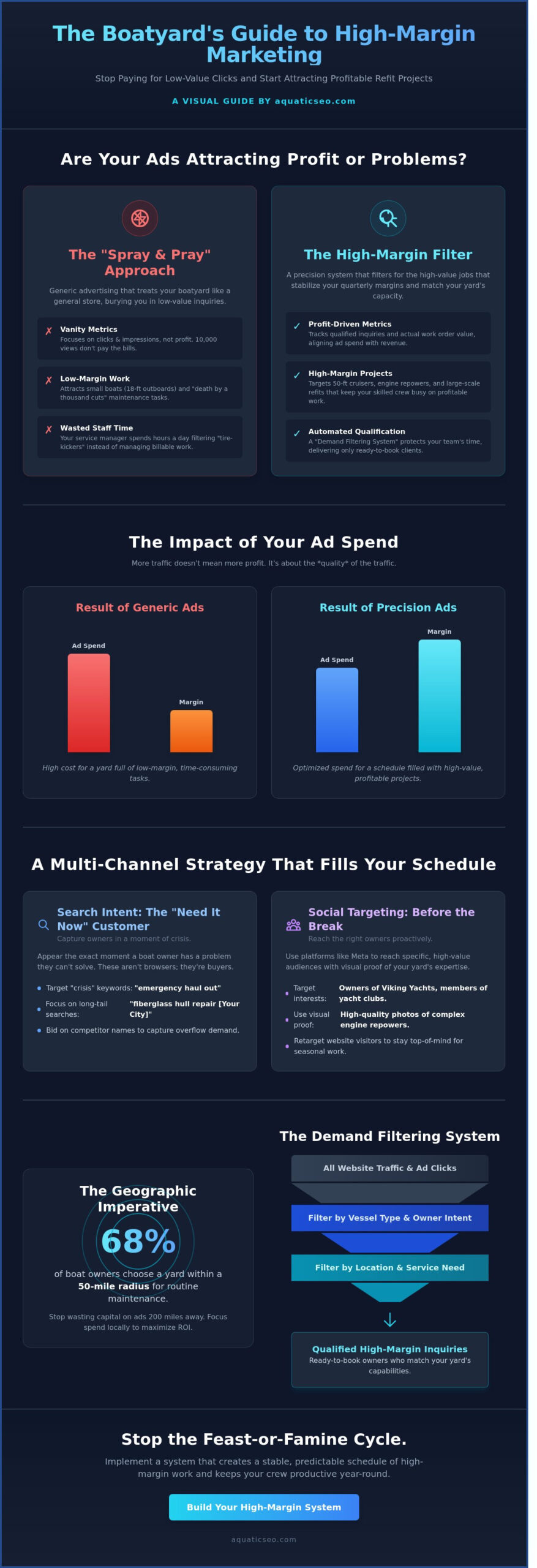
Your yard is likely at capacity, but your bank account doesn’t reflect the hustle. Most owners treat online advertising as a digital billboard to get “exposure.” This is a mistake. Effective online advertising for boatyards isn’t about exposure; it’s a precision tool designed to capture high-intent maintenance demand. If your ads target everyone, you end up with a yard full of 15-foot outboards and DIYers asking for free advice while the 80-foot refit goes to your competitor. You don’t need more traffic. You need a system that filters for high-margin work.
Generic agencies love “more traffic” because it’s an easy metric to manipulate. To a boatyard owner, more traffic often means more phone calls from people who can’t afford your shop rate. This “spray and pray” approach creates operational bottlenecks where your service manager spends three hours a day qualifying tire-kickers instead of billing hours.
Ignoring intent is expensive. When you don’t filter your audience, you pay for clicks from people looking for “how to fix a bilge pump” instead of “mobile marine diesel repair near me.” Every dollar spent on an advice-seeker is a dollar stolen from your profit margins. Precision demand capture ensures your budget is spent only on owners ready to book a haul-out.
The Problem with Vanity Metrics
Stop looking at clicks and impressions. These are vanity metrics that hide a lack of industry knowledge. If an agency brags about 10,000 impressions but your yard is filled with low-margin winterizations, the campaign failed. Generic agencies use high lead counts to justify their fees, even if those leads are for jobs you don’t want. True growth comes from qualified inquiries that align with your specific operational capacity and target margins.
The “Service Yard” vs. “Marina” Distinction
Marketing dockage is easy; it’s a real estate play. Advertising for a 50-hour refit or an engine repower requires a different strategy that addresses technical pain points. You must target the specific anxieties of boat owners facing downtime. Precision targeting ensures you capture the owner who values a quick turnaround and expert technicians over the lowest price. A boat owner with a seized engine is searching for a specific technical solution to salvage their season, not a general price list for basic maintenance.
Targeting High-Intent Maintenance and Refit Leads
Most boatyards flush their marketing budget by targeting people who simply “like” boats. A teenager scrolling through yacht photos on Instagram isn’t a customer. He’s a dreamer. You need to reach the owner of a 42-foot Yellowfin who just hit a submerged log. Generic online advertising for boatyards fails because it prioritizes visibility over intent. We focus on the active buyer whose vessel is currently out of commission or due for a major refit. If your ads don’t filter for job quality from the first click, you’re just paying for a crowded waiting room of low-margin tire-kickers.
Effective targeting requires a ruthless focus on vessel types. If your yard specializes in large-scale refits, your ads shouldn’t appear for “small boat repair.” You must use keyword intent to find owners of specific vessels, like center consoles or yachts, to ensure your shop floor stays filled with high-margin work. Geographic targeting is equally vital. Data shows that 68% of boat owners choose a yard within a 50-mile radius for routine maintenance. Unless you offer a highly specialized service like custom carbon fiber fabrication, spending money on ads 200 miles away is a waste of capital.
Search Intent: Capturing the “Need it Now” Customer
Google Ads allow you to appear the exact moment a boat owner has a crisis. When someone searches for “marine mechanic near me” or “emergency haul out,” they aren’t browsing. They’re buying. We prioritize long-tail keywords like “fiberglass hull repair [City]” to capture these high-intent leads. Bidding on competitor names is another tactical win. If a local yard is at capacity, your ad can offer an immediate solution to their frustrated customers. Following digital advertising best practices means matching your message to the user’s specific need, not just shouting into the void.
Social Targeting: Reaching the Yacht Owner Before the Break
Meta platforms allow you to target by specific interests, such as owners of Viking Yachts or members of exclusive yacht clubs. This is where you use visual proof. High-quality photos of a complex engine repower or a flawless topside paint job act as a first-level filter. It shows you’re a specialist, not a generalist. Retargeting previous website visitors keeps your yard top-of-mind for seasonal maintenance. If a prospect looked at your refit gallery in November, they should see your “spring commissioning” ad in February. This creates a consistent flow of qualified inquiries instead of seasonal spikes and valleys.
Success in online advertising for boatyards isn’t about the number of clicks. It’s about the quality of the vessel on the trailer. If you want to stop chasing low-value leads and start dominating your local market, it’s time to audit your current ad strategy.
Building a Demand Filtering System for Your Service Yard
Most boatyard owners think more leads are the solution to a quiet season. They’re wrong. If you’re a busy service manager, a generic “Contact Us” button is a liability that invites tire kickers with 18-foot outboards when you need 50-foot refits. Effective online advertising for boatyards isn’t about volume; it’s about filtration. You need a system that forces prospects to prove they’re a fit before they ever take up five minutes of your time.
Qualifying Inquiries Before They Hit Your Desk
Generic forms are for generic agencies. Your site needs to target a niche market by demanding vessel make, model, and specific project scope up front. If a prospect won’t tell you their hull material or engine hours, they aren’t serious about a $20,000 repower. Use automated responses to set expectations. Send a professional PDF of your yard’s capabilities or a link to schedule a paid consultation. This filters out the price-shoppers immediately and protects your service manager’s schedule.
A high-performing filtering system should include:
- Required fields for vessel length and propulsion type.
- Drop-down menus for specific services like “Bottom Paint” or “Engine Overhaul.”
- Budget range selection to qualify financial capability.
- Automated scheduling links for qualified vessel owners.
Controlling the Job Mix Through Ad Messaging
You can’t let the market dictate your schedule. If your bays are full but your technicians are idle, you need “Emergency Repair” ads to fill the gaps. If you’re looking to book out Q1, you pivot your messaging to “Scheduled Refit” campaigns. This is how you stabilize your margins. We use the Marine Demand Control System to dial these levers up or down based on your current yard capacity. It transforms your marketing from a random expense into an operational valve.
Stop guessing which ads work. Integrate your inquiries with a CRM to track the job mix from the initial click to the final invoice. When a $500 ad spend results in a $45,000 bottom job, you’ve found a repeatable win. Without this data, you’re just throwing money at Google and hoping for the best. Precision in tracking allows you to see exactly which vessel types and project scopes are driving your revenue and which are just wasting your staff’s time.
Executing a Multi-Channel Ad Strategy That Fills Your Schedule
Most boatyards suffer from a chaotic schedule that swings between unmanageable backlogs and expensive silence. This feast or famine cycle isn’t just stressful; it’s a margin killer that forces you to overpay for seasonal labor or lose skilled technicians during the winter. You don’t need more random leads; you need a system to control your shop’s throughput. Effective online advertising for boatyards functions as a valve, allowing you to turn up the volume on high-margin refits when the yard is empty and focus on rapid-turnaround repairs during peak season. By deploying a multi-channel strategy, you stop reacting to the market and start dictating your production schedule.
Execution requires a methodical approach to labor and bay management. Follow these steps to ensure your ad spend translates into a stable, profitable calendar:
- Audit your “dead zones”: Review your 12-month service calendar to identify specific weeks where labor utilization historically drops below 85%.
- Allocate budget by profit: Prioritize spend on high-margin services like repowers, electronics refits, or hull restorations rather than low-margin maintenance.
- Launch search ads: Capture owners with immediate, urgent mechanical needs to fill gaps in the current week.
- Layer in social ads: Build a six-month pipeline for major winter projects by showing your work while owners are still on the water.
- Review auditable tracking: Use a CRM to verify which campaigns produced the highest-margin jobs, filtering out the “tire kickers” who only want free estimates.
Google Ads: The Engine of Immediate Demand
When a boat owner is stuck at the fuel dock with a dead engine, they don’t browse; they search. Set up “Call Only” ads for mobile users to capture these urgent mechanical issues the moment they happen. You must use aggressive negative keywords to exclude terms like “cheap boat parts” or “DIY repair” to avoid wasting your budget on people who won’t pay for professional expertise. Optimize your bidding for local search terms to dominate your specific waterway or port, ensuring you’re the first name seen when a breakdown occurs.
Meta Ads: Generating Future Demand
While Google captures the “now,” Meta builds the “next.” Use video content to demonstrate the technical expertise of your crew; show a complex engine pull or a flawless gelcoat restoration to prove your yard’s quality. This builds trust long before the owner needs a haul-out. Target boat owners during the off-season with early-bird maintenance incentives to keep your bays full during the winter months. You can find your next high-value client by using Lookalike Audiences based on a list of your top 20% highest-margin existing customers, allowing the system to find similar owners in your region.
Beyond the Click: How Aquatic SEO Stabilizes Your Revenue
Most boatyards are trapped in a cycle of “busy work” that kills margins. You see the bays full, but the bank account doesn’t reflect the effort. This happens because generic agencies focus on clicks while ignoring your service manager’s sanity. We don’t operate as a marketing agency; we are a growth partner. Our online advertising for boatyards focuses on the Marine Demand Control System to move you from “busy” to “profitable.” We prioritize qualified inquiries that fit your specific shop capacity and technical expertise. This shift protects your team from wasting hours on phone calls for 12-foot skiffs when you need 60-foot yacht refits.
Our approach transforms your yard from a reactive business into a proactive operator. When you have a surplus of high-value inquiries, you gain the power to filter out the projects that clog up your bays and eat your margins. This isn’t about vanity metrics. It’s about creating a predictable pipeline that increases your business valuation. A yard with a proprietary system for generating demand is worth 25% to 35% more than one relying solely on the owner’s personal network. We build an asset that proves your revenue isn’t tied to the whims of the local grapevine.
Protecting Your Margins and Your Schedule
Your schedule is your most valuable asset. If your team is stuck doing low-margin repairs because you’re afraid of an empty calendar, your strategy is broken. Taking on “filler” work can lead to a 20% drop in overall shop efficiency due to constant tool changes and parts ordering friction. Our system provides enough high-value demand to let you say “no” to work that doesn’t fit your ideal profile. We use auditable tracking to show you exactly which online advertising for boatyards efforts are driving $50,000 refits versus $500 tune-ups. You can find more about our dedicated services for boatyards to see how we specialize in this operational shift.
Taking Control of Your Boatyard’s Future
Relying on word-of-mouth is a strategy for stagnation. It leaves your growth in the hands of others. By owning your demand rather than renting it from expensive marketplaces that sell the same lead to five competitors, you build a moat around your business. You stop competing on price and start competing on availability and expertise. This data-driven approach allows you to make hiring decisions based on a 90-day forecast rather than last week’s bank balance. It’s time to stop guessing and start controlling your yard’s trajectory. Book a no-BS analysis of your current advertising and see the specific gaps in your current strategy.
Synthesis Summary: Revenue stability isn’t a happy accident. It’s the result of a system that filters out noise and captures high-intent buyers. When you own your demand, you own your future. You stop reacting to the market and start dictating your terms. This is how you build a yard that survives the off-season and thrives during the peak.
Stop Reacting and Start Controlling Your Job Mix
Your boatyard shouldn’t be at the mercy of whatever leads happen to walk through the door. Generic marketing fails because it prioritizes volume over margins; it fills your schedule with low-value tasks instead of the high-intent refit projects you actually want. Effective online advertising for boatyards requires a filtering system that protects your mechanics’ time and your bottom line.
We help operators in the $300K to $5M revenue bracket implement our proprietary Marine Demand Control System. This framework moves beyond vanity traffic to focus on qualified inquiries that match your yard’s specific capabilities. By prioritizing high-margin maintenance and refit leads, you can finally stabilize your revenue and eliminate the “feast or famine” cycle that plagues most service yards.
You’ve likely dealt with agencies that don’t know a transom from a trim tab. We’re different. We understand the operational reality of running a marine business and focus only on results that impact your P&L.
Request a No-BS Marine Marketing Analysis
It’s time to build a predictable engine for your yard’s growth.
Frequently Asked Questions
Is Google Ads or Facebook Ads better for a boatyard?
Google Ads is the superior choice for capturing active demand because it targets owners searching for specific services like “bottom painting” or “engine repower.” Facebook Ads work for general brand awareness, but they often generate vanity traffic from people browsing their feed rather than owners with an immediate problem. Our system prioritizes Google Search to ensure your yard captures high-intent inquiries when a vessel is actually out of the water or broken down.
How much should a boatyard spend on online advertising per month?
Most profitable boatyards allocate between 5 percent and 10 percent of their annual gross revenue toward growth and online advertising for boatyards. According to 2023 industry benchmarks, yards that underinvest often see their schedules dictated by seasonal fluctuations rather than a controlled pipeline. A yard generating 2 million dollars annually should invest enough to maintain a consistent flow of work across all service bays throughout the entire year.
Can online ads help me find more refit projects instead of just small repairs?
You can target high-margin refit projects by bidding on specific, high-intent keywords and using negative keyword lists to filter out small-scale owners. Instead of targeting generic repair terms, we focus on “yacht restoration” or “teak deck replacement” to attract owners with 50 foot plus vessels. This strategy ensures your technicians spend their hours on profitable, long-term projects that stabilize your yard’s schedule and improve your operational margins.
What is a “qualified inquiry” in the marine service industry?
A qualified inquiry is a prospect who owns a vessel within your yard’s lift capacity, has a documented need for your specific services, and possesses the budget to move forward. It’s the opposite of a lead who just wants a free estimate for a 15 foot skiff you don’t service. We measure success by the volume of these high-value conversations, not by clicks or vague website visits that don’t convert into work orders.
How long does it take to see results from an online advertising campaign?
You will typically see your first qualified inquiries within 7 to 14 days of launching a search-based campaign. Unlike long-term SEO strategies that take 6 to 12 months to mature, online advertising for boatyards provides immediate visibility in search results. This rapid deployment allows you to fill unexpected gaps in your service schedule and respond to market shifts, such as a sudden storm surge or a seasonal influx of transient vessels.
Do I need a new website to start running effective online ads?
You don’t need a full website redesign if your current site can host high-performance landing pages designed to convert traffic into inquiries. Most yard websites act as digital brochures that fail to capture demand effectively. We often implement a dedicated landing page that strips away distractions and forces the user to take a specific action, such as booking a haul-out or requesting a detailed refit consultation.