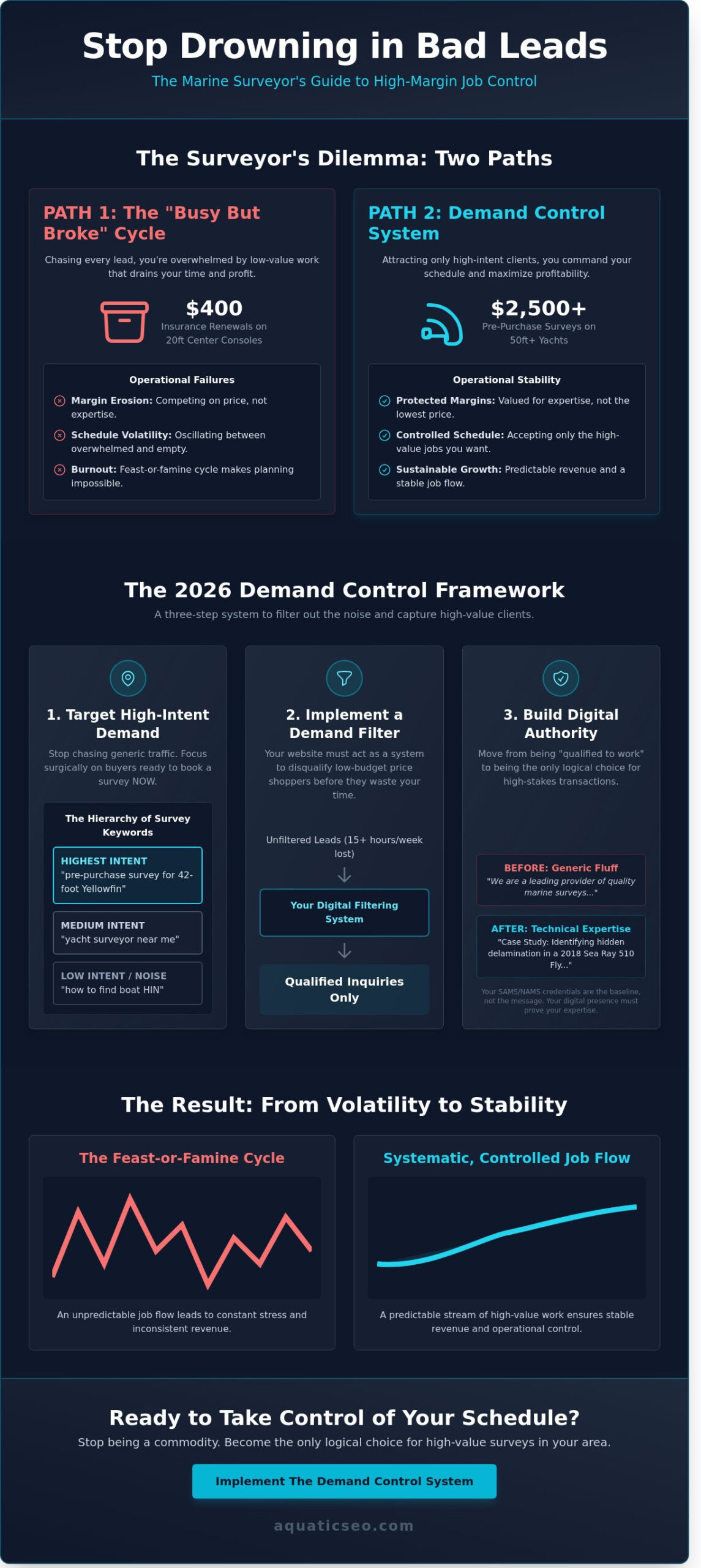
Most marine surveyors believe more leads equate to more profit, but they usually end up drowning in low-margin insurance renewal requests for 20 foot center consoles. If your schedule is packed with $400 jobs while $2,500 pre-purchase surveys on 50 foot yachts go to your competitors, you don’t have a lead problem; you have a control problem. Learning how to market a marine surveying business effectively means building a system that filters out the tire kickers before they ever pick up the phone. It’s about shifting from being a commodity to being the only logical choice for high stakes transactions.
A healthy surveying business requires a mix of high-stakes pre-purchase work and predictable insurance surveys. To see how Ocean Marine Surveyors maintains high standards for these reports, find out more about Insurance Condition and Value Survey. You can use your marketing to fill ‘dead weeks’ by adjusting your visibility for routine inspections when your schedule for major acquisitions looks thin. This allows you to throttle your marketing spend based on your current inspection schedule rather than leaving your revenue to chance. Demand control ensures that scaling your revenue doesn’t come at the cost of your sanity or your schedule’s integrity.
You likely feel the exhaustion of a busy week that leaves your margins thin because you spent 40 hours on low-value reporting and travel. This guide will show you how to stop chasing vanity metrics and start capturing high-intent, qualified inquiries that stabilize your job flow and protect your revenue. We’ll break down the 2026 Demand Control framework to help you dominate your local territory and secure the high-value pre-purchase work you actually want.
Key Takeaways
- Stop chasing vanity metrics that lead to the “busy but broke” trap and start focusing on capturing qualified inquiries that protect your schedule.
- Learn how to market a marine surveying business by targeting high-intent, pre-purchase searches instead of generic informational traffic.
- Deploy a demand filtering system to disqualify low-budget price-shoppers before they hit your inbox, ensuring your profit margins stay intact.
- Build genuine digital authority by auditing your site for generic agency fluff and replacing it with technical deep-dives on critical survey failure points.
- Eliminate the feast-or-famine cycle by implementing a systematic approach to job flow that prioritizes operational stability over raw lead volume.
Why Most Marine Surveyors Fail with Generic Marketing
You spent years earning your credentials and thousands on specialized tools, yet your phone only rings for low-margin pre-purchase inspections on aging vessels. You are likely trapped in the “Busy but Broke” cycle. You have plenty of work, but your margins are shrinking because you spend more time driving between boatyards than actually billing for technical expertise. Learning how to market a marine surveying business isn’t about getting more phone calls. It’s about taking command of your schedule and filtering for high-value surveys that respect your time and your bottom line.
Generic marketing agencies fail because they sell you on “traffic” and “impressions.” They don’t understand the difference between a first-time boat buyer looking for a cheap transom tap and a yacht broker needing a detailed condition and valuation report for a 60-foot Viking. These agencies focus on vanity metrics like clicks and rankings. We focus on demand control. We don’t want you to rank for every search term; we want you to dominate the specific inquiries that lead to five-figure monthly revenue stability.
You need a growth partner who knows the industry, not a vendor who treats your business like a local bakery. We are not an agency; we are specialists who understand that your time is your most finite resource. Our approach replaces vague lead counts with a system designed to capture and filter only the inquiries that fit your ideal profile.
The Cost of Unfiltered Leads
Unfiltered leads are a drain on your operational capacity. Every minute you spend answering basic questions for an unqualified prospect is a minute you aren’t on a vessel. Industry data suggests that surveyors lose up to 15 hours a week on administrative waste without a system to pre-qualify inquiries. This creates several operational failures:
- Margin Erosion: Low-budget inquiries force you to compete on price rather than expertise.
- Schedule Volatility: You oscillate between being overwhelmed and having an empty calendar.
- Burnout: The psychological toll of the “feast or famine” cycle makes long-term planning impossible.
Why Your Credentials (SAMS/NAMS) Aren’t a Marketing Strategy
Being a SAMS-AMS or NAMS-CMS member is the baseline. It tells the insurance company what a marine surveyor does at a professional level, but it doesn’t tell a high-value client why they should hire you over the guy down the street. By 2026, credentials alone won’t win contracts. Competitors with less experience are outranking you right now because they play the digital game better. You must move from being “qualified to work” to being “qualified to be found.” Our marketing services for marine surveyors ensure your technical authority translates directly into market dominance.
Capturing High-Intent Demand with Niche Marine SEO
Stop obsessing over “visibility” and start focusing on intent. If your marketing strategy treats a weekend boater looking for a DIY repair the same as a yacht buyer needing a $3,000 pre-purchase survey, you’re burning money. Knowing how to market a marine surveying business effectively requires a surgical focus on the Pre-Purchase intent. This is where the highest margins live. According to 2023 industry data, pre-owned boat sales reached 275,000 units in the United States, creating a massive pool of high-intent buyers who require professional valuation before a bank or insurance company cuts a check.
Generic SEO agencies will try to sell you on “traffic” from informational searches. You don’t need prospects looking for “how to find a boat’s hull identification number.” You need prospects who have already found the boat and are ready to hire. We prioritize Qualified Inquiries over vanity metrics. Our Digital Marketing for Marine Surveyors system focuses on capturing the buyer at the exact moment they move from “browsing” to “buying.”
The Hierarchy of Survey Keywords
Ranking for “marine surveyor near me” is the baseline, but it’s often the most competitive and price-sensitive space. To dominate, you must target specific vessel types and survey categories. A prospect searching for “pre-purchase survey for 42-foot Yellowfin” is 10 times more valuable than a generic searcher. These model-specific searches indicate a buyer who is deep in the sales funnel and values expertise over the lowest price. A Qualified Inquiry is a prospect ready to book a pre-purchase inspection right now.
Dominating Local Service Yards and Marinas
Boats don’t live in Google; they live in boatyards and marinas. Your digital presence must align with the physical locations where surveys actually happen. If you aren’t the first name that appears when a buyer searches for surveyors near a specific high-volume hub, you’re losing work to whoever is. By implementing modern marketing strategies that emphasize local authority, you can claim “digital territory” around the specific yards where you want to work.
Strategic alignment with SEO for Service Yards and Boatyards creates a powerful referral loop. When buyers research the facility where a boat is hauled, your name should be synonymous with that location. This isn’t about being “everywhere”; it’s about being the obvious choice in the specific hubs that drive your revenue. If you want to stop chasing leads and start controlling your schedule, book a fit call to see how we can stabilize your inquiry volume.
Synthesis Summary
- Target pre-purchase intent rather than general boating information to maximize ROI.
- Use vessel-specific keywords to attract high-margin clients who value specialized expertise.
- Geo-fence your SEO efforts around high-volume service yards and marinas to capture local demand.
- Define success by Qualified Inquiries, not total website traffic or clicks.
Implementing a Demand Filtering System to Protect Your Margins
Most surveyors mistake a flooded inbox for business success. If you spend three hours a day answering calls from price-shoppers looking for the cheapest “Condition and Valuation” report for their 1985 project boat, your marketing is failing you. True growth requires a system that filters demand before it reaches your phone. You don’t need more leads; you need more Qualified Inquiries that respect your expertise and your rate sheet. When considering how to market a marine surveying business, your primary goal is to build a digital barrier that keeps low-margin distractions away from your calendar.
Effective demand control means your website does the heavy lifting of disqualification. By the time a prospect clicks “submit,” they should already understand that you aren’t the budget option. This shift moves the conversation from “How much do you charge?” to “When can you get to the boatyard?” We implement this through a specific Marine Demand Control System designed to prioritize high-value pre-purchase inspections over routine insurance renewals that often carry lower margins and higher administrative headaches.
The ‘Gatekeeper’ Website Strategy
Your website shouldn’t be a passive brochure. It must function as a rigid intake system. We use specific forms that require the prospect to provide the vessel age, length, and the specific survey type immediately. If a vessel is over 30 years old or under 20 feet, your system can automatically trigger a different response or a higher pricing tier to account for the extra liability and time. This strategic content friction eliminates the tire-kicker who is only interested in the lowest number on a quote.
Communicate your value by highlighting your credentials, such as your standing with the Society of Accredited Marine Surveyors, as a non-negotiable standard of quality. When you position your expertise correctly, price becomes a secondary consideration to the technical accuracy of the report. You are selling the peace of mind that comes with a $500,000 yacht purchase, not a commodity service.
Balancing the Job Mix for Maximum Stability
A healthy surveying business requires a mix of high-stakes pre-purchase work and predictable insurance surveys. You can use your marketing to fill “dead weeks” by adjusting your visibility for routine inspections when your schedule for major acquisitions looks thin. This allows you to throttle your marketing spend based on your current inspection schedule rather than leaving your revenue to chance. Demand control ensures that scaling your revenue doesn’t come at the cost of your sanity or your schedule’s integrity.
- Automated Prioritization: Flag inquiries for vessels over 50 feet for immediate callback.
- Dynamic Friction: Add more qualifying questions to your forms during peak seasons to filter for the highest-value jobs.
- Margin Protection: Use your digital presence to justify premium rates before the first phone call occurs.
Learning how to market a marine surveying business is ultimately about operational control. You must dictate who gets on your schedule and at what price point, ensuring every hour spent on a hull is an hour spent at maximum profitability.
Building Your Digital Surveying Authority Without Vanity Metrics
Most surveyors waste thousands on brand awareness campaigns that never book a single pre-purchase inspection. They chase likes on Instagram while their competitors capture high-intent buyers on Google. Building digital authority isn’t about looking pretty; it’s about proving you’re the only person who can spot a failing bulkhead before the check clears. This requires a shift from generic marketing to a system that demonstrates technical dominance in your specific region.
Step 1 is auditing your current site for generic agency fluff. If your homepage features stock photos of smiling families on sailboats instead of a thermal imaging shot of a wet core, you’re failing. You must remove industry errors and vague promises. Replace “we care about safety” with “we identify hidden stringer rot in 1990s Sea Rays.” Precision wins the job.
Step 2 involves creating deep-dive content on specific failure points. Write about delamination in specific hull years or the common electrical faults in specific outboard models. When you explain how to market a marine surveying business through technical expertise, you filter out the price-shoppers and attract clients who value their investment. Use your industry-native knowledge to build case studies that prove you’ve been in the bilges of every major brand in your harbor.
Case Studies as a Conversion Engine
A photo of a moisture meter hitting 30% on a transom tells a story that no stock photo can match. These “Big Save” stories demonstrate how your survey saved a client from a $150,000 mistake. Structure these pages to include specific boat models like the Hatteras 53 or Boston Whaler Outrage. This strategy ensures you rank when a buyer searches for that exact vessel and wants to know what to look for before making an offer.
The Myth of Social Media for Surveyors
Likes on Instagram don’t translate to bookings. Buyers don’t scroll through reels to find a surveyor; they use search engines when they’re ready to wire funds. Focus your energy on Google and Bing where demand is active. Social media only works when used to build direct referral loops with boat dealers who need reliable partners for their clients. Spend your time on search visibility, not content for other surveyors to “like.”
Stop chasing vanity metrics and start capturing qualified inquiries that actually book surveys.
Mastering Job Flow: The Marine Demand Control System for Surveyors
Most marine surveyors operate in a punishing cycle of feast or famine. You spend three weeks back-to-back on hull inspections and engine sea trials, followed by ten days of silence where the phone doesn’t ring. This instability exists because you rely on passive referrals rather than a predictable system. Understanding how to market a marine surveying business requires moving past basic visibility and toward total demand control.
We are not a marketing agency; we are a growth partner. A typical agency sells you vanity metrics like clicks and impressions that don’t pay the bills. As a growth partner, we focus on operational outcomes and qualified inquiries. We help you transition from chasing every low-margin lead to managing a business asset that generates high-value work on command.
For a deeper dive into these strategies, read our Marine Marketing: The Ultimate Guide to see how industry leaders capture market share.
Achieving Operational Control
Operational control means you choose your clients instead of them choosing you. When your calendar is full of qualified inquiries, you can decline low-margin requests or difficult clients without fear. This shift significantly impacts your long-term business valuation. Data shows that a surveying firm with a documented, automated system for acquiring clients is worth 20% to 30% more than a solo operator dependent on a personal Rolodex.
- Selectivity: Focus on high-value insurance claims or commercial surveys rather than $400 pre-purchase inspections for small runabouts.
- Predictability: Know exactly where next month’s revenue is coming from before the month even starts.
- Scalability: Add junior surveyors to your team without fearing they will sit idle and drain your overhead.
If you are tired of vague promises, we offer a “No-BS” analysis of your current efforts. We will look at your data and tell you exactly where your system is leaking money. We don’t sugarcoat the results; we provide the hard numbers you need to fix your margins.
Synthesis: Your Path to a Scalable Surveying Business
The transition from simple visibility to qualified demand capture is the final step in learning how to market a marine surveying business effectively. Stop wasting time on price-shoppers and tire-kickers. It’s time to enforce a system that filters for the margins you deserve. Demand Compounding is the operational process where an established flow of qualified inquiries lowers your overall acquisition costs while simultaneously increasing your average contract value through brand authority.
If you are ready to stop the “busy-work” and start building a scalable operation, book a fit call today. Let’s build a system that works as hard as you do in the boatyard.
Stop Chasing Leads and Start Controlling Your Surveying Demand
Generic agencies fail because they trade in vanity metrics while your schedule remains erratic. Mastering how to market a marine surveying business requires more than just an online presence. It demands a system that captures high-intent buyers and filters out low-margin noise before it ever reaches your phone. You need a partner who understands that a qualified inquiry is the only metric that actually impacts your bottom line.
At Aquatic SEO, we’ve specialized in marine surveyor growth since our inception. We work exclusively with businesses in the $300K to $5M revenue range to install operational stability. Our proprietary Marine Demand Control System replaces the cycle of busy weeks followed by dead weeks with a predictable flow of high-value jobs. You don’t need more traffic. You need command over your margins and your time.
Stop guessing about your growth and start enforcing a system that works. We’ll identify exactly where your current strategy leaks revenue and show you how to fix it with precision.
Request a No-BS Marine Marketing Analysis for Your Surveying Business
Your expertise deserves a calendar filled with high-value surveys instead of an inbox full of tire-kickers.
Frequently Asked Questions
Is SEO worth it for a solo marine surveyor?
SEO is the most efficient way to capture active buyers without wasting your billable hours on cold calls. For a solo surveyor, organic visibility ensures your calendar stays full during the 4 month spring rush and the slower winter months. Instead of chasing work, you position yourself as the local authority. This allows you to cherry-pick high-margin jobs while the system handles the heavy lifting of discovery.
How long does it take to see results from a Marine Demand Control System?
You will typically see a shift in inquiry quality within the first 30 days of implementation. Achieving total schedule stability through the Marine Demand Control System generally requires a 90 day window to calibrate for your specific territory. This isn’t a “set it and forget it” tactic. It’s an operational shift that builds compound interest in your market share every month the system runs in your local area.
Should I list my survey prices on my website?
Listing exact prices often triggers a race to the bottom that destroys your profit margins. Instead, use “starting at” figures or price ranges based on vessel length to filter out shoppers who only care about the lowest bid. Your website should sell the value of your technical expertise and the risk you mitigate for the buyer. This ensures you attract clients who prioritize a thorough inspection over a cheap report.
What is the difference between a lead and a qualified inquiry for a surveyor?
A lead is just a name and an email address that may never turn into a paycheck. A qualified inquiry is a prospect with a specific vessel, a set location, and a firm closing date on a purchase. When learning how to market a marine surveying business, you must focus on the latter. We prioritize inquiries that meet your specific criteria for boat type and survey location to stop schedule bleed.
Do I need to be on every social media platform to market my business?
Spreading yourself thin across every platform is a waste of operational resources. Most surveyors find success by dominating one or two channels where active buyers congregate, like regional Facebook groups or LinkedIn for commercial work. It’s better to have a commanding presence on one platform than a ghost town on five. Focus your energy on providing technical insights that prove you know your way around a hull.
How do I target high-value yacht pre-purchase surveys specifically?
Target high-value yacht surveys by creating content that addresses the specific technical failures of premium brands like Viking or Hatteras. When you demonstrate deep knowledge of a $2 million yacht’s complex systems, you attract the buyers of those vessels. This specialized approach filters out small boat inquiries and positions you as the only logical choice for high-stakes transactions. High-value clients want a specialized expert, not a generalist.
Can marketing help me get more referrals from boat insurance agents?
Marketing builds the professional credibility that makes an insurance agent comfortable putting their reputation on the line for you. When your digital presence reflects a high standard of reporting and technical accuracy, agents refer you with confidence. Use your platform to highlight your certifications and your track record of meeting strict carrier requirements. This systematic approach turns one-off referrals into a predictable stream of recurring business.
What are the biggest mistakes marine surveyors make with their websites?
The biggest mistake is building a digital resume instead of a lead generation tool. Most surveyor sites focus on their personal history rather than the buyer’s risks. They also fail to include a filtering system, which results in the surveyor spending hours on the phone with unqualified callers who won’t book. A successful site must clearly state your service area and the specific vessel types you are qualified to inspect.