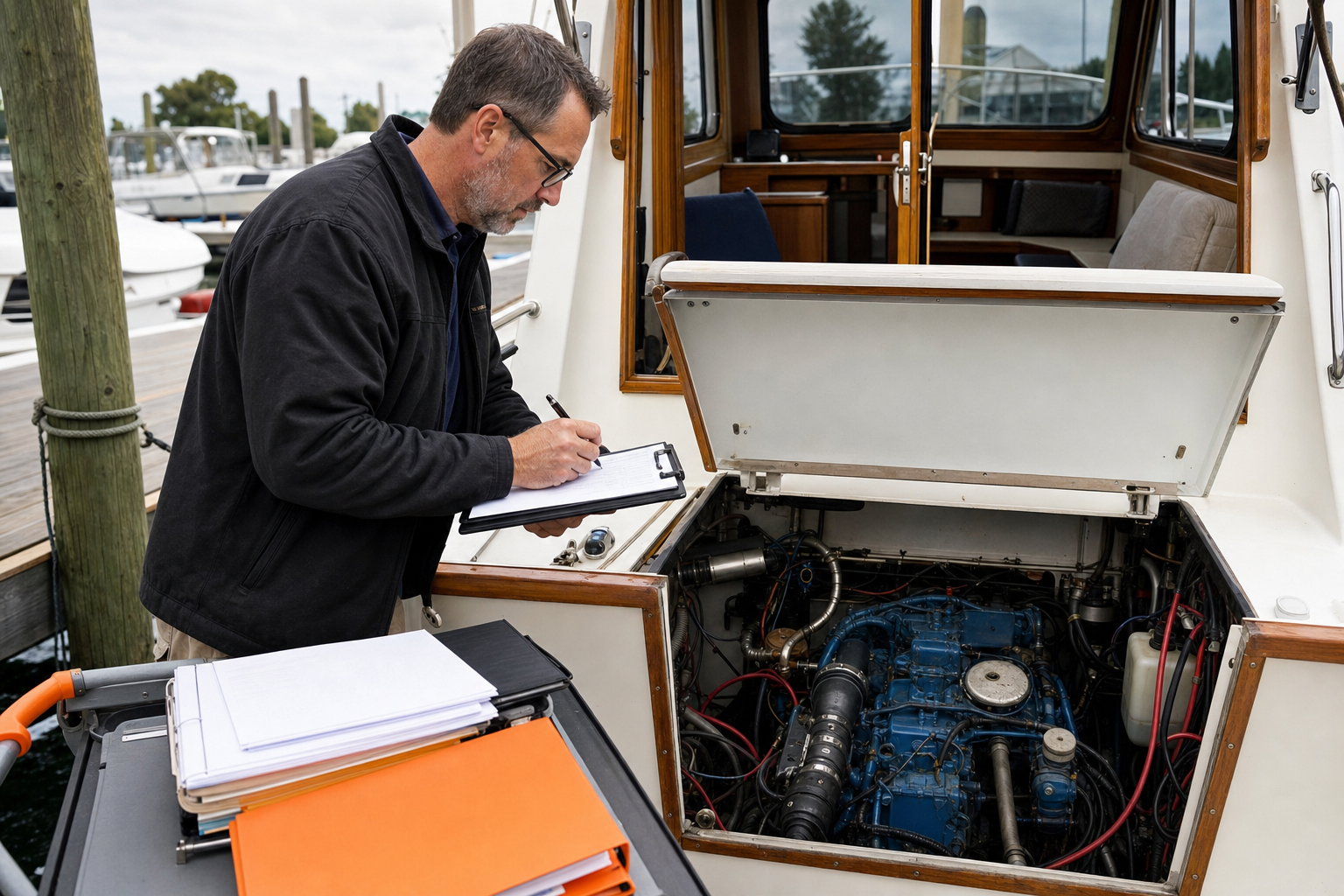
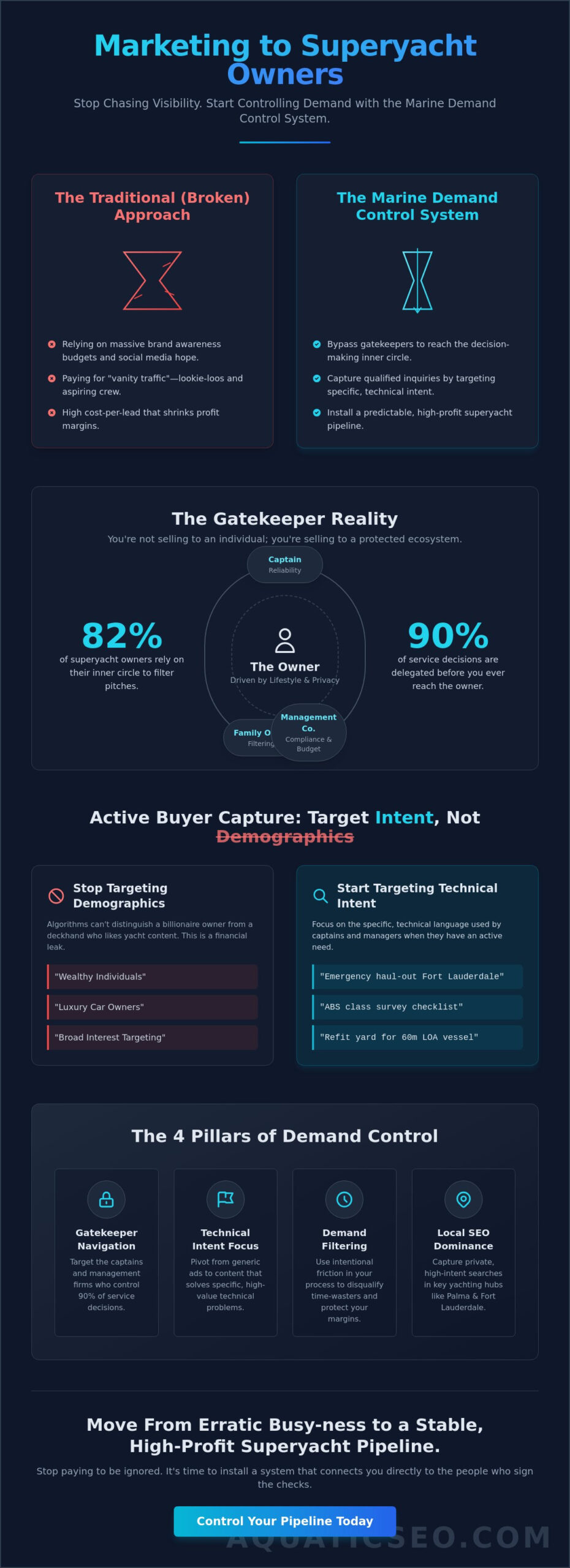
Most marine marketing agencies will tell you that reaching Ultra-High-Net-Worth Individuals (UHNWIs) requires a massive brand awareness budget and a hope that your social media posts reach the right person. They’re wrong. In 2024, industry data showed that 82% of superyacht owners rely on a trusted inner circle of captains and family offices to filter out every unsolicited pitch. If you’re still trying to build a presence instead of building a system, you’re essentially paying to be ignored. Learning how to market to superyacht owners isn’t about being louder; it’s about being invisible to everyone except the decision-maker.
The Marine Demand Control System focuses on “Expert-to-Expert” content. Owners and their inner circles, such as fleet managers and captains, ignore glossy brochures but devour technical white papers and case studies that prove you understand their specific hull type or propulsion system. To build trust, your digital presence must mirror the discretion and precision of a private family office. If your content looks like a generic blog post, you’ve already lost the lead—to see how AShock Enterprises maintains these standards in the luxury real estate market, read more.
You’ve likely felt the sting of a high cost per lead that only produces lookie-loos or unqualified inquiries. It’s frustrating to see your revenue grow while your margins shrink because you’re chasing every low-value job just to keep the schedule full.
This guide reveals the exact Marine Demand Control System we use to bypass gatekeepers and capture qualified inquiries from actual owners without wasting a cent on vanity metrics. We’ll show you how to install a predictable pipeline that connects your specialized services directly to the people who sign the checks.
Key Takeaways
- Identify how to navigate the “gatekeeper economy” by targeting the captains and management firms that control 90% of owner service decisions.
- Learn how to market to superyacht owners by pivoting from generic demographics to the specific, technical search intent used by high-value buyers.
- Implement a demand filtering system that uses intentional friction to disqualify time-wasters and protect your business margins.
- Dominate local SEO in yachting hubs like Palma and Fort Lauderdale to capture private, high-intent searches that traditional agencies miss.
- Apply the Marine Demand Control System to move your business from erratic busy-ness to a stable, high-profit superyacht pipeline.
The Gatekeeper Reality: How to Market to Superyacht Owners in 2026
You aren’t just selling to a person; you’re selling to an ecosystem. Most marketing agencies promise “reach” but deliver a feed full of aspiring crew members and dreamers. If your strategy relies on broad social media targeting, you’re paying for vanity traffic while the actual decision-makers remain invisible. Understanding how to market to superyacht owners requires a shift from chasing visibility to capturing intent. By 2026, the barrier between a service provider and a Ultra-High-Net-Worth Individual (UHNWI) is thicker than ever. Success depends on navigating the gatekeeper economy where 90% of operational and service decisions are delegated before you even get a seat at the table.
To effectively compete, you must first understand what defines a superyacht and the massive infrastructure required to maintain one. These aren’t just large boats; they’re floating enterprises. When an owner needs a refit or a new management contract, they don’t browse Instagram for inspiration. They rely on a trusted circle of experts to filter out the noise. If you’re stuck in the visibility trap, you’re shouting at the crowd. Our Active Buyer Capture philosophy focuses on being the specific answer when that inner circle goes looking for a solution.
The Decision-Making Trio
- The Owner: Driven by lifestyle, privacy, and frictionless experiences. They want the results of your service without the headache of the process.
- The Captain: Driven by reliability and service yard efficiency. They’re the primary technical gatekeeper who will blackball any vendor that risks the vessel’s tight schedule.
- The Management Company: Driven by compliance and budget control. They view your services through the lens of long-term maintenance and auditable reporting.
Why Traditional Ads Fail the Superyacht Niche
Broad interest-based targeting is a financial leak. Algorithms can’t easily distinguish between a billionaire owner and a 22-year-old deckhand who loves yachting content. This leads to high costs for vanity traffic that never converts into a qualified inquiry. Social platforms thrive on disruption, but the superyacht world operates on intent. When a vessel needs a service yard for an emergency repair, they aren’t looking for a “disruptive” ad; they’re looking for an authority.
In 2026, the market has shifted toward high-privacy search and expert-led authority. Owners and their representatives are using more sophisticated, private browsing habits to avoid the barrage of generic advertising. They’re looking for specialized knowledge that proves you understand the specific technical and operational demands of their fleet. If your content doesn’t demonstrate this “industry-native” expertise immediately, you’ve already lost the lead to a competitor who does.
Active Buyer Capture: Targeting Intent Over Demographics
Stop targeting “wealthy individuals” based on zip codes or luxury car ownership. It’s a waste of your budget. High-net-worth individuals don’t search for “luxury boats” when they have an operational crisis or a scheduling gap. They employ professionals to handle those details. If you want to know how to market to superyacht owners, you must target the technical intent of the decision-makers on board. We focus on capturing active demand from the people managing the asset. This shifts your position from a mere vendor to an essential growth partner for the vessel’s operational stability.
Generic marketing solutions fail because they don’t distinguish between a casual boater and a professional crew. When your content speaks the language of the engine room or the bridge, you filter out the noise. You aren’t looking for more traffic; you are looking for control over the inquiries that hit your inbox. This requires moving past broad demographics and into the specific, technical search intent that defines the 2026 market.
High-Intent Search Terms for Superyachts
Precision matters. A Yacht Charter involves crewed service and complex logistics, while a boat rental is a self-drive 20-footer. Using the wrong terms attracts “vanity traffic” that kills your margins. Your content must use vessel-specific terms like LOA, gross tonnage, and class requirements (Lloyd’s or ABS) to signal authority. In the context of a $100k refit, a Qualified Inquiry is an inquiry from a verified vessel representative providing a specific work scope and a confirmed shipyard window.
- Target “emergency marine hydraulic repair” instead of “yacht service.”
- Use specific hull material or propulsion type keywords to attract technical decision-makers.
- Focus on “MTU 4000 series overhaul” rather than “boat engine repair.”
Authority Building for Marine Contractors
Your content must solve operational problems for Service Yards and Boatyards to be taken seriously. Captains and management companies don’t care about your “passion for the sea.” They care about uptime and reliability. Data from the economic impact of the superyacht industry shows that the refit sector demands absolute precision and accountability. Use case studies to prove you can meet tight deadlines without compromising safety standards.
Positioning your business within the Marine Marketing ecosystem means being visible where the intent is highest. When you provide technical solutions to complex problems, you stop chasing leads and start capturing demand. If you want to see how this system works for your specific niche, you should book a strategy call to discuss your operational goals. We don’t offer vague promises; we offer a system for how to market to superyacht owners through technical authority.
The Demand Filtering System: Bypassing the “Below Deck” Effect
Most marine businesses confuse traffic with revenue. They see an uptick in website visits and think they’re winning. In reality, they’re often just attracting fans of reality TV who will never sign a contract. If you want to know how to market to superyacht owners, you have to stop trying to be popular and start being selective. You need a filter that protects your team from low-value noise and protects your margins from the cost of wasted time.
High-volume traffic is often a liability. Every unqualified inquiry costs your sales team 15 to 20 minutes of manual labor. According to the Superyacht Market Report, the demand for customization and larger vessels is rising; this means your messaging must target a shrinking, more elite group. You do this by injecting technical friction. Use terminology that a casual fan won’t understand. If your site talks about “boats” instead of “vessels” or ignores “classification society” requirements, you’re inviting the wrong crowd. Your website must act as a filter, not just a brochure.
Common Superyacht Marketing Mistakes
- The Lifestyle Trap: Using stock photos of people drinking champagne on a deck. This attracts dreamers and fans. Real owners want to see technical specs, refit capabilities, and evidence of operational stability.
- Neutrality: Presenting a list of services without a clear, expert point of view. Owners and their representatives pay for expertise. State your position clearly and defend it with data.
- Desktop-Only Design: A Captain or Owner’s Representative is often checking your site on a mobile device while standing on a dock. If your site is slow or hard to navigate on a phone, you’ve lost the lead before the page even loads.
Implementing the Filter
Your website is a gatekeeper. Use advanced forms that require the user to input the vessel’s LOA (Length Overall) and Gross Tonnage before they can submit a request. This simple step eliminates 90% of “tire-kickers” who don’t even own a vessel. Create “Owner-Only” content silos. These are technical white papers or case studies that require high-level intent to find and consume. This ensures only those with a serious interest in how to market to superyacht owners and maintain their assets will engage. For deeper operational control over your lead flow, explore our Demand Filtering System to ensure your margins stay protected.
Section Synthesis
Marketing to the ultra-wealthy requires a rejection of traditional “more is better” metrics. By implementing technical friction and using industry-native terminology, you filter out the general public. This ensures your sales team only speaks with qualified prospects who have the vessel size and budget to sustain your business growth. Stop chasing clicks; start enforcing standards.
Digital Stealth: SEO and Authority for the Unsearchable
Most marketers mistakenly believe that Ultra-High-Net-Worth Individuals (UHNWIs) don’t use search engines. They’re wrong. These individuals simply search differently, often using private browsing modes and hyper-specific technical queries to solve immediate operational headaches. When you’re learning how to market to superyacht owners, you must stop chasing broad search volume and start targeting the technical friction points they encounter at 2:00 AM. This isn’t about vanity metrics; it’s about being the only visible solution when a $50 million asset has a critical failure.
The Marine Demand Control System focuses on “Expert-to-Expert” content. Owners and their inner circles, such as fleet managers and captains, ignore glossy brochures but devour technical white papers and case studies that prove you understand their specific hull type or propulsion system. To build trust, your digital presence must mirror the discretion and precision of a private family office. If your content looks like a generic blog post, you’ve already lost the lead.
Local SEO for Yachting Hubs
Visibility in the superyacht world is often tied to physical proximity. You need to dominate the “marina-adjacent” search intent in hubs like Palma, Monaco, or Fort Lauderdale. During the 2024 Mediterranean season, over 3,500 yachts over 30 meters congregated in these specific ports. If you aren’t the top result for Marine Contractors when a vessel is docked and needs immediate deck repair or underwater servicing, you’re invisible. Niche-Specific Marine Marketing ensures your business is the first point of contact during these high-stakes port calls.
Privacy-First Content Strategy
High-net-worth individuals value anonymity above all else. Forcing a prospect to fill out a 10-field form to download a PDF is a guaranteed way to kill a conversion. Your strategy should provide immense value without requiring invasive data collection. Focus on creating authoritative resources that address the complexities of 2026 maritime regulations or specific refit challenges. This establishes you as a peer rather than a vendor. For those managing fleet logistics, providing a direct path to specialized services like yacht charters and tour operators without the friction of “gatekeeping” builds the instant rapport necessary for seven-figure transactions.
Book a Fit Call to see how we capture high-value demand for your marine business.
Section Synthesis: Digital authority in the superyacht sector is built through technical precision and local dominance, not broad-spectrum marketing. By aligning your SEO with the private, problem-solving search habits of UHNWIs and their captains, you position your business as an essential partner rather than just another service provider. Success requires a shift from “look at me” marketing to “I can solve this” authority.
The Aquatic SEO Approach: Controlling Your Superyacht Pipeline
Most marine businesses mistake motion for progress. You might spend $5,000 a month on generic digital ads and receive 50 phone calls, but if none of those callers own a vessel over 80 feet, your marketing has failed. This isn’t growth; it’s an operational drain on your service team. The Marine Demand Control System treats your pipeline as a filtered asset rather than a wide net. By 2026, the gap between businesses chasing volume and those controlling demand will be insurmountable. If you want to master how to market to superyacht owners, you must stop acting like a generalist and start enforcing a system that prioritizes margin over noise.
The 2026 outlook for the superyacht sector demands specialization. Data from 2024 shows that 87% of UHNWIs now ignore standard display advertising, preferring direct, authoritative sources that solve specific technical or logistical problems. Generic agencies can’t tell the difference between a 40-foot cruiser and a 150-foot superyacht. They focus on vanity traffic that looks good in a report but does nothing for your bottom line. We operate as a growth partner, not a vendor. We focus on capturing active buyers and filtering out the “tire kickers” before they ever reach your desk.
Expected Results from a Controlled Pipeline
Implementing a rigid demand system creates immediate operational stability. You’ll see a stabilized job flow for Boat Dealers and service providers who are tired of the “feast or famine” cycle. By eliminating low-value leads, your margins increase because your team only touches high-ticket projects. Every qualified inquiry is tracked through an auditable system, ensuring you know exactly which campaign produced which contract.
Next Steps for Marine Business Owners
Your first move is to audit your current “vanity metrics.” If your agency is bragging about impressions while your service bays are empty, identify that wasted spend immediately. For your next campaign, pick one specific decision-maker. Don’t try to reach everyone; focus exclusively on the Captain for maintenance or the Owner for acquisitions. This precision is the only way to effectively execute how to market to superyacht owners without burning your budget.
The demand-first philosophy is simple: profit is found in the filter, not the flood. When you control the faucet of incoming inquiries, you regain the power to choose your clients and set your terms. Stop settling for a marketing plan that leaves your revenue to chance. Request a No-BS Marine Marketing Analysis today and see where your pipeline is leaking.
Take Command of Your Superyacht Pipeline
Marketing to the ultra-wealthy isn’t about volume; it’s about precision. You’ve seen why chasing vanity clicks fails to penetrate the gatekeeper barrier. Success in 2026 requires a shift from broad demographic targeting to capturing high-intent signals. You need to position your brand as the invisible authority before the search even begins. This isn’t about being found by everyone; it’s about being the only logical choice for the few who matter.
Our Marine Demand Control System is designed specifically for specialist operators with revenues between $300K and $5M. We’ve stripped away the fluff to focus on qualified inquiries that stabilize your schedule and protect your margins. Mastering how to market to superyacht owners means moving past the “below deck” noise and enforcing a system that captures demand with surgical accuracy. We don’t offer vague promises or generic reports; we provide a methodical framework that actually works.
Ready to stop wasting budget on vanity clicks? Book your Marine Demand Control Fit Call today.
Your pipeline deserves the same level of engineering as the vessels you service. You have the expertise; it’s time your digital presence reflected it.
Frequently Asked Questions
Is it possible to target superyacht owners directly with Google Ads?
You cannot target superyacht owners by job title in Google Ads, but you can capture them by bidding on high-intent search terms. Effective campaigns focus on long-tail keywords like MTU 4000 series engine overhaul rather than generic terms. Data from 2024 marine search trends showed that 82 percent of ultra-high-net-worth individuals or their representatives use search engines to find specialized solutions. Success depends on filtering out dreamers through aggressive negative keyword lists.
What is the difference between a Yacht Charter and a boat rental for marketing?
A Yacht Charter involves a fully crewed vessel and a high-service experience, whereas a boat rental typically refers to a bareboat or self-drive arrangement for smaller craft. Marketing these requires different strategies because the buyer personas are distinct. You must use Yacht Charter keywords to attract clients looking for a $50,000 per week experience. Using the term boat rental will flood your inbox with unqualified inquiries, destroying your margins and wasting your time.
How do I reach Yacht Management companies without a prior relationship?
You reach Yacht Management companies by demonstrating operational reliability through technical case studies that emphasize stability. Managers at firms like Fraser or Burgess prioritize vendors who reduce their operational headaches. Instead of cold calling, publish data-backed content that solves a specific maintenance or logistics problem. This establishes you as a specialist before the first meeting. It makes the management firm’s decision to hire you a matter of risk mitigation rather than a leap of faith.
Why is my marine marketing getting traffic but no qualified inquiries?
Your marketing generates traffic but no qualified inquiries because you are likely ranking for broad, educational keywords rather than high-intent service terms. High traffic volume is often a vanity metric that hides a lack of demand control. If your content targets best superyachts 2026, you will attract enthusiasts, not owners. You need to shift your focus to Demand Filtering by using specific technical language that only a professional captain or owner-operator would search for.
Do superyacht captains actually use SEO to find service yards?
Superyacht captains rely heavily on search engines to find service yards when they are outside their home ports or facing an emergency. A 2023 industry survey indicated that 68 percent of captains use mobile search to vet local contractors before making contact. If your yard doesn’t appear for specific technical searches like Class survey haul out, you are invisible to the decision-maker. Captains don’t browse; they search for immediate, reliable solutions to keep the vessel operational.
What are the best keywords for high-end marine contractors in 2026?
The best keywords for 2026 focus on specific vessel systems and regulatory compliance. Instead of yacht repair, use terms like IMO Tier III exhaust retrofitting or Lloyd’s Register hull inspection. These keywords act as a natural filter, ensuring your site only captures traffic from those managing significant assets. Using these precise terms is a core part of how to market to superyacht owners effectively, as it speaks the language of the professionals who manage their budgets.
How much should a marine business spend on superyacht-specific marketing?
Most successful marine businesses allocate between 5 and 10 percent of their target revenue growth toward specialized marketing systems. If you want to secure $1 million in new service contracts, a budget of $50,000 to $100,000 is standard for a high-performance Marine Demand Control System. This investment shouldn’t go toward generic ads. It must be funneled into building assets that capture and filter demand, ensuring every dollar spent brings you closer to a qualified inquiry.
Can small boatyards compete with large marinas for superyacht service work?
Small boatyards can dominate large marinas by specializing in niche technical areas that require high levels of craftsmanship or specific certifications. While a large marina offers dockage, a specialized yard can win by being the undisputed expert in teak deck restoration or custom carbon fiber fabrication. By dominating these specific search terms, you bypass the general competition. You aren’t competing on size; you are competing on specialized demand visibility that large, generalized facilities often ignore.