

Most marine mechanics are tired of being treated like a commodity by agencies that think a transom is a type of engine part. You didn’t spend years mastering complex diesel systems or NMEA 2000 networking just to spend your days fielding calls about fifty-dollar impeller swaps or “quick” bilge pump fixes. If your phone is ringing but your profit margins are shrinking, you don’t have a lead problem; you have a filtering problem. You deserve a system that prioritizes high-margin engine overhauls and complete electrical refits over the low-value noise that clutters your shop schedule.
You can learn more about how Compass Marine establishes this technical certainty through their expert engine servicing and mechanical repairs for outboards, inboards, and jet skis.
You already know that not every inquiry is worth your time, especially when you’re trying to balance a frantic peak season with the inevitable off-season dip. This article will teach you how to implement a marketing for marine mechanics strategy that moves beyond generic lead generation and puts you back in control of your actual job mix. We’re going to examine the Demand Filtering framework designed to capture high-intent engine repairs while keeping the “tire kickers” away from your technicians.
Key Takeaways
- Stop wasting budget on generic marketing for marine mechanics that delivers high click volume but fails to book high-margin engine overhauls.
- Identify the specific search triggers that generate a Qualified Inquiry for emergency repairs rather than low-value maintenance questions.
- Learn how a Demand Filtering system gives you the power to turn the tap of inquiries on or off based on your current shop capacity.
- Discover the specific steps to dominate local search results and ensure your service yard is the first one local boat owners see.
- Move beyond the “one-man-band” model by shifting your focus from reactive lead chasing to a scalable demand control framework.
The Problem with Generic Marketing for Marine Mechanics
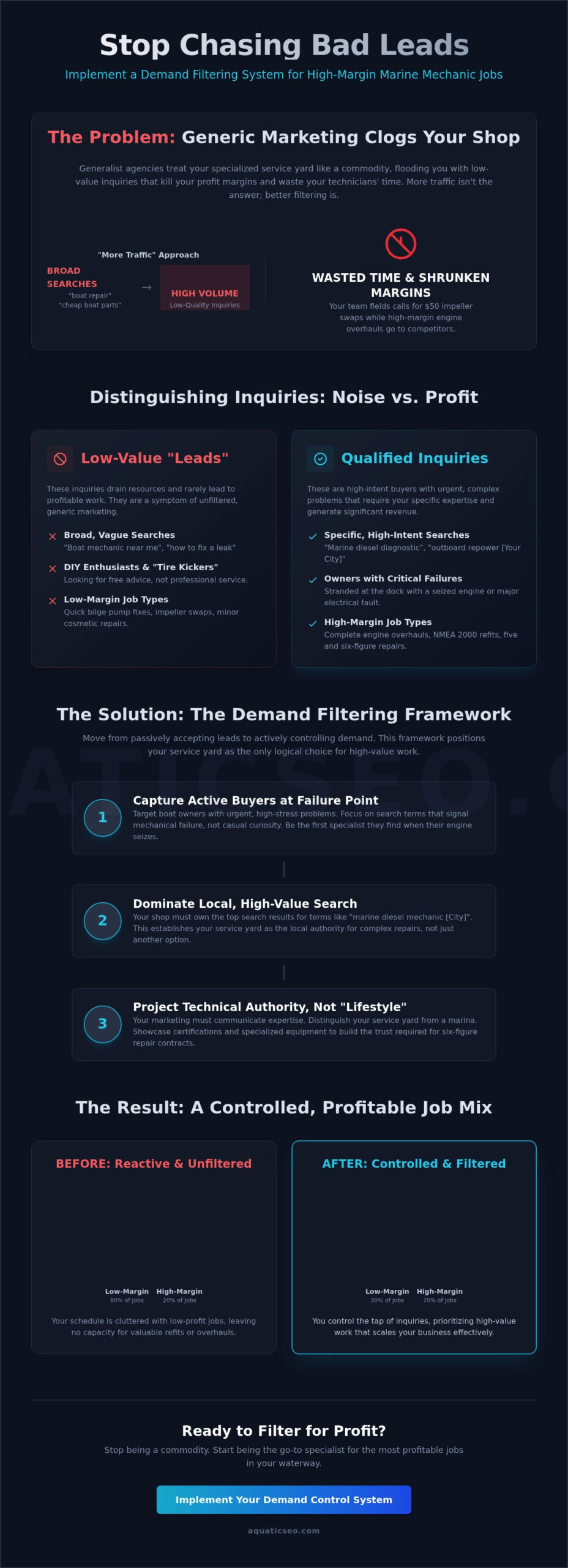
Most generalist agencies apply the same digital marketing strategies to a marine mechanic that they use for a local house painter. This approach is a recipe for wasted spend. They focus on volume because they don’t understand the technical complexity of your work. You don’t need a thousand clicks from people looking for “cheap boat parts” or “how to fix a leak.” You need the owner of a 50 foot sportfish with a smoking engine. Generic marketing for marine mechanics fails because it treats your specialized technical skill as a commodity. It forces you to compete on price rather than expertise.
Agencies that don’t know the difference between a transom and a tiller often hide behind vague metrics. They talk about “engagement” when you need engine pulls. They present options without a clear point of view on what actually drives revenue in a boatyard. This lack of industry knowledge leads to a job mix dominated by low-margin repairs that barely cover your overhead. If your current agency brags about “impressions” while your technicians are standing around waiting for real work, you’re being sold a vanity project.
Why “More Traffic” is a Trap for Your Shop
High traffic numbers often hide a painful reality; your service writers are wasting hours on “tire-kickers” who will never book a job. Broad search terms like “boat repair” are magnets for DIY enthusiasts and owners of small vessels with no budget for professional service. These inquiries drain your team’s time and lower shop morale. When you invest in marketing for marine mechanics, you aren’t just buying ads. You’re buying a filter. You should be targeting high-intent phrases like “inboard engine overhaul” or “marine diesel diagnostic.” Every minute your staff spends explaining basic maintenance to an unqualified lead is a minute they aren’t billing for high-margin technical work.
Distinguishing Between Service Yards and Marinas
A common mistake made by outside vendors is confusing a marina with a service yard. A marina provides dockage, fuel, and lifestyle amenities. Your Digital Marketing for Marine Mechanics and Electricians must communicate technical authority instead. Yacht owners don’t look for a mechanic where they buy ice. They look for a specialist who understands their specific propulsion systems and complex electrical grids. If your online presence looks like a generic directory listing, you’re losing high-value refit projects to competitors who project an “industry-native” image. Precision in your messaging isn’t just about branding. It’s about establishing the trust required to secure five and six-figure repair contracts. You provide technical solutions. Your marketing should reflect that level of specialized expertise.
Capturing High-Intent Demand for Engine Repairs and Refits
Active Buyer Capture is the process of positioning your shop in front of owners at the exact moment of mechanical failure. When a yacht owner is stranded at the dock with a seized engine, they don’t want to browse social media or read lifestyle blog posts. They need a specialist who can diagnose the failure and provide a quote for a repower or overhaul. Effective marketing for marine mechanics focuses on these high-stress moments by targeting search intent that signals a critical need rather than a casual curiosity.
The psychology of a boat owner during a mechanical failure is driven by a desire for technical certainty. They’re looking for a partner who speaks their language and has a track record with their specific propulsion systems. Your website must act as a filter that validates your expertise immediately. If your site looks like a generic brochure, you’ll lose that Qualified Inquiry to a competitor who clearly displays their certifications and specialized tools.
Targeting Active Buyers in Your Local Waterway
You need to dominate search results for high-value terms like “marine diesel mechanic” or “outboard repower [City]” to capture demand before it goes elsewhere. Owners rarely search for these terms unless they have a serious problem or a planned major project. By appearing at the top of these results, you establish your Service Yard as the local authority for complex repairs. You should also ensure your service pages answer technical objections regarding turnaround times and parts availability before the owner even picks up the phone.
To scale effectively, you must develop a marketing plan that accounts for the seasonal nature of the industry. The projected US boat repair and maintenance market size of $5.5 billion by 2026 shows there’s plenty of demand to go around. The key is ensuring that demand flows to your shop rather than your competitors. Structured service pages that highlight your specific capabilities are the foundation of this strategy.
The Role of Marine SEO in Job Filtration
Generic terms like “boat repair” are too broad and often attract low-margin work. Instead, focus your SEO efforts on specific engine brands like Yamaha, Mercury, or Volvo Penta. This technical specificity proves you aren’t a generalist “handyman” but a specialized operator capable of handling high-value projects. Creating dedicated landing pages for specific disciplines, such as NMEA 2000 networking or pod drive service, helps filter out the noise and attracts the high-margin work your technicians prefer.
If you’re ready to stop chasing every lead and start focusing on high-margin technical work, it’s time to refine your marketing for marine mechanics strategy. This approach ensures your shop remains full of the right projects; even during the off-season. By prioritizing technical authority over generic visibility, you build a more stable and profitable business.
Implementing a Marine Demand Control System
Most mechanics operate in a state of reactive chaos. You spend your peak season drowning in low-margin repairs and your off-season wondering how to keep your best technicians on the payroll. A Marine Demand Control System replaces this volatility with a predictable framework for business growth. It shifts your focus from chasing generic leads to managing a pipeline of high-value technical projects. Effective marketing for marine mechanics is about installing a “tap” that you can turn on or off based on your current shop capacity and financial goals.
You must distinguish between a lead and a Qualified Inquiry. A lead is often just a phone number attached to a boat owner looking for the cheapest price on a spark plug change. A Qualified Inquiry is a yacht owner or captain with a specific, high-margin problem who values your technical expertise over a discount. Stabilizing your job flow requires a system that attracts the latter while systematically repelling the former. This level of oversight ensures your service yard remains profitable without burning out your crew.
How to Filter Out Low-Margin Inquiries
Your digital presence should act as your first line of defense. By implementing Demand Filtering Systems, you qualify owners before they ever take up a minute of your service writer’s time. Your website must explicitly state which engine brands you service and the minimum project size you accept. If you specialize in diesel overhauls, your content should reflect that level of complexity. We recommend using a “fit call” process to verify that a project aligns with your high-margin targets before scheduling a diagnostic visit. This simple hurdle saves hours of wasted time on “tire-kickers” who aren’t a match for your shop.
Stabilizing Your Seasonal Revenue Cycles
Seasonality is the biggest threat to your organizational stability. You don’t have to accept the “feast or famine” nature of the industry as a permanent reality. Use your peak summer demand to build a backlog of winter refit projects. When your shop is at 100% capacity in July, your marketing should pivot toward booking major electrical upgrades and engine repowers for the cooler months. This strategy uses demand compounding to ensure your high-value assets; your technicians; stay busy year-round.
Combining these internal processes with proven local marketing strategies creates a defensive perimeter around your business. Research shows that 65% of boat repair shop revenue comes from repeat customers. By controlling your job mix, you ensure those repeat customers are the ones providing the highest margins. A predictable job mix isn’t just about revenue; it’s about the financial health and long-term stability of your entire operation.
Dominating Local Search Without the Marketing Fluff
Local search isn’t a popularity contest; it’s about geographical dominance. For a mobile mechanic or a fixed service yard, your Google Business Profile is often the only thing standing between you and a high-margin repower job. Generic agencies will try to sell you on national reach, but you can’t service a boat three states away. You need to own the search results within the specific waterways you service. Effective marketing for marine mechanics requires a rejection of low-quality tactics like buying bulk backlinks from unrelated sites that do nothing to build local authority.
We see too many shops settle for “nice guy” reviews. While being polite is fine, it doesn’t prove you can handle a complex diesel diagnostic. You need technical testimonials that mention specific brands and systems. A review stating you fixed a Volvo Penta IPS drive is worth ten reviews saying you’re “friendly.” This level of specific proof builds the trust necessary to convert a high-value prospect before they even call your shop.
Optimizing Your Google Business Profile for Repair Specifics
Stop listing “boat repair” as your only service. You must break your profile down into technical categories like Engine Diagnostics, Electrical Troubleshooting, and NMEA 2000 Networking. Use high-quality photos of your technicians using diagnostic software or performing engine pulls to prove your shop has the proper tools. Since Florida holds over 18% of the national market share for boat repair revenue, competition is stiff; your profile must look more professional than the “shade tree” mechanic down the canal. When responding to reviews, use industry-native language to confirm the technical work performed, which reinforces your expertise to both the customer and the search algorithm.
Building Authority with Industry-Native Content
Most marine blogs are filled with filler content like “Top 5 Summer Boating Tips.” This attracts low-intent browsers, not buyers. You should be writing about technical solutions, such as “Common Cooling Issues in Volvo Penta D6 Engines” or “Symptoms of a Failing Sterndrive.” Using Marine SEO to target these specific technical problems proves your expertise long before the first phone call. A Qualified Inquiry is a prospect with a confirmed mechanical need and the specific budget required to execute a professional repair or refit. By focusing your content on these high-margin problems, you filter out the noise and attract the projects that keep your best technicians busy.
If you’re ready to stop competing on price and start winning on expertise, you can book a fit call to discuss a tailored demand control system for your shop.
Scaling Your Marine Mechanic Business with Precision
Scaling a marine service operation requires more than just hiring another technician or buying a second service van. True growth is a result of systems-driven efficiency. You must move from a “one-man-band” mentality where you react to every ringing phone to a framework where you choose only the highest-margin projects. This transition allows you to stop being a slave to your schedule and start acting as a specialist operator. Effective marketing for marine mechanics provides the filtration necessary to ensure your bays are filled with engine overhauls and electrical refits rather than low-value maintenance tasks.
As your revenue grows toward the $5M mark, the cost of an unqualified inquiry increases. Every hour your service writer spends on the phone with a “tire-kicker” is an hour stolen from managing a profitable project. You need to transition from taking any job to choosing the best jobs. This level of demand control is the only way to build a stable business that survives the cyclical nature of the boating season. Precision in your job mix leads to better financial health and a more motivated crew.
Why Partnership Beats Traditional Agency Models
Traditional marketing firms fail because they apply a generic template to a highly specialized industry. They don’t know the difference between a minor outboard service and a complex diesel repower. Our approach to Digital Marketing for Marine Contractors is built on “in the trenches” experience. We reject the standard vendor relationship in favor of a results-oriented partnership. You need a partner who understands that a 15% increase in technician efficiency is worth more than a thousand generic website visitors.
Accountability is the foundation of our system. We don’t hide behind engagement counts or superficial digital metrics. We focus on auditable tracking that connects your marketing spend directly to high-value technical work. By working with a specialist who speaks the industry language, you avoid the waste associated with generalist agencies. We help you build a defensive perimeter around your market share by focusing on the technical authority your shop provides.
Your Next Steps to Demand Control
The first step toward scaling with precision is a brutal audit of your current inquiry flow. Identify how many calls last week resulted in a Qualified Inquiry versus how many were a total waste of your time. If your team is frustrated by low-margin noise, your current marketing is likely the culprit. You must implement a system that prioritizes technical solutions and filters out the DIY crowd. This shift in strategy transforms your business from a reactive repair shop into a dominant service yard.
If you’re ready to secure your market territory and stop chasing leads, the next step is a Fit Call. We use this process to ensure your shop is operationally ready for a demand control system. We don’t work with every mechanic; we only partner with those who value quality over volume. Demand control isn’t just a marketing tactic; it’s a proprietary framework for long-term organizational stability. Take control of your demand today and build the scalable service operation your expertise deserves.
Synthesis Summary
Marketing for marine mechanics is not a volume game. It’s a game of precision, filtration, and technical authority. We’ve established that generic agencies fail because they don’t understand the nuance of a service yard. By implementing Active Buyer Capture and a Demand Filtering system, you move from reactive chaos to a predictable job mix. This article has detailed how to dominate local search, optimize your digital profile for technical repairs, and scale your business with a partner who understands the stakes. The path to a stable, high-margin marine mechanic business starts with controlling your demand rather than chasing it.
Take Control of Your Shop’s Schedule
Relying on luck or generic agencies to fill your bays is a liability you can’t afford. You’ve seen how a precision-based approach to marketing for marine mechanics transforms a chaotic service yard into a high-margin operation. By implementing a Marine Demand Control System, you stop being a victim of seasonal dips and start choosing the engine refits that actually build your bottom line. You deserve a partner who understands the technical complexity of your work and filters out the noise before it hits your service desk. This shift ensures you focus on high-intent projects that maximize your shop’s specialized labor and parts margins.
Our team consists of no-nonsense, industry-native experts who specialize in stabilizing revenue for marine service yards and mechanics. We don’t deal in vanity metrics; we deal in Qualified Inquiries that keep your best technicians billable and your schedule predictable year-round. It’s time to move beyond generic lead generation and start controlling your demand with surgical precision. If you’re ready to scale your business without the marketing fluff, we are ready to help you dominate your local waterway. Your expertise is rare; your marketing should reflect that exclusivity.
Book a Fit Call to Audit Your Marine Service Demand
Frequently Asked Questions
Is marketing for marine mechanics different from general auto repair marketing?
Yes, because the technical stakes and financial scale of marine systems are significantly higher than automotive repair. Car repairs are often commoditized; however, complex diesel diagnostics and NMEA 2000 networking require deep technical authority. You aren’t just selling a fix; you’re selling the reliability required for offshore operation. We focus on establishing your shop as a specialist yard rather than a generic repair shop.
How long does it take to see results from a Marine Demand Control System?
Expect to see a shift in your inquiry quality within the first 90 days. While long-term SEO assets take time to mature, the filtering mechanisms in a Marine Demand Control System work quickly to deflect low-value noise. This immediately frees your service writers to handle high-margin overhauls. You’ll spend less time on the phone with tire-kickers and more time quoting profitable refit projects.
Can I target specific engine brands like Mercury or Yamaha with SEO?
Targeting specific brands is the most effective way to secure high-margin work. Ranking for terms like “Mercury Verado service” or “Yamaha outboard repower” attracts owners who already have a confirmed need. This precision ensures your marketing for marine mechanics efforts bring in projects that perfectly match your technicians’ certifications. It’s about winning the specific jobs your shop is best equipped to handle.
What is a Qualified Inquiry for a marine service yard?
A Qualified Inquiry is a prospect who possesses a confirmed mechanical need and the budget required for a professional repair. It isn’t just a lead asking for a discount on an oil change. These are yacht owners or captains seeking a specialized service yard for major engine pulls or complex electrical refits. Identifying these prospects early prevents your team from wasting hours on diagnostic dead ends.
Do I need a huge marketing budget to compete with larger boat dealers?
You don’t need a massive budget if you prioritize precision over volume. Large boat dealers often waste spend on broad terms that attract unqualified traffic. By focusing on Active Buyer Capture for specific mechanical failures, you can dominate your local territory for a fraction of their cost. We help you outmaneuver bigger competitors by positioning your shop as the only specialist for technical propulsion issues.
How do I stop getting calls for “boat rentals” when I only do repairs?
We stop these calls by implementing strict demand filtering and using industry-native terminology on your website. If your content focuses on “inboard diesel diagnostics” and “pod drive service,” you naturally repel people looking for boat rentals. We ensure the search engines understand you’re a professional service operation, not a marina or a rental stand. This filtration saves your staff from fielding irrelevant calls.
Can digital marketing help fill my shop during the winter off-season?
Digital marketing is the only way to effectively book winter refits during your busiest summer months. We use demand compounding to capture interest for major projects like repowers or electrical upgrades while boat owners are still on the water. This strategy builds a backlog that keeps your best mechanics billable year-round. You don’t have to accept seasonal revenue dips as a permanent business reality.
Why should I hire a specialized marine marketing agency instead of a local firm?
A local firm doesn’t know a transom from a tiller and will treat your shop like a house painter. You need a partner who understands that a service yard provides technical solutions, not just dockage. We speak the language of the marine industry and focus on tangible business outcomes like shop efficiency and profit margins. Don’t waste your budget on an agency that needs you to explain the basics.