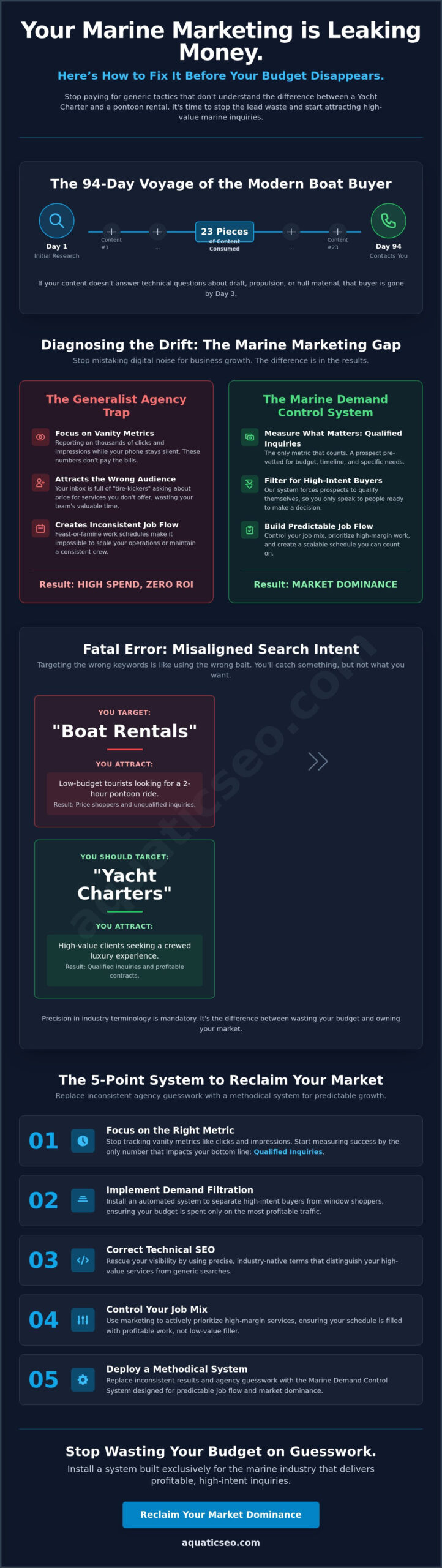
The average boat buyer in 2026 consumes 23 pieces of content over a 94 day decision cycle before they ever contact your dealership or service yard. If your current ads generate clicks but your phone isn’t ringing, you must understand how to fix a failing marine marketing campaign before your budget disappears into generic digital noise. Most agencies treat a Yacht Charter lead like a local plumber’s lead, wasting your money on superficial metrics while your service bays sit empty. You’re likely tired of seeing high costs per lead with zero ROI and inconsistent work schedules that make it impossible to scale.
You’ve realized that generic tactics aren’t enough to secure high-value contracts in a shifting buyer’s market. This guide provides the precision steps to turn unqualified traffic into high-value marine inquiries through a methodical demand filtering system. We will show you how to audit your current spend and reclaim market dominance in your specific niche, ensuring your business remains the first choice for high-intent buyers who value quality over volume.
Key Takeaways
- Stop tracking vanity metrics like clicks and impressions and start measuring success through the volume of Qualified Inquiries that impact your bottom line.
- Implement a demand filtration system to separate high-intent buyers from window shoppers, ensuring your budget is spent only on the most profitable traffic.
- Learn how to fix a failing marine marketing campaign by correcting technical SEO errors and distinguishing between high-value terms like Yacht Charter and generic boat rentals.
- Use your marketing to actively control your job mix, prioritizing high-margin services to ensure your schedule is filled with profitable work rather than low-value filler.
- Replace inconsistent agency guesswork with a methodical Marine Demand Control System designed to provide predictable job flow and market dominance.
Diagnosing the Drift: Why Your Marine Marketing is Underperforming
Most marine marketing fails because it relies on generic templates that ignore the operational reality of the water. You might see high click-through rates and thousands of impressions, but if your sales floor is quiet, you’re experiencing the Marine Marketing Gap. This gap happens when a generalist Marketing strategy is applied to high-ticket assets like center consoles or crewed charters. Generalist agencies don’t understand that the average buyer in 2026 consumes 23 pieces of content over a 94 day decision cycle. If your content doesn’t answer technical questions about draft, propulsion, or hull material, that buyer is gone.
When you’re trying to figure out how to fix a failing marine marketing campaign, you must first audit your metrics. Clicks are vanity. Impressions are ego. The only metric that keeps your gates open is the Qualified Inquiry. If your current marketing partner can’t distinguish between a marina providing dockage and a Boat Dealer moving inventory, they are bleeding your budget dry. You need to spot the warning signs of a leaky funnel before the season peaks. Look for a high volume of inquiries that ask about price before they ask about technical specs or availability. That is a clear symptom of a campaign that attracts the wrong audience.
The Generalist Agency Trap
Agencies that serve “everyone” end up understanding “no one” in the marine sector. You shouldn’t have to pay to educate an outside partner on why a Service Yard has different seasonal needs than a retail store. If they don’t know the difference between a haul-out and a simple wash-down, they can’t write copy that converts a professional captain or a seasoned owner. This lack of niche focus leads to generic ads that fail to resonate with high-intent buyers, leaving you with a full inbox of “tire-kickers” instead of actual customers.
Identifying Misaligned Search Intent
Search intent is the difference between a researcher looking for boat specs and a buyer ready to sign a contract. Broad keywords like “fast boats” drain your budget without increasing your job flow. For Yacht Charters, targeting “boat rentals” is a fatal error. It attracts low-budget tourists looking for a 20 foot pontoon instead of high-value clients seeking a crewed luxury experience. To learn how to fix a failing marine marketing campaign, you must refine your visibility to capture only high-intent phrases that signal immediate commercial needs.
Implementing a Demand Filtration System to Stop Lead Waste
If you want to know how to fix a failing marine marketing campaign, you must first stop the obsession with lead volume. A thousand clicks are worthless if your team spends all day answering questions from people who can’t afford a slip, let alone a vessel. You need to move from a volume-first mindset to a value-first system that prioritizes the Qualified Inquiry. This is a prospect who has already been vetted for budget, timeline, and specific vessel requirements before they ever reach your phone. Most agencies want to show you big numbers, but we focus on the numbers that actually hit your bank account.
Building this system starts with rigorous Market research and competitive analysis to understand exactly who your high-intent buyer is. Most agencies throw wide nets and hope for the best. We use the Marine Demand Control System to create automated gates that force prospects to qualify themselves. If a user isn’t willing to tell you their preferred propulsion type or their planned cruising grounds, they aren’t a high-priority buyer. They are a distraction that costs you time and money.
Filtering for High-Intent Buyers
In a marine context, filtration means asking the hard questions early. For a Yacht Charter operator, this involves distinguishing between someone looking for a “boat rental” and a client seeking a multi-day crewed experience. Your intake forms should include fields for guest count, catering requirements, and previous charter history. This creates a psychological barrier for low-intent users while signaling professionalism to premium clients. You’ll finally experience the relief of only speaking to prospects who value your specific expertise and technical knowledge.
Fixing the “Too Many Low-Margin Leads” Problem
Your current ads likely attract price-shoppers because they focus on generic service features. To fix this, shift your messaging toward operational outcomes. Don’t just list engine specs; describe the reliability of a season without mechanical failure. This shift naturally filters out those looking for the lowest price and attracts those looking for the highest value. If your current lead flow is cluttered with low-margin work, it’s time to deploy technical Demand Filtering Systems to reclaim your schedule. You can book a call to see how these filters integrate with your existing workflow.
Technical Recovery: Rescuing Your Marine SEO and Visibility
Technical SEO in the marine sector isn’t just about page speed. It’s about precision. If your website metadata incorrectly labels your Yacht Charter as a “boat rental,” you are signaling to Google that you want low-budget tourists instead of high-value clients. This misalignment is a primary reason why campaigns stall. Understanding how to fix a failing marine marketing campaign requires a deep audit of these industry-specific technical errors that kill your search rankings.
Mobile-first buyers now dominate the market. Research shows 71% of consumers expect a seamless digital experience, and 40% of marina reservations occur after hours. If your site’s mobile UX is clunky or lacks 24/7 booking capabilities, you’re losing high-intent traffic at the finish line. You must also optimize your Marine Contractor SEO to capture local searches for specific technical expertise rather than broad, useless terms.
Industry-Native Keyword Optimization
Your keyword strategy must distinguish between a boat dealer selling inventory and a marina providing dockage. These are different businesses with different search intents. When you achieve Marine Demand Visibility, you ensure your brand appears for the exact services you provide. This level of precision is essential for getting serious marketing ROI. Using niche-specific terminology improves your Google Ad score by increasing relevance and lowering your cost per click.
The Role of Marine-Specific Content
Generic blog posts about “top boating tips” fail because they don’t capture high-value demand. They attract hobbyists, not buyers. You need SEO Rich Text that establishes authority with both Google’s algorithms and skeptical yacht owners. Focus on content that addresses technical operational challenges or regulatory changes, such as the June 2026 MARAD citizenship verification rules. For specific frameworks, refer to our Digital Marketing for Marine Contractors guide to ensure your content compounds over time.
Operational Precision: Adjusting Your Job Flow and Job Mix
A busy schedule is a liability if it’s filled with low-margin work. If your technicians are stuck performing minor cosmetic repairs while six-figure repower inquiries go unanswered, your business is stagnating. Understanding how to fix a failing marine marketing campaign means moving beyond simple visibility. You must gain total control over your job flow to ensure your team prioritizes high-profit services that stabilize your bottom line. With the U.S. boating industry projected to reach $61.3 billion in sales in 2026, the opportunity is massive, but only for those who control their job mix.
Controlling the Job Mix
A Service Yard should never be at the mercy of whatever leads happen to come in. You should use Demand Control to actively “turn off” low-value inquiries during your peak season. Focus your messaging on complex systems and major overhauls that require your specific technical expertise. A curated list of high-margin clients improves your financial health and allows you to maintain higher standards of service without increasing your overhead. This approach ensures you aren’t just “busy”; you are consistently profitable.
Solving Inconsistent Work Schedules
Inconsistency is the enemy of a profitable marine business. You can use a system of Demand Compounding to fill your books months in advance, effectively eliminating the “feast or famine” cycle. This is especially vital for Marine Mechanics and Electricians who need to stabilize revenue during the off-season. By capturing demand early and filtering for long-term projects, you ensure a predictable job flow regardless of the weather. Proactive campaigns can bridge the gap between summer peaks and winter lulls, keeping your best talent employed year-round. If you’re ready to stabilize your revenue and prioritize high-value work, book a fit call to discuss a custom job mix strategy.
The Synthesis: Deploying a Marine Demand Control System
Generic marketing fixes only treat the symptoms of a deeper operational failure. If you want to know how to fix a failing marine marketing campaign, you must stop accepting agency guesswork and start deploying a methodical Marine Demand Control System. This framework transitions your marketing from a budget-draining liability into a high-performance business asset. It captures high-intent demand while systematically filtering out the low-margin distractions that waste your team’s time. By the time you reach this stage, you’ve moved beyond diagnosing the drift to actively managing your market position.
Reclaiming your market position requires a shift from passive lead generation to active demand oversight. Most agencies focus on volume because it is easy to report, but volume without qualification is just noise. A high-performance campaign functions as a precision tool that aligns your marketing spend with your actual shop capacity or charter availability. This methodical approach ensures that every dollar spent is an investment in the financial health and organizational stability of your business. You finally gain the predictable job flow necessary to scale without the stress of inconsistent revenue patterns.
Why Niche-Specific Expertise is Non-Negotiable
Staying with a generalist digital marketing provider is a risk your business shouldn’t take. Generalists don’t understand the technical nuances of a marine survey or the seasonal pressures of a boat dealer moving inventory. Industry-native positioning is the only way to build trust with a skeptical buyer who has seen every generic ad in the book. We handle the heavy lifting of market filtration, ensuring that every inquiry you receive has already been vetted against your specific operational requirements. This expertise allows you to maintain a premium brand presence that generalist agencies simply cannot replicate.
Your Next Steps for Recovery
Recovery begins with a no-nonsense audit of your current marketing assets. You need to look past the vanity metrics and calculate your actual rate of Qualified Inquiries. If your current partner can’t provide auditable tracking for these outcomes, it’s time to change your strategy. We invite you to a Marine Service Fit Call to diagnose your specific symptoms and outline a path to market dominance. Stop the waste and start capturing the high-intent demand your business deserves.
Reclaim Your Market Dominance
You’ve seen the financial drain of generic agency guesswork. It leads to inconsistent work schedules and a phone that only rings with low-margin price-shoppers. Learning how to fix a failing marine marketing campaign requires more than just changing your ad copy or website colors. It demands a methodical filtration system that prioritizes Qualified Inquiries over meaningless click counts. By aligning your search visibility with your actual shop capacity, you turn your digital presence into a predictable business development asset rather than a monthly expense.
Our Marine Demand Control System™ is built specifically for marine businesses generating between $300K and $5M. We bring industry-native expertise to Yacht Charters, Boat Dealers, and Service Yards that are tired of being treated like a general local business. You deserve a partner that understands the technical nuances of your specific niche and the decision cycles of your buyers. It’s time to stop wasting your budget on broad tactics and start capturing high-intent demand that actually moves the needle. You can stabilize your revenue and take control of your market position starting today.
Request a No-BS Marine Marketing Analysis
Frequently Asked Questions
How long does it take to fix a failing marine marketing campaign?
You will typically see technical corrections within 30 days, but fully learning how to fix a failing marine marketing campaign through demand filtration takes 60 to 90 days. The initial phase stops the budget leak by removing broad, low-intent keywords. The second phase stabilizes your job flow by calibrating your messaging to attract high-value Yacht Charter or boat sales inquiries that actually convert into revenue.
What is the difference between a lead and a Qualified Inquiry in the marine industry?
A lead is just contact information from someone who might be a window shopper or a “tire-kicker.” A Qualified Inquiry is a vetted prospect who has confirmed their budget, vessel type, and specific timeline before you ever pick up the phone. We focus on the Qualified Inquiry because it represents a tangible business asset rather than a vanity metric that clutters your inbox.
Why do generic SEO agencies fail to get results for boat dealers?
Generic agencies treat a $200,000 center console like a $20 pizza delivery. They don’t understand the 94 day decision cycle or the difference between a marina and a Boat Dealer. When they target broad terms like “boats for sale,” they waste your budget on researchers instead of buyers who are ready to sign a contract for a specific hull or propulsion type.
Can a failing Google Ads campaign be saved, or should I start over?
Most campaigns can be saved if the historical data is useful, but you must implement a Marine Demand Control System to stop the waste. We audit your search terms to see if you are accidentally paying for “boat rentals” when you sell Yacht Charters. If the foundation is built on generic keywords, we often recommend a hard reset to focus on how to fix a failing marine marketing campaign properly.
How much should a marine contractor spend on digital marketing in 2026?
Your spend should align with your actual shop capacity and the cost of acquiring high-margin projects like repowers or major refits. Don’t follow generic percentage rules that ignore your operational reality. You should invest enough to maintain a predictable job flow without overspending on leads you don’t have the technicians to service. Focus on ROI, not just total spend.
What are the most common mistakes in Yacht Charter marketing?
The biggest error is failing to distinguish your crewed experience from a basic boat rental. If your ads don’t filter for guest count, catering needs, and multi-day intent, you will spend all day answering calls from low-budget tourists. You must position your brand as a premium service provider to attract clients who value technical expertise and high-end amenities over the lowest price.
How do I know if my current marketing agency understands the marine industry?
Ask them to explain the difference between a Service Yard and a marina. If they can’t distinguish between maintenance operations and dockage, they don’t understand your business model. An industry-native partner will talk about Qualified Inquiries and job mix rather than impressions and clicks. If they don’t know your technical terminology, they cannot write copy that converts a professional captain.
What is a Demand Filtering System and how does it work?
A Demand Filtering System is an automated gate that vets prospects through technical questions before they reach your sales team. It forces users to identify their vessel size, propulsion needs, or charter dates, which naturally discourages low-intent window shoppers. This system protects your time and ensures your technicians only focus on high-margin work that fits your specific shop capacity and financial goals.