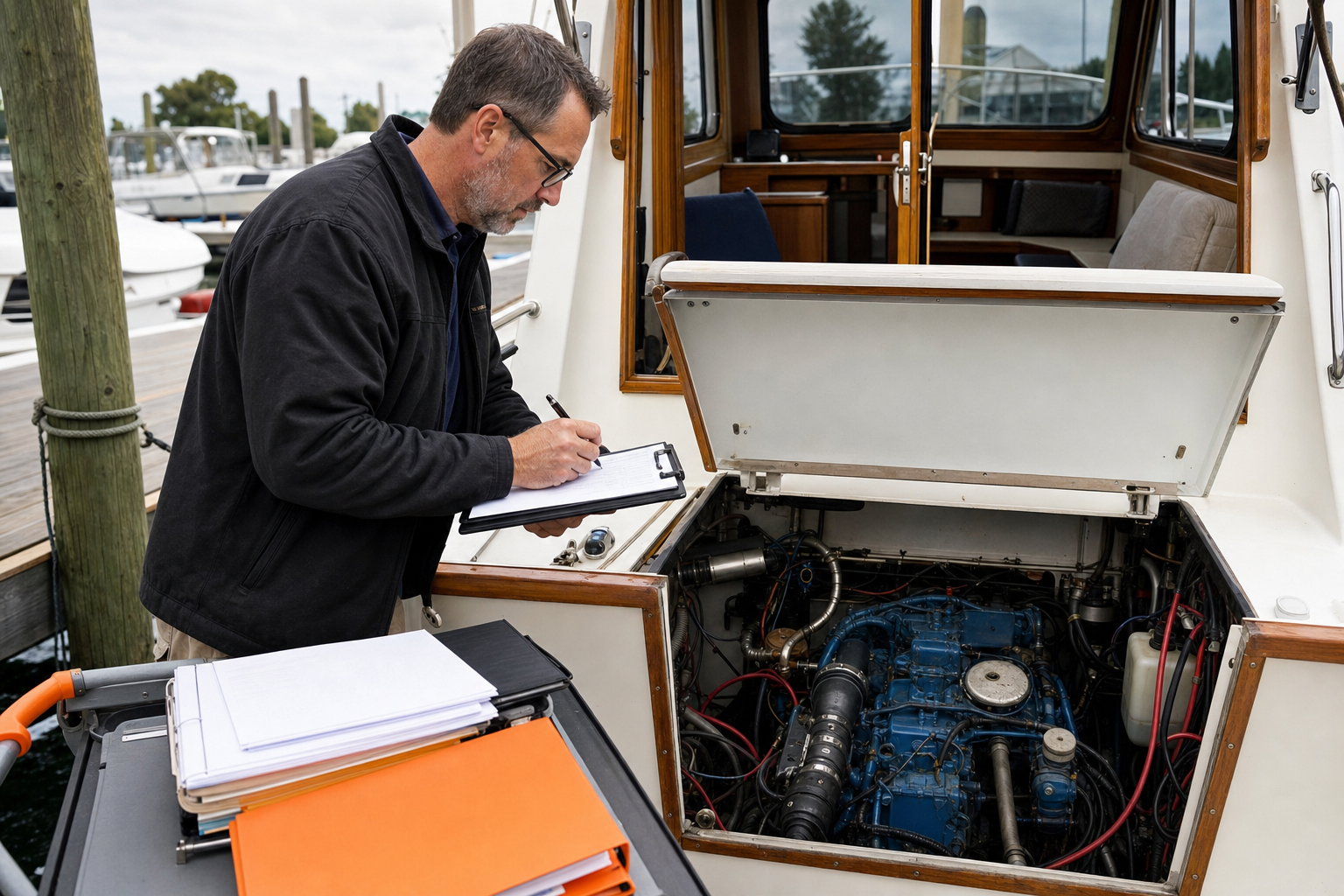
Hiring a full-time marketing manager seems like the logical way to gain control over your schedule, but for most yards, it’s a fast track to a generalist bottleneck. Even if you source a candidate through a local recruitment platform like SavannahJobs.com, an in-house hire often spends their day managing social media posts that only attract low-margin oil change inquiries. This disconnect between effort and ROI is why the debate of in-house marketing vs agency for boatyard operations is more critical in 2026 than ever before. You don’t need a generalist; you need a system that filters out the noise and prioritizes your bottom line.
You’ve likely felt the frustration of a service floor filled with “tire kickers” while your most skilled techs are stuck on basic maintenance tasks. We understand that previous attempts with agencies often failed because they didn’t know a transom from a trim tab. This article explores whether an internal hire or a specialist partner will actually fill your service bays with high-margin refit work. We will break down the true operational costs of both models and show you how to gain total control over your job mix for better financial health.
Key Takeaways
- Focus on filling your bays with high-margin refit work by shifting your primary metric from total website traffic to the number of Qualified Inquiries.
- Recognize that generalist employees often fail to grasp technical marine specifics, which results in a schedule cluttered with low-margin maintenance jobs.
- Evaluate the true financial impact of in-house marketing vs agency for boatyard management by accounting for specialized software costs and the overhead of a full-time salary.
- Use a specialized Demand Filtering System to stop wasting time on unqualified prospects and regain control over your service yard’s job mix.
- Prioritize precision over volume to ensure your marketing spend stabilizes revenue patterns and improves the overall financial health of your yard.
The Boatyard Marketing Dilemma: In-House Speed vs. Agency Expertise
Your service bays are either ghost towns or chaotic bottlenecks. When the spring rush hits, you don’t have time to think about marketing; when the winter lull arrives, you’re desperate for any boat on the hard. This cyclical feast or famine is the primary driver behind the in-house marketing vs agency for boatyard debate. Most yard owners believe a full-time hire offers speed because they sit in the office, but speed is a liability if it’s directed at the wrong targets. You don’t need more leads or generic website traffic. You need a Qualified Inquiry: a boat owner specifically seeking high-margin work like a full repower or a stabilizer installation who is ready to book now.
The “Jack-of-all-Trades” Trap for Service Yards
Hiring one person to handle your entire digital presence is a recipe for mediocrity. A single employee cannot master technical SEO, manage complex PPC bidding, and produce high-intent marine content simultaneously. In reality, that marketing manager usually ends up answering phones, running parts, or managing the yard’s Facebook page with low-value posts. They lack the expensive, specialized tools required to track search trends and competitor movements. Without a dedicated team, your marketing becomes a series of administrative checkboxes rather than a driver of financial health. If you want to see how a specialized approach differs, look at our digital marketing for marine service yards and boatyards to see the level of precision required.
Why Industry-Native Knowledge Trumps Proximity
Proximity to the travel lift doesn’t make someone an expert in digital marketing strategies. A generalist marketer might see a boat and think repair, but an industry native understands the massive revenue difference between a simple patch job and a structural refit. If your content doesn’t speak the language of a captain or a yacht owner, Google won’t show your yard to the right people. Ranking for boat repair is easy; ranking for Seakeeper installation requires a level of technical precision that a generalist simply cannot reach. You need a partner who understands your operational logistics as well as they understand an algorithm. The in-house marketing vs agency for boatyard choice ultimately comes down to whether you want someone who can take photos of the yard or someone who can actually fill it with profitable work.
Why Generalist In-House Hires Struggle with Marine Specifics
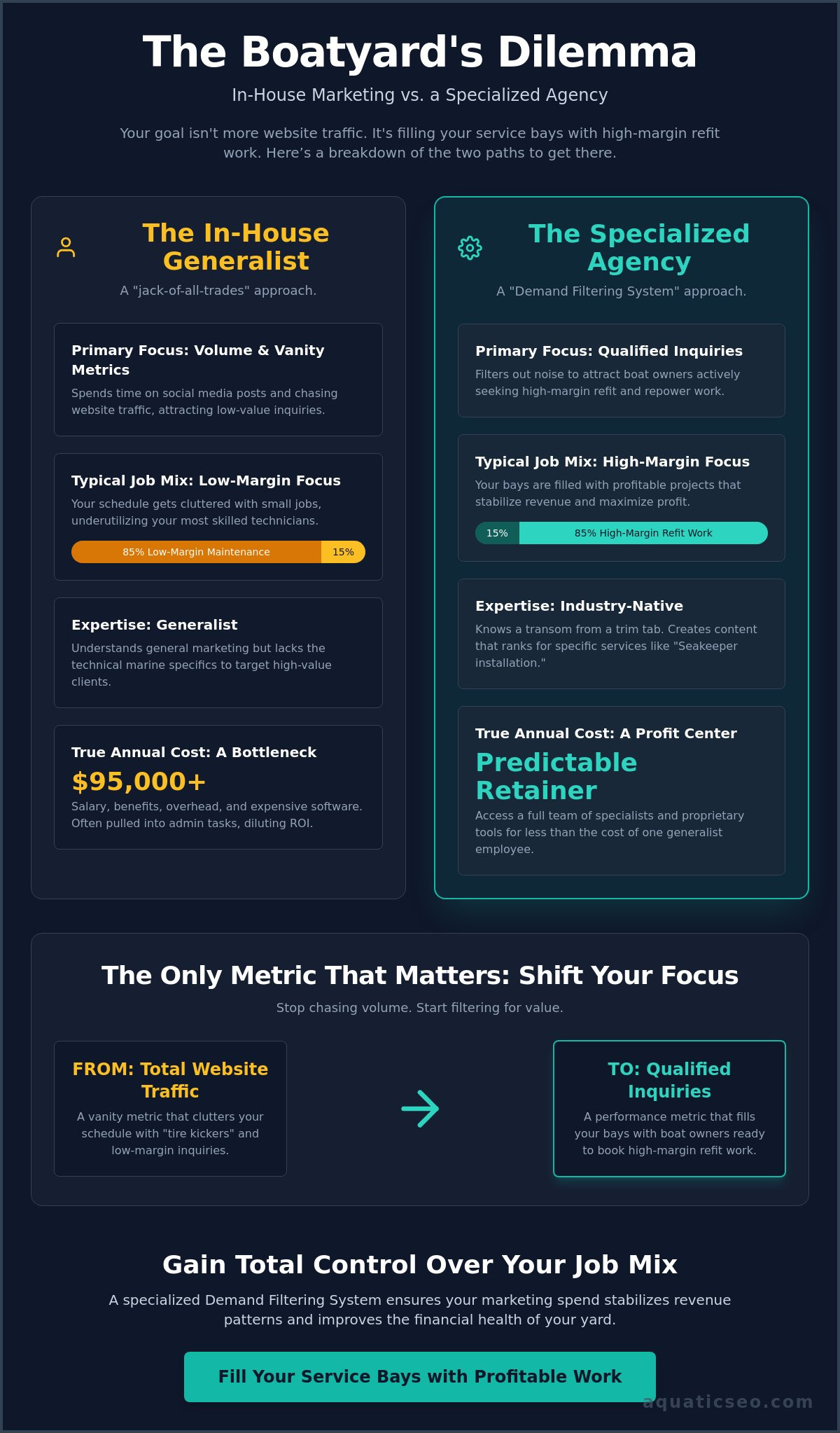
Hiring a generalist often leads to a service bay filled with oil changes rather than engine repowers. When you evaluate in-house marketing vs agency for boatyard growth, you must look at technical literacy. A generalist understands how to post a photo of a sunset over the docks; they rarely understand the search intent behind “Seakeeper 9 installation cost.” This lack of specificity attracts the wrong crowd. You end up paying a salary for someone to generate vanity metrics like “engagement” while your skilled technicians are underutilized on low-margin tasks.
Owners are constantly weighing the pros and cons of internal staff versus external specialists. In the marine sector, proximity to the yard often results in the marketer being pulled into administrative work. They become a “jack-of-all-trades” who handles everything from the front desk to the forklift. This dilution of focus means your high-margin refit opportunities are left to chance while your digital presence remains stagnant.
The High-Margin Refit vs. Low-Margin Maintenance Gap
Specialized marketing targets the $50,000 refit jobs instead of the $500 winterization tasks. A generalist hire focuses on volume because high traffic numbers look good in a monthly meeting. However, volume is the enemy of efficiency if it isn’t filtered. You need a system that captures high-intent buyers searching for specific, high-ticket services. Without this, you waste time on “tire kickers” who drain your service writers’ energy. If you want to focus your technicians on high-value work, consider how specialized marketing for marine mechanics and electricians targets specific technical pain points.
Technical SEO: Beyond the Reach of a Generalist
Marine SEO requires a specific architectural approach that categorizes services by vessel type and technical requirement. A generalist might use “SEO rich text” as a tool, but they won’t know how to outrank a national boat dealer network for “Yanmar authorized service.” They lack the data to know which technical terms actually convert into a Qualified Inquiry. Competing for visibility in 2026 requires more than just a blog post; it requires a deep understanding of marine buyer behavior and algorithmic precision. A generalist simply does not have the resources to keep up with the shifting landscape of search and data privacy.
The True Cost of Managing Your Own Demand Flow
Financial transparency is rare in marketing discussions. When evaluating in-house marketing vs agency for boatyard operations, owners often focus on the monthly sticker price rather than the total cost of ownership. A $60,000 annual salary is merely the baseline. Once you add payroll taxes, health insurance, and 401k contributions, that employee costs your yard significantly more. This doesn’t even account for the “Owner Management Tax.” Every hour you spend training a non-expert on marine terminology or reviewing their basic mistakes is an hour you aren’t managing your yard’s operations.
Salary, Benefits, and the Hidden Tech Stack
An in-house hire arrives with a hidden bill for the tools they need to be effective. Professional SEO software like Ahrefs or Semrush, CRM subscriptions, and premium marine data access can easily exceed $10,000 per year. An agency absorbs these costs into a single retainer. More importantly, an agency provides a “Demand Compounding” asset. You benefit from the collective data and experience gained across multiple marine accounts, rather than relying on the trial-and-error of one person. This specialized oversight ensures your budget is spent on high-intent targets rather than generic visibility.
The Opportunity Cost of Unfilled Service Bays
The most expensive bay in your yard is an empty one. Revenue loss from a single week of an unfilled service bay can dwarf a monthly marketing fee. In-house staff often struggle to maintain a consistent lead flow, leading to scheduling gaps that kill your quarterly projections. By implementing a Marine Demand Control System, you ensure a steady stream of high-margin refit work. This system doesn’t just find leads; it filters out the low-value inquiries that waste your service writer’s time.
Transitioning from a fixed internal cost to a performance-based investment allows you to scale your marketing spend based on your actual capacity. You stop paying for “activity” and start paying for “outcomes.” When your bays are full, you can throttle the system to prioritize only the highest-margin refits. This level of oversight is rarely possible with a single internal marketer who is incentivized by job security rather than yard profitability.
Evaluating Your Service Yard’s Marketing Readiness
Determining your readiness for a specialized partner requires a hard look at your service schedule. If your bays are full of low-margin maintenance while $50,000 refit inquiries go to your competitors, your current approach is failing. This is the core of the in-house marketing vs agency for boatyard decision. You are ready for an agency when you prioritize the quality of the job mix over the quantity of the leads. Use this five-point checklist to assess your yard’s current situation:
- Lead Quality: Do your service writers spend over two hours a day answering basic price questions for “tire kickers”?
- Demand Visibility: Does your yard appear in the top three results for high-intent technical terms like “marine electronics refit” in your region?
- Data Precision: Can you identify exactly which marketing channel produced your last three high-margin repower jobs?
- Operational Focus: Is your current marketing staff spending more time on administrative yard tasks than on generating revenue?
- Filtering Systems: Do you have a functional method to automatically disqualify prospects who don’t fit your ideal boat size or service type?
Many owners believe they are too small for a specialized agency. This is a mistake. Smaller yards actually have a lower tolerance for waste. Every dollar spent on a generalist who cannot distinguish between a marina and a service yard is a dollar that could have been used to capture a specific, high-value refit. Precision is the only way to stabilize revenue in a seasonal industry.
When In-House Makes Sense (And When It Doesn’t)
A hybrid model often works once a yard surpasses the $5 million revenue mark. At this scale, you might benefit from an in-house coordinator to handle internal communications while a specialized agency manages the technical in-house marketing vs agency for boatyard strategy. However, hiring a “social media manager” to do a “revenue generator’s” job is a common trap. Boat dealers need to move inventory; service yards need to sell technical hours. These are entirely different skill sets that a generalist cannot bridge. You need a system that ensures your technical expertise is visible to those who value it most.
The Questions Your Next Partner Must Answer
Don’t hire based on a “gut feeling” or a flashy portfolio of sunset photos. Ask potential partners how they distinguish between a “Yacht Charter” and a “boat rental” in their SEO strategy. Demand to see how they track Qualified Inquiry volume rather than just website traffic. A partner who understands the nuances of digital marketing for boatyards will focus on your financial health, not your follower count. If you are tired of chasing low-value leads, book a call to see how a specialized system can fill your bays with the right work.
The Marine Demand Control System: A Specialized Alternative
General marketing agencies focus on volume. They want to show you big numbers in a dashboard that don’t translate to your bank account. Our philosophy prioritizes precision over volume. This approach settles the in-house marketing vs agency for boatyard debate once and for all. You don’t need thousands of website visitors; you need ten of the right boat owners seeking major projects this month.
The Marine Demand Control System is designed to act as a barrier between your yard and the noise of the general market. It filters for high-intent buyers who are looking for specific technical solutions. This ensures your service writers only spend time on Qualified Inquiries that fit your ideal job profile. We position ourselves as your industry-native partner, understanding the mechanics of your business as well as the mechanics of a vessel.
Capturing High-Value Refit and Repower Jobs
We build systems that dominate technical search terms in your specific region. By focusing on high-intent phrases like “inboard repower” or “hull extension,” we bypass the generic noise that attracts low-margin work. This strategy uses Digital Marketing for Marine Contractors as a foundational pillar for success. The result is a job mix that favors high-margin technical work over repetitive, low-revenue maintenance tasks. You gain the visibility required to attract the largest projects in your area.
Taking Control of Your Job Flow
Stop hoping the phone rings with the right kind of work. Our Demand Filtering process ensures that the inquiries reaching your staff are pre-qualified based on your specific yard capacity and vessel size limits. You gain the ability to control your schedule months in advance, stabilizing your revenue patterns. If you are ready to stop guessing about your ROI and start filling your bays with intent, Request a No-BS Marine Marketing Analysis today. Specialized oversight is the only way to ensure the long-term financial health and operational stability of your boatyard.
Take Control of Your Service Yard’s Financial Future
Your boatyard’s financial health depends on the quality of the jobs in your bays, not the quantity of likes on a social post. The choice between in-house marketing vs agency for boatyard operations isn’t just about cost; it’s about the “Owner Management Tax” you pay when training a non-expert. A specialized agency provides a system that filters out low-margin distractions and prioritizes high-value refits. We are industry-native experts who know that a repower is a different business animal than a simple oil change.
Book a call to see how the Marine Demand Control System can stabilize your service yard. Your bays should be filled with the work that actually grows your bottom line.
Frequently Asked Questions
Is it cheaper to hire a marketing person for my boatyard?
Hiring an internal employee is rarely more cost-effective when you calculate the total cost of ownership. Beyond a salary, you must pay for benefits, payroll taxes, and a tech stack of SEO tools that can exceed $10,000 annually. You also pay an “Owner Management Tax” by spending your own time training someone who doesn’t understand your technical operations.
What is the difference between a service yard and a marina in marketing terms?
Marinas market dockage, fuel, and lifestyle, while a service yard or boatyard markets technical expertise and labor hours. Your marketing must focus on capturing high-intent technical searches rather than just local visibility. This distinction is critical because the buyer journey for a $50,000 refit is entirely different from someone looking for a transient slip.
How long does it take for a marine SEO strategy to start filling bays?
You should expect to see a measurable shift in inquiry quality within 90 to 120 days. While organic search authority takes time to build, specialized demand filtering begins removing low-margin “tire kickers” from your inbox almost immediately. This allows your service writers to focus on high-margin projects that improve your yard’s immediate financial health.
Can an in-house marketer handle the technical SEO for a yacht refit business?
Most generalists lack the technical depth required to outrank national networks for specialized refit terms. The in-house marketing vs agency for boatyard debate often fails to account for the level of technical literacy needed for site architecture. An internal hire usually defaults to social media activity because they lack the tools and data to manage high-level search visibility.
What is a “Qualified Inquiry” and why should my yard track it?
A Qualified Inquiry is a prospect who has been filtered for vessel size, technical need, and intent to book. Tracking generic leads is a waste of time because it doesn’t reflect your actual revenue pipeline. By focusing on qualified inquiries, you ensure your marketing spend is filling your bays with profitable work rather than just generating phone calls for oil changes.
Do I need a specialized marine agency if I only serve local boaters?
Specialized oversight is even more important for local yards because you are competing for a limited number of high-margin projects. Local boaters use technical search terms that are often dominated by large, national service networks. A marine specialist ensures your yard has the local visibility required to capture these high-value refit and repower opportunities before they go elsewhere.
What happens if my yard is already at capacity during the spring rush?
Marketing shouldn’t stop when you are busy; it should pivot to filtering for higher margins. When your bays are full, your in-house marketing vs agency for boatyard strategy should focus on replacing low-margin maintenance with high-margin refit work. This ensures you are maximizing the profitability of your labor hours rather than just staying busy with basic repairs.