
If your current agency thinks a yacht charter is the same as a boat rental, you aren’t just dealing with a minor misunderstanding; you are bleeding capital on a team that cannot tell the difference between a marina and a boatyard. Most agencies chase vanity metrics while your crew wastes hours on low-margin tire-kickers who fail to convert. You didn’t build your marine business to support an agency’s learning curve, and if your phone isn’t ringing with high-intent prospects, it is one of the clearest signs you hired the wrong marketing agency for your operation.
You likely already feel the frustration of paying a monthly retainer only to receive a trickle of unqualified leads that go nowhere. You deserve total control over your job mix and the ability to target high-margin marine construction or yacht charter contracts with precision. This article identifies the red flags draining your marketing budget and explains how to shift toward a system that captures qualified marine inquiries. We will examine seven specific indicators that prove your current partner is dragging down your bottom line and failing to deliver auditable results.
Key Takeaways
- Stop measuring success by clicks and start prioritizing high-intent business outcomes that actually fill your service bays.
- Identify the terminological red flags that prove your agency doesn’t know the difference between a boat dealer and a marina.
- Learn the signs you hired the wrong marketing agency by auditing whether your current leads are high-margin contracts or low-value noise.
- Break the cycle of seasonal inconsistency by moving toward a Marine Demand Control System designed for active buyer capture.
- Gain transparency and control over your job mix with auditable results that prioritize financial health over generic volume.
The Lead Volume Trap: Why Generic Metrics Fail Marine Contractors
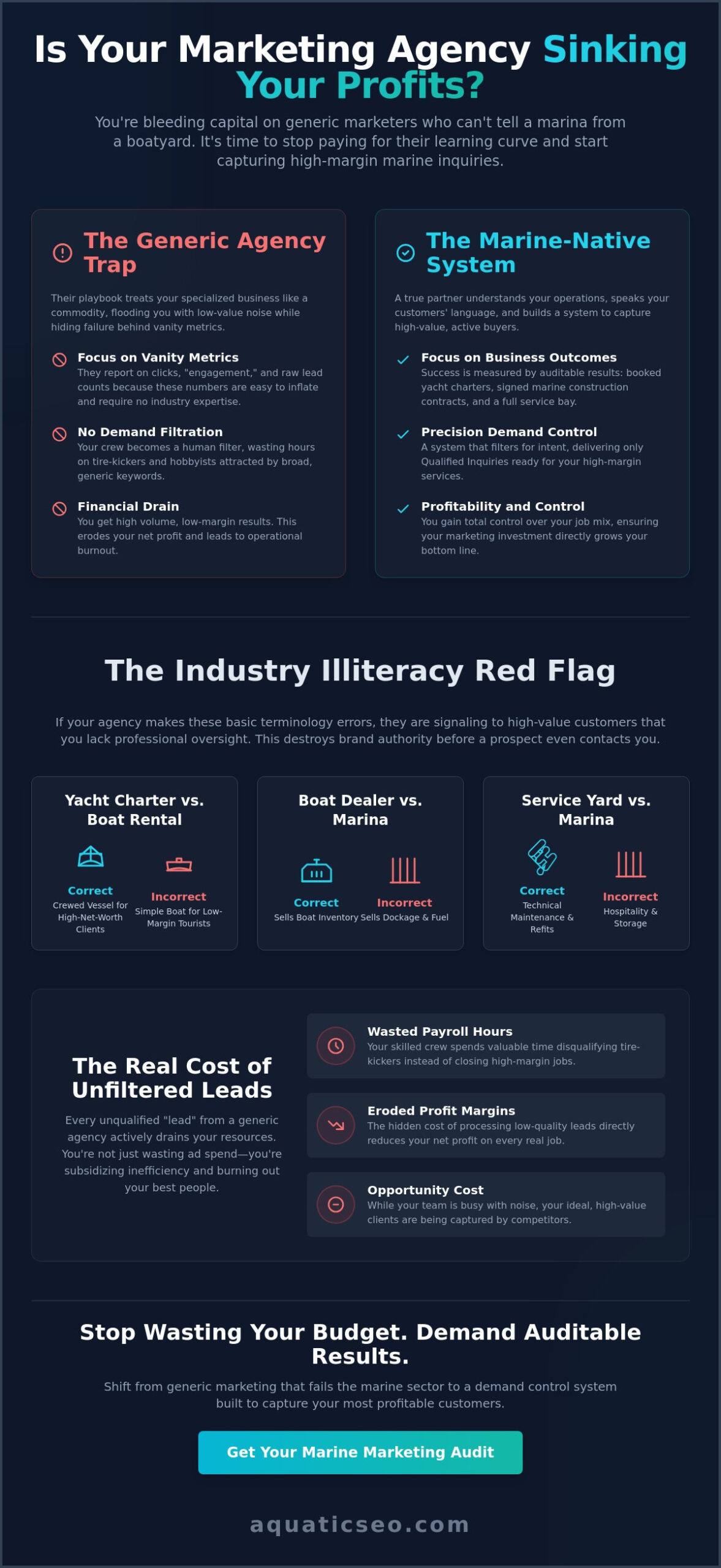
Generic agencies love to brag about explosive growth in lead volume. They treat your business like a commodity, applying the same digital marketing playbook they use for local plumbers or law firms. In the marine sector, a massive influx of leads is usually a red flag. It means your agency has failed to implement a filter, leaving your team to drown in noise while your marketing budget disappears.
When you see high impressions but low-margin results, these are the primary signs you hired the wrong marketing agency. They focus on vanity metrics because those numbers are easy to inflate. High-intent outcomes, such as a signed contract for a custom dock or a booked luxury yacht charter, require a level of industry precision most generalists lack. They mistake activity for productivity, forcing your staff to act as a human filter for their poor targeting.
Common vanity metrics that generic agencies use to hide failure include:
- Total website clicks without tracking intent.
- Social media “engagement” like likes and shares.
- Raw lead counts that include spam and tire-kickers.
- Keyword rankings for terms that don’t drive revenue.
Traffic vs. Targeted Demand
Your website doesn’t need a crowd; it needs a specific buyer. For yacht charters, generic agencies often attract “empty” traffic by bidding on broad keywords. This brings in tourists looking for a cheap boat rental rather than the high-net-worth clients seeking a crewed vessel. 100 visitors with intent are worth more to your bottom line than 10,000 generic browsers who will never book. Agencies that don’t know the industry use broad terms that attract DIYers and hobbyists, wasting your ad spend on people who will never become a Qualified Inquiry.
The Financial Cost of Unfiltered Noise
Every minute your sales team spends on the phone with a tire-kicker is a minute they aren’t closing high-margin jobs. Processing low-quality leads has a massive hidden cost. It erodes your net profit margin and creates burnout in your office. For marine contractors, “more leads” can actually be a liability if they aren’t qualified. You need a system that filters demand before it reaches your desk. This ensures your crew stays focused on profitable work rather than chasing dead-end inquiries that were never a fit for your specialized services.
Industry Illiteracy: Warning Signs Your Agency Doesn’t Understand Marine Operations
If your agency refers to a crewed yacht as a boat rental, they are exposing a fundamental ignorance of the marine market. This isn’t just a minor mistake; it’s a signal to high-intent buyers that your business lacks professional oversight. One of the most glaring signs you hired the wrong marketing agency is their inability to speak the language of your customers. High-net-worth individuals and professional captains spot industry-outsider language immediately, which destroys your brand authority before a lead even enters your CRM.
Confusing a Boat Dealer with a Marina is another disqualifying error. A dealer sells inventory; a marina sells dockage and fueling services. When an agency treats these as interchangeable, they build a marketing and sales plan that targets the wrong search intent. You end up paying for traffic from people looking for a slip when you actually need someone ready to buy a new center console. This lack of precision is why generic SEO fails to deliver a consistent job mix for specialized marine operators.
Confusing Marinas with Service Yards
The operational difference between a marina and a service yard or boatyard is vast. One provides hospitality and storage; the other provides technical maintenance, haul-outs, and mechanical refits. Marketing a service yard requires a focus on technical precision and equipment capabilities, not just scenic lifestyle shots. If your agency uses keywords like boat storage to find customers for a major engine repower, they are attracting low-margin inquiries that waste your crew’s time. You need a partner that understands the logistics of a boatyard to capture active buyers looking for specialized repairs.
The “One-Size-Fits-All” Content Problem
Generic blog posts about tips for a fun day on the water offer zero value to a yacht owner or a marine surveyor. This filler content signals to your audience that you have nothing unique to say. Effective marine marketing requires a deep understanding of vessel types, hull classifications, and propulsion systems. If your agency cannot write intelligently about the difference between a displacement hull and a planing hull, they cannot represent your brand. Content must speak directly to the technical needs of your specific niche to filter out those who aren’t a fit for your high-margin services. If your current content feels like it was written by someone who has never stepped foot on a dock, it is time to evaluate an industry-native marketing approach.
The Filtration Failure: Why You Get Low-Margin Noise Instead of Qualified Inquiries
A Qualified Inquiry is not just a name and an email address. In the marine world, it is a prospect with a verified vessel type, a specific operational need, and the capital to fund high-margin work. Most agencies avoid defining this because they are terrified of low lead counts. They would rather send you 50 tire-kickers than five high-value contracts because their business model relies on volume to justify their retainer. This lack of discipline is one of the primary signs you hired the wrong marketing agency.
When an agency refuses to filter, they force your sales team to act as a manual barrier against noise. This inefficiency drains your profit. True measuring marketing effectiveness requires looking at the quality of the job mix, not just the quantity of form submissions. You need a system that prioritizes demand visibility so you can choose the contracts that offer the best returns for your crew and equipment. Without this oversight, you’re just paying for the privilege of wasting your own time.
Missing the High-Intent Buyer
The search behavior of someone looking for marine surveyors is fundamentally different from a tourist looking for a boat rental. One is a professional necessity; the other is a casual whim. If your agency doesn’t distinguish between these intents, they will waste your budget on broad traffic that never converts. For a marine construction operator, precision is everything. You need to position your brand as the specialist for complex dock builds or seawall repairs, not a general handyman. Understanding this psychology is the key to attracting high-value clients who value expertise over the lowest price.
Why Your Job Mix is Inconsistent
Feast or famine cycles in the boatyard are often the result of poor demand filtering. When you don’t have control over who contacts you, your schedule becomes reactive rather than strategic. A proprietary Demand Filtering System stabilizes your workflow by removing the low-margin clutter that slows down your operations. Instead of just focusing on Active Buyer Capture, you should aim for Demand Compounding. This approach ensures that every marketing dollar spent builds a more resilient pipeline of high-value work, allowing you to dictate your job mix and protect your financial health.
Strategy Stagnation: When Your Marketing Partner Stops Innovating for the Marine Market
Generic agencies often operate on a “set it and forget it” model. They build a campaign once and expect it to perform indefinitely, regardless of the calendar or market shifts. This static approach is one of the major signs you hired the wrong marketing agency. Your business doesn’t operate in a vacuum; you deal with seasonal fluctuations, from winterizing prep in the fall to spring commissioning rushes. A marketing partner that fails to adjust your strategy to these logistical realities is a partner that is costing you money and missing high-margin opportunities.
Generic AI-generated content is another symptom of stagnation. These automated tools lack industry-native nuance and often produce technically inaccurate advice about vessel maintenance or hull repair. When your agency relies on automated filler, they signal to your audience that they don’t understand the high-stakes nature of marine work. You need a dynamic system that evolves with the market and prioritizes technical precision over generic output. If your current content feels like a template used for a hundred other businesses, it isn’t filtering demand; it is diluting your brand.
The Reporting Black Box
If your monthly reports focus on rankings and “hits” rather than job types and margins, you are stuck in a reporting black box. You need to see exactly where your high-value inquiries originate, especially for complex marine contractors projects. Demand reports must be transparent and linked directly to your revenue goals. A true partner offers performance-based assurances because they are confident in their ability to drive high-intent outcomes for your boatyard. Accountability is the cornerstone of organizational stability, and without it, you are just paying for vague promises.
Lack of Auditable Tracking
Qualified Inquiries must be tracked from the first click to the final invoice. Generic agencies often hide behind “brand awareness” metrics when their results aren’t tangible. This lack of oversight makes it impossible to calculate your true return on spend. You should demand a Digital Marketing for Marine Contractors: The 2026 Demand Control Guide framework to ensure every dollar is accounted for. Without auditable tracking, you have no way of knowing if your marketing is a business development asset or just another overhead expense. Stop accepting vague metrics and start demanding auditable growth for your marine service operation.
The Pivot: Moving Toward a Marine Demand Control System in 2026
The transition from a standard vendor to an industry-native partner is the only way to stabilize your revenue in 2026. Generic agencies treat your boat dealership or service yard like any other retail client. This leads to the operational friction and wasted spend we’ve discussed. Recognizing the signs you hired the wrong marketing agency is the first step toward reclaiming your budget and your crew’s time. You need a Marine Demand Control System that prioritizes financial health over superficial engagement counts. This system acts as an operational pillar, ensuring that every inquiry hitting your desk is worth the effort to close.
Defining the Ideal Fit
Aquatic SEO specifically targets marine businesses with revenues between $300K and $5M. We reject general SEO because it fails to account for the technical nuances of the marine sector. If your agency doesn’t know the difference between a marine surveyor and a mechanic, they cannot build a system that filters demand effectively. We only work with operators who value quality over raw volume. There is an immense sense of relief when you finally work with a partner who speaks your language fluently. You no longer have to explain why a yacht charter is a high-ticket transaction requiring specific lead nurturing. We focus on the precision of the job mix to ensure your net profit margins remain healthy throughout the year.
Your 2026 Marine Growth Roadmap
Your growth roadmap for the coming year requires a methodical shift in how you view your sales pipeline. You must move away from reactive marketing and toward a system-driven approach that captures high-intent demand. Follow these steps to reorganize your strategy:
- Step 1: Conduct a rigorous audit of your current lead quality versus actual Qualified Inquiries. Identify which channels are delivering tire-kickers and which are driving high-margin contracts.
- Step 2: Deploy a Demand Filtering System to protect your crew from low-margin noise. This ensures your service bays stay filled with profitable work rather than small, time-consuming repairs.
- Step 3: Direct your resources toward high-margin niches like Marine Construction where technical expertise commands a premium.
Stop funding an agency’s education on your dime. If you are ready for a system that delivers auditable, transparent results, take the next step. Request a No-BS Marine Marketing Analysis today to see how we can stabilize your job flow and capture active buyer demand. We provide the oversight and precision your business needs to scale effectively in the current market.
Reclaim Your Marketing Budget and Stabilize Your Pipeline
Generic agencies thrive on your confusion. They hide behind vanity metrics while your crew deals with the operational burden of low-margin noise. If your current partner cannot distinguish between a service yard and a marina, they are actively destroying your brand authority. These are the definitive signs you hired the wrong marketing agency. You deserve a partner that provides a specialized Marine Demand Control System and auditable tracking focused on high-margin jobs.
True industry-native experts for yacht charters and marine construction don’t just chase clicks; they prioritize your financial health. They implement a system that filters demand and ensures every inquiry is a qualified business opportunity rather than a wasted phone call. It is time to stop supporting an agency’s learning curve and start building a business development asset that scales with your specific revenue goals. You have the power to shift from a reactive feast or famine cycle to a proactive strategy that puts you in command of your market.
Stop wasting money on unqualified leads: get your Marine Demand Analysis today
Frequently Asked Questions
How do I know if my marketing agency actually understands the marine industry?
You can tell they understand the industry when they use precise terminology and respect your operational logistics. If your partner confuses a marina with a service yard or uses broad terms like boat rental to describe a crewed yacht charter, they lack industry-native knowledge. An expert agency focuses on high-intent business outcomes and the technical nuances of your specific vessel types rather than generic digital metrics.
What is the difference between a “lead” and a “qualified inquiry” for a boat dealer?
A lead is simply contact data; a Qualified Inquiry is a prospect with verified intent and the budget for a specific hull in your inventory. For a boat dealer, raw leads often include people just looking for free brochures or general information. Converting at the 2026 average marketplace rate of 18.9% requires a focus on high-quality inquiries from buyers who are ready to discuss specific sales terms.
Why am I getting so many calls for boat rentals when I only offer yacht charters?
This mismatch occurs when your agency targets low-intent, broad keywords that attract tourists instead of luxury clients. Yacht charters involve crewed vessels and high-margin contracts; boat rentals are commodity transactions. This failure to filter demand is one of the most common signs you hired the wrong marketing agency because it forces your staff to waste hours acting as a manual filter for unqualified noise.
Is it normal for my marine marketing agency to never mention my job mix or margins?
No, it is a red flag if your marketing partner ignores your financial health and the profitability of the jobs they generate. A specialized agency prioritizes the jobs that offer the highest returns for your crew and equipment. If they only talk about clicks and impressions without discussing which service types drive your net profit, they are treating your business like a generic retail account.
How much should a marine contractor spend on digital marketing in 2026?
Your spend should be dictated by your specific growth goals and the value of your high-margin contracts. While mid-market agency retainers in 2026 typically range from $7,500 to $25,000 per month, you must ensure that your budget is allocated toward capturing active buyer demand. Focus on the return for specialized marine construction or seawall projects rather than just paying a flat fee for generic visibility.
What are the signs that my SEO agency is using generic, non-marine AI content?
Look for technically inaccurate descriptions and a lack of specific vessel details in your blog posts or service pages. Generic AI content often fails to distinguish between hull classifications or propulsion systems and relies on filler language that offers no value to a professional mariner. If the content feels like it was written by someone who has never stepped foot on a dock, it will fail to build brand authority. These technical errors are clear signs you hired the wrong marketing agency for your specialized operation.
Can a generalist marketing agency successfully market a specialized marine service yard?
Generalist agencies rarely succeed because they don’t understand the technical logistics of maintenance and refit work. They often market your service yard as a marina, which attracts people looking for dockage or fueling rather than engine repowers and hull repairs. This creates a pipeline filled with low-value inquiries that don’t fit your facility’s capabilities or your crew’s expertise.
What is a “Demand Filtering System” and how does it help marine businesses?
A Demand Filtering System is a proprietary methodology that captures high-intent buyers while blocking unqualified tire-kickers before they reach your phone. It helps your marine business by ensuring your sales team only spends time on prospects who have the right vessel type and budget for your services. This system stabilizes your job flow and protects your organizational stability from the drain of unfiltered noise.