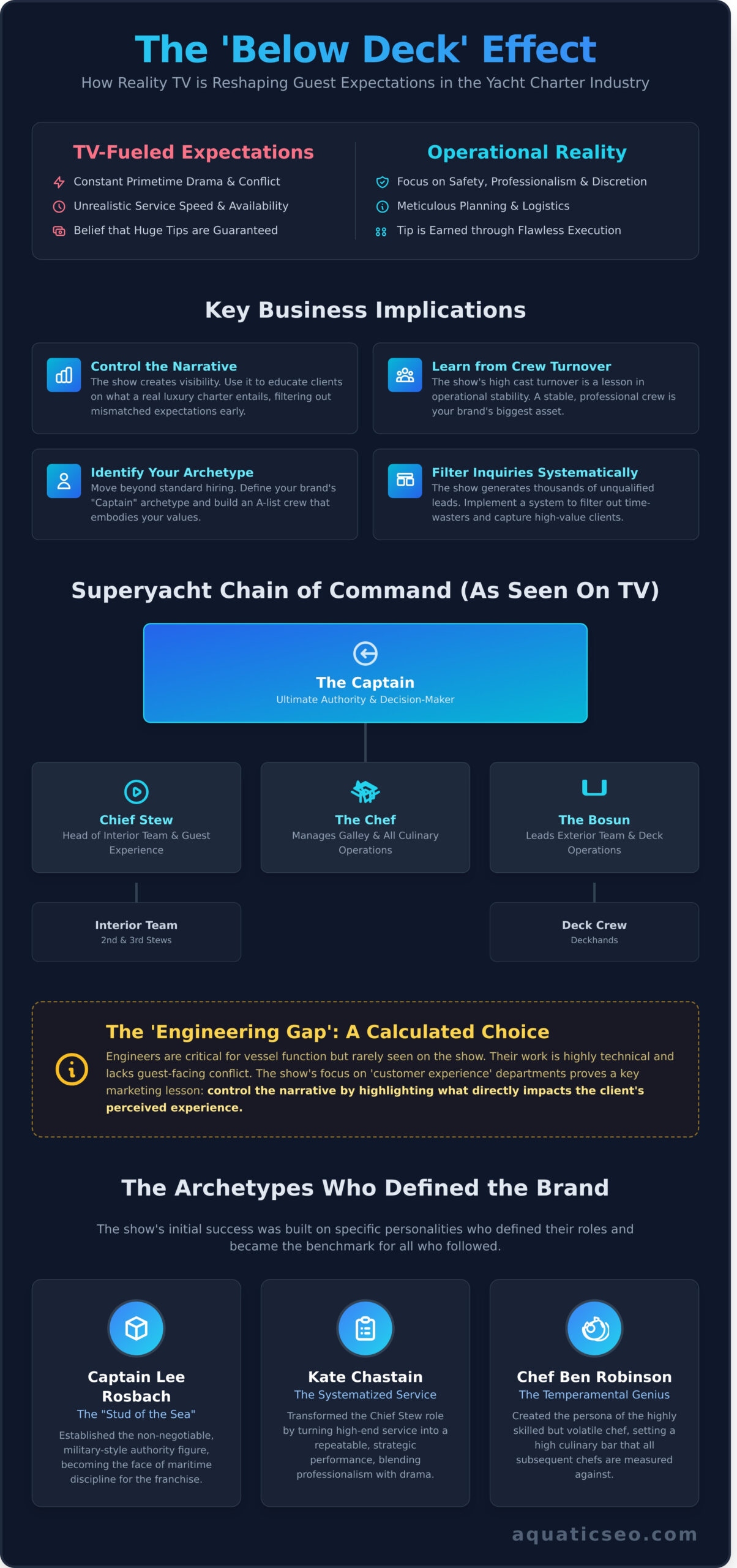
Your charter guests’ expectations are being set by reality TV, and it’s costing your business real money. Since its debut in 2013, Bravo’s Below Deck has fundamentally changed how the public perceives professional yachting, for better and for worse.
You’ve probably dealt with it firsthand. Guests arrive expecting five-star service mixed with primetime drama, a direct result of the on-screen dynamics of the below deck cast. It’s a frustrating operational headache that most marketing agencies simply don’t understand.
This guide cuts through the noise. We will provide the definitive, updated list of every cast member through the current season. More importantly, we’ll give you a system to control the narrative, filter out problematic clients, and use the show’s massive visibility to attract high-margin charters.
We’ll break down the complete cast roster before analyzing exactly how their portrayal impacts your market value and operational stability.
Key Takeaways
- The “Below Deck Effect” creates massive visibility but also sets damaging guest expectations. Learn how to control the narrative for your charter business.
- Get the definitive season-by-season list of every below deck cast member and see how on-screen crew turnover provides critical lessons for your own operational stability.
- Move beyond standard hiring. This guide breaks down how to identify your “Captain” archetype and build an A-list crew that protects your brand reputation.
- The show attracts thousands of unqualified inquiries. Discover the system to filter out time-wasters and capture only high-value charter clients ready to book.
Defining the Below Deck Cast: More Than Just Reality TV Stars
To control your marketing, you must first understand the product. For Bravo’s Below Deck, the product isn’t the yacht; it’s the crew. The below deck cast is a meticulously assembled team of professional yachties, some with decades of experience and others who are ‘green’ recruits, filmed operating a superyacht during a six-week charter season.
This isn’t a permanent crew. It’s a temporary operational unit built for television. This distinction is critical. Unlike a full-time yacht crew, their contracts are for the charter season only, which explains the high turnover rate between seasons. This model maximizes drama and keeps the format fresh for viewers, but it’s a lesson in the power of a flexible operational system.
The show’s structure hinges on a clear hierarchy that mirrors a real superyacht’s chain of command:
- The Captain: The ultimate authority and decision-maker.
- The Chief Stew: Head of the interior team, responsible for guest service and experience.
- The Chef: Manages the galley and all culinary operations.
- The Bosun: Leads the exterior team (deckhands) and manages all deck operations.
What began in 2013 as a niche docuseries has exploded into a global branding powerhouse. The show’s evolution from a single vessel into a multi-franchise phenomenon is well-documented; the full Below Deck series history shows a deliberate expansion strategy that has created immense brand equity. This cast is no longer just yacht crew; they are influencers, brand ambassadors, and a direct channel to an affluent audience.
The ‘OG’ Cast Members Who Started the Phenomenon
The initial success was built on specific archetypes who defined their roles. Captain Lee Rosbach became the face of maritime authority, the non-negotiable “Stud of the Sea.” Kate Chastain systemized the Chief Stew role, turning high-end service into a repeatable performance. Chef Ben Robinson established the temperamental-genius-chef persona that every subsequent chef is measured against. They proved how a powerful personal brand can drive business growth.
The Roles That Make the Show Work
The success of the below deck cast as a marketing vehicle comes from its clear operational structure. The Deck Crew balances intense manual labor with being guest-facing, a constant tension that creates drama. The Interior Team operates as the front-line of the luxury guest experience, directly controlling the perceived value of a $200,000 charter. Their performance directly impacts the tip, a clear metric for client satisfaction and operational margin.
You’ll notice an “Engineering Gap.” We rarely see the yacht’s engineers. This is a calculated production choice. While engineers are arguably the most critical crew for the vessel’s function, their work is technical and lacks guest-facing conflict. The show focuses on the “customer experience” departments, proving that in marketing, you control the narrative by showing your audience what directly impacts their experience, not the complex operations behind the scenes.
The Complete Below Deck Cast List: Season-by-Season Evolution
To understand the Below Deck phenomenon, you must first understand its key asset: the crew. The show’s producers don’t just hire yachties; they cast characters who drive narratives and, ultimately, ratings. For your charter business, this offers a direct lesson in brand representation. Every crew member, from the captain to the third stew, is a client-facing ambassador. The complete below deck cast is a 13-season case study in what works, what fails, and how talent defines the guest experience.
Analyzing the show’s roster reveals a clear system for building a team that delivers results, whether that’s 5-star service or a 5-star television season. The evolution shows a deliberate strategy of balancing operational competence with compelling personalities.
The Captains: The Pillars of the Franchise
Leadership sets the operational standard. Captain Lee Rosbach (Seasons 1-10) built the franchise’s foundation on stern, military-style discipline and his “Stud of the Sea” persona. His departure marked the end of an era. In contrast, Captain Sandy Yawn of Below Deck Mediterranean showcased a more hands-on, micromanagement-heavy style. The introduction of Captain Kerry Titheradge in Season 11 was a calculated move, replacing Lee’s old-school authority with an adventure-yachting background that signals a new operational focus for the main series.
The Chief Stews: Architects of the Interior
The interior team is the core of the client experience. The show’s early seasons with Adrienne Gang established a baseline, but the shift to Kate Chastain (Seasons 2-7) transformed the role. She proved that a Chief Stew could be both a service professional and a central brand personality. The post-Kate era with Francesca Rubi and Heather Chase demonstrated the difficulty in replacing such a pivotal figure. Now, with Fraser Olender, the franchise has its first male Chief Stew, a nod to evolving industry norms and a test of a new leadership dynamic.
The Chefs: From Five-Star Meals to Galley Meltdowns
No role is more critical or carries more risk than the chef. A great chef can single-handedly guarantee a successful charter. An unstable one can destroy it. Chef Rachel Hargrove (Seasons 8-10) embodied this duality, delivering Michelin-level cuisine while being notoriously volatile. Conversely, Chef Marcos Spaziani (Sailing Yacht Season 3) set the gold standard for professionalism under extreme pressure. The frequent galley failures on the show highlight a critical operational vulnerability. The show’s dramatic portrayal of these pressures has a real impact, offering lessons for yacht crew hiring and shaping the expectations of new crew entering the industry.
The distinction between a fan favorite and a true industry professional is the most valuable takeaway from the below deck cast history. As Bravo builds its 2025-2026 roster, it will continue to balance these factors. Your business must do the same, prioritizing operational skill over personality. Just as the show’s producers build a cast for maximum impact, you must build a crew and marketing system with the same precision. Of course, having an A-team is only half the battle if you can’t attract the right clients.
The Below Deck Effect: How the Cast Impacts Your Yacht Brand
You cannot ignore the influence of Bravo’s hit show. It has become the single largest source of ‘Demand Visibility’ for the charter industry, but it’s a chaotic, unfiltered firehose of attention. The show creates massive awareness, but it also establishes dangerous misconceptions about service, pricing, and crew behavior that directly impact your operations and margins. Your challenge is not to fight this effect, but to control it.
The core problem is the ‘Reality TV’ filter. Potential guests now view a multi-million dollar charter through the lens of produced drama. They don’t just expect luxury; they expect a storyline. This fundamentally changes their buying criteria and puts immense pressure on your crew to be performers, not just service professionals.
Guest Expectations in the Age of Bravo
The “beach picnic” is the perfect example of this operational trap. On TV, a Michelin-star-level meal appears on a remote beach in minutes. In reality, this requires hours of logistical planning, tender runs, and staff, often costing thousands in fuel and labor. The show makes the impossible look standard, and now clients expect it. Theme nights and elaborate table scapes are no longer a surprise-and-delight feature; they are a mandatory line item for a 5-star experience. By 2026, the ‘Below Deck Effect’ will force a 15-20% premium on charter pricing just to cover the operational costs of meeting television-fueled service expectations.
This shift proves that the perceived quality of your crew matters more than your yacht’s length overall. A guest’s lasting impression is tied to the service and personality of the staff. The public’s obsession is so detailed that Vulture maintains a comprehensive ranking of every Below Deck crew member, treating them like professional athletes. This level of scrutiny now applies, unofficially, to your crew, making them your most critical brand asset.
Recruitment Challenges: Real Yachties vs. Wannabe Stars
The fame generated by the below deck cast has flooded the hiring pool. Since 2019, top crew agencies report a 50% increase in applications from “green” candidates with no sea time but thousands of social media followers. These applicants aren’t seeking a career in maritime hospitality; they’re chasing a platform. This makes finding true “silent service” professionals-those who prioritize guest privacy over getting the perfect selfie-incredibly difficult. A crew focused on their own brand is a direct threat to yours.
You need a system to filter for quality. Our Marine Demand Control System applies here, too. It’s not just for filtering client inquiries. It helps you build a brand reputation and operational standard that attracts career-oriented professionals and repels those seeking 15 minutes of fame. It ensures the “cast” you hire is focused on performance, not performance art.
Building Your Own A-List Crew: Lessons from the Screen
A luxury yacht is more than fiberglass and teak. It’s an experience delivered by people. On the show, the drama and success hinge entirely on the crew. In your business, that same principle dictates your profit margins. A disorganized crew burns cash and reputations. A high-performing crew becomes your single greatest marketing asset.
Stop thinking of your crew as an operational expense. Start building them as a core part of your product. Here is the five-step process to get it done.
- Step 1: Define Your Captain’s Mandate. Is your captain an authoritative figure who sets clear, non-negotiable standards? Or a hands-on mentor who develops talent? There is no single right answer, but a lack of an answer creates a leadership vacuum. This decision defines your operational culture and how problems get solved, directly impacting guest satisfaction and crew stability.
- Step 2: Hire Personality, Then Train for Service. The show proves that a five-star attitude is harder to teach than silver service. You can train someone to fold a napkin correctly in an afternoon. You cannot train them out of a bad attitude that sours a million-dollar charter. Prioritize candidates who are resilient, personable, and team-oriented. Your P&L will thank you.
- Step 3: Enforce a Real Chain of Command. The “galley drama” that makes for good television is a business catastrophe. It stems from ambiguous roles and a lack of clear protocols. Your bosun, chief stew, and chef must have absolute authority in their domains. This isn’t about ego; it’s about operational integrity. When a guest makes a request, the response must be instant and coordinated, not debated.
- Step 4: Create ‘Demand Visibility’ for Your Crew. Stop hiding your best asset. Potential clients see hundreds of white boats on a blue background; they remember people. Feature your crew in your marketing with professional headshots and bios. The most memorable Below Deck cast members become brands in their own right; your crew can do the same for your charter business.
- Step 5: Audit Against the Gold Standard. Use the show as a benchmark for service excellence, minus the interpersonal chaos. Does your crew anticipate guest needs with precision? Can they execute a flawless beach picnic on two hours’ notice? This isn’t about reality TV. It’s about auditing your service delivery against the high standard that high-net-worth clients now expect as a baseline.
The Importance of Leadership Stability
The constant crew turnover on the show is a profit-killer in the real world. Every new hire costs you in recruitment, training, and time lost to operational errors. A stable crew that returns for multiple seasons builds institutional knowledge, operates with near-telepathic efficiency, and creates a consistent brand experience that drives repeat bookings. The owner sets this tone; a culture of respect and fair compensation is not an expense, it’s an investment in asset protection.
Marketing Your Crew as a Value-Add
Your marketing materials must shift from boat-centric to human-centric. Showcase your chef’s signature dishes with professional food photography to attract high-intent foodies. Create short video interviews with your captain discussing their favorite anchorages. This strategy transforms your crew from an operational cost into a powerful value proposition. It’s a core component of effective Yacht Charter Marketing: Get Booked, Not Just Seen, allowing you to attract clients who value service over specs.
Building an elite crew is only half the battle. You need a system to market them effectively. See how our Marine Demand Control System turns your team into your most powerful sales asset.
Dominating the Charter Market with Aquatic SEO
The massive popularity of shows like Below Deck has created a wave of interest in yachting. But it’s the wrong kind of interest for your business. Generic marketing campaigns capture this broad, low-quality attention, flooding your team with inquiries from dreamers and TV fans, not qualified charter guests. Your time is wasted filtering out “looky-loos” who will never sign a charter agreement.
This is the critical difference between vanity traffic and qualified inquiries. You don’t need more clicks. You need signed contracts and a predictable charter schedule. You need a system built to attract high-net-worth individuals who want the 7-star luxury experience, not the televised drama.
Our Marine Demand Control System is engineered to do exactly that. It acts as a sophisticated filter, separating the serious prospects from the noise. We position your yacht as the logical, premium choice for guests who value discretion and impeccable service over the antics of a reality TV show. We make sure your marketing attracts clients ready to book, not people asking if a specific Below Deck cast member is on your crew.
Our Specialized Approach to Yachting SEO
We don’t chase broad, high-volume keywords. Our entire strategy is built on targeting high-intent search terms that signal a client is in the final stages of their decision-making process. Think “150-foot motor yacht charter St. Barts” instead of “yacht vacation.” This is the foundation of our ‘Demand Compounding’ systems, digital assets that work to attract and qualify leads 24/7, even while you’re offshore. This is a core principle of effective Luxury Yacht Marketing: Attracting High-Value Clients.
Stop Wasting Your Marketing Spend
Let’s be direct. ‘Posts, clicks, and rankings’ are vanity metrics that don’t pay the dockage fees or crew salaries. Most marketing agencies sell you these reports because they are easy to produce and hide a lack of real business impact. Your marketing spend should directly contribute to your bottom line, period.
The Aquatic SEO guarantee is simple: We focus on your operations and margins, not just traffic. We are a growth partner, not an agency. Our success is measured by the increase in qualified inquiries, the stability of your booking calendar, and the health of your profit-and-loss statement. If you’re ready to stop wasting money on marketing that doesn’t work, the next step is a clear-eyed assessment of your current position.
Request a No-BS Marine Marketing Analysis
Turn On-Screen Hype into Off-Screen Profit
The lesson from the screen is clear: your crew is your brand. The immense popularity of the below deck cast proves that high-caliber clients book unforgettable experiences, not just the yacht itself. Your team’s professionalism and service are no longer just operational details; they are your most powerful marketing assets, directly impacting charter rates and repeat bookings.
But an A-list crew is wasted on unqualified leads and price-shoppers. You don’t need more random website traffic. You need a system built to attract clients who value and are prepared to pay for a premium, crew-led experience. This is the difference between being a marketing vendor and a growth partner.
Specializing only in the marine industry, we replace vague marketing promises with operational control. Our proprietary Demand Filtering technology is designed to deliver qualified inquiries, not vanity metrics. We help you capture the high-margin charters that create schedule stability.
Scale your charter business with the Marine Demand Control System and start connecting your five-star crew with five-star clients.
Frequently Asked Questions About the Below Deck Cast
Who is the most famous Below Deck cast member?
Captain Lee Rosbach is the most famous cast member from the franchise. Known as the “Stud of the Sea,” his command of 10 seasons established him as a television icon. His direct leadership style and memorable one-liners built a significant personal brand. Kate Chastain, the Chief Stew for six seasons, is a close second in terms of fame, defined by her sharp wit and central role in the show’s operational drama.
Is the Below Deck cast made up of real yachties?
Yes, the cast members are real yachties who hold legitimate maritime certifications. Production requires all crew to possess valid credentials, such as the STCW (Standards of Training, Certification, and Watchkeeping for Seafarers). While experience levels vary, their on-screen jobs reflect their real-world qualifications. This authenticity is fundamental to the show’s appeal and provides real insight into the high-end charter market.
How much does the Below Deck cast get paid?
The cast earns income from three distinct sources: a production salary, on-charter tips, and a base yachting salary. Production pays an estimated $5,000 to $30,000 per season, with senior roles earning more. Tips from charter guests typically add another $15,000 to $20,000 per person over a six-week filming period. This compensation structure mirrors the financial reality of the industry and is a primary incentive for participation.
What happened to Captain Lee on Below Deck?
Captain Lee Rosbach departed Below Deck during Season 10 because of persistent health issues. He was managing nerve damage that compromised his mobility, making it unsafe for him to remain in command. After a temporary replacement, he returned to finish the season. Bravo confirmed in early 2023 that he would not return for Season 11, with Captain Kerry Titheradge taking his place.
Who is the Chief Stew on Below Deck Season 13?
A Chief Stew for Below Deck Season 13 has not been announced because the season has not been confirmed. The original franchise finished airing Season 11 in May 2024, with Fraser Olender in the Chief Stew role. Any information about a future Season 13 cast is speculation. The Chief Stew is a critical role that directly impacts guest experience and drives major storylines each season.
Can you hire the Below Deck cast for a private charter?
Yes, you can hire individual cast members for private charters, but not as a group through the Bravo network. Many crew members work as freelance yachties when not filming. For instance, Chef Ben Robinson is available as a private chef, and Malia White works as an Officer on non-televised charters. You must contact them through their professional representatives or crewing agencies, not the production company.
How are Below Deck cast members selected?
Cast members are chosen through a casting process that screens for both legitimate yachting experience and a personality fit for reality television. The production company, 51 Minds Entertainment, looks for credentialed yachties who can also generate compelling on-screen drama and storylines. The ideal candidate from the Below Deck cast is someone who is competent at their job but also has a dynamic personality that engages viewers.
Which Below Deck cast members are still in the yachting industry?
Many former cast members remain active in the yachting industry. For example, Malia White from *Below Deck Mediterranean* has advanced her career and is now a certified Officer of the Watch. Aesha Scott from *Mediterranean* and *Down Under* continues to work as a Chief Stew on other vessels between seasons. The visibility from the show often accelerates their careers, leading to senior positions on superyachts worldwide.