Most boat dealers are drowning in traffic that never buys a single vessel. You see your website analytics climbing, yet your sales team spends 40% of their week answering emails from “tyre-kickers” or people looking for hourly boat rentals you don’t even provide. If your current approach to SEO for boat and yacht dealers focuses strictly on “more clicks,” you’re actually inviting the low-margin noise that’s clogging your service schedule and eroding your sales floor’s efficiency. Vanity metrics don’t pay for floorplan interest; only qualified inquiries from high-intent buyers do.
You’ve likely realized that a “lead” is a meaningless term when it comes from someone who can’t afford your inventory or just wants free advice on a 20-year-old outboard. It’s frustrating to watch your revenue grow while your actual margins and schedule stability get worse because of unqualified demand.
You’re about to learn how to replace that vanity traffic with a system that captures high-intent buyers and filters out low-margin inquiries before they ever reach your desk. We’ll examine the specific demand control tactics needed to increase your margins and give you total control over your dealership’s job mix.
Key Takeaways
- Identify the “Vanity Metric Trap” that inflates traffic counts without increasing your bottom line or stabilizing your sales cycle.
- Deploy the four-pillar Marine Demand Control System to capture high-intent prospects while filtering out low-margin tire-kickers.
- Transform your Google Business Profile into a high-conversion asset by prioritizing inventory-specific imagery and local marine citations.
- Replace generic blog posts with targeted “Demand Content” that addresses the specific financial and operational questions unique to SEO for boat and yacht dealers.
- Establish auditable tracking systems to pinpoint exactly which channels originate your most profitable inquiries and eliminate wasted spend.
Why Traditional SEO Fails Boat and Yacht Dealers
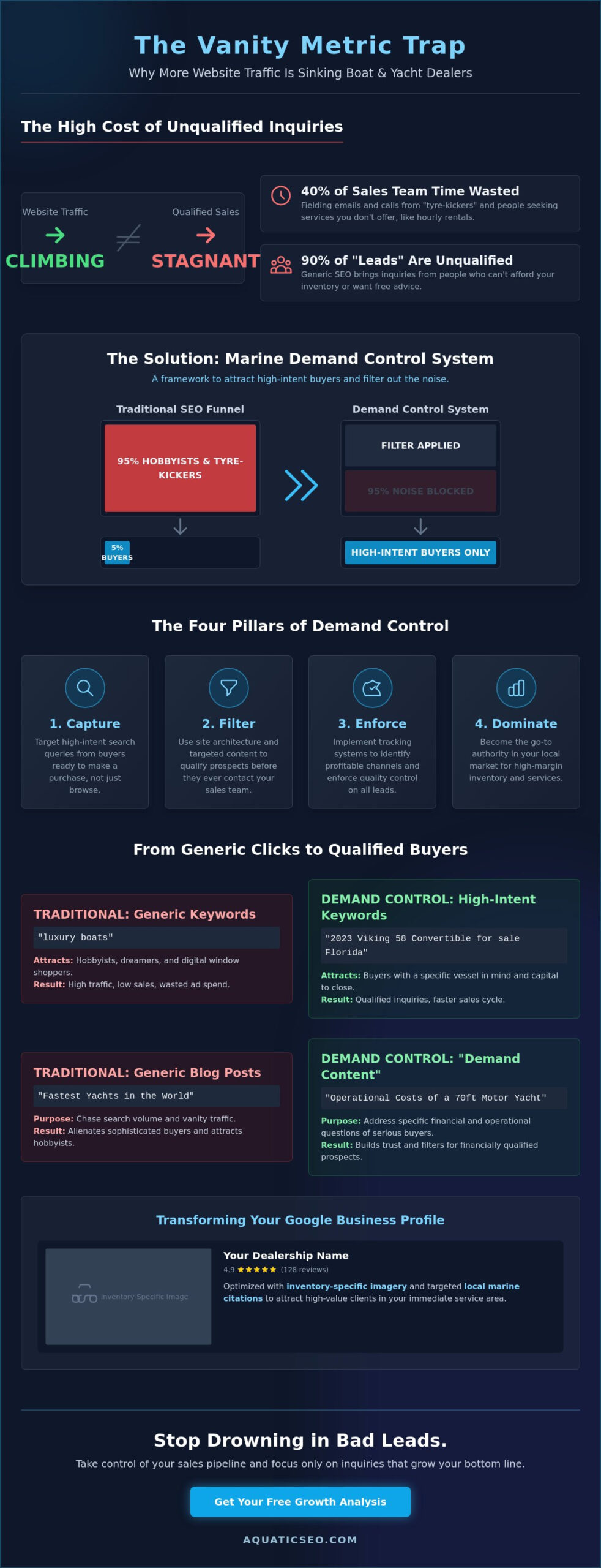
You see the charts moving up, but your sales floor is quiet. Your current agency sends monthly reports full of green arrows and increased impressions, yet your bottom-line revenue hasn’t shifted an inch. This is the Vanity Metric Trap. Traditional search engine optimization (SEO) focuses on volume, but effective SEO for boat and yacht dealers requires a surgical focus on intent. If you aren’t ranking for the specific search terms used by high-net-worth buyers, you’re just paying for digital window shoppers. Being first on Google is worthless if you’re ranking for the wrong search intent.
The High Cost of Unqualified Inquiries
Generic agencies promise more leads. They don’t tell you that 90% of those leads will be people looking for a $200 afternoon boat rental when you’re trying to move a $1.5M Viking. Your sales team wastes 15 hours a week fielding calls from tire kickers who can’t afford your inventory. This busy-ness destroys your margins and creates schedule instability. We view demand filtering as a prerequisite for any campaign. You don’t need more noise; you need a system that enforces quality over quantity. Our Marine Demand Control System is designed to capture the 5% of the market ready to sign a contract, not the 95% looking for a weekend distraction.
The Industry-Native Advantage
Most marketers can’t tell the difference between a service yard and a marina. They treat a crewed yacht charter like a simple boat rental. This lack of industry knowledge leads to content that alienates actual buyers. When your site uses the wrong terminology, a sophisticated buyer leaves in 5 seconds. To attract high-value clients, you must demonstrate that you understand the operational realities of the water. We are not a marketing agency; we are a growth partner that speaks your language. You can read more about this in our Marine Marketing: The Ultimate Guide to Attracting High-Value Clients. We focus on qualified inquiries that turn into closed sales, ensuring your SEO investment delivers stability rather than just clicks.
The Marine Demand Control System: A Framework for Qualified Inquiries
Stop settling for leads that go nowhere. Most agencies deliver traffic that clogs your inbox with tire-kickers and just-looking dreamers. We built the Marine Demand Control System to fix this operational leak. This proprietary framework provides four pillars: Capture, Filter, Enforce, and Dominate. It moves your business away from the feast-or-famine cycle by focusing on demand visibility. You don’t need everyone to see your inventory; you need it seen by the 2% of the market with the immediate capital to buy.
Effective SEO for boat and yacht dealers requires Demand Visibility. This means your high-margin inventory appears exactly when a buyer is ready to commit. Without Demand Filtering, your sales team wastes 40% of their week chasing prospects who can’t afford the slip fees, let alone the vessel. We prioritize your schedule stability by ensuring only high-intent traffic reaches your contact forms.
Capturing High-Intent Search Queries
Effective SEO for boat and yacht dealers relies on identifying keywords that signal a ready-to-buy state rather than just-browsing curiosity. Generic keywords like “luxury boats” are a waste of your budget. We target search queries that indicate immediate intent. A prospect searching for “2023 Viking 58 Convertible for sale Florida” is a buyer; someone searching for “fastest yachts in the world” is a hobbyist. Long-tail strategy involving specific brands and models ensures you capture the right intent. In a yacht brokerage, a Qualified Inquiry is a prospect who has identified a specific vessel class, possesses the verified capital to close, and expects to finalize a purchase within a 90-day window.
Filtering for Margin and Stability
Stability comes from knowing exactly who is entering your funnel. We use technical Demand Filtering tools to qualify prospects before they ever reach your sales floor. This includes site architecture that funnels high-value clients toward your most profitable inventory while discouraging low-margin inquiries. By implementing proven local marketing strategies, we ensure your dealership dominates its specific geographic territory without attracting out-of-market noise.
Your website should act as a gatekeeper. If your digital presence isn’t actively protecting your sales team’s time, it’s failing your operations. You can see how we structure these funnels on our Boat Dealers Service Page. We don’t just generate noise; we enforce a system that prioritizes your margins and prevents burnout. If you want to stop chasing clicks and start controlling your calendar, you can see if your dealership qualifies for our system.
Dominating Local Search: Google Business Profiles and Marine Citations
Most boat dealers treat their Google Business Profile (GBP) like a static digital business card. That’s a mistake that leaks revenue to competitors who understand local proximity. If you aren’t visible when a buyer searches “center consoles for sale near me,” you don’t exist. Effective SEO for boat and yacht dealers requires a profile that acts as a digital showroom. Data from 2023 shows that 64% of local consumers use GBP to find contact details before visiting a physical location. You need a strategy that mirrors a professional marketing and sales plan, focusing on visibility where the buyer actually stands.
Optimizing Your Digital Storefront
Your physical location and service area must be defined with surgical precision to avoid wasting resources on out-of-territory clicks. A common failure is mislabeling the business type in the primary category. Google distinguishes between a “Marina” and a “Service Yard.” If you sell and maintain boats but don’t offer transient slips or fuel, labeling yourself as a marina confuses the algorithm and attracts the wrong traffic. Use GBP Posts to highlight new inventory arrivals and successful closings. This signals to Google that your business is active and provides social proof to prospects that you are moving hulls.
Professional imagery is non-negotiable. Don’t use grainy cell phone shots of a boat sitting on a trailer in a gravel lot. High-resolution photos of the inventory in the water or in a clean showroom environment communicate that you handle high-value assets with care. Google’s vision AI analyzes these images to categorize your business; clear shots of specific boat brands can actually improve your rankings for those specific keywords.
Review Management for Yacht Brokers
High-net-worth individuals value privacy above all else. You won’t get a public testimonial from a billionaire by asking them to post their full name and boat model on Google. Instead, guide these clients to provide reviews that focus on the professionalism of the transaction and the stability of the process. If you receive negative feedback, respond within 24 hours. State the facts without getting defensive. A professional response to a complaint often builds more trust with skeptical buyers than a string of perfect five-star ratings. For a deeper look at local search tactics, review our guide on local SEO for marine operations.
Marine-specific citations are the final pillar. Your dealership must appear in directories that boat buyers actually frequent, such as YachtWorld, BoatTrader, and local chamber of commerce listings. Generic directories won’t move the needle. You need links from high-authority marine domains to prove to search engines that you are a legitimate player in the industry. This isn’t about volume; it’s about the relevance of the source to the marine niche.
Content Strategy That Filters: Moving Beyond Generic Blog Posts
Most SEO for boat and yacht dealers fails because it prioritizes traffic volume over inquiry quality. You don’t need 10,000 visitors looking for boat name ideas; you need 50 visitors ready to sign a purchase agreement. Effective SEO for boat and yacht dealers requires a shift from entertaining the masses to educating the high-intent buyer. This is about Demand Filtering. By answering the specific, difficult questions a buyer asks during a $2M transaction, you position your dealership as the only logical choice.
| Vanity Content (Waste) | Demand Content (Revenue) |
|---|---|
| Top 10 Boats for Summer | Yacht Maintenance Costs in Florida |
| How to Tie a Cleat Hitch | Financing a $2M+ Sportfish Vessel |
| Cool Yacht Names | Marine Survey Requirements for Insurance |
We focus on creating Demand Compounding assets. These are deep, technical resources that grow in value as they age. By 2026, AI-driven search results will prioritize expert density and direct answers over keyword stuffing. If your content doesn’t provide specific data or industry-native insights, AI search engines will ignore you. Your text must be clear, authoritative, and stripped of fluff to dominate these future search results.
Repelling the Wrong Audience
Your copy should act as a gatekeeper. If you sell luxury yachts, your content must signal your price point immediately to filter out bargain hunters. Stop trying to rank for “cheap boats” or “discount hulls” if your margins depend on premium sales. Use specific language like “vessels exceeding $500k” or “custom builds” to disqualify low-budget leads. Remember that “Boat Dealer” keywords target buyers in the acquisition phase, while “Marina” keywords attract owners seeking slip availability and utility services.
Building Authority with Expert Guides
High-value buyers are skeptical. They want to know you understand the operational realities of yacht ownership. Develop resources that cover yacht financing structures, the nuances of sea trials, and what to look for in a professional inspection. You should cross-reference your internal Marine Surveyors Service Page to show buyers you have the right network to facilitate a clean closing. Using industry-native terminology like “stringer integrity,” “electronic charting systems,” and “deadweight tonnage” proves you aren’t just a marketer; you are a specialist who knows the deck as well as the boardroom.
Stop wasting your budget on clicks that don’t convert into closings. Schedule a Fit Call to install a Demand Control System.
Implementation: Transforming Your Dealership into a Growth Machine
You have likely been told that more traffic equals more sales. That is a lie that kills margins. If your digital presence brings in 50 inquiries but 45 of them are for low-margin, entry-level vessels you do not have in stock, your marketing is a liability. It is time to stop chasing generic clicks and start capturing demand for the inventory that drives 80% of your profit. Effective SEO for boat and yacht dealers isn’t a creative exercise; it is an operational upgrade that filters out the noise and protects your sales team’s time.
Stop guessing where your revenue comes from. We implement auditable tracking that maps every qualified inquiry back to its specific search origin. This isn’t about counting clicks; it is about knowing which specific search terms resulted in a high-value sale versus a lead you didn’t want. A traditional marketing agency wants to show you a graph that goes up. A growth partner wants to show you a schedule that is full of high-value work. We transition your dealership away from the agency model of vague promises and toward a relationship built on auditable results.
Auditing Your Job Mix
Look at your sales data from the past 12 months. You will likely see a clear pattern where 20% of your current inquiries drive 80% of your net profit. Our “No-BS” marine marketing analysis identifies these high-margin segments and strips away the vanity metrics. We then adjust your search strategy to double down on these specific areas. This ensures your digital footprint matches your operational goals. We focus on the bottom line, providing you with job mix control and schedule stability that protects your margins even when the broader market fluctuates.
The Next Step: Booking Your Fit Call
The Fit Call is not a sales pitch. It is a rigorous 15-minute diagnostic to determine if your dealership’s infrastructure can handle the influx of qualified inquiries our system generates. We only work with specific dealers who value precision over volume. Before the call, identify your top three most profitable boat categories and be ready to discuss your current sales targets. We will tell you exactly how we intend to capture that specific demand. If we aren’t a match, we’ll tell you directly.
Book your Yacht Dealer Fit Call
Synthesis Summary: Stop settling for marketing that creates more work instead of more profit. A Marine Demand Control System isn’t about ranking first for every boat-related search. It is about dominating the searches that result in high-margin contracts. When you align your digital presence with your operational capacity, you stop being a victim of market seasonality and start controlling your own growth. By implementing SEO for boat and yacht dealers with a focus on auditable tracking and job mix control, you transform your website into a predictable revenue engine.
Take Command of Your Dealership’s Digital Pipeline
Stop settling for traffic that never buys a boat. Most agencies sell you on ranking for generic terms, but that doesn’t keep your sales team busy with actual buyers. You need a system that filters out tire-kickers before they ever reach your inbox. By implementing our Marine Demand Control System, you move from hoping for leads to enforcing a predictable flow of qualified inquiries.
Effective SEO for boat and yacht dealers isn’t about chasing the latest algorithm update; it’s about owning the search results where high-net-worth individuals spend their time. We’ve built this framework to be 2026-ready, focusing on local dominance and content that speaks the language of a serious buyer. It’s time to end the cycle of busy weeks followed by dead weeks. You deserve stability and margins that reflect your expertise.
Book your Yacht Dealer Fit Call to take control of your demand.
We look forward to helping you transform your dealership into a high-performance growth machine.
Frequently Asked Questions
How is SEO for boat dealers different from general automotive SEO?
Boat dealer SEO focuses on lifestyle aspirations and technical specifications that justify a six or seven figure investment. Unlike automotive SEO which relies on high volume local searches for utility vehicles, marine buyers often search nationally for specific hulls or power configurations. Your strategy must prioritize these technical nuances to capture buyers who have moved past the research phase and are ready to commit.
Can SEO help filter out people looking for boat rentals when I only sell yachts?
Yes, a structured Marine Demand Control System uses negative keyword targeting and specific intent based content to filter out rental seekers. We replace generic boat terms with high intent yacht sales and brokerage terminology throughout your site architecture. This ensures your sales team spends 100 percent of their time on qualified inquiries rather than explaining that you don’t offer hourly rentals.
How long does it take to see qualified inquiries from a new marine SEO system?
You will typically see a shift in inquiry quality within 90 days of implementing a specialized SEO for boat and yacht dealers strategy. While search engines need time to index new pages, the initial 30 to 60 days focus on technical corrections that stop you from wasting money on dead end traffic. By the third month, the system begins to stabilize demand and generate a predictable flow of high value prospects.
What is the difference between a boat dealer and a yacht broker in terms of SEO strategy?
Boat dealers usually focus on inventory specific SEO for new models and local market dominance for specific brands they represent. Yacht brokers require a broader geographical reach and a strategy built around sold data and market expertise to win listings. The broker SEO must position them as a trusted advisor for 80 foot plus transactions; the dealer system targets the immediate availability of 20 to 40 foot stock.
Do I need to list my entire inventory on my website for SEO to work?
You must list your inventory because each listing acts as a dedicated landing page that captures specific search intent for that make and model. Search engines cannot rank what they cannot see, and hiding inventory behind a call for details wall kills your visibility. A robust system uses these listings to dominate long tail searches, ensuring that when a buyer searches for a specific 2024 center console, your dealership appears first.
Is it better to rank for specific boat brands or general boat dealer terms?
Ranking for specific brands delivers 4 times higher conversion rates because it captures buyers who have already decided what they want. General terms like boat dealer attract window shoppers and researchers who are months away from a purchase. We prioritize brand specific and model specific keywords to ensure you’re capturing demand at the bottom of the sales funnel where the margins are highest.
How does the Marine Demand Control System handle local vs. national buyers?
The system uses a tiered approach that secures your local 50 mile radius while simultaneously optimizing for national buyers seeking rare or high spec inventory. For dealerships, we focus on local near me intent to drive showroom foot traffic. For yacht brokers, we deploy a national strategy that targets buyers across coastal hubs, ensuring your listings get eyes from Florida to California regardless of where the vessel is docked.
Why do generic marketing agencies often fail in the marine industry?
Generic agencies fail because they don’t know the difference between a yacht charter and a boat rental, leading to a flood of unqualified leads. They focus on vanity metrics like clicks and impressions instead of operational stability and profit margins. You need a partner who understands that a 10 percent increase in qualified inquiries is worth more than a 500 percent increase in random website traffic.