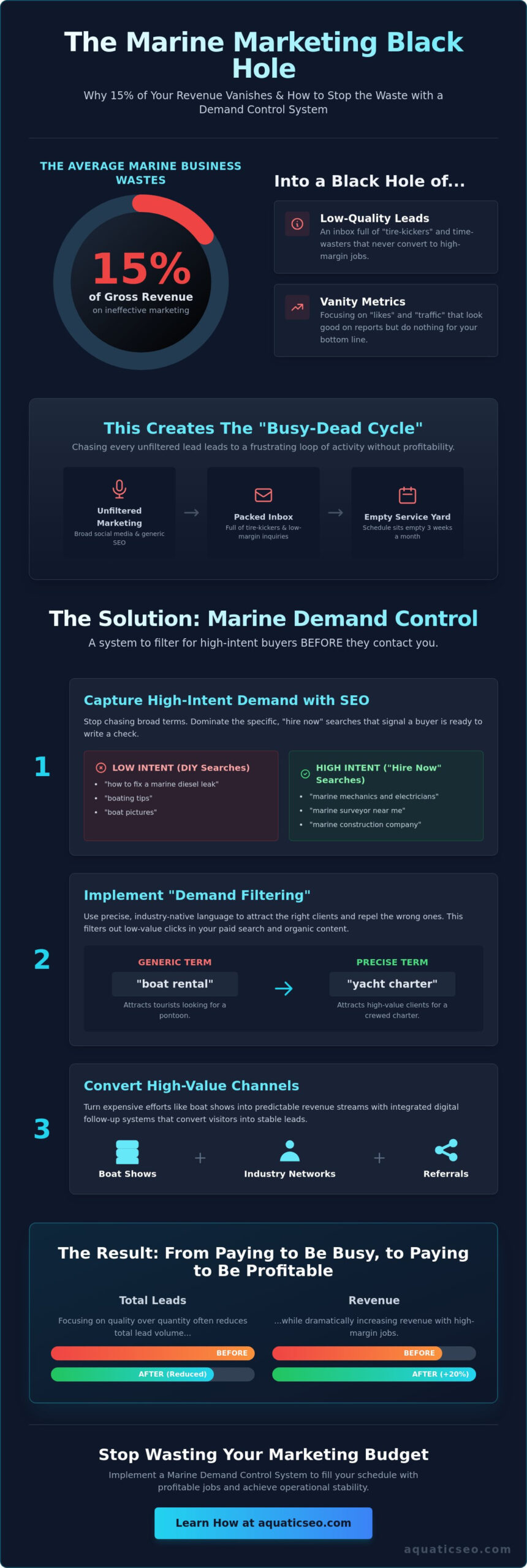
Most marine businesses are currently throwing 15% of their gross revenue into a black hole of social media posts and generic SEO that produces nothing but “likes” and low-quality leads. You’ve likely felt the frustration of a packed inbox full of tire-kickers while your service yard sits empty three weeks out of the month. The truth is that identifying the best marketing channels for marine industry growth in 2026 isn’t about being everywhere at once; it’s about ruthlessly filtering for high-intent buyers before they even click.
It’s exhausting to watch your margins shrink while an agency tells you that traffic is up. You need actual inquiries from people ready to book a yacht charter or buy a boat, not more vanity metrics. This guide will show you how to stop the waste and install a system for demand control with surgical precision. We’ll break down the specific platforms where your ideal clients are actively searching and how to dominate them to ensure your schedule stays full.
Key Takeaways
- Stop chasing vanity metrics and start prioritizing the specific channels that drive qualified inquiries and protect your profit margins.
- Identify the best marketing channels for marine industry growth by focusing on high-intent search terms that capture customers ready to hire.
- Implement “Demand Filtering” in your paid search strategy to block low-value clicks and fill seasonal gaps with high-margin jobs.
- Turn expensive boat show appearances into predictable revenue by integrating digital follow-up systems that convert booth visitors into stable leads.
- Move beyond the “marketing agency” model and adopt a Marine Demand Control System to capture, filter, and dominate your local market.
Why Most Marketing Channels Fail Marine Contractors and Dealers
You’ve likely spent thousands on digital marketing strategies that promised growth but delivered nothing but noise. When searching for the best marketing channels for marine industry growth, most owners get distracted by vanity metrics. Your inbox fills up with “is this available” messages while your actual service bays sit empty three weeks later. This is the Busy-Dead Cycle. It’s a direct result of choosing the wrong marketing channels. Most agencies prioritize clicks because clicks are easy to generate. They don’t care if those clicks come from a teenager looking at boat pictures or a high-intent owner needing a hull repair.
Vanity traffic looks good on a monthly report but does nothing for your bank account. If you’re a marine contractor, 10,000 website visitors mean nothing if none of them own a dock or a bulkhead. Broad-reach social media platforms often cast too wide a net. This results in low-margin inquiries that eat up your sales team’s time. You end up chasing $500 minor repairs when you should be closing $50,000 repower projects. You need a system that filters for intent before you ever pick up the phone.
The High Cost of Unfiltered Demand
Chasing every lead erodes your profit margins. Every hour your team spends talking to “tire-kickers” is an hour not spent on billable work. This creates a heavy psychological toll on your sales staff. They stop treating every lead with urgency because they expect most of them to be duds. You need a system to enforce quality over quantity. Without a filter, you’re just paying to be busy, not paying to be profitable. We’ve seen businesses increase revenue by 20 percent while actually reducing their total lead volume simply by focusing on qualified inquiries.
Industry-Native Terminology and Why It Matters
Generic agencies don’t know the difference between a Yacht Charter and a boat rental. They treat a service yard like a standard marina. This lack of precision confuses search engines and attracts the wrong crowd. If your site uses “boat rental” to describe a $5,000-a-day crewed charter, you’ll get tourists looking for a pontoon. Search engines reward businesses that use precise industry language. Using the right terms ensures you appear in the best marketing channels for marine industry searches that actually convert. Precision is the difference between a wasted click and a high-value contract.
Capturing High-Intent Demand with Marine-Specific SEO
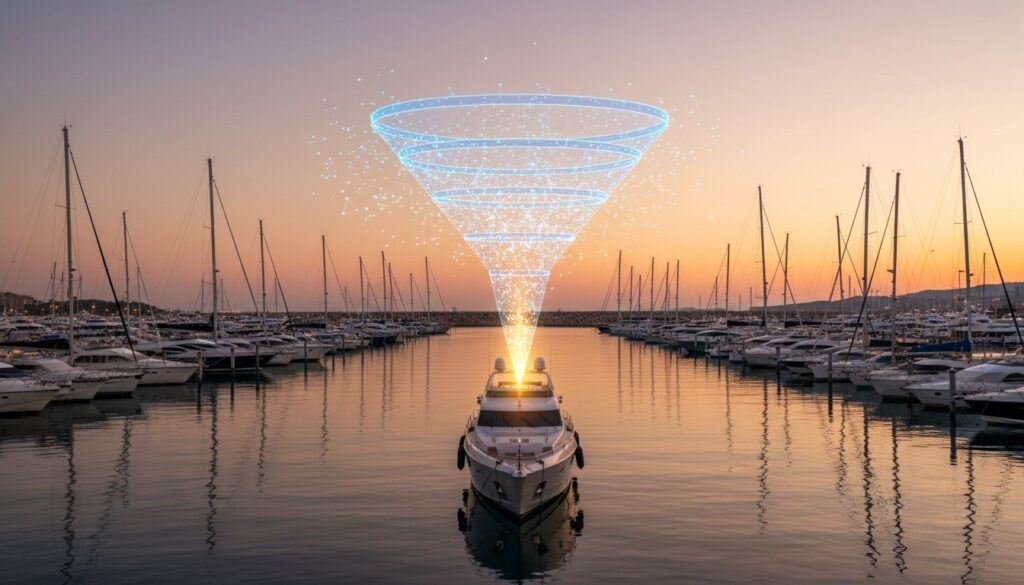
Most marine businesses waste 80% of their marketing budget on traffic that never converts. You see “impressions” and “clicks” in a monthly report, but your schedule still has dead weeks that kill your margins and destabilize your operations. This disconnect exists because generic agencies don’t understand the difference between a hobbyist and a high-value client. When you stop chasing volume and start enforcing demand control, you focus on the specific searches that signal a buyer is ready to write a check. SEO is the foundation of this process because it positions your business exactly where high-intent prospects look when they have an urgent problem or a major purchase planned. This makes it one of the best marketing channels for marine industry operators who value stability over vanity metrics.
Our Marine Demand Control System treats search engines as a filtering mechanism. Instead of ranking for broad terms like “boating tips,” we target high-intent keywords such as “marine surveyor” or “marine construction” that indicate a specific, commercial need. According to recreational boating industry statistics, the economic impact of the marine sector exceeds $230 billion annually. Capturing your share of that requires technical SEO that ensures your site loads faster and functions better than the local competition. When a high-value client needs an emergency repair or a pre-purchase inspection, your site must be the immediate, authoritative solution they find.
Search Intent: Finding Buyers Who Are Ready to Act
There is a massive gap between “how to” searches and “hire now” searches. A boat owner searching for “how to fix a marine diesel leak” is looking for a DIY solution that wastes your time. Conversely, someone searching for marine mechanics and electricians is looking for a professional to solve a problem immediately. We build content that captures this urgent demand by answering the specific questions high-value clients ask before they book. Effective SEO for the marine industry requires a no-nonsense approach that ignores tire-kickers and focuses on qualified inquiries.
Local SEO for Boatyards and Dealers
For service-based businesses, local authority is the only metric that matters. If you operate a service yard or boatyard, you need to dominate the search results for your specific geographic area. This starts with optimizing your Google Business Profile to ensure boat dealers and private owners find you first. We use location-specific landing pages to signal to search engines that you are the primary authority in your radius. This geographic focus prevents you from competing with businesses 500 miles away and ensures your lead flow comes from clients you can actually serve. If your local presence is weak, you are handing your market share to competitors who are simply easier to find. You can schedule a fit call to see how we bridge this gap in your specific service area.
By focusing on intent rather than volume, SEO becomes a predictable engine for growth. It moves your business away from the “hope and pray” method of marketing and into a system of total demand control. This is how you secure the high-margin projects that keep your crew busy and your revenue growing in 2026.
Paid Search and Demand Filtering: Speed vs. Stability
Most marine operators treat Google Ads like a slot machine. You put money in and hope a high-value client comes out the other side. This lack of precision is why many marine ad accounts waste over 40% of their budget on tire-kickers and irrelevant clicks. While Google Ads is one of the best marketing channels for marine industry growth, it only works if you use it as a scalpel. Our Marine Demand Control System treats paid search as a temporary bridge. It fills immediate schedule gaps while your organic assets mature, ensuring your crew stays busy without sacrificing your margins.
Filtering Out the Noise in Paid Search
Effective demand control requires aggressive negative keyword lists to stop budget leaks. If you operate a crewed yacht charter, you cannot afford to pay for clicks from users searching for a “cheap boat rental” or “DIY pontoon.” These are different buyers with different intentions. You must enforce strict filters to block bargain hunters and focus on high-intent searchers. We optimize your Google Ad Score to ensure you aren’t paying a “stupid tax” for irrelevant traffic. Your ad copy must speak directly to owners who value specialized expertise, effectively qualifying the prospect before they even click. This approach turns a broad search into a stream of qualified inquiries for your sales team.
PPC for Seasonal Job Flow Control
Marine businesses live and die by the seasonal calendar. Recent Outdoor Recreation Economy data shows the boating sector contributes billions to the national economy, but that revenue is rarely distributed evenly throughout the year. You need a system to turn the demand tap on during “dead weeks” and pull back when your service yards are at capacity. Scaling spend shouldn’t be a guessing game based on gut feelings. We use historical data to predict when your shop floor will be empty and ramp up capture efforts 14 to 21 days in advance. This protects your operational stability and prevents the “feast or famine” cycle that destroys small business morale.
Paid search provides the speed you need today, but organic compounding provides the stability you need for 2026. Relying solely on PPC is a recipe for long-term margin erosion as bid prices rise. The goal is to use paid capture to stabilize cash flow while your SEO builds a permanent competitive moat. This balanced approach ensures you aren’t held hostage by platform algorithm changes or rising ad costs. By filtering demand at the source, you ensure every dollar spent on the best marketing channels for marine industry players results in an auditable business outcome rather than a vanity metric.
Niche Channels: Boat Shows, Industry Networks, and Referrals
Most boat dealers and service providers treat boat shows as a branding exercise. They spend $15,000 on floor space, hand out brochures to everyone who walks by, and hope for the best. This is a waste of capital. To make these events one of the best marketing channels for marine industry growth, you must stop acting like a passive exhibitor and start acting like a data collector. High-intent buyers don’t just wander into your booth; they’re often there because you invited them three weeks before the doors opened.
The real work happens in the digital follow up. If you wait more than 48 hours to contact a lead, their interest drops by 60% according to industry sales data. You don’t need a stack of business cards from “dreamers” who just want to look at upholstery. You need a system that filters for Qualified Inquiries. This means using digital lead capture tools at the booth that immediately segment prospects based on their timeline and budget. If they aren’t planning to buy or book service within the next six months, they don’t belong in your primary sales funnel.
Event Marketing for Marine Businesses
Success at events like the Seattle Boat Show requires a pre-show offensive. We see a 35% increase in high-value booth appointments when businesses run targeted ads to their existing email lists and local prospects 14 days before the event. Use a simple landing page to book specific time slots for consultations. This ensures your best sales staff spend their time with buyers, not tire-kickers. Post-show, use automated SMS sequences to filter out the noise and book follow up appointments while the excitement is still fresh.
Building a Referral Engine with Partners
Generic LinkedIn outreach is a dead end for marine professionals. Real authority is built through Demand Compounding with industry-native partners. For example, marine surveyors are your most potent source of high-intent leads. They are the first people to know when a boat has a mechanical failure or needs a refit. When a surveyor recommends your shop, the trust is already established. The sale is 80% done before you even pick up the phone.
Don’t leave these relationships to chance. Create a formal referral system with marine electricians and mechanics. When you share data and leads with partners who serve the same high-net-worth client base, you create a closed loop of demand. This approach outperforms general advertising because it relies on “industry-native” credibility. It transforms your business from a solo operator into a central hub within a local maritime network. This is how you stabilize your schedule and protect your margins during the off-season.
Implementing Your Marine Demand Control System
Stop viewing your website as a digital business card. It’s an operational tool designed to solve the “busy but broke” cycle that plagues many owners. For marine contractors, a website without a system is just a liability that generates noise. You need a Marine Demand Control System to turn the best marketing channels for marine industry into predictable, high-margin revenue.
This system functions on four non-negotiable pillars. First, you Capture high-intent demand where buyers are already looking. Second, you Filter out the low-margin tire-kickers before they ever reach your desk. Third, you Enforce your operational standards to protect your schedule. Finally, you Dominate your local market by compounding your authority over time. This isn’t about getting more traffic; it’s about gaining total control over your business flow.
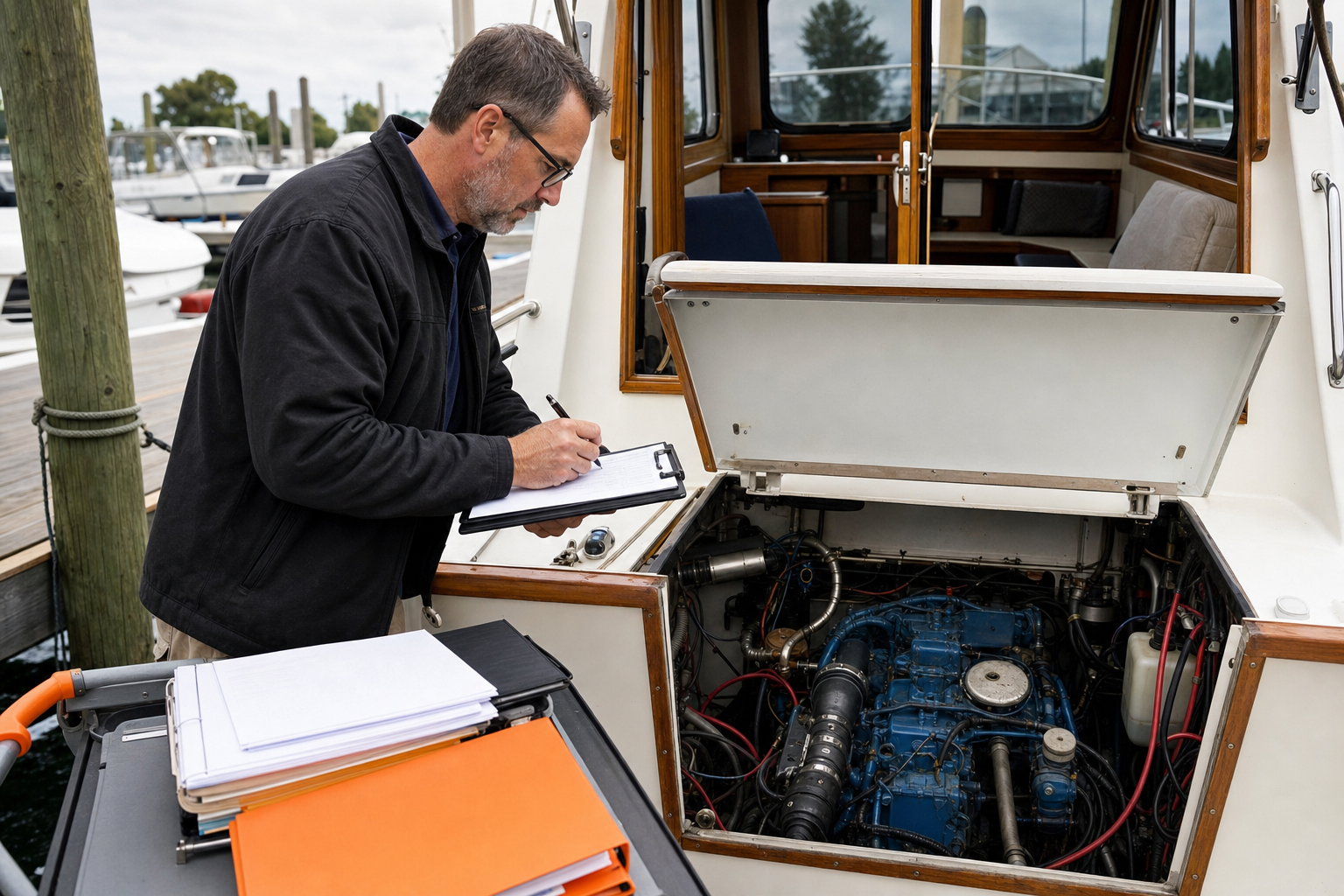
Healthy margins require audible tracking. Every inquiry must be recorded and reviewed to ensure your sales process isn’t leaking cash. If you don’t know exactly why a prospect didn’t close, you’re guessing with your profit. Tracking 100% of your interactions allows you to identify the 25% of inquiries that are wasting your time, allowing you to refocus on high-value jobs.
The Growth Partner Approach
Aquatic SEO rejects the “agency” label because agencies prioritize vanity metrics like impressions and clicks. We act as a growth partner focused on your job mix and bottom line. We set clear expectations for qualified inquiries rather than just flooding your inbox with junk. If a channel doesn’t improve your schedule stability or your margins, we cut it. We aren’t here to make you look good; we’re here to make your business run better.
Your Next Steps for 2026
Start with a no-BS analysis of your current performance. Identify the single bottleneck that’s preventing you from hitting your 2026 revenue goals. Most often, it’s not a lack of traffic, but a lack of control over that traffic. Stop chasing volume and start demanding better results from the best marketing channels for marine industry. Your next step is to move away from generic tactics and implement a system built specifically for the marine sector.
Marketing in the marine industry isn’t a game of who has the prettiest website or the most followers. It’s a logistical challenge of matching high-intent demand with your operational capacity. By moving from a passive website to an active Demand Control System, you stop being a victim of the “feast or famine” cycle. You gain the power to choose your clients, protect your margins, and ensure your crew stays busy with the right kind of work.
If you’re tired of marketing that feels like a black hole and you’re ready for a system that produces auditable results, let’s talk. We don’t work with everyone, but if you’re a fit, we’ll help you take control of your market. Book your fit call today to see how we can stabilize your demand for 2026.
Take Command of Your Marine Service Pipeline
Most marine contractors and dealers waste thousands on agencies that can’t tell a service yard from a marina. You don’t need more likes or broad traffic. You need a system that filters for high-margin yacht charters and qualified inquiries. By implementing the Marine Demand Control System, you stop the cycle of busy weeks followed by dead weeks. You focus on the best marketing channels for marine industry growth that prioritize your schedule stability over vanity metrics. It’s about capturing high-intent buyers who are ready to book, not window shoppers who drain your sales team’s time.
We’ve spent years in the trenches of the marine sector. We know that revenue growth means nothing if your margins and operational sanity suffer. Our approach replaces vague promises with auditable tracking and industry-native expertise. You’ll finally have a clear view of which channels drive profit and which ones just create noise.
Stop guessing where your next big contract is coming from. Request a No-BS Marine Marketing Analysis and see exactly how we enforce margin protection for our partners. Your business deserves a growth partner that speaks the language of the water. Let’s get to work.
Frequently Asked Questions
Is social media worth the effort for a marine service yard?
Social media rarely generates immediate revenue for a service yard because owners don’t browse Instagram when their hull needs emergency repair. Organic social reach has dropped below 3% for business pages since 2023. You should treat these platforms as a digital business card rather than a primary growth engine. Focus your resources on channels where owners actively search for technical expertise when a specific problem occurs.
How long does it take for marine SEO to start generating qualified inquiries?
You can expect marine SEO to produce consistent, qualified inquiries within 4 to 9 months of implementation. This timeline accounts for Google’s indexing speed and the competitive landscape of the marine industry. While initial technical fixes might show movement in 60 days; the high-value traffic that converts into engine overhauls or refit contracts requires established authority. It’s a long-term play for the best marketing channels for marine industry.
Can I use Google Ads if I only serve a small local area?
You can absolutely use Google Ads for a small territory by setting precise geographic radiuses or targeting specific zip codes. We often see local marine businesses waste 40% of their budget by targeting entire states instead of the specific 15 mile radius around their marina. By limiting your reach to high-wealth waterfront communities; you ensure your spend only targets prospects who can actually bring their vessel to your facility.
What is the difference between a lead and a qualified inquiry in the marine industry?
A lead is just a name and an email; a qualified inquiry is a prospect with a specific vessel, a defined problem, and the budget to solve it. Generic agencies brag about lead volume, but 70% of those leads often turn out to be tire-kickers or owners of vessels you don’t service. A qualified inquiry fits your specific operational sweet spot, such as a 50 foot sportfish owner needing a repower.
How much should a marine contractor spend on marketing channels?
Most successful marine contractors allocate between 5% and 12% of their annual gross revenue to marketing channels. If you’re doing $1M in revenue, you should reinvest at least $50,000 to maintain your current position and capture new demand. This isn’t a cost; it’s an investment in your schedule stability. Spreading this budget across the best marketing channels for marine industry ensures you aren’t dependent on a single source.
What happens if I have too many inquiries and can’t handle the work?
When your schedule is full, you don’t stop marketing; you increase your filters to raise your profit margins. We use a Demand Control System to prioritize high-margin work and push lower-value jobs to a waitlist or a referral partner. This allows you to cherry-pick the most profitable projects while maintaining a 3 month backlog. Don’t turn off the tap; just tighten the nozzle to filter for better clients.
Why do generic marketing agencies fail when working with boat dealers?
Generic agencies fail because they don’t understand that a center console buyer has different motivations than a motoryacht buyer. They treat boat sales like car sales, ignoring the 12 to 18 month sales cycle common in the marine sector. Since they don’t know the difference between a production boat and a custom build, they waste your budget on broad keywords that attract people who cannot afford your specific inventory.