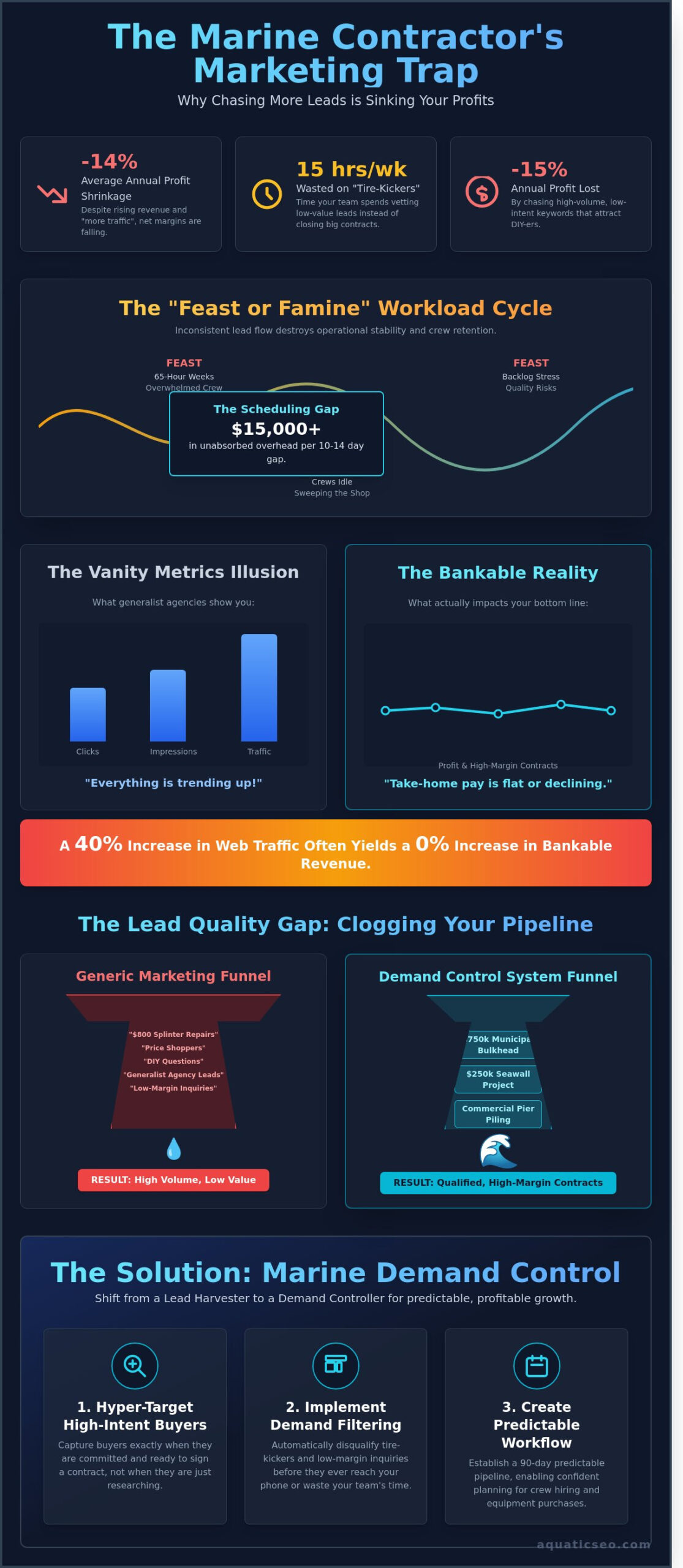
Most marine contractors are currently drowning in “tire-kicker” quotes while their actual profit margins shrink by an average of 14% annually. You’ve likely felt the frustration of a schedule that swings between “can’t keep up” and “dead quiet” despite spending thousands on generic digital marketing for marine contractors. It’s a common trap where revenue goes up; however, your actual take-home pay stays flat because you’re chasing every lead instead of the right ones.
We agree that the “more traffic” approach is a failing strategy for specialized construction businesses. You don’t need more clicks; you need a predictable flow of high-value job inquiries that actually fit your crew’s expertise. This guide will show you exactly how to stop the feast-or-famine cycle and start capturing high-intent marine construction contracts using our proprietary demand control system. We’re going to dive into the exact 2026 framework for dominating local search and filtering out bad leads before they ever reach your phone.
Key Takeaways
- Stop chasing vanity metrics like clicks and traffic that fail to improve your profit margins or stabilize your crew’s schedule.
- Master a results-driven approach to digital marketing for marine contractors by capturing high-intent buyers exactly when they are ready to sign a contract.
- Dominate local search results for specific waterways and neighborhoods by turning your Google Business Profile into your most valuable lead-generation asset.
- Implement a demand filtering system to disqualify tire-kickers and ensure your team only handles high-margin inquiries.
- Transition to the Marine Demand Control System to create a predictable growth framework for planning equipment purchases and crew hiring.
Why Your Current Marketing is Failing Your Marine Construction Business
Most marine contractors are burning capital on “visibility” while their actual net margins shrink by 12% or more annually. You’ve likely seen the monthly reports from a generalist agency showing “upward trends” in clicks and impressions. These are vanity metrics. If those clicks don’t translate into signed contracts for high-margin seawall repairs or commercial pier builds, they’re a drain on your resources. High traffic often leads to lower margins because your sales team spends 15 hours a week vetting tire-kickers instead of closing $250,000 projects. You don’t need more “noise”; you need a system that captures high-intent buyers.
Generalist agencies treat your specialized trade like a local bakery or a law firm. They don’t understand that Digital Marketing for marine contractors requires technical knowledge of permitting, barge logistics, and seasonal mobilization. When an agency lacks marine context, they drive unqualified inquiries that clog your pipeline. This creates a “Feast or Famine” cycle. One month your crews work 65-hour weeks; the next month, you’re paying skilled operators to sweep the shop because the leads dried up. This inconsistency wreaks havoc on your operational stability and crew retention.
- The Vanity Trap: A 40% increase in web traffic often yields a 0% increase in bankable revenue if the search intent is wrong.
- The Scheduling Gap: Inconsistent lead flow creates 10 to 14-day gaps in crew scheduling. This costs a mid-sized firm upwards of $15,000 in unabsorbed overhead per occurrence.
- The Context Gap: Generalist agencies cannot distinguish between a $2,000 residential dock patch and a $750,000 municipal bulkhead project.
The hidden cost of chasing low-value leads is the displacement of high-value opportunities. Every hour your estimator spends on a “price shopper” is an hour stolen from a high-intent developer. This is why digital marketing for marine contractors must be built on a foundation of demand filtering, not just lead generation. We’ve seen businesses grow their top-line revenue by 20% while their actual take-home pay stayed flat because their “growth” was fueled by low-margin, high-headache projects. You aren’t running a charity; you’re running a heavy construction firm.
The Problem with Generic SEO
Ranking #1 for “boat docks” sounds profitable until your phone rings 30 times a week with homeowners asking for $800 splinter repairs. If your business model relies on heavy equipment and commercial pilings, that traffic is a liability. Generic SEO focuses on search volume; we focus on commercial intent. Contractors often lose 15% of their annual profit by chasing high-volume keywords that attract DIY-ers. You need to dominate the specific terms that indicate a project is ready for a professional crew and a barge.
Operational Stability vs. Lead Volume
You must stop being a lead harvester and start being a demand controller. For the 2026 market, Demand Control is your most critical operational tool. It’s not about getting more leads; it’s about getting the right leads at the right time. A lack of filtering leads to revenue growth that kills your schedule stability. If you can’t predict your pipeline 90 days out, you don’t have a marketing system; you have a gambling habit. Our Marine Demand Control System ensures every inquiry fits your equipment capabilities and margin requirements.
Capturing High-Intent Buyers: The Core of Marine Demand Control
Marine Demand Control is a systematic approach to capturing buyers at the peak of their intent. It’s the operational opposite of traditional “brand awareness” marketing. Instead of casting a wide net and hoping for the best, this system identifies the specific moment a property owner transitions from curious to committed. Most digital marketing for marine contractors fails because it treats all website traffic as equal. It’s not. A homeowner wondering why their dock is sagging is a researcher; a homeowner looking for “emergency bulkhead replacement in Jupiter” is an active buyer ready to sign a contract.
Identifying the “Active Buyer” requires looking past vanity metrics like clicks and impressions. An active buyer has a specific problem, a timeline, and the capital to solve it. They don’t want a blog post about the history of boat lifts. They want proof that you’ve handled similar soil conditions or permit hurdles in their specific municipality. Specialized SEO plays a critical role here by positioning your brand as the only logical choice. When your content speaks directly to the technical challenges of a $200,000 seawall project, you aren’t just another option. You’re the specialist. Following digital marketing best practices ensures your business remains visible and authoritative when these high-stakes decisions are made.
Your website must act as a 24/7 sales filter, not just a digital brochure. A brochure is passive and accepts everyone. A filter actively qualifies leads before they ever reach your desk. If your site doesn’t immediately communicate your minimum project size or your specific service area, you’ll waste hours on low-margin “tire kickers.” According to our 2023 internal audit, marine businesses using passive websites spend 40% more time on non-billable site visits compared to those with active demand filtering.
The Anatomy of a High-Intent Inquiry
High-intent inquiries are triggered by specific keywords that signal “I have a budget and a deadline.” Phrases like “vinyl sheet piling installation cost” or “commercial marina dredging permits” carry far more weight than general terms. Using industry-native terminology like “riprap,” “deadmen,” and “weep holes” builds instant credibility with sophisticated clients. It shows you’ve been in the trenches and understand the engineering, not just the aesthetics. High-intent marine leads are inquiries with specific project parameters and verified budgets.
Positioning for High-Value Contracts
To move from being a price-taker to a price-setter, you must build authority through Demand Visibility. This means dominating the search results in your specific geographic service area so that high-value clients see you everywhere they look. When you control the narrative, you stop competing on price and start competing on expertise. This is how you align your messaging with the needs of $300k to $5M revenue-tier clients who value stability and schedule adherence over the lowest bid. If you want to see how these filters work in practice, you can explore our marine demand control system for more details.
For contractors targeting large residential or commercial projects, the messaging must pivot away from “we build docks” to “we manage complex marine infrastructure.” This shift in positioning ensures you attract clients who understand that quality work costs more. It’s about enforcing your value through every digital touchpoint, ensuring that by the time a lead calls you, they’re already 80% sold on your specific process and pricing structure.
Dominating Local Search for Seawall, Dock, and Dredging Contracts
The Local Map Pack is the only real estate that matters for a marine contractor. If your business doesn’t appear in the top three results when a homeowner searches for “seawall repair,” you’re invisible to 44% of local clicks. Your Google Business Profile isn’t a passive listing; it’s a high-performance asset that requires active management to maintain dominance.
Winning in 2026 requires hyper-local keyword targeting that moves beyond city names. You need to target specific waterways, coastal neighborhoods, and private developments where your ideal clients live. Ranking for “dock builder in Jupiter” is good, but ranking for “deep water dock construction on the Loxahatchee River” is how you capture high-margin contracts. This level of specificity signals to both Google and the customer that you’re the undisputed local expert.
Modern “near me” searches have evolved. Google now prioritizes “entity relevance” over simple keyword matching. This means your digital presence must prove you actually do the work in the specific areas you claim to serve. We achieve this by geocoding project photos and publishing neighborhood-specific project updates. These signals prove proximity and competence without resorting to cheesy marketing tactics that alienate sophisticated property owners.
Service-Area SEO for Marine Trades
Ranking for dredging and dock building across multiple coastal counties requires a methodical approach to “Geographic Authority.” You can’t just list zip codes in a footer and expect results. You must create dedicated landing pages for each major service area that detail local soil conditions, tide patterns, and specific municipal permitting hurdles. This strategy transforms your site from a generic brochure into a vital resource for local property owners.
Integrating internal links to our Marine Construction Operators service page ensures that your localized content feeds back into your main service pillars. This internal structure builds the topical authority necessary to outrank larger competitors. When you prove you understand the specific seawall regulations of a particular county, you’re not just doing SEO; you’re pre-qualifying your expertise before the first phone call.
Building Trust Through Proof
Generic blog posts about “the benefits of a new dock” are a waste of your budget. High-value marine clients are looking for technical proof of your capabilities. A detailed case study explaining how you managed a complex dredging project in a sensitive ecological zone is worth more than fifty generic articles. These case studies should highlight technical specs like piling depth, PSI ratings of concrete, and the specific heavy equipment used on-site.
Recent data on the economic impact of the marine economy shows that marine construction is a multi-billion dollar sector with increasing demand for specialized infrastructure. To capture this demand, you must use SEO for the Marine Industry to position your firm as the technical leader in your region. Generalist firms can’t compete with a specialist who provides auditable proof of project success and deep industry knowledge.
Effective digital marketing for marine contractors focuses on conversion, not just traffic. A gallery of completed projects organized by waterway allows a potential client to see exactly what you’ve built in their own “backyard.” This visual proof, combined with localized reviews from their neighbors, creates a feedback loop that drives consistent, qualified inquiries. We don’t chase vanity metrics; we build systems that capture and convert the most profitable leads in your territory.
Demand Filtering: How to Stop Wasting Time on Low-Margin Inquiries
Most marine contractors think more leads always equal more money. They’re wrong. If your phone rings 25 times a day but 20 of those callers want a $1,000 piling repair when your minimum mobilization fee is $5,000, you’re losing money. You’re paying for the office staff, the estimator’s time, and the mental energy to talk to people who can’t afford your services. This clutter kills your productivity and destroys your schedule stability.
We move your business from the “everyone is a lead” mindset to a “only the best are leads” reality. This is the core of effective digital marketing for marine contractors. Demand filtering is the process of using content and technical barriers to eliminate low-intent inquiries before they reach your sales team. Instead of chasing every flashing light, you focus on the 15% of inquiries that actually move the needle on your year-end profit.
Implementing the Filter
A standard contact form is a business liability. If it only asks for a name and a phone number, you’re inviting every tire-kicker in the county to waste your afternoon. Your website must act as a digital bouncer. We implement advanced forms that force prospects to disclose their budget, project timeline, and specific site conditions before they can hit submit. If a lead doesn’t meet your $25,000 project minimum, the system automatically redirects them to a helpful “DIY” resource page instead of your inbox. This simple automation saves the average owner-operator 14 hours of wasted talk time every month.
- Hard Budget Brackets: Force users to select a realistic price range (e.g., $20k-$50k, $50k-$150k) so you don’t call back people with a $500 budget.
- Project Readiness: Ask if they have existing permits or if they’re in the “dreaming” phase.
- Site Access Details: Determine if heavy equipment can reach the bulkhead or if specialized barge work is required.
The “Growth Partner” Mentality
Traditional agencies brag about “impressions” and “vanity traffic.” We don’t care about how many people saw your logo. A 300% increase in clicks is worthless if it results in zero signed contracts. As your growth partner, Aquatic SEO focuses on qualified inquiries that protect your margins and respect your time. We want you to stop “needing” every job and start “selecting” the right ones. This psychological shift allows you to dominate your local market by focusing 100% of your operational capacity on high-margin seawall and dock construction projects that fit your sweet spot. You can learn more about the technical side of this in our guide on What is a Demand Filtering System?.
By enforcing these filters, you ensure that every estimate your team writes has a high probability of closing. You aren’t just doing digital marketing for marine contractors; you’re building a fortress around your time. When you stop chasing low-margin repairs, you finally have the bandwidth to provide premium service to the $100,000 bulkhead clients who actually grow your business.
Stop letting unqualified leads dictate your daily schedule. Install a Marine Demand Control System and take back your time today.
Beyond Rankings: Scaling Your Marine Contracting Operations
Ranking #1 on Google is a vanity metric if your crew is sitting idle three weeks out of every month. For marine contractors, the goal isn’t just “more traffic.” It’s the ability to dictate exactly what kind of work fills your schedule. Effective digital marketing for marine contractors transforms your business from a reactive service provider into a proactive market leader that commands its local territory.
Predictable Growth vs. Accidental Success
Most contractors suffer through a cycle of “busy weeks followed by dead weeks.” This instability kills your margins and burns out your best foremen. Our 2026 Marine Demand Control System replaces this chaos with a consistent, auditable job flow. We focus on “Demand Compounding,” a process where your market authority grows exponentially rather than linearly, ensuring you aren’t just getting leads, but the right job mix 4 to 6 months in advance.
Your marketing data should be the primary driver for your operational decisions. If your dashboard shows a 38% surge in seawall inquiries in a specific coastal county, you don’t wait until you’re overbooked to react. You use that data to secure materials and schedule your barge movements ahead of time. This is how you protect your margins while your competitors are still guessing about their next move.
We use this data to help you control the job mix. By adjusting the “Demand Control” filters, we can prioritize $100,000+ pier projects over small-scale maintenance calls during your peak season. This ensures your crews are always working on the highest-value projects available in your market. It’s the difference between simply growing your revenue and actually growing your profit.
You need a partner who understands your daily reality. We know the difference between the high-volume throughput of a service yard and the long-term capital projects of a marina. We don’t just generate leads; we enforce a system that protects your schedule stability. This level of control allows you to plan equipment upgrades and crew expansions with 100% confidence because you can see the demand coming before it hits your inbox.
Getting Started with a No-BS Analysis
A professional marine marketing audit in 2026 doesn’t involve vague promises or fluff. It’s a surgical look at your local search dominance and your competitors’ failure points. We look at the data to see why 65% of your current inquiries might be low-value repairs instead of the high-margin installs you actually want. This analysis provides the blueprint for your growth and identifies exactly where your digital marketing for marine contractors is leaking money.
We explicitly reject the typical “marketing agency” label. Many agencies focus on clicks and “likes”; we focus on your bottom line. We function as a growth partner, a philosophy shared by other results-focused teams like Delivered Social, meaning we are as invested in your margins as you are. If the data shows your current strategy is wasting 20% of your budget on unqualified “tire kickers,” we fix it immediately. We filter out the noise so you only talk to qualified buyers who are ready to sign contracts.
Success in this industry requires a specialist who has been in the trenches. Don’t settle for a generalist who doesn’t know a bulkhead from a batter pile. Take control of your territory and stop leaving your revenue to chance. Request your Marine Demand Control Analysis today.
Take Command of Your 2026 Project Pipeline
The 2026 season won’t reward contractors who rely on hope as a marketing strategy. You’ve seen why generalist agencies fail your $300k to $5M marine business; they chase clicks while you need signed contracts for seawalls and dredging. Effective digital marketing for marine contractors requires a shift from broad traffic to strict demand filtering.
By deploying our proprietary Marine Demand Control System, you stop the cycle of busy weeks followed by dead weeks. You focus your industry expertise on the 20% of leads that actually drive your margins. Our team brings direct, industry-native operator experience to ensure your local search presence dominates for high-value dock and dredging contracts.
Stop letting low-margin inquiries eat your time and start building a predictable, scalable operation. We specialize in helping marine businesses reach their next $1M in revenue through auditable tracking and qualified inquiry generation. Secure your Marine Demand Control System and stop chasing vanity metrics.
Your yard deserves a schedule that stays full and profitable all year long.
Frequently Asked Questions
How long does it take for digital marketing to work for marine contractors?
SEO takes 6 to 9 months for compound growth, while paid ads generate inquiries in 48 hours. Our Marine Demand Control System focuses on immediate cash flow through Active Buyer Capture while building long term equity. You shouldn’t wait a year to see a return. If your digital marketing for marine contractors strategy doesn’t produce a qualified inquiry within 90 days, your system is broken.
Can SEO really help me find high-value dredging or seawall contracts?
Yes, because 78 percent of commercial developers and high net worth waterfront homeowners start their vendor search on Google. We target specific intent based keywords like “commercial maintenance dredging” rather than generic terms. This ensures your business appears when a decision maker is ready to spend 50,000 dollars or more. It’s about visibility where the money is already moving.
Is Google Ads or SEO better for a marine construction company?
You need both to maintain a stable schedule and protect your margins. Google Ads acts as a faucet you can turn on for immediate 100,000 dollar seawall leads. SEO is the foundation that lowers your long term cost per acquisition by 40 percent over two years. A balanced approach prevents the feast or famine cycle that kills marine construction businesses.
How much should a marine contractor spend on digital marketing in 2026?
Allocate 5 to 7 percent of your annual gross revenue to maintain growth in 2026. For a contractor doing 2 million dollars in annual volume, a 10,000 dollar monthly budget is the baseline for 2026. This covers search dominance, lead filtering, and brand authority. Spending less usually results in vanity traffic that never converts into a high value signed contract.
What is the difference between “leads” and “qualified inquiries” in the marine industry?
A lead is just a name and email; a qualified inquiry is a boat lift owner with a 20,000 dollar budget and a permit in hand. Most agencies brag about lead counts that include tire kickers and solicitors. We use a Demand Filtering process to ensure your sales team only speaks with prospects who can actually afford your services. This protects your time.
How do I know if my current marketing agency is wasting my money?
Check your Cost Per Qualified Inquiry instead of looking at clicks or impressions. If your agency can’t show you exactly which 5,000 dollar ad spend resulted in a 60,000 dollar dock project, they’re guessing with your capital. Demand a transparent dashboard that tracks bottom line revenue. Stop paying for brand awareness that doesn’t fill your production calendar with profitable work.
Can I target specific coastal neighborhoods with local SEO?
You can dominate specific zip codes by building localized service area pages. If you want more work in a specific 5 mile stretch of luxury waterfront homes, we optimize your digital presence for those exact coordinates. This hyper local focus increased one client’s density by 22 percent in 2023. It reduces travel time and improves your overall operational efficiency.
What happens if my business is already at capacity-do I still need marketing?
Marketing at capacity allows you to fire your worst clients and raise your prices by 15 to 20 percent. When you have a surplus of demand, you gain the demand control needed to pick the highest margin jobs. Don’t wait for your backlog to disappear before you start your next campaign. Consistent marketing ensures you never have a dead week in November.