
Most yacht charter marketing is fundamentally broken because it measures success by the volume of clicks rather than the quality of the contract. If your inbox is full of “tire-kickers” asking for discounts on a 40-meter vessel; you aren’t winning; you are just busy being unpaid. To effectively attract high-value yacht charter clients, you must stop paying for vanity traffic that treats your luxury asset like a budget boat rental.
This level of detail also extends to shore-based planning. For clients whose charters begin or end in hubs like New York City, demonstrating knowledge of exclusive local experiences can be a powerful differentiator. For instance, to understand the caliber of dining they expect, you can find out more about Brunch at premier seafood restaurants that align with the luxury charter lifestyle.
You’ve likely experienced the frustration of a “busy” week that yields zero deposits because the leads lacked the net worth to actually book. It’s an operational drain that kills your team’s morale and shrinks your margins. We’ll show you the exact system to filter for wealth and intent before a single inquiry reaches your desk.
This guide breaks down how to implement a Marine Demand Control System to stabilize your booking schedule and reclaim your time. You’ll learn how to stop the “dead week” cycle and focus exclusively on the high-margin charters that keep your business profitable.
Key Takeaways
- Stop burning budget on “boat rental” keywords and target the $20k+ price floor where high-value intent lives.
- Deploy the Marine Demand Control System to capture active buyers in global hubs while competitors chase vanity traffic.
- Use intentional website friction to filter out tire-kickers so your team only handles qualified inquiries that protect your margins.
- Learn how to attract high-value yacht charter clients by dominating high-intent search terms like “Charter Management” instead of “boat hire.”
- Transition from seasonal chaos to a controlled backlog of leads that allows for predictable fleet expansion and stable operations.
The Distinction Between ‘Boat Rentals’ and High-Value Yacht Charters
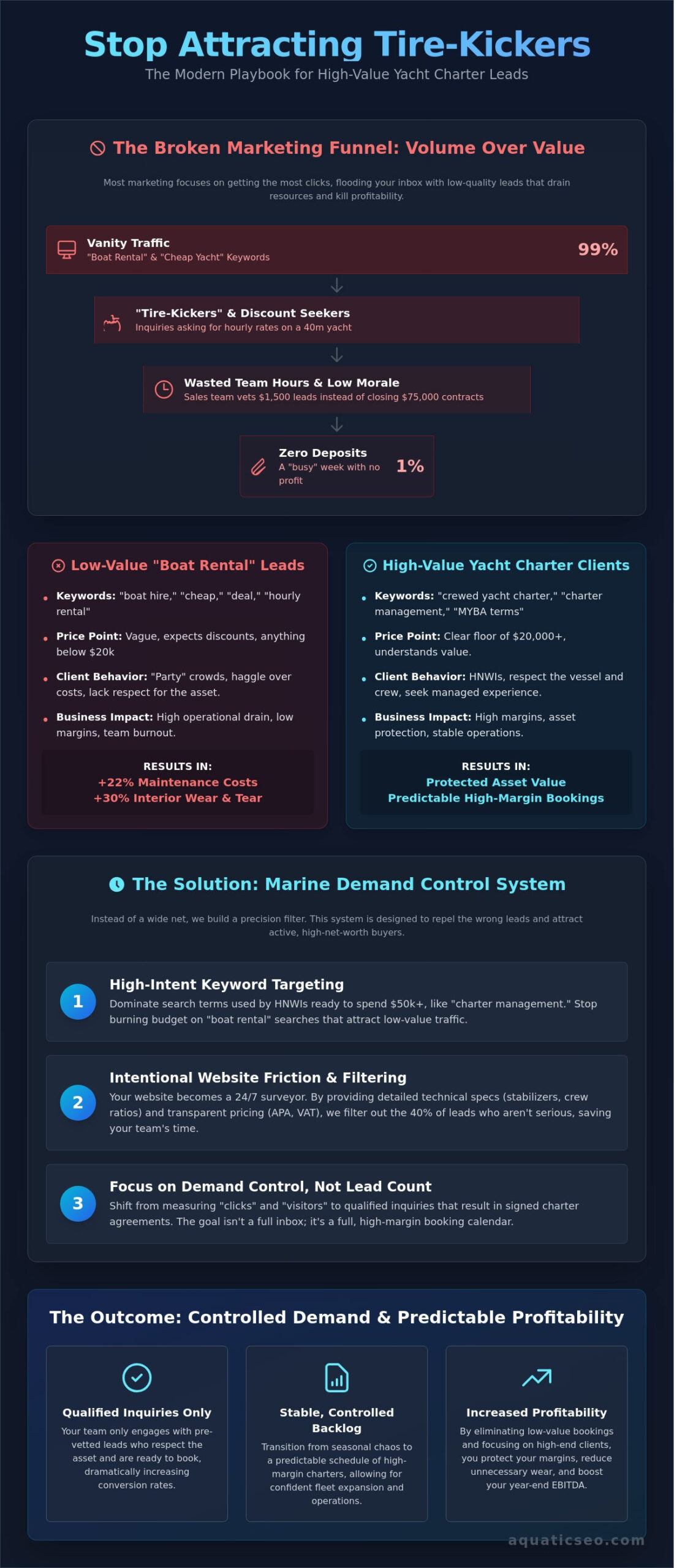
Stop chasing ‘boat rental’ keywords. It’s the fastest way to erode your margins and burn out your crew. If your marketing brings in inquiries asking for hourly rates on a 112-foot Westport, your strategy is fundamentally broken. To attract high-value yacht charter clients, you must stop thinking like a rental shop and start acting like a luxury asset manager. High-value clients don’t want a ‘boat ride’; they want a managed experience where the price floor starts at $20,000 per week. Generic agencies fail because they equate traffic volume with success, ignoring the fact that 99% of ‘boat rental’ searchers will never book a luxury charter.
The psychological shift is absolute. You aren’t selling time on the water. You’re selling the flawless execution of privacy, service, and technical excellence. When you target the wrong keywords, you’re inviting ‘vanity traffic’ that clogs your inbox and distracts your team from the 1% of leads that actually drive your year-end EBITDA. We don’t care about clicks. We care about qualified inquiries that respect the vessel and the crew.
Understanding the HNWI Search Intent
High-net-worth individuals (HNWIs) use a specific lexicon. They search for ‘crewed yacht charter,’ ‘APA included,’ or ‘MYBA terms.’ They don’t use words like ‘cheap’ or ‘deal.’ For these clients, ‘luxury’ is a filter, not a marketing buzzword. If your content targets ‘affordable yachting,’ you’re signaling to the wrong crowd. You’ll end up with ‘red flag’ leads who haggle over fuel costs and waste your sales team’s time with 50 questions before ghosting you.
The Cost of Poor Positioning
A busy calendar is often the enemy of a profitable one. Low-value bookings can increase vessel maintenance costs by 22% due to ‘party’ crowds who lack respect for high-end finishes. Every hour your sales team spends vetting a $1,500 lead is an hour lost on a $75,000 contract. This operational drag kills your stability. Our Marine Demand Control System eliminates this waste by enforcing strict filters to attract high-value yacht charter clients before a lead ever reaches your desk. We focus on ‘demand control’ rather than ‘lead counts’ because volume without qualification is just expensive noise.
- Price Floor: High-value leads start at $20k+; anything less is a rental, not a charter.
- Asset Protection: Qualified clients cause 30% less wear and tear on interiors compared to discount-seekers.
- Operational Focus: Stop rewarding your team for ‘busy work’ and start measuring them on closed high-margin contracts.
Capturing Active Buyers: The Marine Demand Control System Approach
Most agencies talk about brand awareness while your calendar stays empty. We don’t care about awareness; we care about capture. To attract high-value yacht charter clients, you must stop fishing in the middle of the ocean and start positioning your business where the money is already moving. Our Marine Demand Control System treats your digital presence as a 24/7 surveyor. It doesn’t just show pictures; it audits the visitor’s intent and filters out the tire-kickers looking for a $500 boat rental.
Your website is your most expensive salesperson. It should work like one. If it isn’t converting 3% to 5% of its traffic into qualified inquiries, it’s a liability. We move away from vanity metrics like “monthly visitors” and focus on auditable inquiries that result in signed charter agreements. The 4 pillars of capturing high-intent marine demand include:
- Intent Alignment: Targeting search terms used by people ready to spend $50,000 or more on a weekly charter.
- Technical Authority: Providing the exact specs that seasoned charterers use to compare vessels.
- Operational Proof: Using real-world data and imagery to prove the yacht is ready for sea.
- Frictionless Conversion: Removing the “request a quote” mystery in favor of direct, transparent communication.
The Architecture of a High-Conversion Yacht Page
Serious charterers spend an average of 12 minutes on a page before inquiring. They aren’t looking at the sunset; they’re looking for stabilizers, crew-to-guest ratios, and cruising range. If your page doesn’t specify whether you have Zero Speed stabilizers or a 1:1 crew ratio, you’ve lost the lead. Lifestyle photos must be backed by operational clarity. Transparency is the only way to attract high-value yacht charter clients who value their time as much as their money. List the APA and VAT expectations upfront to eliminate the 40% of leads that would otherwise drop out during the contract phase.
Dominating the Consideration Stage
Clients in the consideration stage have hidden questions. They want to know about fuel burn at cruising speed or how the chef handles a gluten-free menu for 10 guests. We create content that answers these questions before they are asked. This positions your service as the only logical solution to their specific travel problem. This is the “Growth Partner” mindset. We don’t just buy ads; we build a system that dominates the search results for the specific problems your fleet solves. We don’t guess what works; we use a 15-point inspection to ensure every page on your site is an asset, not an expense.
Demand Filtering: Why You Must Repel the Wrong Leads to Win the Right Ones
Most yacht charter marketing focuses on volume. They want more clicks, more likes, and more generic inquiries. If you want to attract high-value yacht charter clients, you must do the opposite. You need a system that actively discourages the tire-kickers who waste your sales team’s time.
High-net-worth individuals (HNWIs) don’t value a low-barrier entry. They value exclusivity and expertise. When you introduce strategic friction into your booking process, you signal that your fleet is not for everyone. This Anti-Marketing approach ensures your calendar stays open for high-margin jobs rather than being cluttered with low-value inquiries that never convert.
Implementing Intent-Based Filtering
Stop using basic contact forms. Your inquiry process should act as a digital gatekeeper. Ask wealth-indicator questions such as “Which vessels have you chartered previously?” or “What is your preferred catering budget per head?” These questions filter out the 50% of leads that aren’t a fit before they ever reach your inbox.
Automated filtering allows you to prioritize high-value dates. If a lead requests a peak-season Saturday for a four-hour cruise, your system should automatically flag it as low priority. Your goal is to identify the clients seeking week-long charters with premium provisioning. Telling the wrong lead no is the fastest way to save your operational overhead.
Protecting Your Margins and Schedule
Demand control gives you the power to say no to gap fillers. These are the low-margin bookings that owners take out of fear of an empty boat. In reality, these bookings often cause more wear and tear while blocking the schedule for a late-booking, high-value client. A predictable flow of qualified inquiries removes this desperation.
- Reduced Sales Fatigue: Your team spends 100% of their time on leads that can actually afford the $80,000 weekly rate.
- Operational Stability: High-value clients are often more respectful of the vessel and follow established charter protocols.
- Increased Profitability: One Mediterranean operator used this filtering method to increase their average contract value by 40% within a single season.
By focusing on intent rather than just traffic, you ensure every hour spent on sales has a higher ROI. This isn’t about being elitist; it’s about business efficiency. You can’t attract high-value yacht charter clients if you’re too busy answering emails from people looking for a discount boat rental.
Tactical Execution: SEO and Content for High-Intent Charter Leads
Stop chasing clicks. High-volume keywords like “boat hire” or “cheap boat rentals” are a drain on your resources. They attract tourists looking for a $500 afternoon, not the clients who spend $150,000 on a week in the Exumas. To attract high-value yacht charter clients, your strategy must pivot toward high-intent, low-volume phrases that signal a serious buyer. We focus on “Charter Management” and “Bespoke Itineraries” because these terms filter out the noise before it reaches your sales team.
Local SEO is your frontline. Dominating hubs like Palma, Fort Lauderdale, and Monaco requires more than a basic Google Business Profile. It requires location-specific content that addresses real operational hurdles, such as the 12% Spanish charter tax or specific berth availability in Port Hercule during the Grand Prix. This isn’t just “content”; it’s a Marine Demand Control System designed to capture demand where the money actually moves.
For a practical example of a company effectively targeting its local market, you can visit Blue Barracuda Charters to see how they position their professional services in Southwest Florida.
We view SEO as an asset, not an expense. This is the “Demand Compounding” effect. Unlike paid ads that stop the moment you stop paying, a well-structured SEO profile builds long-term equity. A single ranking for a high-value vessel can generate inquiries for years. It’s about building a digital moat around your specific niche in the market.
Keyword Strategy for the Luxury Tier
Generic terms are for amateurs. We target long-tail phrases that indicate a ready-to-book client. If someone searches for “Sunseeker 95 charter price” or “Kismet yacht availability,” they’ve already moved past the discovery phase. They’re in the selection phase. Vessel-specific SEO captures this high-intent traffic by providing the exact technical specs and luxury features these clients demand. We avoid the trap of high-volume tourist keywords because they destroy your margins with low-quality inquiries.
Content that Proves Expert Authority
Generic guides are a liability. Your content must prove you’ve been in the trenches. This means writing about seasonal demand shifts in the Caribbean or the intricacies of local cruising regulations in the Cyclades. We use “Specialization Tests” to ensure your content isn’t something an AI or a generalist agency could produce. If the advice applies to a car rental company, it’s too generic for a yacht charter business. Every page should link from educational top-of-funnel content directly to your booking capture pages to ensure no lead is left behind.
Stop wasting money on vanity traffic and start building a system that delivers results. Secure your Marine Demand Control System today
Expected Results: Transitioning from Seasonal Chaos to Controlled Demand
Stop crossing your fingers when the season shifts. The primary objective of a functional marketing system is to move your business from “hoping for calls” to managing a predictable backlog of qualified inquiries. When you successfully attract high-value yacht charter clients, you stop being a victim of the calendar and start dictating your own operational pace.
Your marketing is an operational system, not a monthly expense. Traditional agencies treat SEO as a line item for “visibility,” but in the marine world, visibility without conversion is just a drain on your time. Our Marine Demand Control System treats your digital presence as a lead-filtering machine that protects your crew from tire-kickers and low-margin inquiries. This shift allows you to plan fleet expansions and crew hiring with 90 days of lead time rather than reacting to a sudden quiet week in the middle of July.
Measuring What Matters
Revenue growth is a vanity metric if your margins are shrinking under the weight of “price-shopper” leads. We focus on auditable tracking that links specific SEO rankings directly to signed charter contracts. If a keyword doesn’t lead to a wire transfer, it doesn’t belong in your strategy. We also track the “Stability Metric,” which measures your ability to maintain at least 70% of peak-season revenue during shoulder months. This consistency ensures your best crew members stay on the payroll year-round because the work doesn’t disappear when the temperature drops 10 degrees.
Your Next Steps as a Marine Operator
Most charter businesses operate with a “leaky bucket” approach. They pour money into ads or generic SEO, only to watch 95% of that traffic bounce because it wasn’t the right audience. It’s time for a “No-BS” analysis of your current setup. We look at your lead-to-contract ratio and your current cost per qualified inquiry to see if your business is actually ready for a demand control system. If you’re tired of “busy weeks” followed by “dead weeks,” you need a system that enforces stability.
- Evaluate your current lead quality: Are you talking to people who can actually afford a $50,000 weekly rate?
- Analyze your shoulder season: Is your fleet sitting idle for more than 25% of the year?
- Audit your tracking: Can you name the exact source of your last three high-value bookings?
If you’re ready to stop wasting money on vanity traffic and start building a predictable pipeline, let’s look at the data. Request a No-BS Marine Marketing Analysis to determine if your operation is a fit for our system.
Take Control of Your Charter Calendar
Stop settling for “busy-ness” that fails to move the needle on your bottom line. You’ve seen how vanity traffic from generic agencies fills your inbox with tire-kickers looking for $500 boat rentals. True growth happens when you install a filter that only lets the right leads through. Our Marine Demand Control System is built specifically for $300k to $5M marine operators who need predictable, high-margin bookings.
We understand the difference between a service yard and a marina because we operate exclusively in this industry. When you align your digital presence with active buyer intent, you finally attract high-value yacht charter clients who respect your pricing and your crew. You don’t need more traffic; you need a system that enforces your standards. It’s time to transition from seasonal chaos to a controlled, profitable schedule.
Your fleet deserves a partner that speaks the language of the water. Stop wasting money on vanity metrics; get a Marine Demand Control System analysis today.
You’ve built a premium operation. Now it’s time to make sure your lead flow reflects that excellence.
Frequently Asked Questions
What is the difference between a boat rental and a yacht charter for marketing purposes?
A boat rental is a self-drive or bareboat transaction for vessels under 40 feet, usually priced by the hour. A yacht charter is a high-end service involving a professional crew, curated itineraries, and vessels over 60 feet. Marketing to attract high-value yacht charter clients requires selling exclusivity and service rather than the hourly price points used for boat rentals.
How much should I spend to attract a high-value yacht charter client?
You should allocate 5% to 10% of your target booking value toward acquisition. If a week-long charter earns your business $60,000, spending $3,000 to $6,000 to secure that specific lead is a healthy 10x return. Most operators fail because they spend $500 on “social media awareness” and wonder why their $100,000 peak weeks remain unbooked.
Can SEO really reach ultra-high-net-worth individuals?
SEO reaches the gatekeepers, family offices, and personal assistants who conduct research for UHNW individuals. These decision-makers search for specific vessel types and destinations to present options to their principals. By dominating search results for “80ft crewed catamaran charter Virgin Islands,” you position your fleet as the primary choice before a broker is even contacted.
Why do most marketing agencies fail in the yachting industry?
Most agencies focus on vanity metrics like “likes” and “impressions” because they don’t understand marine operations. They treat a $50,000 charter like a $50 e-commerce purchase. Our Marine Demand Control System replaces this generic approach with a specialized workflow that filters for liquidity and intent, ensuring your team only talks to people who can actually afford your fuel burn.
How long does it take to see results from a Marine Demand Control System?
You will see initial lead visibility and tracking data within 14 days of system deployment. The shift in lead quality usually becomes apparent by day 30 as the filtering mechanisms begin to block low-intent traffic. By the 90 day mark, the system typically stabilizes your booking calendar and eliminates the frustrating “busy weeks followed by dead weeks” cycle.
Should I list my prices on my website to filter leads?
Yes, listing “starting at” prices is the most effective way to eliminate 70% of unqualified inquiries immediately. High-value clients respect transparency and value their time; they won’t hunt for basic financial feasibility. If your 2024 rates are hidden, you’re inviting tire-kickers to waste your sales team’s time with questions that a simple price tag would have answered.
How do I handle ‘tire-kickers’ who waste my sales team’s time?
You must implement automated friction in your inquiry process to force low-intent leads to disqualify themselves. Require specific details like guest counts, preferred dates, and budget ranges in your contact forms. If a lead is unwilling to provide basic operational information, they aren’t a high-value client and shouldn’t be allowed to speak with your staff.
What are the most important SEO keywords for luxury yacht charters?
Focus on high-intent, long-tail phrases that include vessel specifications and destinations, such as “luxury motor yacht charter Mediterranean.” Avoid broad terms like “boat trips” which attract low-value tourists and drain your budget. To attract high-value yacht charter clients, you must target keywords that signal a specific desire for crewed services, gourmet catering, and multi-day itineraries. This level of detail extends to provisioning, and for charters in the Mediterranean, offering authentic Greek foods and beverages can be a significant draw; you can learn more about Helexo to understand the logistics behind sourcing such premium products.