
If you’re handing over 25% of every booking to a third-party platform just to keep your crew busy, you aren’t running a business; you’re subsidizing a broker’s growth. Most operators accept this margin drain because they lack a reliable way to generate their own high-intent leads. You end up trapped in a cycle of answering basic questions for tire-kickers who can’t distinguish between a budget boat rental and a luxury yacht charter. It’s a frustrating pattern of busy weeks followed by total silence, where the only thing consistent is the shrinking of your bottom line.
You realize that every dollar paid in commissions is a dollar taken directly from your maintenance budget or net profit. This guide will show you exactly how to increase online bookings for yacht charters by deploying a systematic engine that puts you back in command of your schedule. We’ll break down the Demand Control Framework, a methodical approach to filtering out low-value noise and capturing high-margin, direct sales through our proven Marine Demand Control System.
Key Takeaways
- Stop chasing “vanity traffic” and start capturing qualified demand through a systematic engine designed for high-intent yacht charter guests.
- Upgrade your website from a passive digital brochure into a high-performance infrastructure built for real-time availability and conversion.
- Protect your margins by implementing automated demand filtering to separate high-value inquiries from time-wasting tire-kickers.
- Execute a 5-step framework to increase online bookings for yacht charters while eliminating your dependency on third-party brokers and OTAs.
- Transition from treating marketing as a monthly expense to building a permanent business asset that provides total control over your fleet’s schedule.
Stop Chasing Traffic: Why Your Charter Booking Problem is Actually a Demand Control Problem
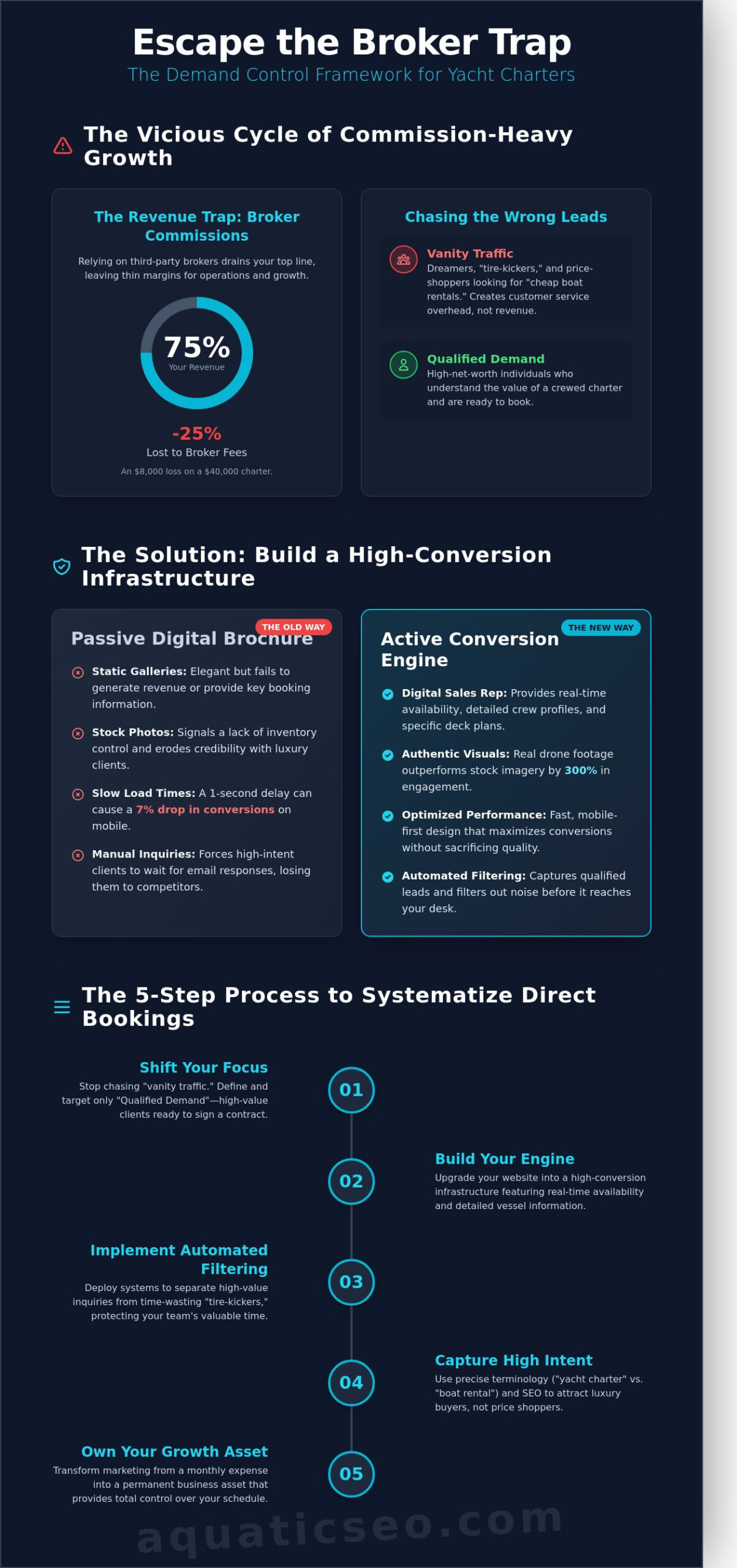
Most charter operators are obsessed with traffic. They monitor site visitors and social media likes while their calendar shows empty slips for the third week of June. This is the result of chasing “Vanity Traffic” instead of “Qualified Demand.” Traffic is just a number; demand is a person with a high net worth ready to sign a contract. If your marketing brings in 10,000 people looking for “cheap boat rentals,” you haven’t succeeded. You’ve just created a customer service nightmare for your staff.
To increase online bookings for yacht charters, you must stop acting like a passive recipient of whatever the market throws your way. You’re likely experiencing the symptoms of poor demand control right now. These include “dead weeks” where the crew sits idle, followed by unmanageable spikes that force you to turn away high-value clients. This volatility isn’t a market reality; it’s a failure of your internal systems to regulate interest. The Marine Demand Control System fixes this by installing a predictable mechanism to capture and filter inquiries before they reach your desk.
- Vanity Traffic: Clicks from dreamers, tire-kickers, and people searching for low-cost hourly rentals.
- Qualified Demand: Inquiries from individuals who understand the value of a crewed charter and have the liquidity to book it.
- The Revenue Trap: Relying on third-party brokers who take 15% to 25% of your top line, leaving you with thin margins for fleet maintenance.
The High Cost of Commission-Heavy Growth
Relying on OTAs and brokers creates a dangerous dependency. When you pay a 20% commission on a $40,000 charter, you’re losing $8,000 that should be going toward your next refit or engine overhaul. You’re operating on a “borrowed” audience that the platform can take away or charge more for at any time. Demand control is the ability to dictate who books and when.
Distinguishing Yacht Charters from Commodity Rentals
Generic marketing fails because it lacks terminology accuracy. A “boat rental” is a commodity; a “yacht charter” is an experience. If your website uses these terms interchangeably, you’re attracting price-sensitive shoppers instead of luxury buyers. High-value clients look for specific markers of professionalism and exclusivity. To increase online bookings for yacht charters, your digital presence must reflect the high-stakes nature of the maritime industry, ensuring your search intent matches the $5,000+ per day reality of your operations.
This principle of targeting a specific, high-value niche applies across the marine tourism industry. For instance, to see how a specialized dive operator attracts serious enthusiasts rather than casual snorkelers, you can visit Cozumeldivehub, or see how Sola Travel captures high-intent demand for specialized excursions in Egypt.
Building a High-Conversion Infrastructure: Beyond the Basic Website
Most yacht charter websites are vanity projects. They feature high-end photography and elegant fonts but fail to generate actual revenue. A “pretty” website is a liability if it lacks a conversion-focused marine architecture. If your site doesn’t turn a visitor into a lead within 60 seconds, it’s just an expensive digital brochure. To increase online bookings for yacht charters, your digital infrastructure must prioritize operational efficiency over artistic flair.
This isn’t a new problem; web developers have been tackling the challenge of monetizing digital real estate for decades. For a classic example of a simple but effective online revenue model, you can read more.
Your fleet pages shouldn’t be static galleries. They must function as digital sales representatives. This means providing real-time availability, detailed crew profiles, and specific deck plans. High-intent buyers are looking for reasons to book now, not reasons to call you later. If they have to wait for an email response to see if a vessel is available for a specific July window, they will move to a competitor who provides that data instantly.
Visual Credibility and Technical Performance
Trust is the primary currency in luxury charters. Authentic drone footage of your specific fleet outperforms stock imagery by 300% in terms of user engagement. Stock photos signal a lack of inventory control and immediately erode credibility. Technical performance is equally critical. In the 2026 mobile-first market, a one-second delay in page load time can result in a 7% drop in conversions. Your boat pages must be optimized for speed without sacrificing visual quality.
We use “SEO rich text” to provide value to search engines without cluttering the luxury aesthetic for the user. This involves placing technical specifications, destination details, and luxury yacht charter guides in collapsible modules or beneath the fold. This strategy ensures Google understands your authority while the client enjoys a seamless, high-end experience.
The Frictionless Booking Path
Reducing the steps from discovery to deposit is the fastest way to stabilize your calendar. High-value clients have zero patience for friction. Your infrastructure should integrate secure, marine-specific payment gateways and digital contract signing. This allows a client to secure their dates immediately, moving them out of the “shopping” phase and into the “booked” phase before they can get distracted.
Price transparency is a strategic filter, not a deterrent. Displaying “starting from” rates or clear seasonal pricing structures eliminates unqualified inquiries. This saves your sales team from wasting hours on leads that don’t have the budget for a private voyage. By building a system that filters and captures demand automatically, you gain better control over your charter margins and operational schedule. This isn’t just about a website; it’s about a specialized growth engine designed for the water.
Qualified Lead Capture: Filtering Tire-Kickers from High-Value Guests
Most charter operators fall into the trap of the “Busy Fool” syndrome. They celebrate a high volume of inquiries while their actual margins shrink. If your sales team spends 12 hours a week responding to “Is this available?” emails from people who cannot afford a $40,000 weekly rate, your system is broken. To effectively increase online bookings for yacht charters, you must stop treating every inquiry as a potential win. Volume is a vanity metric; qualified intent is the only figure that matters for your bottom line.
The Marine Demand Control System replaces open inquiry forms with a qualified application workflow. By forcing prospects to provide specific details before they can speak with your team, you create a friction point that discourages tire-kickers but attracts high-value guests. Serious clients who are ready to book a 100-foot motor yacht expect a professional, structured intake process. They don’t want a generic “Contact Us” box; they want to know you have the operational capacity to handle their specific itinerary and provisioning needs.
Using precise marine terminology acts as a natural filter. When your site asks about Advanced Provisioning Allowance (APA), preferred cruising grounds, or the distinction between a crewed term charter and a bareboat rental, it signals your expertise. People looking for a $500 party boat will be intimidated by this language and leave. This is intentional. You want to repel the low-margin traffic so you can focus 100 percent of your energy on the 4 percent of leads that actually move the needle.
Implementing Demand Filtering Systems
Ditch the basic contact form. Use high-intent questionnaires that require data on group size, desired dates, and realistic budget ranges. If an inquiry falls below your minimum threshold, use an automated response to redirect them to a partner or a self-service booking page. This protects your brand reputation without wasting human resources on dead-end leads. For a deeper look at this strategy, see our guide on Marine Marketing: The Ultimate Guide to Attracting High-Value Clients.
Data-Driven Filtering
Rankings are irrelevant if they don’t produce signed charter contracts. You must track lead sources to identify which channels produce the highest Lifetime Value (LTV). If a specific paid search campaign brings in 50 leads but zero bookings, kill it. Shift your focus from “Lead Generation” to “Qualified Appointment Setting.” This operational shift ensures that every minute your team spends on the phone is a high-probability investment in your revenue growth. To increase online bookings for yacht charters, you must prioritize the data that proves a lead is ready to sign, not just browse.
The 5-Step Process to Systematise Your Direct Bookings
Generating revenue on the water requires more than a functional website. It requires a system that removes the friction between a high-net-worth individual and your calendar. To increase online bookings for yacht charters, you must stop treating your digital presence as a brochure and start treating it as a high-performance sales floor. This 5-step process is designed to shift your business from broker dependency to direct-to-consumer control.
- Step 1: Audit your demand mix. Review your last 24 months of bookings. If brokers or third-party platforms account for more than 70% of your volume, your margins are at risk. Identify the specific percentage of revenue lost to commissions and set a target to reclaim that 15% to 25% through direct channels.
- Step 2: Deploy Active Buyer Capture. Use search ads and SEO to target users who are ready to book. These are not people looking for “yacht photos.” They are people searching for specific dates and destinations.
- Step 3: Optimise fleet listings. Your listings must target high-value search queries such as “private yacht charter Miami” or “crewed catamaran Bahamas.” Every page should answer three questions immediately: Is the boat available? What is the total cost? How do I book? For a solid example of clear service offerings, you can check out Blue Barracuda Charters.
- Step 4: Install a Demand Filtering System. Automate your lead qualification. A 4-step intake form can instantly separate a qualified $40,000 weekly charter lead from a “boat rental” seeker looking for a two-hour sunset cruise. This protects your time and focuses your energy on high-margin contracts.
- Step 5: Execute Demand Compounding. Turn every guest into a recurring asset. Use post-charter follow-ups and referral incentives to ensure your fleet stays booked 12 months in advance.
Step 2: Dominating High-Intent Search
You don’t need more traffic; you need the right traffic. Focus on “Bottom of Funnel” keywords where the user intent is clear. A user searching for “luxury yacht charter price” is 10x more valuable than someone searching for “yacht interior design.” Local SEO for your specific marina or service yard is also vital. It serves as a physical trust signal that proves your operation is legitimate and local. For more on capturing these high-intent leads, see our Digital Marketing for Marine Contractors: The 2026 Demand Control Guide.
Step 5: Maximising Fleet ROI
The math of yachting is simple. The second booking from a client is 5x more profitable than the first because your acquisition cost drops to near zero. Use automated CRM sequences to stay top-of-mind. If a guest chartered in the Virgin Islands in February, they should receive a personalized invitation for a Mediterranean itinerary by September. This “Demand Compounding” ensures your off-season is just as profitable as your peak weeks. It transforms your business from a seasonal gamble into a stable, predictable operation.
Stop letting brokers control your revenue. Install the Marine Demand Control System and take command of your fleet’s schedule.
Implementing the Marine Demand Control System for Your Charter Fleet
Generic marketing agencies fail in the marine sector because they treat a 100 foot motor yacht like a pair of sneakers. They focus on “brand awareness” and “engagement” while your crew sits idle on a Tuesday. To increase online bookings for yacht charters, you must stop spending on vanity metrics and start investing in a business asset. Our Marine Demand Control System is designed for operators who view their fleet as a high performance machine that requires a steady stream of high margin fuel.
Transitioning to this system moves you away from the “hope and pray” method of filling your calendar. You stop being a victim of the local economy or shifting weather patterns. Instead, you gain a predictable mechanism that filters for quality before a lead ever hits your inbox. This shifts the power dynamic back to the owner. When you have a surplus of qualified demand, you can enforce your pricing, maintain your margins, and keep your assets utilized without resorting to desperate last minute discounts.
What to Expect in the First 90 Days
The first 30 days of implementation focus on noise reduction. We install filters that immediately stop the tire-kickers who confuse a luxury yacht charter with a cheap boat rental. You will see a decrease in total inquiry volume, but the quality of those inquiries will skyrocket. By day 60, our reporting moves past “clicks” and focuses entirely on margin based data. We analyze which vessels are performing and which are lagging.
- Days 1-30: Elimination of low intent traffic and setup of the Marine Demand Control System.
- Days 31-60: Identification of the pricing “sweet spot” where demand allows for rate increases without sacrificing occupancy.
- Days 61-90: Stabilization of the schedule; mid week lulls are filled with high value bookings rather than gap fillers.
The Growth Partner Advantage
We reject the “agency” label because agencies are incentivized to keep you paying regardless of your bottom line. As a growth partner, we operate with the same precision you expect from your chief engineer. Our system is exclusive; we only work with fleets that meet specific operational standards. If your market is oversaturated or your fleet isn’t a fit for our aggressive growth model, we will tell you directly. We don’t have time for projects that won’t produce a 5x or 10x return.
Stop letting the market dictate your schedule. It is time to move from being a passenger in your business to being the master of your own demand. If you are ready to increase online bookings for yacht charters using a system built for the water, let’s look at the data.
Take Control of Your Fleet’s Future: Request a No-BS Marine Marketing Analysis
Take Command of Your Charter Revenue
Relying on generic marketing agencies to fill your calendar is a recipe for inconsistent margins and wasted ad spend. You’ve seen that the real path to increase online bookings for yacht charters isn’t about chasing more traffic; it’s about installing a system that filters for high-value guests while you sleep. By shifting from a basic website to a high-conversion infrastructure, you stop being a victim of seasonal fluctuations and start dictating your own schedule.
Aquatic SEO doesn’t do “digital marketing” in the traditional sense. We’re a no-nonsense growth partner with native marine industry expertise. We understand the operational difference between a 40 foot day charter and a week long luxury excursion. Our Marine Demand Control System is built specifically to solve the “busy one week, dead the next” cycle that plagues most operators. It’s time to stop chasing clicks and start capturing qualified inquiries that actually convert into revenue.
If you’re ready to stop the guesswork and implement a proven framework for your fleet, we’re ready to talk. Apply for your Marine Demand Control System analysis today. Let’s get your booking calendar where it needs to be.
Frequently Asked Questions
Is it possible to increase online bookings for yacht charters without brokers?
Yes, you can dominate your market without relying on traditional brokers who take 15% to 20% off your top line. Our Marine Demand Control System captures high-intent traffic directly, allowing you to increase online bookings for yacht charters while keeping your full margin. By owning the customer relationship from the first click, you stop paying for lead access you should already own.
How much should a yacht charter business spend on digital marketing?
Most successful operators allocate 5% to 10% of their annual gross revenue toward digital growth. If your charter business generates $1.5 million annually, a $75,000 to $150,000 investment ensures your schedule stays full during the 12-week peak season and shoulder months. We don’t view this as an expense; it’s the cost of installing a predictable system that eliminates dead weeks in your calendar.
Can SEO really help a luxury yacht charter business find high-value clients?
SEO works when you stop chasing vanity traffic and start targeting high-intent search terms used by qualified buyers. High-value clients don’t search for cheap boat trips; they search for crewed motor yacht charters or specific hull models like Sunseeker 80 charter. When your site appears for these technical, high-intent queries, you capture the 3% of the market ready to book a $50,000 week right now.
What is the difference between a boat rental and a yacht charter for SEO purposes?
The difference lies in intent and operational scale. A boat rental usually implies a 4-hour self-drive or bareboat trip with a $500 price point, attracting high-volume, low-margin inquiries. A yacht charter signifies a professional crew, luxury amenities, and multi-day itineraries. We optimize your site to filter out the rental crowd, ensuring your team only spends time on inquiries capable of funding a $20,000 charter.
How long does it take to see results from a direct booking system?
You will typically see an uptick in qualified inquiries within the first 90 days of system implementation. While SEO is a long-term play that compounds over 12 months, our Active Buyer Capture strategies start filling your calendar almost immediately. By the second season, the system achieves full stability, allowing you to increase online bookings for yacht charters without the frantic, last-minute discounting common in the industry.
Do I need a custom website to increase my charter bookings?
You need a high-performance conversion engine, not just a digital brochure. Generic templates lack the technical infrastructure to handle complex filtering and demand visibility. A custom-built site allows us to enforce strict qualification criteria, ensuring that every lead hitting your inbox has already been vetted for budget and intent. This operational focus is why custom systems consistently outperform $50-a-month website builders in the marine sector.
What are the best keywords for yacht charter marketing in 2026?
The most profitable keywords move away from generic terms toward destination-plus-vessel combinations. Focus on terms like term charter Exumas, luxury catamaran charter Greece, or specific brand searches like Princess yachts for charter. Data shows that these specific queries convert at a 400% higher rate than broad terms. Your strategy must prioritize these bottom-of-funnel keywords to maintain high margins and schedule stability.
How can I filter out low-budget inquiries from my website?
Stop hiding your prices. Displaying starting at rates and requiring detailed inquiry forms immediately discourages the $500-budget crowd. We use multi-step forms that ask for guest count, preferred dates, and specific catering needs before an inquiry is ever sent to your team. This process acts as a digital gatekeeper, ensuring your staff only talks to clients who respect the value of your fleet and operations.