
High rankings for “luxury boats” won’t pay your crew if the inquiries come from tire-kickers with zero intention of signing a contract. Industry data shows that 90% of generic marine traffic never converts into a qualified lead, leaving you with vanity metrics instead of a solid bottom line. If you are tired of explaining the difference between a transom and a tiller to a “specialist” who has never stepped on a deck, you already know the problem. Effective seo for yachts isn’t about being seen by everyone; it’s about being found by the right buyer at the exact moment they are ready to book.
You know that a single high-margin charter booking is worth more than ten thousand clicks from people who just want to look at photos of hulls. You will learn how to stop chasing vanity metrics and start capturing high-intent brokerage and charter leads through a specialized demand control system. We’ll break down how to filter your inquiries so your team spends less time on the phone with unqualified leads and more time closing deals.
Key Takeaways
- Stop wasting resources on vanity metrics and learn how a specialized system for seo for yachts filters out tire-kickers to prioritize high-net-worth intent.
- Identify the specific search queries that signal a buyer is ready to book a $50k+ charter rather than a budget boat rental.
- Implement demand filtering strategies that disqualify low-margin leads on-page, protecting your team’s time for qualified inquiries.
- Break your reliance on third-party marketplaces like YachtWorld by establishing a direct search strategy that your business owns and controls.
- Shift your KPIs from useless clicks and impressions to the only metrics that matter: predictable revenue and operational margins.
Why Generic SEO is a Sinking Ship for Yacht Businesses
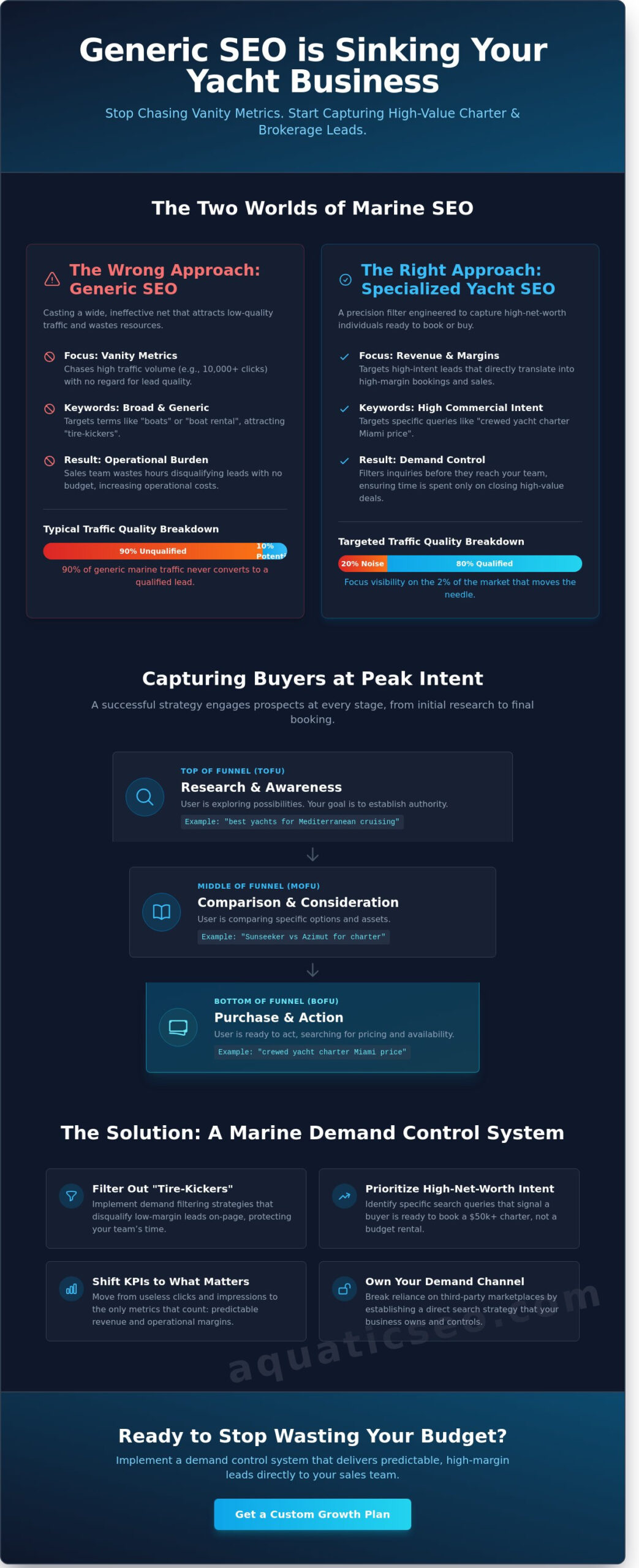
Traffic is the ultimate vanity metric in the marine world. If your website attracts 10,000 visitors but generates zero bookings, your marketing isn’t working; it’s just costing you hosting fees. Effective seo for yachts isn’t a broad net designed to catch everything in the water. It’s a precision filter engineered to capture high-net-worth individuals who are ready to sign a charter agreement or purchase a vessel.
Standard search engine optimization (SEO) focuses on volume, but volume is a liability for a yacht brokerage or charter firm. When you rank for “boat rental,” you invite thousands of people looking for a $400 afternoon on a pontoon. This creates a massive operational burden. Your sales team wastes hours disqualifying leads that never had the budget for a $150,000 weekly charter. You need a system that filters intent before the phone even rings.
Generalist agencies fail because they don’t understand the marine industry’s unique seasonality and terminology. They treat a service yard like a local mechanic and a private yacht charter like a hotel booking. They miss the nuance of the Mediterranean season versus the Caribbean winter circuit. They chase keywords that look good on a monthly report but do nothing for your bottom line. Using seo for yachts requires an operator’s mindset, not an agency’s guesswork.
The Cost of Ranking for the Wrong Keywords
Broad terms attract “lookie-loos” who treat your listings as digital window shopping. If a Florida charter firm ranks for the generic term “boats,” they’ll be flooded with inquiries about parts, licensing, or cheap rentals. This represents a significant hidden operational cost. Every minute your staff spends answering a “how much to rent a boat” email is a minute they aren’t closing a high-margin contract for crewed luxury charters. You don’t need more leads; you need the right leads that respect your margins.
The Marine Demand Control System vs. Traditional Marketing
We don’t just “get you found.” We ensure you get selected by the right client. Traditional marketing is about chasing demand wherever it exists, which leads to inconsistent revenue and schedule instability. Our Marine Demand Control System shifts the focus to controlling that demand. This system filters out low-intent noise and focuses your visibility on the 2% of the market that actually moves the needle for your business.
Aquatic SEO acts as a growth partner rather than a standard agency. We implement systems that enforce quality over quantity. This methodology ensures that your visibility is concentrated where the profit is highest. It’s the difference between being a visible option and being the only logical choice for a high-net-worth client.
The Anatomy of High-Intent Buyer Capture for Yachts
Most agencies talk about “visibility” as if it pays your crew. It doesn’t. If your seo for yachts strategy focuses on broad terms like “cool boats,” you are inviting dreamers to clog your inbox. High-intent buyer capture is about filtering for the individual ready to commit to a $50,000 charter or a multi-million dollar acquisition. This requires a shift from vanity metrics to commercial intent. You need to target queries that signal a specific operational need or a financial readiness to act.
Technical site health is your baseline, not your strategy. Having a fast, mobile-responsive site is the equivalent of having a clean hull; it’s expected. It doesn’t win the race. To dominate, you must align your content with the specific vocabulary of the high-net-worth individual. Understanding the nuances of digital marketing for luxury brands is what separates a generic agency from a growth partner that understands the high-net-worth mindset. We focus on the “Marine Demand Control System” to ensure every click has a clear path to a signed contract.
Mapping the Yacht Buyer Journey
The buyer journey for a yacht is rarely linear. It starts at the Top of Funnel (TOFU) with research based queries like “best yachts for Mediterranean cruising.” At this stage, you are establishing authority. As they move to the Middle of Funnel (MOFU), they compare specific assets, searching for “Sunseeker vs Azimut for charter.” By the time they reach the Bottom of Funnel (BOFU), they use high-intent phrases like “crewed yacht charter Miami price.” Our seo for yachts framework ensures you capture them at the moment of peak intent, not just when they are browsing galleries.
Local SEO for Yacht Hubs and Marinas
In the marine world, geography is everything. If your brokerage or service yard isn’t dominating local search in hubs like Fort Lauderdale, Miami, or Palma, you are invisible to the buyers physically standing on the docks. Local SEO isn’t just about “near me” searches; it’s about owning the digital real estate around specific marinas and refit yards.
- Google Business Profiles: These must be optimized with high-resolution, professional imagery and accurate operational hours to capture walk-in and local search traffic.
- Local Citations: We build links from industry-specific directories and local marine associations that actually carry weight with search engines.
- Geographic Keywords: Targeting specific locations like “Port Hercules berth rental” or “Ryovich Nelson service yard” positions you exactly where the demand is highest.
If your current marketing feels like a series of “dead weeks” followed by “busy weeks,” you lack a predictable system. You can stabilize your inquiries by implementing a strategy that prioritizes qualified lead volume over raw traffic counts. We don’t guess what works; we use a methodical approach to ensure your margins stay protected while your schedule stays full.
Demand Filtering: Turning Searchers into Qualified Inquiries
Traffic is a liability if your sales team spends 40 hours a week explaining to “tire kickers” why a 100-foot motor yacht costs more than a center console. Most seo for yachts strategies fail because they prioritize volume over intent. We don’t want the tourist looking for desktop wallpapers. We want the owner looking for a specific LOA or a captain researching stabilizers at anchor. Our approach uses on-page content to disqualify low-budget leads before they ever pick up the phone.
Content that Filters: Speak to the Owner, Not the Tourist
Your website content acts as your first line of defense. If you write for beginners, you’ll attract beginners. We replace generic “Top 10 Yacht Destinations” posts with technical High-Value Content Assets (HVCAs). These assets focus on precise metrics like Gross Tonnage, fuel burn at cruise speeds, and specific maintenance schedules for Tier III engines. According to this Yacht Industry Analysis, high-net-worth individuals and their representatives prioritize technical data over lifestyle imagery when making acquisition decisions. Speaking the language of an operator proves you’ve been in the trenches. It signals to the high-value lead that you’re a peer. We ignore “beginner” keywords because they waste your digital real estate and drain your operational capacity. You don’t need more clicks; you need better clients.
Systematizing Lead Quality
The Marine Demand Control System enforces strict standards before a user can even submit a form. We integrate filtering questions into your lead capture that require specific industry knowledge. This might include asking for a vessel’s current port or its specific classification society. This isn’t about making it easy to contact you. It’s about making it worth your time to respond. A lead count is a vanity metric that often hides operational rot. A qualified inquiry is a business asset that moves the needle on your bottom line. We track the delta between raw seo for yachts traffic and actual closed revenue to ensure your margins stay healthy. This system identifies which search terms result in signed service contracts and which ones only produce noise. You gain total control over your schedule, ending the cycle of “busy work” that never results in a deposit.
5 Common Mistakes Costing Yacht Brokers Their Margins
Most yacht brokers operate on a treadmill of high-volume, low-margin inquiries. They chase every lead while their profit margins get squeezed by third-party platforms. If you aren’t controlling your own demand, you’re just a tenant on someone else’s website. Investing in seo for yachts ensures your brokerage is the primary destination, not an afterthought on a crowded marketplace.
The Marketplace Trap: Why You Need Your Own Platform
Relying on YachtWorld or BoatTrader is a dangerous strategy. These platforms own the data and the relationship with the buyer. When you pay for a listing, you’re competing against 50 other similar vessels on the same page. Effective seo for yachts allows you to capture buyers before they enter the marketplace ecosystem. This direct path removes middleman fees and keeps your margins intact. For those managing fleet maintenance alongside sales, see our guide on Digital Marketing for Marine Contractors to learn how to capture high-intent service leads directly.
Technical Errors That Kill Yacht Conversions
Your website must work where your clients are: on the docks. High-net-worth buyers often browse while on their current vessel using satellite or marina Wi-Fi. If your listing takes more than three seconds to load, they’re gone. We consistently see brokers lose 20% of their mobile traffic because of heavy, unoptimized scripts that don’t play well with slow marina connections.
- Slow Page Speeds: Heavy, unoptimized images stall on 4G or satellite connections.
- Broken Forms: 15% of mobile inquiries fail because of poorly coded “Contact Broker” buttons or unmonitored chat bots that don’t alert the team.
- Missing Schema: Without vessel-specific Schema markup, Google cannot display your boat’s price, length, or year directly in search results.
Another massive failure is using stock photography. A 2023 industry study found that listings with authentic vessel imagery, including the engine room and bilge areas, see a 40% higher inquiry rate than those using manufacturer stock photos. Buyers want to see the actual condition of the teak and the electronics suite, not a sanitized version from a brochure.
Finally, many brokers ignore their service department’s “Demand Visibility.” A service yard is often the first point of contact for a seller looking to refit before a sale. If your SEO doesn’t capture these “refit and sell” inquiries, you’re losing the listing before it even hits the market. This is the essence of Demand Compounding; your search presence should grow more valuable every month, rather than resetting with every new listing you post.
Implementation: Scaling with Predictable Demand
Stop chasing volume. Most boat dealers and yacht charter operators leak 35% of their potential lead value through generic search terms that never convert. If your analytics show 5,000 monthly visitors but your sales team is wading through “tyre kickers,” your strategy is broken. A professional audit identifies these leaks by mapping search intent to actual revenue. We look for the exact point where high-intent traffic is diverted to your competitors because your site lacks the specific authority they require.
We measure success by revenue and margin, not vanity metrics like clicks or impressions. A 15% increase in qualified inquiries for a $20,000-per-week charter is a business victory. Gaining 2,000 new impressions for “cool boat photos” is a waste of your hosting space. Your bank does not accept clicks. Our Marine Demand Control System focuses on the 4% of searchers ready to book a service yard slot or purchase a vessel right now.
The 90-Day Demand Control Roadmap
Month 1: Technical Audit and Intent-Mapping. We strip away the fluff. We identify the technical bottlenecks slowing your site and map out the specific keywords that signal buyer intent. We find the “leaks” where your current traffic fails to reach your contact forms.
Month 2: High-Intent Content and Filtering. We deploy content designed to attract and filter. This isn’t generic blogging. We build pages that answer the hard questions serious yacht owners ask. If a prospect can’t afford your docking fees or charter rates, our content ensures they don’t waste your time. This is how seo for yachts becomes an operational filter.
Month 3: Authority and Lead Quality. We cement your position as the dominant local authority. By building high-quality links from marine-specific sources, we ensure your business is the only logical choice in your specific marina or service area. We optimize the lead flow to ensure your sales team only speaks with qualified prospects.
Expected Results: Stability and Growth
True success is “Demand Visibility.” This is the ability to see your schedule fill up 90 days in advance. When your lead flow is stabilized, you gain the power to increase prices and protect your margins. You no longer have to discount your fleet during the shoulder season because you have a system that generates consistent inquiries regardless of the month.
Specialized seo for yachts is not an optional marketing expense; it’s a core operational requirement for serious marine businesses. It’s the difference between a seasonal struggle and a scalable, predictable operation. You have a choice. You can continue paying for vanity traffic, or you can implement a system that captures, filters, and converts the highest-value clients in the industry. It’s time to take control of your demand.
Take Command of Your Brokerage’s Pipeline
Generic marketing agencies want you to celebrate traffic spikes. We know better. For a marine business in the $300k to $5M revenue range, a thousand irrelevant clicks are just a drain on your focus. Effective seo for yachts must function as a filter, not just a magnet. It’s the difference between a busy week spent answering dead-end emails and a profitable month closing high-intent inquiries.
Our Proprietary Marine Demand Control System replaces vague promises with operational stability. We’ve moved past the fluff to focus on buyer capture and margin protection. You don’t need more noise; you need a system that enforces quality and delivers predictable growth for your service yard or brokerage. We focus on what works for businesses that operate on the water, period.
Request a No-BS Marine Marketing Analysis
It’s time to stop hoping for leads and start controlling your demand. We’re ready to help you build the stable, high-margin business you’ve worked for.
Frequently Asked Questions About SEO for Yachts
How long does it take to see results from SEO for yachts?
You’ll typically see measurable movement in 4 to 9 months. While technical fixes show impact in 30 days, building the authority required for seo for yachts takes consistent effort. Most marine businesses see a 40% increase in qualified inquiries by the six month mark if they follow a structured system. This timeline accounts for the long sales cycles inherent in the 80 foot plus vessel market.
Can I rank for yacht charter keywords if I’m in a competitive market like Miami?
You can dominate Miami by ignoring broad terms and targeting high-intent long-tail keywords. Don’t chase “Miami yacht charter” because you’ll fight every generic travel site. Focus on “term charter Miami to Exumas” or specific vessel classes like “80ft Azimut charter Miami.” This strategy captures principals who know what they want, rather than tourists looking for a 20 foot bowrider.
What is the difference between SEO for a boat dealer and a yacht broker?
Dealers need local visibility for specific brands while brokers need global authority for individual listings. A dealer’s site must rank for terms like “service yard” in their specific zip code to drive maintenance revenue. A broker needs a system that ranks a specific 112 foot Westport across multiple continents to find the one right buyer. The dealer sells a recurring service; the broker sells a unique asset.
Why is my website getting traffic but no high-value charter inquiries?
Your content is likely optimized for vanity traffic instead of qualified demand. If your site uses terms like “boat rental” or “cheap trips,” you’ll attract low-budget leads that waste your team’s time. We use our Marine Demand Control System to filter out the noise and focus exclusively on high-net-worth individuals who understand the costs of a full crewed charter. High traffic numbers mean nothing if your margins are shrinking.
Is it better to use Google Ads or SEO for a yacht business?
Use Google Ads for immediate seasonal spikes and SEO for long term stability. Ads are a faucet you can turn on when the charter calendar is empty in July. SEO is the foundation that ensures you aren’t paying $15 per click forever. A balanced approach protects your margins and prevents dead weeks during the off-season. Most successful operators use a 70/30 split between organic and paid traffic.
How do I filter out low-budget leads through my website content?
Enforce Demand Filtering by using industry-standard pricing transparency and technical language. Mentioning the APA (Advance Provisioning Allowance) or specific crew requirements immediately signals that your service is premium. If a lead doesn’t know what a base rate is, they aren’t your client. This saves your sales team 10 hours of wasted calls every week. It forces the wrong people to click away before they contact you.
Does social media impact my yachting SEO rankings?
Social media doesn’t directly boost your rank, but it reinforces your brand’s authority. Google looks at brand signals, such as people searching for your brokerage by name after seeing a Reel of your latest 150 foot listing. High engagement on Instagram can lead to more direct searches, which tells Google your business is a trusted leader in the yachting space. It’s about building a footprint that search engines cannot ignore.
What are the most important technical SEO factors for a marine website?
Site speed and structured data for vessel listings are the most critical factors. A yachting site that takes more than 3 seconds to load will lose 40% of its mobile users. You must also use specific Schema markup so search engines can read your vessel’s length, manufacturer, and year. This technical precision is a core part of effective seo for yachts. Without it, Google won’t know how to categorize your inventory correctly.