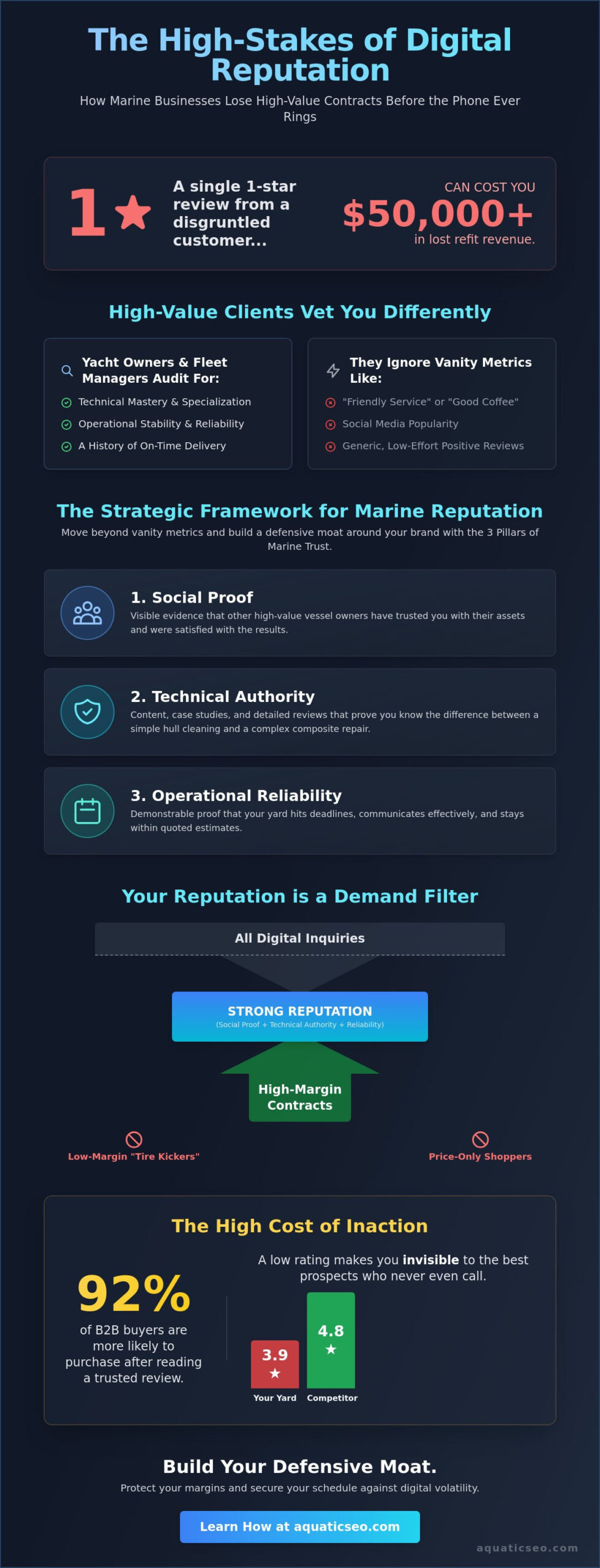
One single 1-star review from a disgruntled customer can cost a service yard $50,000 in refit revenue before the owner even picks up the phone. It’s not just about a rating on a map; it’s about the invisible wall between your business and high-margin contracts. Most owners watch their digital presence like a slow-motion collision. They know one bad actor can poison the well for years, yet they rely on generic agencies that focus on vanity stars instead of protecting their bottom line. Effective reputation management for marine companies isn’t about collecting more reviews for the sake of it. It’s about building a defensive perimeter around your brand that filters out noise and enforces your authority.
When a genuine service failure occurs, use the response to demonstrate operational stability. Acknowledge the specific technical issue and explain how your internal systems have been adjusted to prevent a recurrence. This turns a liability into a proof point for your quality control. For malicious reviews from competitors or disgruntled ex-employees, stick to the facts. Report the violation to the platform immediately, but post a brief, professional rebuttal that highlights your verified project history. In situations where reputation damage involves legal complexities or defamation, seeking advice from specialists like Aquarius Lawyers can help safeguard your commercial interests. Silence is often interpreted as an admission of guilt; a factual, cold response is an assertion of authority.
You already know that your reputation is your most valuable asset in the boatyard or the charter office; a single whisper of incompetence can sink a deal. As your growth partner, I’m going to show you how to build a defensive system that protects your margins and secures your schedule against digital volatility. We’ll examine the specific mechanics of turning your digital presence into a tool for capturing qualified inquiries and high-value contracts while neutralizing the impact of unfair feedback.
Key Takeaways
- Stop letting a single outlier review derail a $100k refit contract by understanding how high-value yacht owners vet your boatyard differently than retail consumers.
- Identify the specific “margin killers” in your digital footprint that drive away qualified inquiries and create instability in your production schedule.
- Deploy a strategic framework for reputation management for marine companies that prioritizes job flow control over vanity metrics or social media popularity.
- Master a “No-BS” response protocol to neutralize negative feedback without wasting time or authority on public arguments with tire kickers.
- Build a defensive moat around your business by integrating case studies into your demand filtering system to prove your results and secure high-margin contracts.
Why Your Digital Presence Dictates Your Boatyard’s Schedule
A single 1-star review from 2021 can kill a $125,000 refit contract before you even know the prospect exists. High-net-worth yacht owners and commercial fleet managers don’t shop like retail boaters buying a life vest; they audit your operational stability. If your digital profile suggests technical friction or missed deadlines, they’ll quietly move their vessel to a competitor’s slip. This invisible attrition is the primary reason reputation management for marine companies has shifted from a marketing luxury to a core operational requirement for any yard looking to protect its margins.
Luxury yacht owners and commercial operators research your business with a specific set of criteria that differs from the average weekend boater. They aren’t looking for “friendly service” or “good coffee” in your lounge. They are looking for proof of technical mastery, specialized equipment, and a history of on-time delivery. When these high-value prospects see a neglected Google profile or unresolved complaints about project timelines, they view it as a systemic risk. They won’t call to ask for your side of the story. They simply remove you from their shortlist.
Weak digital trust forces your business into a “busy fool” cycle. Without a strong reputation to filter for quality, you’re left competing solely on price against every mobile mechanic with a toolbox. This attracts low-margin clients who demand the most time and provide the least profit. Effective Reputation Management allows you to maintain high margins by proving your value before the first phone call. It ensures your schedule is filled with complex, high-ticket projects rather than a series of small, unprofitable distractions.
Distinguishing Your Reputation: Service Yards vs. Marinas
A Service Yard or Boatyard requires a fundamentally different narrative than a transient marina. While a marina sells convenience and amenities, your yard sells technical results and engineering precision. For marine mechanics, your review profile must reflect expertise in specific systems like Garmin electronics or Volvo Penta repowers. A “Qualified Inquiry” threshold is met when your online reputation proves you can handle $50,000 engine overhauls with the same reliability you bring to routine bottom paint.
The Cost of Inaction in the Marine Sector
Inaction costs you the “invisible” prospects who see a 3.9-star rating and choose the yard with a 4.8-star profile instead. Industry data indicates that 92% of B2B buyers are more likely to purchase after reading a trusted review. If you experience “busy weeks followed by dead weeks,” it’s often a symptom of a reputation that fails to capture steady demand. For marine contractors, a digital reputation is a verifiable operational asset that enforces pricing power and filters out low-margin distractions.
The Strategic Framework for Reputation Management for Marine Companies
Reputation management for marine companies isn’t about collecting gold stars or feeling liked. It is a core pillar of the Marine Demand Control System designed to protect your job flow. Most agencies treat reviews as a vanity metric. We treat them as a conversion tool. If your rankings bring 1,500 visitors but zero service yard contracts, your SEO is failing you. Effective reputation management for marine companies ensures that high-intent traffic converts into bankable revenue by removing the friction of doubt.
We break marine trust down into three distinct layers that every operator must master:
- Social Proof: Visible evidence that other vessel owners have trusted you with their assets and walked away satisfied.
- Technical Authority: Content and feedback that proves you know the difference between a simple hull cleaning and a complex composite repair.
- Operational Reliability: Proof that your yard or dealership hits deadlines and stays within 10% of quoted estimates.
Reputation as a Demand Filter
Your review profile should act as a gatekeeper. It should actively discourage low-margin “tire kickers” who only shop on price. When you showcase specific, high-stakes projects, you attract Marine Construction Operators and commercial clients who value precision over the lowest bid. A 4.8-star rating backed by 50 detailed accounts of complex engine overhauls captures high-value demand. A 5.0-star rating with two-word “great job” reviews is a liability that invites price-sensitive shoppers to waste your time. You can see how we structure these filters in our specialized marine services.
Local SEO and the Reputation Loop
Google prioritizes businesses with consistent, industry-specific feedback. The algorithm looks for “Marine-Native” keywords tucked inside your customer reviews. When a client mentions your “Palma-based yacht refit” or “Fort Lauderdale outboard repower,” it signals to search engines that you are the dominant authority in that hub. This creates a loop; better reviews lead to better visibility, which leads to more qualified inquiries.
You must maintain this loop with clinical precision. Authenticity is non-negotiable, as 93% of high-net-worth clients now research service history before committing to projects exceeding $25,000. Following FTC guidance on online reviews helps you maintain a profile that stands up to scrutiny and protects your local dominance. Don’t leave your reputation to chance; enforce it through a system that rewards your best work with your best clients.
The 4-Step Marine Reputation Audit
Most marine business owners treat their online presence like a static billboard. That’s a mistake that costs you 20% or more in annual revenue. You need a systematic online reputation management framework to ensure your digital footprint attracts high-margin work instead of tire-kickers. Reputation management for marine companies isn’t about vanity; it’s about demand control.
- Step 1: Map your footprint. Check Google, YachtWorld, and Facebook. If your data is inconsistent across these three platforms, you’re confusing both Google’s search algorithm and your potential prospects.
- Step 2: Identify “Margin Killers.” Scour your reviews for recurring complaints about pricing or timelines. Even if you’re 90% on time, three reviews mentioning “delayed service” will scare off high-value clients who value their schedule over a low price. These specific negative data points act as friction in your sales funnel, forcing you to lower prices to win jobs.
- Step 3: Analyze “Qualified Inquiries.” Look at your last 50 leads. If 80% of your inquiries are looking for cheap boat rentals but you offer luxury charters, your reputation is misaligned with your operations. Effective reputation management for marine companies ensures your public profile filters out the waste before it hits your phone.
- Step 4: Benchmark. Audit the top three local competitors. If they have 50 more reviews than you or a higher average rating, they’re capturing the demand you’re losing.
Auditing Your Google Business Profile
Your categorization determines who finds you. A Boat Dealer is not a broker; if you’re listed incorrectly, you’ll get calls for inventory you don’t have. Ensure your service area reflects where your $10,000+ jobs actually originate, not just your physical shop’s zip code. Finally, hunt down ghost listings. These duplicate profiles dilute your authority and scatter your reviews, making your business look disorganized.
The Yacht Charter and Brokerage Audit
Reputation needs for Yacht Charters and Tour Operators differ from service yards. Prospects care about the crew’s hospitality and the “experience” more than the engine hardware. You must filter out “boat rental” seekers immediately. These low-budget prospects clutter your inbox and waste your sales team’s time. Use your reviews to highlight the luxury and exclusivity that justifies your higher margins and attracts the right clientele.
Responding to Noise: Handling Negative Feedback Without Killing Your Margins
Every minute you spend arguing with a “tire kicker” on Google is a minute you aren’t billing at your standard shop rate. Negative feedback isn’t just an ego hit; it’s a direct threat to your project flow and your bottom line. If a prospective client sees an unanswered complaint about a project delay, they don’t see a busy boatyard. They see a disorganized operation that can’t manage its schedule. Effective reputation management for marine companies requires a clinical, system-driven approach to noise. You must filter out the distractions to protect your high-margin inquiries and maintain schedule stability.
Generic marketing agencies tell you to “engage” with every commenter to build community. In the marine service sector, that is a recipe for wasted labor. Use a “No-BS” response framework instead: Acknowledge, Contextualize, and Move Offline. You don’t respond to win the argument with the disgruntled person. You respond to demonstrate your professional standards to the 500 qualified prospects who will read that review later. If a non-customer or a known “tire kicker” leaves a review, don’t engage in a back-and-forth. State clearly that you have no record of their project and move on. Arguing with someone who hasn’t spent a dollar with you only lowers your brand’s perceived status.
When a genuine service failure occurs, use the response to demonstrate operational stability. Acknowledge the specific technical issue and explain how your internal systems have been adjusted to prevent a recurrence. This turns a liability into a proof point for your quality control. For malicious reviews from competitors or disgruntled ex-employees, stick to the facts. Report the violation to the platform immediately, but post a brief, professional rebuttal that highlights your verified project history. Silence is often interpreted as an admission of guilt; a factual, cold response is an assertion of authority.
The Boatyard Response Template
If a client complains about a project delay, use this 3-sentence structure to protect your reputation. First, acknowledge the timeline: “We understand the frustration regarding the extended delivery date for your refit.” Second, mention your “Marine Demand Control System” indirectly by highlighting your standards: “Our shop maintains strict quality gates that prioritize structural integrity over speed to ensure every vessel meets our safety benchmarks.” Third, move it offline: “Our service manager will contact you at 0900 tomorrow to finalize the remaining punch-list items.” This signals to high-value clients that you don’t cut corners for the sake of a calendar.
The Power of Positive Proactivity
Don’t wait for feedback to happen to you. Systematize the request process by targeting the most influential voices in the harbor. Reach out to the Marine Surveyors who have recently inspected your work. Their professional validation carries more weight than ten anonymous comments. Time your “Qualified Inquiry” follow-up to hit 48 hours after a successful sea trial or project handover. This is when customer satisfaction peaks. Automation should handle the initial “ask” to ensure no one is missed, but the actual follow-up on a positive review should be a personal note from your leadership team. This reinforces the premium nature of your service.
Stop letting bad reviews dictate your schedule. Book a fit call to see how we filter your demand.
Beyond Reviews: Integrating Reputation into Your Marine Demand Control System
Reputation is not a passive score. In a high-stakes industry where a single service yard error can cost $50,000 in damages, your reputation acts as the enforcement layer of your demand filtering. It separates the price-shoppers from the high-margin clients who value reliability over the lowest bid. Effective reputation management for marine companies requires moving past defensive damage control and into aggressive demand compounding. You don’t just want to be seen; you want to be the only logical choice for a vessel owner with a $250,000 refit project.
Case Studies as Reputation Assets
A generic 5-star review says you showed up. A deep-dive project report proves you can handle the technical complexity of a 100-foot hull repair. When you structure a case study for Digital Marketing for Marine Contractors, you create a moat around your business. You must showcase specific project timelines and material margins to demonstrate operational stability. If a client sees you delivered a dredging project 15% ahead of schedule while maintaining strict environmental compliance, they stop questioning your price. They start asking for your availability.
The Role of Video Proof
Technical authority is non-negotiable for marine mechanics and electricians. Video proof provides the “how” behind the “what.” Seeing a technician correctly diagnose a complex NMEA 2000 network failure on camera carries more weight than 100 written testimonials. This content transforms your reputation from a static list of reviews into a dynamic engine for reputation management for marine companies. It forces competitors to compete on your terms of expertise, not on a race to the bottom in pricing. You aren’t just telling them you are an expert; you are showing them the proof in 4K resolution.
Next Steps for Demand Control
Stop being a victim of “Marketing Agency” fluff that focuses on vanity metrics like clicks or impressions. You need a Growth Partner who understands that reputation is a business asset to be managed, not just monitored. If your current strategy doesn’t result in more qualified inquiries and stable schedules, it’s failing. It’s time to stop guessing and start controlling your demand. You can Request a No-BS Marine Marketing Analysis to see exactly where your reputation is leaking revenue and how to plug those holes with a system that prioritizes margins over volume.
Synthesis Summary: Reputation is the final filter in your Marine Demand Control System. By weaponizing case studies and video proof, you move from defending your name to compounding your demand. This ensures that every inquiry hitting your desk is pre-qualified and ready to pay your premium. Don’t leave your job flow to chance; enforce your authority and dominate your local waters.
Take Control of Your Boatyard’s Digital Authority
Your digital reputation isn’t a vanity metric. It’s a functional component of your Marine Demand Control System. When a yacht owner sees a 3.2 star rating, they don’t call. They move to the next service yard on the list. By implementing a systematic approach to reputation management for marine companies, you stop the silent attrition of high-margin inquiries. You ensure your schedule stays filled with profitable refits rather than low-yield tire kickers.
We specialize in Marine Demand Control because we’ve been on the docks and in the construction bays. We aren’t a marketing agency; we are a growth partner that understands why a single negative review about a haul-out delay can cost you fifty thousand dollars in lost revenue. It’s time to stop leaving your schedule to chance. Our industry-native expertise from yachting to construction ensures your operations remain protected from digital noise.
Stop losing high-margin jobs—Book your Marine Demand Analysis here
Your expertise on the water is unmatched. Let’s make sure your online presence reflects that same level of professional command.
Frequently Asked Questions
Is reputation management for marine companies just about getting more Google reviews?
No, it is a systematic approach to controlling how your business is perceived across the entire digital landscape. While Google reviews are a critical component, reputation management for marine companies also involves monitoring maritime forums, managing business listings, and ensuring your brand appears as a dominant authority. You need a process that filters out noise and highlights the high-margin work your service yard or dealership actually performs.
Can I delete a fake or malicious review from a competitor?
You cannot personally delete reviews, but you can flag them for violating platform policies regarding “Conflict of Interest.” If a competitor or a non-customer leaves a 1-star rating, document the lack of service history and submit a formal removal request to Google or Yelp. When platforms refuse to remove the post, the most effective strategy is to dilute the malice by capturing positive feedback from 100% of your satisfied boatyard clients.
How much time should a boatyard owner spend on reputation management weekly?
Spend no more than 30 minutes per week if you have a functional system in place. Most of this time should focus on reviewing your inquiry flow and ensuring your team responds to new feedback within 24 hours. Efficient operators don’t micro-manage every comment; they use a demand control system to automate the collection process while they stay focused on high-margin repairs and operations.
What happens if I have a 4.0 rating but my competitors have a 4.8?
You lose approximately 15% of potential inquiries to the higher-rated competitor before they even visit your website. A 4.0 rating often signals operational inconsistency or a failure to ask for feedback, which creates a trust gap in the mind of a high-value prospect. To close this gap, you must implement a system that systematically prompts your best yacht charter or boat dealership clients for reviews at the moment of peak satisfaction.
Does reputation management affect my Google search ranking directly?
Yes, review signals account for roughly 17% of how Google ranks local search results according to 2024 industry data. High-velocity, positive feedback tells search engines that your marine business is a relevant and trusted authority in your specific region. Effective reputation management for marine companies increases your visibility in the Local Map Pack, which is where 42% of local search clicks currently occur.
Is there a difference between reputation management for yacht charters and boat dealers?
The focus shifts from the experience of the trip to the reliability of the asset and the sales process. For a yacht charter, reviews should emphasize the crew’s professionalism and the vessel’s condition. For a boat dealer, the feedback must highlight the transparency of the transaction and the quality of post-purchase support. Each segment requires a distinct filtering process to ensure the right message reaches your specific target audience.
Can I use automation for my marine reputation management without sounding like a bot?
You can use automation for the request phase, but your responses must remain human and specific. Use a system to trigger a text message or email two hours after a boat leaves your slip or a sale closes. When the review arrives, write a personalized response that mentions specific details of the service provided. This approach maintains your industry-native voice while removing the manual labor of chasing every client for a comment.
How do I handle a negative review that is technically accurate but unfair?
Address the facts directly without getting defensive or emotional in your public response. If a client complains about a three-week delay caused by a documented parts shortage, state that clearly and explain the steps you took to mitigate the wait. Prospective high-margin clients value honesty and operational transparency. A professional rebuttal often carries more weight than a generic apology because it demonstrates you’re a serious operator who stands by your work.