

Are you paying a monthly retainer for “traffic” that never actually converts into a high-margin service job or a yacht sale? If your agency can’t distinguish a service yard from a marina, they aren’t an asset; they’re an anchor dragging on your bottom line. Learning how to fire your marketing agency is an operational necessity when your partner prioritizes generic engagement metrics over the qualified inquiries required to sustain a marine business. You shouldn’t have to beg for transparency regarding your own ad accounts or website ownership.
You probably feel trapped by the complexity of your digital assets and the fear of losing your hard-earned Google rankings. It’s frustrating to watch your budget disappear into a black box while your competitors capture the high-intent buyers you need. You deserve a partner that understands the specific nuances of the boat dealer and yacht charter markets.
This guide provides a no-nonsense framework to audit your assets, execute a clean break, and regain full control without sinking your lead flow. We’ll detail exactly how to transition to a system that filters for qualified inquiries and protects your business’s digital health.
Key Takeaways
- Recognize the signs of an underperforming partner by auditing whether your current traffic actually converts into high-margin service jobs or boat sales.
- Secure your digital assets, including domain registration and hosting credentials, to ensure you maintain full ownership before sending a termination notice.
- Follow a professional four-step transition plan to learn how to fire your marketing agency while protecting your hard-earned search rankings.
- Stop paying the industry-ignorance tax to generalist firms that cannot distinguish a crewed yacht charter from a boat rental.
- Replace generic marketing tactics with a Marine Demand Control System that filters for high-intent buyers and qualified inquiries.
Signs Your Current Agency Is Treading Water (Not Driving Qualified Inquiries)
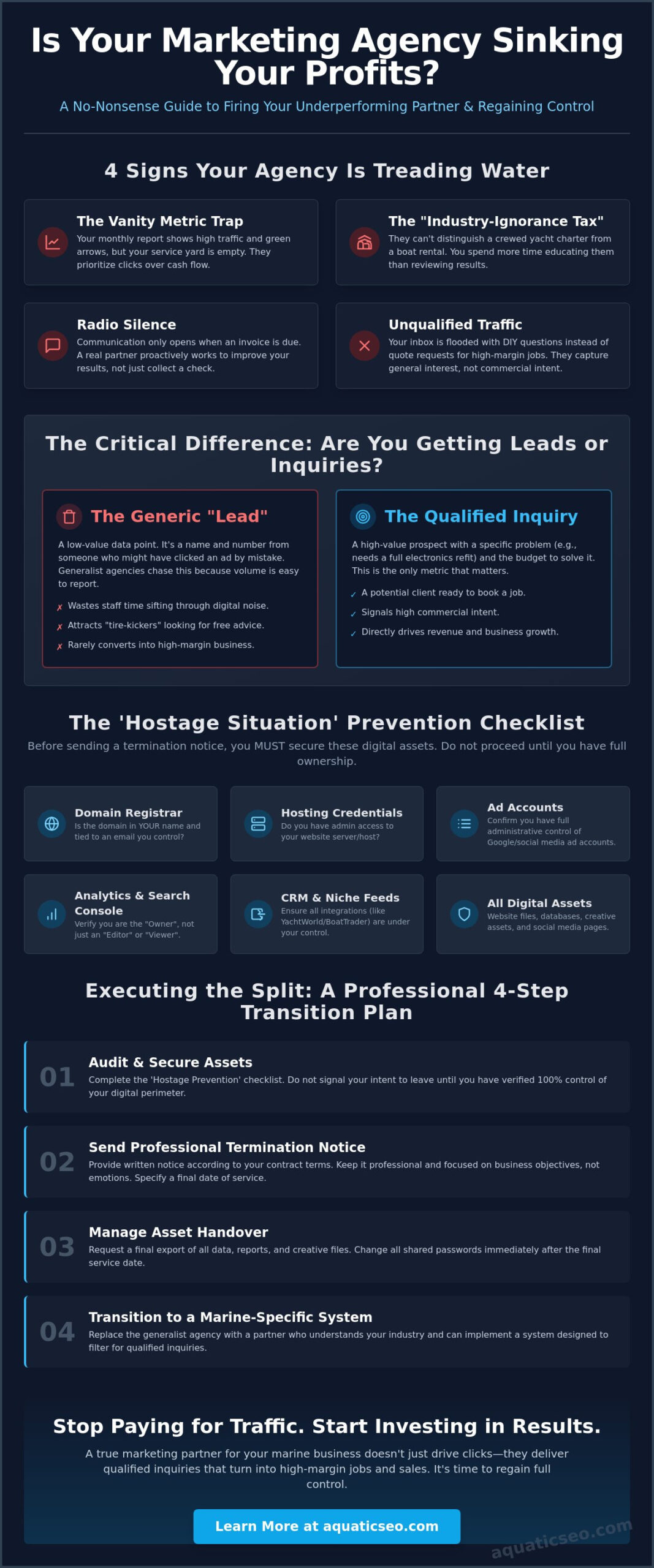
Your agency sends a monthly report full of green arrows and high traffic counts. Yet, your service yard is empty and your sales team is idle. This is the “Vanity Metric” trap. If you are spending more time explaining your business model than reviewing actual revenue results, it’s time to learn how to fire your marketing agency. A partner that prioritizes clicks over cash flow is an expense, not an investment.
A generalist firm doesn’t know why a marine surveyor needs different leads than a boatyard. They charge you an “Industry-Ignorance Tax” every time you have to correct their terminology or explain basic maritime logistics. Under the Law of Agency, your marketing partner has a duty to act in your best interest. If they don’t understand your market, they can’t fulfill that duty. Executing a clean break starts with recognizing that your current partner is simply treading water.
Communication shouldn’t be a one-way street that only opens when an invoice is due. If your agency disappears for twenty-nine days a month, they aren’t managing your growth; they’re just collecting a check. A partner focused on results will proactively discuss how to filter out “tire kickers” and focus on high-margin jobs. If your inbox is flooded with people asking how to DIY a fiberglass repair instead of booking a hull job, your agency is failing. They are capturing general interest rather than commercial intent. This lack of demand filtering wastes your staff’s time and creates digital noise.
The Difference Between a Lead and a Qualified Inquiry
A lead is just a data point. It’s a name and a phone number from someone who might have clicked an ad by mistake. A Qualified Inquiry is a prospect with a specific problem and the budget to solve it. This might be a boat owner looking for a full electronics refit or a group ready to book a crewed yacht charter. Generic agencies struggle here because they don’t know which keywords signal high intent in the marine sector. They chase volume because it’s easier to report, even if it never turns into a contract.
When “More Traffic” Is Actually the Problem
Attracting 10,000 visitors to your site sounds impressive in a report. However, if those visitors are looking for “free boat ramps” while you are trying to sell $200k center consoles, that traffic is a liability. It creates operational strain for boat dealers who have to sift through digital noise to find one buyer. You need a strategy built on digital marketing for marine contractors that prioritizes the quality of the visitor over the quantity of the clicks. Understanding how to fire your marketing agency allows you to stop the bleed of unqualified traffic and focus on high-intent buyers.
The Pre-Termination Audit: Securing Your Digital Assets
Before you send a termination notice, you must secure your perimeter. Many agencies build walled gardens where they own the keys to your website, your domain, and your data. If you don’t own these assets, you aren’t a partner; you’re a tenant. Understanding how to fire your marketing agency requires a tactical approach to asset sovereignty. You need to verify that your domain registrar account is in your name and tied to an email you control. If the agency registered your domain under their own account, move it immediately.
Hosting access is equally critical. You must have the logins for your server or hosting provider to ensure you can secure your website files and database. For boat and yacht dealers, this includes verifying access to niche feeds like YachtWorld or BoatTrader. If your agency manages these API connections through their own accounts, your inventory could disappear from the web the moment you part ways. This quiet audit is a mandatory step in How To Fire An Agency without losing your digital footprint.
The ‘Hostage Situation’ Prevention Checklist
Verify your administrative roles across every platform before giving notice. You need Owner status on Google Search Console and Google Analytics, not just Editor or Viewer permissions. Check your CRM integrations and ensure all lead data is exportable. If your website is built on a proprietary CMS that the agency owns, you may need to plan a full site migration before you can fully exit. Don’t leave your data behind in a system you can’t control.
Google Ads and the Data Ownership Trap
Your ad data is your property. Some agencies create ad accounts under their own Master account and refuse to hand over the access. This hides their actual performance and prevents you from seeing which keywords drive a high-intent Qualified Inquiry. Never let an agency pay your ad spend directly to Google. You should pay Google directly with your own credit card so the account, the data, and the conversion history remain yours. If you’re unsure about your current setup, you can book a call to review your asset security.
Why Generic Marketing Agencies Fail Marine Contractors and Yacht Dealers
A firm that markets for local dentists or residential plumbers cannot effectively market for boat dealers. Their strategies are built on high-volume, low-intent lead generation that doesn’t translate to the complex sales cycle of a yacht. When your agency treats a $500,000 vessel like a $50 tooth cleaning, your brand’s credibility suffers. This fundamental misalignment is a primary reason why you need to understand how to fire your marketing agency before your reputation in the marina takes a hit.
Terminology errors are catastrophic in this sector. Confusing a “Yacht Charter” with a “boat rental” tells every seasoned boater that you don’t know your own industry. Most generalist agencies also suffer from “Seasonal Blindness.” They don’t understand that a service yard needs a different strategy during winterization than it does during the spring commissioning rush. They run the same generic campaigns year-round, wasting your budget on services your customers aren’t looking for in the off-season.
Generic SEO is another budget sink. An agency focused on volume will brag about ranking for “how to fix a boat engine.” While this brings traffic, it attracts DIYers who will never spend a dime at your boatyard. You need to rank for “marine mechanic near me” or “outboard repower services.” These are the searches that lead to a Qualified Inquiry. If your agency can’t see the difference, they are simply burning your cash.
The High Cost of Industry Ignorance
Seasoned boaters can spot an outsider from a nautical mile away. When your website copy refers to a “boat garage” instead of a service yard, your professional authority evaporates instantly. You shouldn’t have to spend your monthly strategy calls teaching your account manager the difference between a marina and a boatyard. Industry-native marketing is a requirement for survival. If your agency doesn’t understand your technical specifications, they cannot filter your demand effectively.
The Vanity Metric vs. Real Revenue Debate
Generic agencies love reporting on “impressions” and “clicks” because these numbers are easy to inflate. However, you cannot pay your dockage fees or your technicians’ salaries with impressions. High-intent business outcomes require a focus on auditable tracking and financial health. Transitioning away from an underperforming partner allows you to stop chasing meaningless digital noise. You need a system that prioritizes actual revenue over superficial engagement counts. Learning how to fire your marketing agency is the first step toward stabilizing your inconsistent revenue patterns.
Executing the Split: A Professional 4-Step Transition Plan
Transitioning away from an underperforming partner is a logistics operation, not an emotional breakup. You need a methodical approach to ensure your lead flow doesn’t stall while you change the guard. Learning how to fire your marketing agency requires discipline and a refusal to be swayed by last-minute promises. Follow this four-step framework to stabilize your business during the handoff.
- Step 1: Review your contract. Locate the specific notice period required, which is typically 30 days. Identify any exit fees or “tail” clauses that might impact your final billing cycle.
- Step 2: Secure your replacement first. Never leave a vacuum in your marketing oversight. Line up your next partner and have them ready to catch the ball before the current one knows you are leaving.
- Step 3: Lock down your assets. As established in your pre-termination audit, ensure every administrative login is under your control. Export your CRM data and customer lists to prevent any “accidental” data loss during the notice period.
- Step 4: Send the notice. Deliver a professional, written termination email. You don’t need to apologize or provide a lengthy justification; the lack of results is the justification.
The Termination Email: Direct and Final
Your termination notice should be a short, declarative statement of fact. Avoid the “exit interview” trap where agencies attempt to sell you on a “recovery plan” they should have implemented months ago. State the final date of service and provide a specific list of deliverables required before the final invoice is paid. This includes a final performance report and the removal of their access from all your accounts. If you want to ensure your transition is handled with precision, you can schedule a fit call to review your exit strategy.
Managing the Overlap Period
The 30-day notice period is the most vulnerable time for your digital presence. It is often beneficial to pay your new partner and the outgoing agency simultaneously for at least two weeks. This overlap allows your new team to audit the existing setups while the old agency is still contractually obligated to answer questions. This is particularly vital for maintaining SEO for the marine industry without a dip in rankings. A clean handoff ensures that your visibility for high-intent searches remains stable while you transition to a system that prioritizes a Qualified Inquiry over generic traffic.
Beyond the Exit: Moving to a Marine Demand Control System
Once you’ve executed the split, you must address the strategic vacuum left behind. Most owners focus on replacing “traffic,” but traffic is a commodity that generalists use to hide poor results. You need to move toward a Marine Demand Control System. This framework stops the cycle of chasing volume and starts the process of controlling your pipeline through precision. Learning how to fire your marketing agency is only profitable if you replace their generic tactics with a system built for the maritime sector.
A core pillar of this approach is Demand Filtering. You shouldn’t waste your service manager’s time answering “how-to” questions from DIYers. The system uses specific industry qualifiers to ensure your staff only speaks to people ready for a repower or a hull job. By filtering out the digital noise, you reclaim your operational efficiency and focus on high-margin work. This allows your team to prioritize actual revenue over administrative tasks.
Visibility must be calibrated for high-intent buyers. This means appearing when a captain is searching for an emergency mechanic or when a buyer is looking for a specific class of vessel. A Marine Demand Control System prioritizes these commercial triggers over general engagement. You stop hoping for leads and start capturing active demand from people ready to sign a contract.
The Specialist Advantage
Specialized partners like Aquatic SEO don’t look at clicks; they look at business outcomes. We understand that stabilizing inconsistent revenue patterns requires a methodical approach to how to fire your marketing agency and transition to auditable tracking. By focusing on a Qualified Inquiry rather than a generic lead, you stop paying the industry-ignorance tax. You reclaim your time by only speaking to prospects who have been filtered for intent and budget.
Your Next Steps to Market Effectiveness
Evaluate your next partner based on their “in the trenches” experience. Ask for proof of how they distinguish between a yacht charter and a boat rental in their copy. Insist on performance-based assurances and full transparency of your digital assets. Your marketing should be a predictable system, not a source of frustration.
Synthesis Summary: Firing an underperforming agency isn’t just about cutting a cost. It’s about reclaiming your business growth from partners who don’t understand your unique operational challenges. Moving to a specialist system ensures that every dollar spent is an investment in capturing and filtering the demand your marine business requires to scale. This transition marks the end of vanity metrics and the beginning of results-driven stability.
Reclaim Your Market Authority
Securing your digital assets and administrative sovereignty is the first step toward long-term business stability. You now understand why generalist agencies fail to deliver the high-intent buyers your service yard or boat dealership requires to scale. Learning how to fire your marketing agency is a critical operational necessity that stops you from being held hostage by vanity metrics and industry ignorance.
Transitioning to a Marine Demand Control System ensures that your pipeline is filled with a Qualified Inquiry rather than a flood of tire kickers. It’s time to stop chasing generic traffic and start capturing actual demand through a methodical, specialist approach. You deserve a partner who understands the difference between a yacht charter and a boat rental without needing a monthly explanation.
Take the lead in stabilizing your revenue and eliminating digital waste. Request a No-BS Marine Marketing Analysis today to audit your current performance. You can move forward with confidence and precision.
Frequently Asked Questions
How much notice do I typically need to give my marketing agency?
Most contracts require a 30-day written notice period to terminate services. While some agreements may specify 60 or 90 days; the 30-day window is the industry standard for ongoing marketing retainers. You must review your specific contract for “evergreen” clauses that might auto-renew your commitment if you don’t act before a certain date.
What happens to my website if I fire the agency that built it?
Your website remains functional if you own the domain registration and the hosting account. If the agency built your site on a proprietary platform they own; you may be forced to rebuild from scratch upon termination. This is why you must verify administrative access to your server and database before you learn how to fire your marketing agency.
Can an agency keep my Google Ads data after we stop working together?
An agency can technically withhold your data if they created the ad account under their own manager profile instead of yours. You lose your entire conversion history and keyword performance data if you don’t maintain administrative ownership. Always ensure you pay Google directly with your own credit card to keep your data sovereign.
Is it possible to switch agencies without my Google rankings dropping?
You can switch partners without losing visibility if your new partner executes a technical audit during the overlap period. Rankings typically drop when tracking codes are broken or when the outgoing agency removes optimized content. A specialist transition ensures your site maintains its authority for high-intent marine searches while you move to a new system.
Should I tell my agency I am looking for a replacement before I fire them?
Do not inform your current agency of your intent until you have secured all digital logins and signed a contract with a replacement. Early notification often leads to “quiet quitting” where the agency stops monitoring your accounts or optimizing your campaigns. Maintain the status quo until your assets are secure and your new partner is ready to catch the ball.
What are the most common traps in marketing agency contracts?
The most common traps are auto-renewal clauses and high early termination fees. Some agencies also include “tail clauses” that claim a commission on a Qualified Inquiry that closes months after the contract ends. Review your agreement for any language that restricts your ability to move your website files or data to a different provider.
How do I know if my new agency actually understands the marine industry?
Verify their knowledge by asking them to define the logistical difference between a yacht charter and a boat rental. If they don’t understand the seasonal cycles of a service yard or the specific technical needs of a boat dealer; they are generalists. A true specialist will focus on business outcomes rather than generic traffic counts.
What is the first thing I should change after firing an underperforming agency?
The first priority is implementing a demand filtering system to stop unqualified digital noise from wasting your time. You must stop paying for generic impressions and focus on capturing buyers ready to sign a contract. This shift immediately reclaims your team’s efficiency, a process that שי דוד משרד פרסום suggests can be further enhanced through strategic automation, ensuring your marketing budget targets high-intent prospects instead of tire kickers.