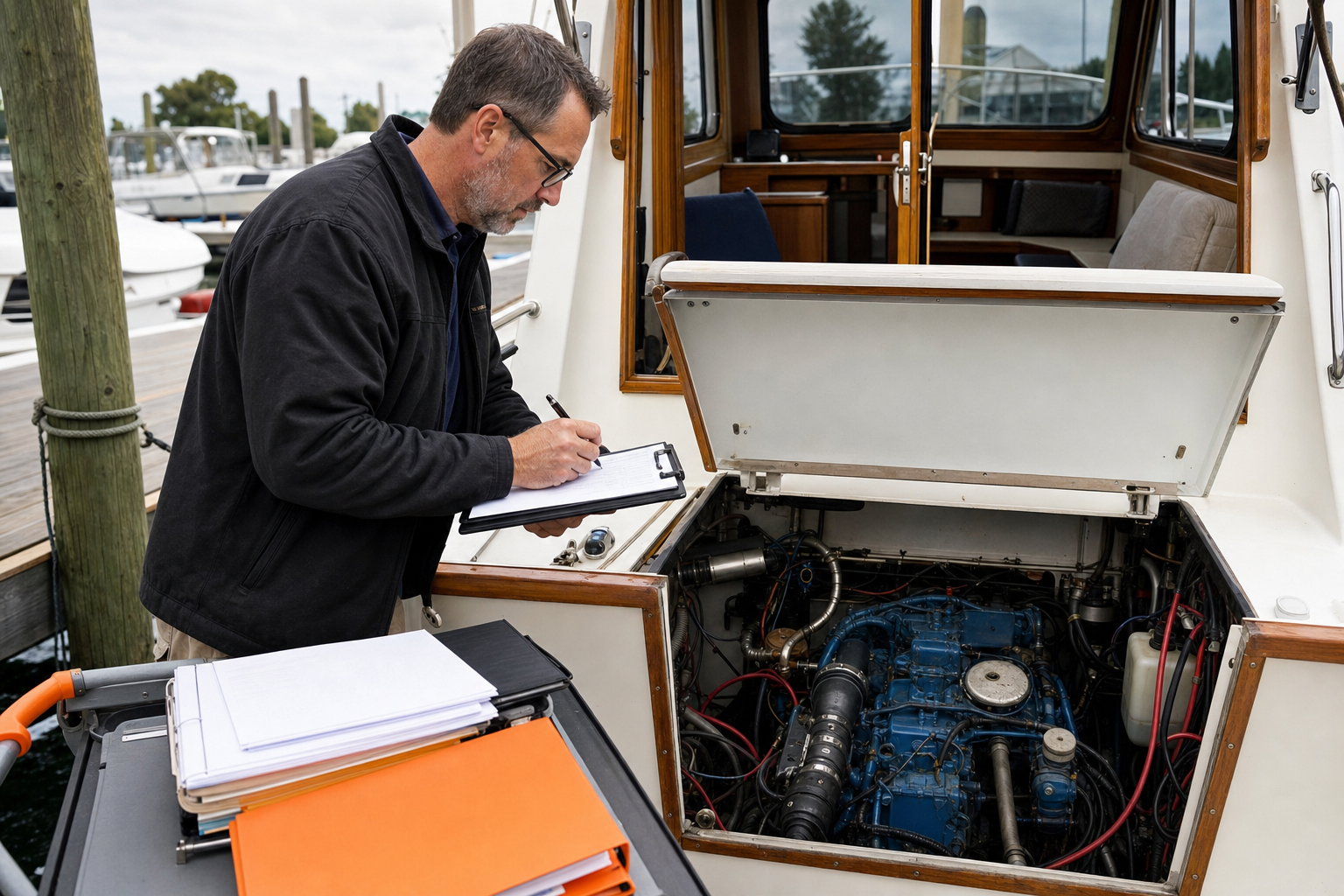
Why does your revenue dry up the moment you actually start doing the work you’re paid for? Many marine business owners believe the feast-or-famine cycle is just an unavoidable part of the industry. It’s not. It’s a symptom of a SYSTEMIC FAILURE that forces you to stop selling every time you start servicing. You can reduce stress of feast-or-famine sales cycle patterns by shifting from manual chasing to a system-driven architecture. Most operators think they need more leads when they are slow. The real fix actually happens when you are busy. It requires a method that captures demand while you’re in the yard or out on the water.
You likely feel the pressure to take on low-margin filler work the moment the phone stops ringing. It’s a frustrating cycle that leads to personal burnout and unpredictable cash flow. This article explains the specific framework required to stabilize your marine revenue and eliminate the anxiety of seasonal work gaps. We will examine how to build a consistent pipeline of qualified inquiries year-round. This ensures you have the freedom to reject low-margin jobs and focus on predictable growth.
Key Takeaways
- Identify the systemic flaw that causes your revenue to dry up the moment your boatyard or charter schedule gets busy.
- Learn how to reduce stress of feast-or-famine sales cycle fluctuations by automating high-intent buyer capture.
- Avoid the trap of “Lead Inundation” by replacing vanity traffic metrics with bankable, qualified inquiries.
- Use Demand Filtering to aggressively disqualify low-margin prospects and reclaim your operational capacity.
- Build a compounding visibility asset that ensures your phone keeps ringing even during the traditional off-season.
Defining the Marine Feast-or-Famine Trap in 2026
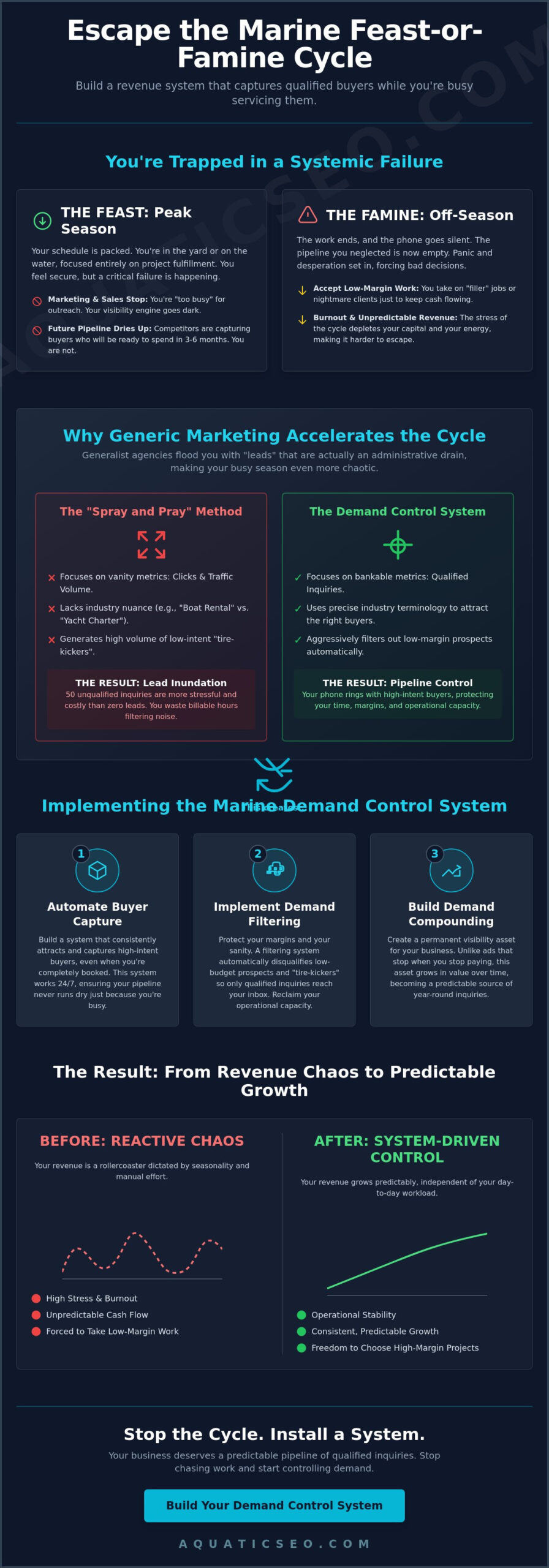
The feast-or-famine cycle is a systemic failure in demand capture that occurs when your business development engine shuts down the moment project fulfillment begins. In the marine industry, this usually looks like a frantic summer rush followed by a silent winter drought. You spend your peak months buried in the yard or on the water, then spend your off-season staring at a silent phone. This isn’t a natural law of the sea; it’s an architectural flaw in how you manage your revenue pipeline.
When you ignore marketing because you’re “too busy,” you create a vacuum that eventually sucks the profit out of your business. This cycle forces you into a state of desperation where you begin taking on low-margin filler work or “nightmare” clients just to keep the lights on. To reduce stress of feast-or-famine sales cycle patterns, you must understand that the famine was actually created during the feast. Desperation is the direct result of failing to maintain visibility when things were going well.
The Complacency of the Busy Season
Closing a major contract feels like the finish line, but for your long-term stability, it’s actually the danger zone. Most marine operators suffer from what we call the Henry VIII effect. They feast on current jobs while the future pipeline starves. When you’re fully booked in the boatyard, your instinct is to stop all outreach and visibility efforts because you can’t handle more work today.
By focusing solely on the work in front of you, you inadvertently turn off your future revenue. While you’re turning wrenches or managing crews, your competitors are capturing the high-intent buyers who will be ready to spend in three months. You can’t afford to let your business development go dark just because your hands are full today. Consistent growth requires a system that works even when you’re busy.
Why Traditional Seasonality is a Choice, Not a Law
There’s a massive difference between a market slow-down and the total disappearance of demand. While actual service work might fluctuate with the weather, the research and booking phases follow their own business cycles that often peak when the yard is quiet. For example, high-intent buyers for yacht charters are often searching and comparing options months before they ever step on a dock.
If your visibility is reactive, you only appear when you’re desperate for work. Proactive demand visibility ensures that you’re capturing interest while your prospects are in the research phase. This shift allows you to maintain a steady stream of inquiries regardless of the temperature outside. Stability comes from staying visible when your competitors have retreated to wait for spring.
Why Generic Marketing Agencies Accelerate the Stress Cycle
Generic agencies are often the primary reason you can’t reduce stress of feast-or-famine sales cycle patterns. They sell you on vanity metrics like traffic and clicks; however, they don’t understand that an inbox full of “tire-kickers” is actually a liability. For a marine operator, 50 unqualified inquiries are significantly more stressful than zero leads. Each bad lead requires time you don’t have to filter out the noise manually while you are trying to manage a yard or a fleet.
Precision in terminology is where most generalist providers fail immediately. They treat a “boat rental” seeker with the same weight as a high-value buyer looking for a crewed Yacht Charter. This lack of industry nuance floods your system with low-intent prospects who have no intention of paying your rates. You have likely been burned by vague promises and empty promotional rhetoric before. If an agency cannot distinguish between a marina and a service yard, they lack the competence to manage your business development.
The High Cost of Low-Intent Traffic
“Spray and pray” marketing is an expensive administrative drain. When an agency focuses on volume over intent, they ignore the operational reality of your business. For marine mechanics and electricians, this is particularly dangerous. You don’t need more people asking for “cheap fixes” on 20-year-old outboards. You need owners of complex vessels who value technical expertise and possess the budget to maintain them properly.
Every hour you spend responding to unqualified inquiries is an hour you aren’t billing in the shop or on the dock. Generic marketing often leads to less profit because it increases your overhead without increasing your margins. It is a cycle of waste that keeps you trapped in the off-season famine because you spent your peak season chasing the wrong work.
Rejecting Vanity Metrics for Operational Precision
We reject impressions and vague engagement counts because they don’t result in bankable outcomes. A “lead” is just a name and an email; a Qualified Inquiry is a prospect who has been filtered for intent, vessel type, and budget. You need auditable tracking that shows exactly how your visibility translates into signed contracts. This level of oversight is the only way to ensure your marketing budget isn’t being set on fire.
If your current provider cannot explain how their work specifically targets high-intent buyers, they aren’t a partner. They’re a vendor selling noise. True SEO for the marine industry focuses on filtration and precision over raw volume. This methodical approach ensures your pipeline stays healthy without overwhelming your staff with junk inquiries that lead nowhere.
Implementing a Marine Demand Control System for Consistent Flow
The Marine Demand Control System is the structural answer to the revenue instability we identified earlier. To reduce stress of feast-or-famine sales cycle patterns, you must install a system that operates independently of your manual effort. This framework consists of two primary levers: Capture and Control. Capture involves identifying the precise technical phrases high-value customers type into search engines when they are ready to commit. Control gives you the oversight to dial demand up or down based on your current yard bandwidth or charter schedule.
Automated demand capture functions as a persistent sales force that identifies and engages prospects while you are focused on vessel maintenance or client fulfillment. You shouldn’t have to choose between doing the work and finding the next job. By hard-wiring this architecture into your business, you ensure that the “phone” never truly stops ringing, even when you aren’t there to answer it. This creates a foundation of organizational stability that protects your margins and your sanity.
Capturing High-Intent Buyers Year-Round
During the traditional off-season, your best prospects aren’t disappearing; they are entering a heavy research phase. They are comparing service yards, evaluating refit capabilities, and looking for technical expertise. You capture these buyers by positioning your business as the obvious authority long before they need to haul out. This is where SEO for marine contractors becomes a vital asset for long-term demand visibility.
We focus on capturing Qualified Inquiries who value your specific expertise over the lowest price. This requires a methodical approach to keyword selection that filters out the “DIY” crowd and targets owners of complex vessels. When you capture intent early in the buyer’s journey, you build a relationship based on trust rather than a race to the bottom on price. This ensures your pipeline remains full of high-margin opportunities regardless of the weather.
The Shift from Prospecting to Processing
Monday morning should involve reviewing a list of Qualified Inquiries, not cold-calling or hoping for a miracle. A system-driven approach automates the top of the funnel so you never start your week from zero. This significantly reduces the “desperation gap” that usually occurs between completing one project and signing the next. You move from “hunting” for work to “processing” a steady stream of validated interest.
For boat dealers and service operators, this shift provides the financial health necessary for predictable growth. You gain the confidence to turn away low-margin filler work because you know exactly when the next high-value inquiry will arrive. Stability isn’t about working harder; it’s about building a machine that handles the heavy lifting of business development for you. This allows you to focus on what you do best: delivering exceptional results on the water.
Demand Filtering: Protecting Your Margins and Sanity
The filter is the engine room of the Marine Demand Control System. Without it, you’re just inviting chaos into your business. Most agencies try to convince you that more traffic is the solution, but they’re wrong. To reduce stress of feast-or-famine sales cycle patterns, you must aggressively disqualify the wrong clients before they ever reach your phone. This preserves your operational capacity for high-margin jobs that actually move the needle on your bottom line.
Your website should act as a filtration tool that answers common objections and sets expectations on pricing and scope. When you use the Marine Demand Control System, you’re building a barrier against low-intent noise. You don’t need a larger sales team; you need a more effective filter. This shift ensures that every conversation you have is with someone who already understands your value and is ready to pay for it.
Identifying the ‘Ideal Fit’ Client
High-value marine contracts in 2026 require a specific type of client: one who values technical precision and reliability over the lowest bid. In a market that has transitioned into a buyer’s market with increased inventory, you can’t afford to get caught in price wars. You attract the right people by using industry-native terminology that speaks directly to their needs. Sophisticated boat and yacht dealers don’t look for “deals”; they look for specialist partners who handle complex logistics.
This is a psychological shift for most owners that involves moving from a scarcity mindset to one of positive intent. By adopting a focus on constructive action, similar to the philosophy at SoundWater.com, you stop being a generic vendor and start being an exclusive operator. By defining your ideal fit client with narrow parameters, you signal to the market that your time is valuable. This exclusivity naturally filters out the price-shoppers and leaves you with a pipeline of Qualified Inquiries that respect your expertise and your schedule.
Reducing Administrative Waste
Automated qualifying is the only way to protect your service yard’s capacity for profitable maintenance work. You can’t afford to waste hours of talk time explaining why you don’t handle “boat rentals” when your focus is on crewed Yacht Charters. By asking the right questions through automated forms and targeted content, you filter out low-intent queries before they ever hit your inbox. This isn’t being rude; it’s being efficient.
This system-driven approach saves your team from the exhaustion of manual vetting. You move from a reactive state of answering everyone to a proactive state of servicing the best. Protecting your margins starts with protecting your time. If you’re ready to stop chasing every lead and start filtering for high-value outcomes, book a call to discuss our Demand Filtering Systems.
Demand Compounding: The Path to Long-Term Stability
Demand compounding occurs when your visibility architecture begins to generate momentum independently of your daily effort. It’s the final stage in the process to reduce stress of feast-or-famine sales cycle fluctuations. Instead of starting from zero every month, your past visibility efforts continue to attract high-intent buyers while you focus on current projects. This transition from “hunting” for every individual job to “harvesting” a steady stream of inquiries is what separates a high-stress job from a scalable enterprise.
You cannot scale a marine business on a foundation of unpredictable cash flow. Hiring specialized technicians, investing in yard equipment, or expanding your fleet requires the confidence that future revenue is already secured. A system-driven approach provides the organizational stability necessary to make these capital-intensive decisions without the fear of a sudden winter drought. Stability is the prerequisite for growth; you must stabilize before you can expand.
From Reactive Panic to Proactive Growth
Reactive panic is an expensive way to run a business. When you rely on walk-in traffic or seasonal peaks, you are at the mercy of factors you don’t control. Professional boat dealers who implement a demand control system consistently outperform those who wait for the phone to ring. The compounding effect of being found by high-value clients month after month builds a brand authority that competitors cannot easily displace.
This stability allows you to plan your labor and resource allocation with precision. You no longer have to lay off skilled staff during slow periods only to struggle to find them again when the rush returns. By maintaining a constant presence in the research phase of your buyers, you ensure that your service yard or dealership remains the first choice regardless of the season. Consistent demand visibility builds on itself, creating a moat around your business that protects your margins.
Your Next Steps for Demand Control
Stop settling for vanity metrics like likes or clicks that don’t pay the bills. You must demand auditable outcomes that translate directly into bankable revenue and Qualified Inquiries. The 2026 marine market is too competitive for generic marketing strategies that don’t understand the nuances of vessel maintenance schedules or yacht charter booking windows. You need an industry-native strategy that prioritizes filtration and high-intent capture over raw volume.
Synthesis Summary: Breaking the cycle requires a permanent shift from manual hustle to system-driven demand capture. To reduce stress of feast-or-famine sales cycle patterns, you must treat your business development as a technical system, not a series of desperate tasks. This methodical approach ensures your long-term stability and gives you the freedom to focus on operational excellence. It is time to stop chasing work and start managing a predictable pipeline.
Stabilizing Your Marine Revenue for 2026
The seasonal drought isn’t an inevitable law of the water; it’s a solvable architectural problem in your business. You’ve seen how the Marine Demand Control System moves you from reactive desperation to a position of command where you choose clients based on margin rather than survival. This methodical shift requires capturing high-intent buyers while you are at peak capacity and aggressively filtering out low-value noise. It is the only functional way to reduce stress of feast-or-famine sales cycle patterns and build a business that scales without burning you out; if you are looking for ways to maintain mental clarity through these changes, you can learn more about using intuitive tools for professional and personal reflection.
If you’re tired of vanity metrics and want a partner with specialized industry-native expertise, let’s look at your actual numbers. Request a No-BS Marine Marketing Analysis for 2026 to see how we deliver performance-based results for marine contractors. Your yard deserves a consistent pipeline of Qualified Inquiries that respect your expertise and your schedule. Start building the system that secures your operational stability today.
Frequently Asked Questions
Is it possible to reduce the stress of feast-or-famine sales cycles without hiring more sales staff?
You can absolutely reduce stress of feast-or-famine sales cycle patterns without increasing your headcount. The fix isn’t more people; it’s a better system. By automating your high-intent buyer capture, you ensure your business development continues while your current team is focused on project fulfillment in the yard or on the water.
How long does it take to see results from a Marine Demand Control System?
Results typically begin to manifest within the first 90 days as the system identifies and captures existing market demand. While initial inquiries often appear sooner, the compounding effect of demand visibility requires a full quarter to stabilize your pipeline. This timeline ensures the system is properly filtered to attract high-margin work rather than just raw volume.
Can a Demand Filtering System really stop ‘tire-kickers’ from calling my marine business?
A Demand Filtering System aggressively disqualifies low-intent prospects before they ever reach your phone. By using industry-native terminology and automated qualifying questions, you create a barrier that “tire-kickers” won’t cross. This preserves your administrative capacity for Qualified Inquiries who are ready to commit to professional service rates and technical expertise.
What is the difference between a ‘lead’ and a ‘Qualified Inquiry’ in the marine industry?
A “lead” is merely contact information from someone who might have a general interest in boating. In contrast, a Qualified Inquiry is a prospect who has been vetted for specific vessel type, project scope, and budget alignment. We prioritize the latter because chasing unvetted leads is a primary cause of operational burnout and wasted shop time.
How much time do I need to spend on marketing if I use an automated system?
Your time commitment shifts from active prospecting to high-level oversight of bankable outcomes. Once the architecture is installed, your primary task is reviewing the validated inquiries that arrive in your inbox. This allows you to spend your hours in the boatyard or managing your fleet rather than struggling with digital metrics and manual outreach.
Why do generic marketing agencies fail to understand the seasonality of marine contractors?
Generic agencies rely on volume-based metrics that ignore the specific operational cycles of marine contractors and service yards. They don’t understand that your busiest service months are often when you need visibility the most to prevent a future winter drought. Their lack of industry-native knowledge leads to tactics that flood you with low-margin noise at the worst possible times.
What happens to my sales cycle if I stop marketing during the busy season?
Stopping your visibility efforts during the busy season creates a “revenue hole” that you will fall into several months later. Because the marine research phase is often lengthy, the inquiries you ignore today are the jobs you won’t have tomorrow. Maintaining a consistent system ensures you reduce stress of feast-or-famine sales cycle dips by capturing demand year-round.
Can I use demand capture to specifically target high-margin yacht charter clients?
You can target high-margin Yacht Charter clients by identifying the technical search phrases they use during their planning phase. This requires a specialized approach that distinguishes your crewed vessel offerings from generic boat rentals. By positioning your expertise correctly, you capture sophisticated clients who prioritize quality and reliability over the lowest price point.