Most boatyard owners and yacht dealers are currently burning five figures a year on visibility that actually creates more work for less money. You’ve likely felt the frustration of a staff bogged down by low-margin inquiries while your high-value service bays sit empty during the shoulder season. Generic agencies treat your marina like a retail shop; they flood your inbox with tire-kickers who don’t know the difference between a major refit and a basic wash. This marketing plan to dominate local marine market proves that true authority isn’t about being seen by everyone. It’s about owning the specific searches that lead to high-margin contracts.
You already know that a busy schedule doesn’t guarantee a healthy profit margin if your team spends half their day answering basic questions for unqualified prospects. We will show you how to stop wasting money on shotgun marketing and implement a specialized system that captures high-intent marine buyers while filtering out low-margin noise. This guide breaks down the exact steps to install a precision filtration system that ensures your brand dominates local search for the specific jobs that drive your bottom line.
Key Takeaways
- Identify why generic agencies fail by prioritizing vanity metrics over the high-intent search patterns of actual boat owners.
- Deploy a Marine Demand Control System that uses precision filtration to repel low-budget tire-kickers and capture qualified inquiries.
- Master a marketing plan to dominate local marine market by owning the specific local search territory for your highest-margin services.
- Execute a structured 90-day roadmap designed to stabilize revenue and audit operational profit drivers before increasing traffic volume.
- Shift away from generalists to a specialized partner who understands marine seasonal cycles and technical industry terminology.
Why Traditional Marketing Plans Fail to Dominate Local Marine Markets
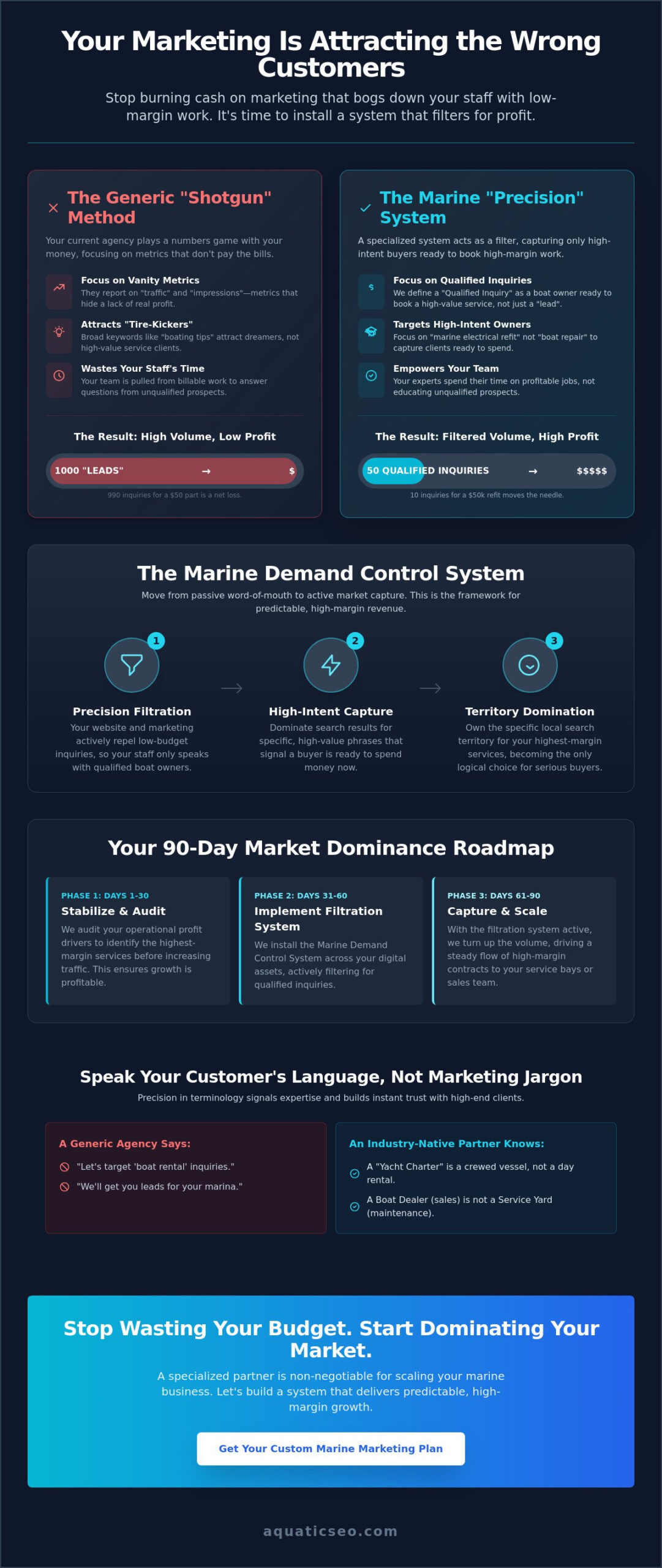
Most marketing agencies play a numbers game that costs you money. They show you charts with upward-sloping lines for “traffic” and “impressions.” These metrics don’t pay your dockage fees or cover your payroll. A generic detailed marketing plan often fails because it treats marine services like a commodity. You don’t need more people looking at your website. You need the right people calling your office.
Traditional plans use a “shotgun” approach. They bid on broad keywords like “boats” or “boating tips.” This attracts casual enthusiasts and dreamers who have no intention of spending money with you. Your marketing plan to dominate local marine market must pivot toward high-intent demand. It’s the difference between being seen by everyone and being hired for a $50,000 refit by a serious owner.
The Trap of Vanity Metrics and Lead Volume
If an agency delivers 1,000 leads but 990 of them are looking for a $50 impeller, they’ve wasted your staff’s time. We define a “lead” as anyone who breathes; we define a “Qualified Inquiry” as a boat owner ready to book a high-value service. Managing unqualified prospects has a real operational cost. It pulls your best people away from billable work to answer basic questions that should have been filtered out by your website before they reached a human.
High lead volume is often a mask for poor strategy. Agencies brag about “reach” while your service manager spends all morning on the phone with tire-kickers. This noise creates a false sense of activity that hides a lack of actual profit. You need a system that filters out the low-margin noise so your team can focus on the jobs that move the needle.
The Industry-Native Difference: Precision over Breadth
Most marketers don’t know the difference between a Boat Dealer and a marina. They’ll try to use the same strategy for a Service Yard that they use for a local plumber. This lack of industry-native knowledge leads to expensive errors that kill your conversion rates. For example, confusing a “boat rental” with a “Yacht Charter” destroys your credibility with high-end clients instantly.
Implementing a specialized marketing plan to dominate local marine market requires precision in your terminology. We understand the “in the trenches” reality of your business because we speak the language of transoms and bilge pumps. Precision isn’t just about being correct. It’s about signaling to the owner of a 60-foot sportfish that you are the expert they can trust with their vessel.
Building Your Marine Demand Control System: A Framework for Qualified Inquiries
Word-of-mouth is a trap. It feels reliable because the closing rate is high, but it offers zero control over your growth or your seasonal schedule. Relying on referrals means you are waiting for the phone to ring instead of making it ring with the specific jobs you want. A predictable business requires a system that generates a steady flow of inquiries regardless of who is talking about you at the yacht club this week. This system acts as the foundation for any marketing plan to dominate local marine market that actually produces a return on investment.
The Marine Demand Control System moves your business from passive observation to active market capture. It focuses on the moments when a boat owner has a high-intent need and is searching for a professional solution. By installing this framework, you gain the ability to dial your volume up or down based on your current capacity. You can prioritize high-margin engine repowers when your bays are empty or shift focus to yacht sales when inventory is high. This level of oversight is what separates a stable operation from one that is constantly reacting to market whims.
Capturing High-Intent Demand
Most digital strategies waste budget on broad terms like “boats for sale” or “boat repair.” These terms attract browsers, not buyers. You need to target specific, high-intent phrases such as “authorized [Brand] boat dealer in [City]” or “marine electrical refit specialists.” These searchers have already decided to spend money; they are simply looking for the right expert. Integrating proven local marketing strategies ensures you appear exactly where these high-value prospects are looking. Our Marine Demand Control System is designed to intercept this traffic before it reaches your competitors.
Filtering Out the Noise
A high volume of leads is a liability if those leads don’t have the budget for your services. You must use “negative” targeting and technical precision to repel DIYers and low-margin repair requests. For example, specific landing pages for Marine Contractors should use industry-native language that signals you handle professional-grade projects rather than minor residential dock repairs. This filtration happens before the prospect ever picks up the phone, saving your office staff hours of wasted time.
Technical precision in your content proves your authority to wealthy vessel owners who are skeptical of generic promises. When you speak accurately about hull integrity, NMEA 2000 networking, or specific gelcoat finishing techniques, you qualify yourself to the prospect. This approach ensures that every marketing plan to dominate local marine market you deploy results in a Qualified Inquiry rather than a generic lead. If you want to see how these systems function in a real-world environment, you can explore our specialized service frameworks to find the right fit for your operation.
Precision Local SEO: Dominating Your Specific Waterfront Territory
Local SEO is not just about showing up on a map; it’s about ensuring your service yard appears when a vessel owner hits a rock or needs a pre-purchase inspection. You need to own the “near me” searches that indicate immediate, high-ticket needs. This visibility is a critical pillar of any marketing plan to dominate local marine market. If you aren’t visible in the Map Pack for your specific city, you’re handing your most profitable local jobs to the competitor down the canal.
Generic agencies often fail here because they don’t understand the difference between a marina and a boatyard. They’ll optimize you for general terms that bring in tourists looking for “boat rentals” when you actually sell $200,000 center consoles. You must claim your territory with technical precision. This requires a strategy that mirrors the operational reality of your specific waterfront.
Owning the Map Pack for High-Value Marine Services
Optimizing your Google Business Profile (GBP) requires more than just a business name and a phone number. You must categorize your business with surgical accuracy to capture high-intent demand. If you operate as a Marine Surveyor, you need local citations from marine-specific directories rather than general business listings. These industry-native signals tell search engines that you are a specialized operator.
Reviews also play a massive role in conversion. A review that mentions a “thorough hull survey” or “precision engine alignment” is far more valuable than a generic “great service” comment. Encourage your clients to use technical terminology in their feedback. This builds trust with skeptical owners who are looking for a specialist rather than a generalist.
Content that Speaks to the Local Waterfront
Generic content won’t rank against national aggregators that have massive budgets. You can outmaneuver them by mentioning specific local marinas, landmarks, and regional water conditions. If you understand the local shoals or the specific draft requirements of the local harbor, say so. This proves to both Google and your prospects that you have “in the trenches” experience. Local marine SEO requires knowing the specific draft requirements of the local harbor to ensure you aren’t attracting vessels your facility cannot actually service.
Using specialized SEO for the Marine Industry allows you to target the nuances of your region. Mentioning local boat brands that are popular in your specific bay or sound establishes immediate credibility. This approach ensures your marketing plan to dominate local marine market focuses on the high-value jobs that keep your bays full and your margins high.
Executing Your 2026 Marine Marketing Plan: A 90-Day Dominance Roadmap
Planning is useless without a sequence for execution. Most marine business owners fail because they attempt to fix everything at once; they end up with a fragmented presence that attracts the wrong crowd. A successful marketing plan to dominate local marine market follows a rigid timeline. You must move from auditing your current profit drivers to installing the systems that capture and filter demand automatically.
This 90-day roadmap is designed to stabilize your revenue and clear the noise from your inbox. It shifts your focus from vanity metrics like “site visits” to the only number that matters: the volume of Qualified Inquiries. By the end of this cycle, you will have a predictable system that fills your bays with high-margin work instead of low-budget distractions.
Phase 1: The Operational Audit
The first 30 days are about filtration. You cannot dominate a market if you are still trying to be everything to everyone. You must identify the “ideal fit” client for your specific niche, whether that is a yacht owner needing a full electronics refit or a commercial operator requiring hull maintenance. Review your current Digital Marketing for Marine Contractors performance to identify where you are wasting budget on broad, non-converting keywords.
During this phase, you must purge your website of generic filler content. If your blog is full of “boating safety tips” that attract tourists, delete it. This content dilutes your authority and confuses search engines. You want every page on your site to signal to high-value prospects that you are the specialist they need for technical, high-ticket jobs.
Phase 2: Deploying the Demand Capture Assets
Days 31 through 60 focus on building your visibility for active buyers. You will launch specific service pages for Marine Mechanics and Electricians that address technical pain points directly. These pages should not just list services; they should prove your expertise with industry-native terminology that signals quality to skeptical owners. This is where you move from being an “Information Seeker” destination to an “Active Buyer” capture point.
Implementing the Marine Demand Control tracking allows you to see exactly where your high-value jobs originate. You need to know if your revenue is coming from a specific local search term or a targeted service page. This data ensures that your marketing plan to dominate local marine market is based on financial health rather than guesswork. If you are ready to stop guessing and start measuring, you can book a fit call to audit your current roadmap.
Phase 3: Compounding and Control
The final 30 days are for fine-tuning the system. You now have data on which landing pages produce the highest profit margins. Use this oversight to adjust your digital presence, filling gaps in your seasonal schedule before they become revenue dips. Focus your measurement on the Customer Acquisition Cost (CAC) for your most profitable services. When you control the filtration, you control the job mix in your yard, ensuring every hour your staff bills is at the highest possible margin.
Scaling Your Marine Business: Why a Specialized Partner is Non-Negotiable
Stop explaining your business to your marketing team. If you have to define a transom or explain why a service yard has different margins than a boat dealership, you’re losing money. A generalist agency is a drain on your time and your budget. They require constant hand-holding to produce content that doesn’t even sound like it came from a professional boatyard. Scaling your operation requires a partner who understands the hardware as well as the digital landscape.
A specialized partner understands the seasonal cycles of the marine industry. They know when to push for winter storage contracts and when to pivot to active buyer capture for the spring rush. This oversight transforms your marketing from a monthly expense into a business development asset that secures your financial health. You need a system that works as hard as your service manager to keep the bays full of high-margin work.
Rejecting the Generic Agency Model
Vague promises of “brand awareness” don’t keep the lights on. Red flags like “holistic strategies” or “comprehensive packages” usually mean you’re paying for services you don’t need. These agencies prioritize vanity metrics because they don’t know how to track a Qualified Inquiry for a $50,000 engine repower. An industry-native voice ensures your content resonates with serious vessel owners rather than casual tourists. You can see the difference in results when you review specialized service frameworks designed specifically for the marine sector.
The Synthesis: Your Path to Market Command
Dominance in 2026 requires a marketing plan to dominate local marine market that is as precise as a haul-out schedule. A focused plan beats a broad one because it ignores the low-margin noise that slows down your growth. You’ve seen how the Demand Control Strategy filters out tire-kickers and focuses on the high-intent buyers who drive 80% of your profit. Moving from inconsistent revenue to a controlled, high-margin job mix is only possible when your partner speaks your language and understands your technical requirements.
We are the methodical partner for businesses ready to stop guessing and start dominating. Our systems are built for operators who value quality over volume and precision over reach. If you are ready to install a predictable flow of qualified inquiries into your business, the next step is a direct conversation about your goals. You should book a Marine Service Fit Call to see if your operation is the right fit for our Demand Control methodology.
Take Command of Your Waterfront Territory
Generic agencies focus on vanity metrics because they don’t understand the operational reality of a service yard or boatyard. You’ve learned that true market authority comes from capturing high-intent demand and filtering out the low-margin noise that drains your staff’s time. By installing the Marine Demand Control System, you move from a reactive seasonal schedule to a predictable, high-margin job mix. Executing a precision marketing plan to dominate local marine market is about operational control, not just digital visibility.
We specialize in scaling marine businesses with revenues between $300K and $5M using industry-native expertise that requires zero hand-holding. We don’t use jargon or waste your budget on broad traffic; we focus on the specific financial health of your operation. It’s time to stop letting unqualified inquiries dictate your schedule and start owning your local territory. Take the first step toward a more stable and profitable operation today.
Request a No-BS Marine Marketing Analysis
Frequently Asked Questions
How much should a marine business spend on a local marketing plan?
Your investment should be viewed as a percentage of your gross revenue target rather than a fixed cost. Most marine businesses with $300K to $5M in revenue allocate budget based on the volume of high-margin jobs they need to fill their bays. A marketing plan to dominate local marine market requires enough capital to outpace local competitors in search visibility and lead filtration without wasting money on broad, non-converting traffic.
What is the difference between a lead and a Qualified Inquiry in the marine industry?
A lead is anyone who fills out a form; a Qualified Inquiry is a vessel owner with the specific intent and budget for your high-value services. General agencies flood you with leads who want free advice or minor parts. We prioritize filtration to ensure your office staff only spends time on prospects who own the right vessels and need your specific technical expertise.
Can SEO really help a specialized business like a Marine Surveyor or Electrician?
SEO is the most effective way for specialists to intercept high-intent buyers at the exact moment a vessel failure or purchase occurs. When a boat owner needs a precision engine alignment or a pre-purchase survey, they search for local experts. Dominating these specific, technical search terms ensures you are the first professional they call when a high-ticket need arises.
How long does it take to see results from a Marine Demand Control System?
You will typically see shifts in inquiry quality within the first 30 to 60 days as we audit and filter your current traffic. While long-term search dominance takes time, the immediate removal of low-margin noise provides instant relief to your staff. The goal is to stabilize your revenue patterns and job mix within a single 90-day execution cycle.
Why do generic marketing agencies fail to understand the marine sector?
Generic agencies fail because they don’t understand the technical nuances of vessel maintenance and the seasonal nature of your cash flow. They treat a boatyard like a standard retail shop, failing to distinguish between a yacht charter and a boat rental. This lack of industry-native knowledge results in content that sounds amateur and attracts the wrong type of clientele.
Is it better to focus on social media or search engines for boat sales?
Search engines are superior for capturing active buyers who are ready to make a purchase today. Social media is useful for brand awareness among enthusiasts, but it rarely captures the high-intent demand needed to dominate a local market. Your marketing plan to dominate local marine market should prioritize search visibility for terms that indicate a buyer is in the final stages of their decision process.
How do I filter out low-budget callers who just want free advice?
You filter these callers by using technical precision and clear service boundaries on your landing pages. By speaking directly to the owners of specific vessel classes and mentioning minimum project sizes, you signal that you are a premium operator. This technical barrier repels DIYers and “free advice” seekers before they ever reach your phone lines.
What are the most important local SEO factors for a Yacht Charter business?
The most critical factors are Google Business Profile accuracy and reviews that use specific industry terminology. You must clearly distinguish your crewed yacht charter service from basic boat rentals to attract high-end clients. Local citations from marine-specific directories and mentions of local harbor draft requirements further establish your authority in a specific waterfront territory.