
Most marine contractors are trapped in a cycle where they work 70 hours a week only to find their bank accounts don’t reflect the effort. You’re likely exhausted by the constant influx of tire kickers asking for boat rentals when your crew is built for high-value refits or complex dock construction. When you’re stuck in reactive mode, you can’t plan your crew schedule more than a week in advance. This feast-or-famine cycle isn’t just stressful; it’s an operational failure. Understanding how to get control over your job flow isn’t about working harder. It’s about installing a system that kills low-margin distractions before they ever reach your desk.
You know the frustration of a schedule that feels like it’s dictated by whoever calls your office first rather than the projects that actually improve your financial health. We’ll show you how to shift from reactive scheduling to a proactive, high-margin job mix using a dedicated demand filtering system. This article breaks down why generic marketing fails marine contractors and how to build a predictable project pipeline that gives you the power to say “no” without fear of a dry spell.
Key Takeaways
- Stop chasing every lead and learn how to get control over your job flow by filtering for high-intent, high-margin projects instead of low-value boat rentals.
- Identify and eliminate “drain” projects that consume your crew’s time without contributing to your bottom line or long-term operational stability.
- Replace generic marketing tactics with a dedicated Demand Filtering System designed specifically for the logistical realities of marine contractors and service yards.
- Shift from a reactive, one-week planning horizon to a predictable schedule of high-value refits and construction work.
- Understand why “more leads” often destroys profitability and how a filtered stream of qualified inquiries protects your margins and your sanity.
The Feast-or-Famine Trap: Why Marine Contractors Lose Control
Job flow control is the ability to dictate the timing and profitability of your projects. It isn’t just about having a full calendar. For marine contractors, true control means your schedule consists of high-margin work that fits your crew’s specific skills. Most operators in this industry suffer from a “Feast-or-Famine” cycle. You’re either overwhelmed by low-value tasks or panicked by an empty dock. This inconsistency kills your ability to scale.
This cycle exists because you’ve relied on reactive marketing. You accept whatever inquiry hits your inbox first. This creates a backlog of “drain” projects that block your capacity for high-value refits. You might feel busy, but busy-ness is not operational control. Control is the power to filter out noise. It requires a systematic organization of resources to ensure your yard stays profitable, not just occupied. Learning how to get control over your job flow starts by identifying why your current lead mix is failing you.
The High Cost of the Wrong Inquiries
If you operate a Yacht Charter business, every minute spent answering questions about “boat rentals” is wasted capital. These are two different markets with different intent. Similarly, service yards and boatyards often lose money by quoting small repairs when they should be booking major refits. Relying on word of mouth is a liability because it provides no filtration. You get whatever the wind blows in; usually the low-margin work your competitors didn’t want. Without a way to distinguish a Qualified Inquiry from a tire kicker, you’ll never discover how to get control over your job flow.
Symptoms of a Broken Job Mix
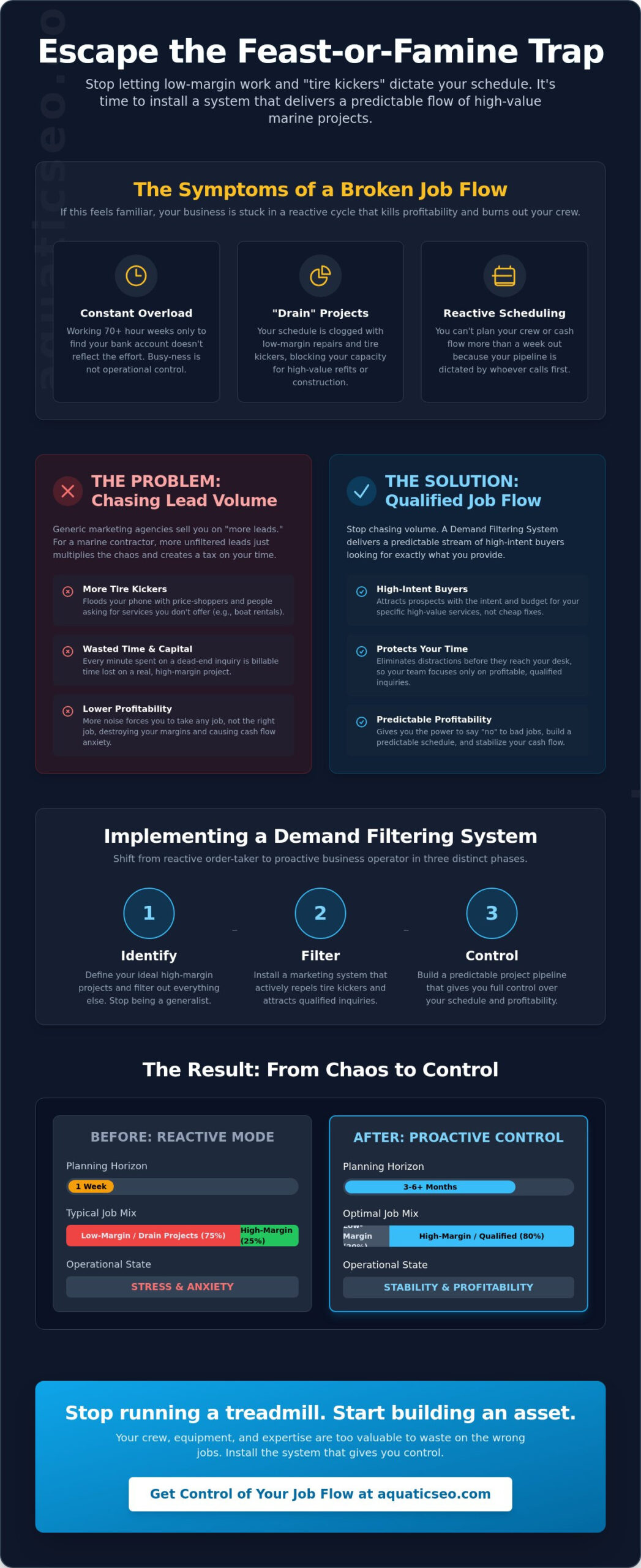
A broken job mix shows up in your bank account and your crew’s morale. You’ll see skilled technicians burning out on repetitive, low-skill tasks that don’t pay the bills. Your cash flow hits bottlenecks because small jobs have high administrative overhead and low returns. Eventually, you find yourself unable to invest in the facility upgrades or new equipment needed to stay competitive. You’re running a treadmill, not a business. The symptoms are clear:
- Crew burnout from low-skill, high-stress repetition.
- Constant cash flow anxiety despite a packed schedule.
- Delayed investments in essential dredging or crane maintenance.
If you recognize these signs, your current approach to capturing demand is broken. You’re allowing the market to dictate your schedule instead of commanding it yourself.
Lead Volume vs. Qualified Job Flow: The Critical Distinction
Most marketing agencies will tell you that you need more leads to grow. They’re wrong. For a marine business already struggling with a chaotic schedule, an increase in lead volume is often the worst thing that can happen. More leads without filtration simply means more time spent on the phone with people who can’t afford your services or don’t understand your value. If you want to learn how to get control over your job flow, you must stop chasing volume and start demanding a Qualified Job Flow.
A Qualified Job Flow is a filtered stream of high-intent buyers who are looking for exactly what you provide. Generic agencies focus on superficial traffic metrics because they don’t understand the difference between a dockage inquiry and a maintenance request. They celebrate when your phone rings, even if it’s a “tire kicker” looking for a cheap fix. At Aquatic SEO, we focus on your job mix because your bank account doesn’t care about clicks; it cares about high-margin contracts. A Qualified Inquiry is a prospect with both the intent and the budget for specialized marine services.
The “Tire Kicker” Tax on Your Business
Every minute you spend on a dead-end phone call is a tax on your profitability. If you spend 30 minutes quoting a small repair for someone who eventually ghosts you, you’ve lost billable time that could have been spent on a major refit. Generic SEO often attracts these price-shoppers by targeting broad, low-intent keywords. This creates a psychological toll on you and your staff, leading to the feeling that you’re working harder than ever while the feast and famine cycle continues unabated. You don’t need a higher volume of noise; you need a system that silences it.
Identifying Your Ideal Job Mix
To regain control, you must analyze which services drive your highest margins. Apply the 80/20 rule to your revenue. You’ll likely find that 20% of your projects, such as marine construction or complex electrical overhauls, provide 80% of your actual profit. Niche-specific marketing is the only way to attract this top 20% consistently. By tailoring your visibility toward these high-value outcomes, you discover how to get control over your job flow by design rather than by luck. If you’re ready to stop the cycle, you can explore our specialized digital marketing for marine contractors to see how we filter for quality over quantity.
Why Generic Marketing Fails to Fix Your Schedule
Most agencies sell generic packages that promise broad visibility. These providers use vague language to hide their lack of industry knowledge. If an agency cannot distinguish between dockage and maintenance, they cannot help you build a profitable business. You need a marine digital marketing agency that understands the technical nuances of your specific services. Without this level of precision, your marketing will only increase your noise, not your profit.
Generic providers prioritize vanity metrics like likes, shares, and raw traffic. These numbers don’t solve operational chaos or pay your crew. If you want to know how to get control over your job flow, you must stop valuing raw volume. High traffic is a liability when it attracts people seeking free advice or small boat rentals instead of high-value refit projects. You cannot pay your mortgage with engagement counts.
You have likely experienced the frustration of marketing that simply makes you busier with the wrong people. This is the direct result of a “more is better” strategy that fails to filter demand at the source. Without precision, your crew remains trapped in low-margin work while high-margin opportunities go to your competitors. A specialist partner understands that a full schedule of the wrong jobs is a fast track to bankruptcy.
The “Spray and Pray” SEO Problem
Ranking for broad terms like “boats” is a total waste of capital for a marine surveyor. You do not want someone looking for a “cheap fishing boat”; you want the buyer of a 60-foot sportfish who needs a pre-purchase inspection. High-volume keywords attract DIYers who want to fix things themselves. This type of generic content destroys your authority and fills your inbox with noise that your staff has to filter manually. Learning how to get control over your job flow requires a strategy that ignores these broad, low-intent terms.
The Difference Between a Vendor and a Specialist Partner
A general vendor does not understand that a service yard is not the same as a marina. They write copy that sounds like a generic travel brochure rather than an industry-native authority. You need a partner who understands the operational realities of the marine sector from the inside. Specialist filtering protects your crew from low-value distractions and ensures your schedule remains focused on profitable, specialized work. This methodical approach is the only way to stabilize inconsistent revenue patterns.
Implementing a Demand Filtering System to Regain Control
Shifting from a reactive schedule to a proactive one requires more than a mindset change. You need a functional mechanism that works 24/7 to protect your calendar from low-value noise. This is how to get control over your job flow. You must stop acting like a general vendor and start operating like a specialist. We use a 5-step framework to transition your business from chaos to precision.
- Step 1: Audit your current job mix. Review your last 12 months of projects and identify the “drain” jobs that consumed your crew’s time with minimal profit.
- Step 2: Deploy high-intent keyword targeting. Stop wasting capital on broad terms and focus on specific services that attract active, high-value buyers.
- Step 3: Install Demand Filtering on your website. This is the core of how to get control over your job flow; you must qualify prospects through your digital presence before they ever reach your phone.
- Step 4: Align your sales process. Ensure your staff knows how to handle a Qualified Inquiry with the speed and professionalism a high-value client expects.
- Step 5: Measure success by Job Margin. Stop looking at lead counts. Your success is defined by the profitability of the work on your board, not the number of times your phone rings.
The Mechanics of Demand Filtering
Effective filtering starts with specialized landing pages. If you operate yacht charters, your content must explicitly repel “boat rental” seekers by focusing on crewed vessel experiences and high-end service. Your contact forms should include mandatory qualifying questions. Ask for vessel size, project budget, and desired timelines. This friction is intentional. It ensures your technicians spend their time quoting major refits rather than explaining pricing to people who aren’t your ideal fit. We also use SEO Rich Text to signal authority to high-value clients, ensuring they recognize you as the specialist they need.
Expected Results: From Chaos to Precision
After 90 days of implementing this system, your schedule will look fundamentally different. The panic of the “dry spell” disappears because you have a predictable pipeline of high-intent work. You’ll see a significant impact on your bottom line as you stop chasing low-margin tasks that bleed your resources. Stability allows you to plan crew schedules months in advance and finally invest in the facility upgrades you’ve been delaying. If you are ready to install these Demand Filtering Systems in your business, the first step is auditing your current output.
The Marine Demand Control System: Stability for 2026
The Marine Demand Control System is the mechanism that turns your boatyard from a reactive workshop into a precision-guided operation. This proprietary framework is built specifically for marine contractors who are finished with the noise of generic marketing. It focuses on auditable tracking and the actual financial health of your business rather than vanity engagement counts. By prioritizing high-intent outcomes, you finally learn how to get control over your job flow.
Most agencies hide behind vague reports that highlight traffic spikes or social media reach. We reject these metrics because they don’t help you plan your crew schedule or pay your bills. Our system tracks the source of your highest-margin inquiries, allowing you to double down on the work that matters. We position ourselves as an exclusive partner for businesses that value quality over volume. This is not about getting more work; it’s about getting the right work.
A Partnership, Not a Service
Aquatic SEO explicitly rejects the label of a “vendor.” Vendors are replaceable; partners are accountable. In the marine sector, you need performance-based assurances that your marketing spend is translating into actual job margin. We protect your market effectiveness through intense specialization. Because we only work within this industry, we understand the logistical constraints of your crew and the seasonal shifts of your revenue. This “in the trenches” experience ensures that your marketing copy speaks the language of a boat owner, not a tourist.
Regain Your Time and Your Profit
Operational stability doesn’t happen by accident; it’s the result of a deliberate filtration strategy. Job flow control is the foundation of a healthy marine business, allowing you to move from a state of constant reaction to a state of command. 2026 is the year to stop accepting “whatever comes in” and start demanding the work that justifies your expertise. You’ve spent years building your reputation; don’t let a broken lead mix destroy your margins or your crew’s morale.
Learning how to get control over your job flow is the first step toward building a business that serves you rather than consumes you. When you stop chasing tire kickers, you regain the time needed to lead your company instead of just working in it. If you’re ready to move beyond the feast-or-famine cycle, it’s time to book a fit call to analyze your marine marketing. We’ll look at your current job mix and show you exactly where the leaks are costing you money.
Command Your Calendar and Your Profit
Operational stability in the marine industry isn’t a matter of luck or working more hours. It’s the result of a deliberate shift from accepting every inquiry to commanding a filtered pipeline of high-intent buyers. By implementing the Marine Demand Control System, you stop the tire kickers from draining your resources and start filling your schedule with high-margin refits and construction projects. You now understand how to get control over your job flow by valuing precision over raw lead volume.
This transition protects your crew from burnout and ensures your financial health is auditable and predictable. Stop settling for “whatever comes in” and start dictating the terms of your growth. If you’re ready to stop the feast-or-famine cycle, we’re ready to show you the leaks in your current strategy. Request a No-BS Marine Marketing Analysis today to see how specialized filtering can transform your yard. Your time is too valuable to waste on the wrong inquiries.
Frequently Asked Questions
How does a demand filtering system differ from standard lead generation?
Demand filtering focuses on project margin while standard lead generation only prioritizes volume. Most agencies try to fill your inbox with any lead they can find, regardless of their budget or project scope. A filtering system uses technical qualifiers and vessel specifications to ensure your crew only spends time quoting high-value work that fits your specific operational capacity.
Can I really get control over my job flow if the marine industry is seasonal?
You can maintain control during off-seasons by using proactive capture systems to book major refits months in advance. Seasonality is an environmental factor, but the feast-or-famine cycle is often a result of reactive marketing. A filtered system allows you to build a stable backlog of high-value work during peak months to stabilize your revenue throughout the year.
What is the difference between a Yacht Charter and a boat rental in marketing terms?
A Yacht Charter involves a crewed vessel and high-end service, whereas a boat rental is a bareboat transaction with lower margins and higher liability. Marketing these the same way is a mistake that destroys your positioning. Your digital presence must use specialized copy to target the luxury intent of charter guests while repelling the low-budget rental crowd.
Why do I keep getting tire kickers from my current website?
You attract tire kickers because your website uses broad language that fails to signal your price point or vessel specialization. If your content doesn’t explicitly state who your services are for, it implicitly invites everyone to call. This lack of intentional friction results in a flood of low-intent inquiries that waste your administrative time and crew resources.
How long does it take to see a shift in my job mix after implementing these systems?
You will typically see a shift in the quality of your inquiries within 90 days of implementing the Marine Demand Control System. While SEO visibility takes time to peak, adding demand filtering to your contact forms and landing pages provides an immediate reduction in low-value noise. This allows you to focus on the high-intent projects that actually improve your financial health.
Is it possible to filter out low-budget leads without losing potential customers?
You aren’t losing customers; you are repelling people who are a poor fit for your business model and margins. Accepting a low-budget project often blocks your capacity for a high-value refit that arrives shortly after. Filtering ensures your resources remain available for the projects that justify your expertise and support long-term operational stability.
What metrics should I actually track to measure job flow health?
Track your average Job Margin and Qualified Inquiry rate rather than raw traffic or lead counts. Raw metrics are vanity numbers that often hide significant operational waste. Understanding how to get control over your job flow requires looking at the percentage of inquiries that turn into signed contracts and the total profitability of your current project mix.
Why is industry-native knowledge important for my SEO partner?
An industry-native partner knows that a Service Yard is not a marina and that a marine surveyor has different requirements than a boat dealer. Generic agencies use marketing jargon that alienates sophisticated boat owners and damages your credibility. Specialist knowledge ensures your copy carries the authority needed to capture high-value contracts and filter out unqualified prospects effectively.