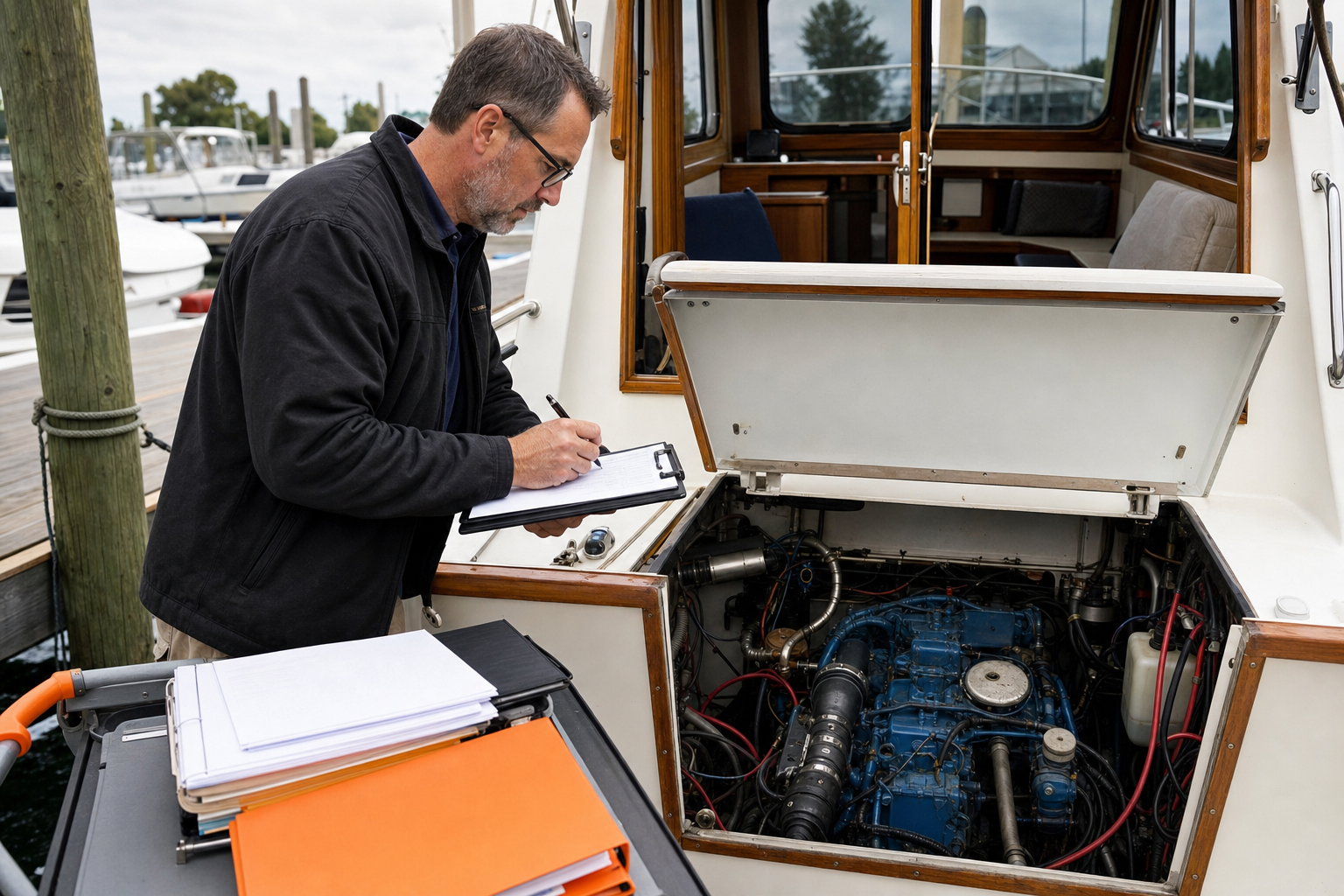
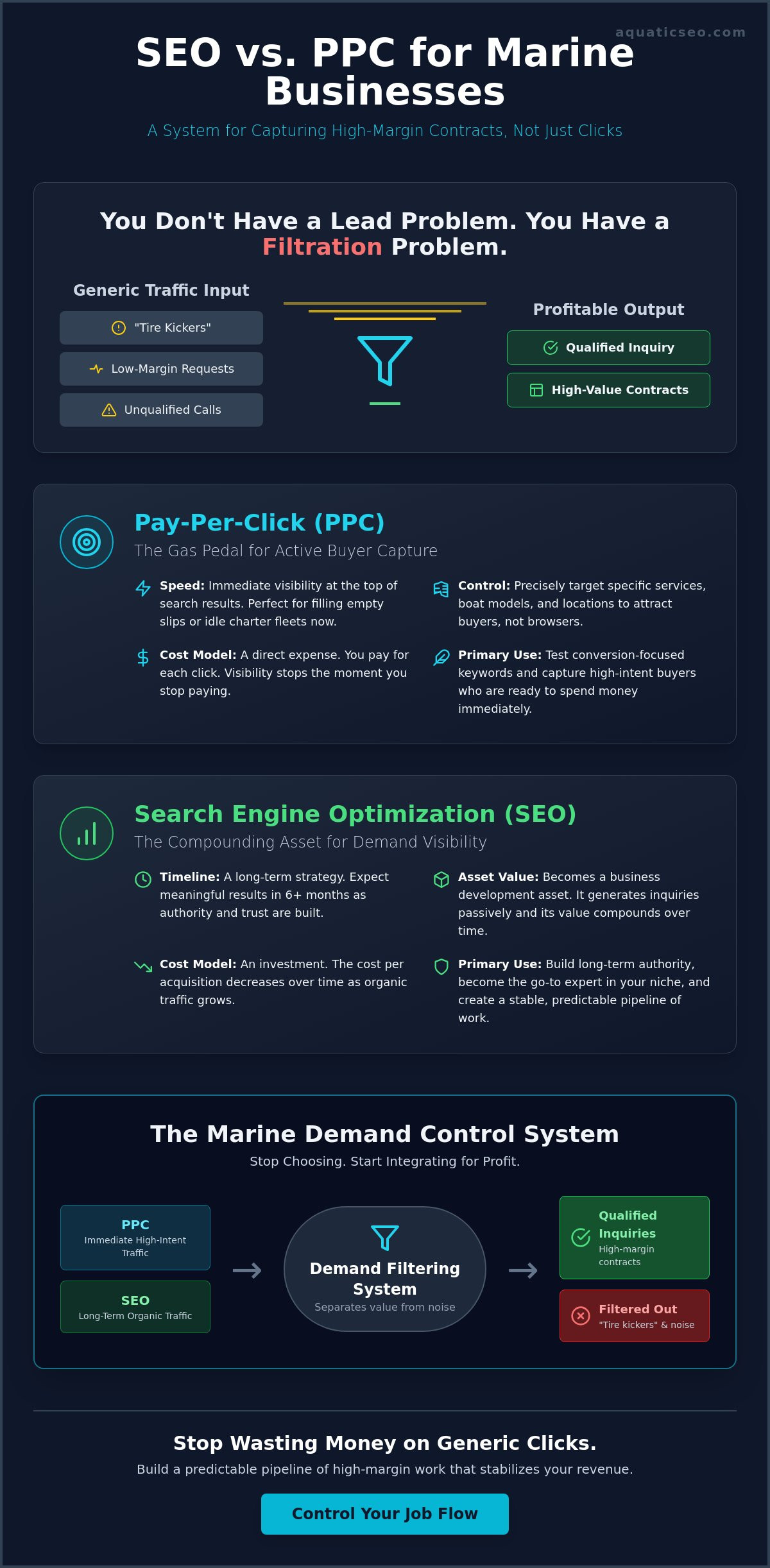
Most marine business owners think they have a lead generation problem, but they actually have a filtration problem. With U.S. boating sales projected to hit $61.3 billion in 2026, the volume of noise in the market is at an all-time high. You’re likely spending thousands on Google Ads only to have your phone ring with “tire kickers” asking for cheap boat rentals when you specialize in high-end yacht charters or major service yard refits. This cycle of paying for generic clicks that result in low-margin requests is draining your budget. You don’t need more volume; you need a system that captures high-intent demand while filtering out the noise. Deciding between SEO vs PPC for marine services requires a focus on capturing a qualified inquiry rather than just chasing traffic.
You’ve likely realized that vanity metrics like impressions don’t pay the bills, and you’re tired of agencies promising vague growth while delivering low-margin leads. We’ll show you how to stop wasting money on generic clicks and start using these digital levers to control your job flow and filter for high-value marine contracts. This article breaks down the operational reality of each strategy, explaining how to build a predictable pipeline of high-margin work that stabilizes your revenue for the long term.
Key Takeaways
- Learn to distinguish between generic traffic and a Qualified Inquiry to stop wasting budget on “tire kickers” who never convert.
- Understand why the debate of SEO vs PPC for marine services is a false choice and how to use both as mechanical levers for profit.
- Discover how to use PPC for Active Buyer Capture to secure high-margin jobs immediately while your competitors wait for organic rankings.
- Build a long-term asset through SEO that creates Demand Visibility and lowers your cost per acquisition over time.
- Implement a Demand Filtering System that automatically separates low-margin boat rental requests from profitable Yacht Charter contracts.
The False Choice: Why Marine Business Owners Get Burned by Generic Search Strategies
Most marketing agencies treat your marine business like a local dry cleaner or a pizza shop. They sell you on the idea of more traffic, assuming that a higher volume of clicks automatically leads to a healthier bottom line. This is the “Search Trap”. You end up paying for generic volume instead of a Qualified Inquiry. When you look at SEO vs PPC for marine services, the goal isn’t just to be seen; it’s to be seen by the right person at the exact moment they need a high-margin solution.
A generic agency fails because they don’t understand your specific sector. They see “boat” and think every click is equal. They can’t distinguish between a high-value Yacht Charter contract and a low-margin boat rental inquiry. This lack of industry-native precision results in wasted ad spend and an organic strategy that attracts “tire kickers” rather than serious clients. Search Engine Marketing (SEM) should be a business development asset that filters your demand, not a monthly marketing expense that delivers vanity metrics like engagement counts or impressions.
The Marine Industry Nuance: Why Context Matters
High-intent buyers search with specificity. A captain looking for specialized marine mechanics and electricians for a complex electrical refit uses different language than a weekend hobbyist. Generic strategies ignore these nuances and the extreme seasonality of the marine world. If your strategy doesn’t account for the pre-season rush or the specific technical terms your clients use, you’ll miss the jobs that actually drive profit. A Qualified Inquiry is the only metric that impacts your financial health; everything else is noise.
Symptoms of a Broken Search Strategy
If your phone is ringing but your bank account isn’t growing, you’re likely stuck in the “Low-Margin Loop”. You get plenty of calls for small, frustrating repairs that eat up your team’s time, but zero inquiries for the large-scale contracts you actually want. This happens when your strategy lacks a Demand Filtering System. Without control over your job mix, you’re at the mercy of whatever the algorithm throws your way. You end up with an inconsistent job flow and a Service Yard full of low-value work that prevents you from accepting higher-margin opportunities.
Pay-Per-Click (PPC): Immediate Visibility for Active Buyer Capture
Think of PPC as the gas pedal for your revenue. If your service yard has empty slips or your charter fleet is sitting idle, you can’t wait six months for organic rankings to climb. PPC allows for Active Buyer Capture by placing your brand at the top of search results for high-intent queries. You target users who are ready to book a Yacht Charter right now, not people browsing for general boating tips. In hyper-competitive markets like Fort Lauderdale or Newport, being at the top of the page is often the only way to intercept a high-value client before they click a competitor’s link.
This strategy also serves as a laboratory for your long-term growth. By running paid campaigns, you identify which specific keywords lead to a Qualified Inquiry before committing your full budget to SEO. It’s an essential step in evaluating SEO vs PPC for marine services because it removes the guesswork. You see exactly what people type when they are ready to spend money. While aggressive, your campaigns must remain transparent and follow FTC guidelines on online advertising to maintain your brand’s reputation and ensure your messaging is compliant.
Strategic Use of Google Ads for Boat Dealers
Stop bidding on broad terms like “boats for sale” and start bidding on specific inventory. Boat Dealers should target prospects looking for specific makes and models to attract buyers, not browsers. You can use geo-fencing to capture demand from prospects physically standing at boat shows or high-end marinas. To keep your acquisition costs sustainable, you must maintain a high Google Ad Score. A poor score means you pay more for the same click, directly eating into your sales margins.
When PPC is the Right Tool for Marine Contractors
For marine contractors, PPC is the ideal tool for filling immediate gaps in the service schedule. If you have a sudden opening for a marine electrical refit or an engine overhaul, a targeted ad can find a client in hours. However, relying solely on PPC creates a dangerous “pay-to-play” dependency. The moment you stop the spend, the demand vanishes. Over time, this dependency can erode your margins as rising competition drives up the cost of every click. If you feel stuck in this cycle, you can book a call to evaluate your current ad performance.
Search Engine Optimization (SEO): Building a Compound Asset for Demand Visibility
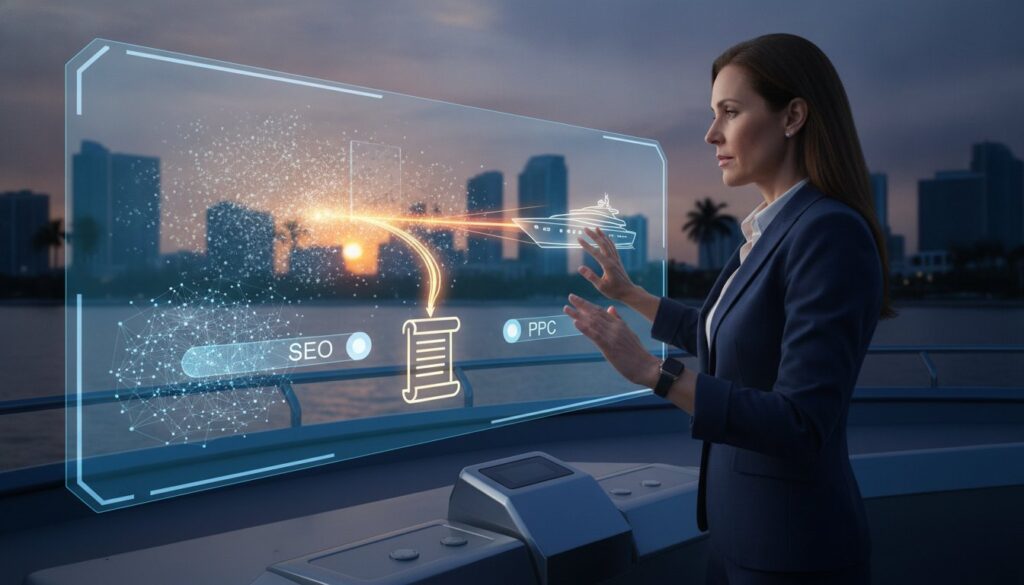
PPC captures demand that already exists, but SEO creates a foundation where your business becomes the default choice for your region. You should view organic search as a long-term investment in Demand Visibility. While ads stop the moment you stop paying, a well-executed organic strategy builds a permanent business asset that appreciates over time. When you weigh SEO vs PPC for marine services, you must recognize that organic rankings carry a level of earned authority that a “Sponsored” tag simply cannot replicate.
Building this level of authority requires moving far beyond Digital Marketing Basics for small businesses. You need niche-specific marine marketing that speaks the precise language of captains, yacht owners, and fleet managers. Over time, organic qualified inquiries become significantly more cost-efficient than paid leads because you aren’t bidding against a dozen competitors for every click. This compounding effect reduces your reliance on expensive ad auctions and provides the organizational stability you need to plan your season with confidence.
The Mechanics of Marine SEO: Beyond Backlinks
Google evaluates your technical setup with the same scrutiny a surveyor applies to a hull. If you’re a boat dealer, your Yachtworld UX and the way your inventory data flows through your site structure directly impacts your search standing. You need SEO rich text that details the technical nuances of your specialized services. Whether you operate a service yard or specialize in marine construction, this level of precision helps you dominate local search in specific coastal regions. It ensures you appear when a client searches for a “Qualified Inquiry” rather than a general “boat guy.”
Demand Compounding: Why the First 6 Months are Just the Start
The first few months of an organic campaign are dedicated to correcting technical errors and building a content foundation. Once that baseline is set, you experience the exponential growth of Demand Compounding. Your high-ranking content begins to act as a 24/7 filtering system. It answers complex technical questions and qualifies prospects before they ever dial your number. This fundamental shift changes your daily operations. You move away from the frustration of chasing low-margin jobs. Instead, you gain the luxury of selecting the best contracts that offer the highest margins and fit your specialized expertise.
Beyond Clicks: Using Search Strategies to Filter Demand and Control Your Job Mix
Most marine marketing focuses on volume. This is a mistake. You don’t need more “leads” if they are low-margin “tire kickers” wasting your time. When evaluating SEO vs PPC for marine services, you must view these tools as a Demand Filtering System designed to protect your team’s capacity for high-value work. You’re looking for the right jobs, not just any jobs.
High-Intent Filtering allows you to stop low-margin boat rental inquiries before they reach your inbox. You use search data to identify which services yield the highest profit margins for your yard and double down on those specific queries. For example, if your data shows that “inboard engine repower” leads to 40% higher margins than “oil change,” you shift your focus accordingly. This precision helps you repel “unfit” clients while actively attracting high-value yacht dealers who require professional, reliable service partners for their inventory.
Controlling Your Job Flow
Effective marketing allows you to dictate your operational schedule. You can dial up PPC campaigns when your yard has empty slips to bridge the gap and keep your crew busy. When you are booked out months in advance, you rely on your organic SEO foundation to maintain visibility without increasing ad spend. Implementing Demand Filtering ensures you prioritize a $50,000 refit over a $500 minor repair. This creates a “buffer” of qualified leads, so you never feel desperate for work or forced to accept low-margin jobs just to keep the lights on.
The Role of Precision Terminology in Conversion
Your choice of words acts as a psychological gatekeeper. Using the term “Yacht Charter” instead of “boat rental” immediately attracts a different class of buyer with higher expectations and larger budgets. Being “industry-native” in your copy proves you understand the complexities of marine operations, such as the difference between a simple dockage request and a full-service refit. Craft a sentence that defines your niche clearly, such as “We specialize exclusively in catamarans over 50 feet requiring complex electrical overhauls.” This level of specificity repels general inquiries, ensures every call you take is worth your time, and protects your technicians from low-value distractions.
This degree of niche positioning is what allows elite adventure destinations to thrive; for instance, travelers can discover Los Buzos and its world-class offshore fishing by searching for specific, high-intent experiences rather than broad vacation terms.
If you’re ready to stop chasing every click and start filtering for profit, book a fit call to discuss your Demand Filtering System.
The Marine Demand Control System: A Unified Approach to Profitable Growth
Choosing between SEO vs PPC for marine services is a false dilemma that limits your growth potential. You shouldn’t have to pick one lever when you can use both to build a Marine Demand Control System. This proprietary approach integrates Active Buyer Capture to fill immediate schedule gaps with Demand Compounding to build long-term market authority. It’s a fundamental shift from chasing vague engagement metrics to prioritizing your financial health and organizational stability.
The Marine Demand Control System isn’t a collection of disparate tactics; it’s a mechanical framework for your business development. By aligning PPC and SEO, you create a feedback loop where paid data informs your organic content, and organic authority lowers your paid acquisition costs. This is how you achieve sustainable, profitable growth without the constant stress of inconsistent job flow. You gain the ability to “turn on” demand when you need it and rely on a steady stream of high-value prospects when you don’t.
We’ve designed this system specifically for the nuances of the water. Whether you are a boat dealer moving inventory or one of the many marine contractors managing complex refits, you need a strategy that understands your specific operational constraints. Aquatic SEO acts as your specialized partner, ensuring your marketing spend translates into high-margin contracts rather than just more noise in your inbox. We focus on the precision of a Qualified Inquiry because we know that volume without margin is just busywork.
What to Expect from a System-Driven Approach
- Auditability: You’ll know exactly where every Qualified Inquiry originated. This transparency allows you to track the return on every dollar spent and adjust your strategy based on real-world revenue, not clicks.
- Precision: We target only the sub-sectors of the marine industry you serve. By using industry-native terminology, we filter out low-value requests before they ever reach your team.
- Predictability: A systemized approach fills your job board with high-margin work months in advance. This foresight gives you the control to plan your operations, hire staff, and manage your inventory with confidence.
Next Steps for Your Marine Business
Stop settling for the generic marketing outcomes promised by generalist agencies who can’t tell a boatyard from a marina. Your business deserves a strategy rooted in the reality of marine logistics and high-ticket sales cycles. If you’re tired of wasting money on “tire kickers” and want to take control of your job flow, it’s time for a different approach. Focus on the metrics that actually matter: profit, margin, and total control over your job mix.
Request a No-BS Marine Marketing Analysis to see the specific gaps in your current strategy. We’ll look at your current positioning and show you exactly where you’re losing high-margin opportunities to competitors. Let’s build a system that works as hard as your crew does.
Stabilize Your Job Flow and Protect Your Margins
Stabilizing your revenue requires moving beyond the false choice of SEO vs PPC for marine services. You now understand that PPC acts as your mechanical lever for immediate buyer capture while SEO builds a compounding asset that filters for higher-margin contracts. By implementing the Marine Demand Control System, you stop reacting to the market and start dictating your own job mix. This industry-native specialized expertise is designed specifically for marine businesses with revenues between $300K and $5M that value precision over generic volume.
You don’t have to settle for a schedule full of low-margin repairs or “tire kicker” inquiries. You can secure the organizational stability needed to grow your yard or dealership with confidence. It’s time to treat your digital presence as a business development asset rather than a marketing expense. Your most profitable season starts with a system that prioritizes profit over clicks.
Request a No-BS Marine Marketing Analysis to identify the gaps in your current strategy and start capturing the jobs you actually want.
Frequently Asked Questions
Is SEO or PPC better for a new yacht charter business?
PPC is better for immediate cash flow, while SEO is better for long-term margin protection. A new Yacht Charter business needs Active Buyer Capture to fill the calendar quickly. Once revenue stabilizes, you should shift budget toward SEO to build Demand Visibility and reduce your dependency on expensive paid auctions.
How long does it take to see a return on investment from marine SEO?
You should expect to see the compounding effects of SEO within six to nine months. While technical site fixes can yield minor wins in weeks, the authority required to dominate local search takes time to build. This investment eventually leads to lower acquisition costs compared to the relentless “pay-to-play” nature of PPC.
Can I stop doing PPC once my marine business ranks #1 on Google?
Stopping PPC entirely often leaves money on the table even if you rank first organically. Google frequently places multiple ads above the first organic result, meaning your “top” spot is actually halfway down a mobile screen. Use a unified approach to SEO vs PPC for marine services to dominate the entire page and defend your brand from competitors.
What is the average cost per lead for marine contractors in 2026?
Lead costs in 2026 are highly variable based on your specific coastal region and service niche. While the average cost-per-click across all industries is between $2.96 and $5.42, high-intent marine keywords often command a premium due to the high-ticket nature of the work. You must measure success by the cost per Qualified Inquiry rather than the cost per generic click.
How do I filter out low-margin “boat rental” inquiries if I only offer “Yacht Charters”?
You filter these out by using precision terminology and aggressive negative keyword lists. In your PPC campaigns, exclude terms like “cheap,” “hourly,” or “self-drive.” In your SEO content, use phrases like “crewed vessels” and “luxury Yacht Charter” to signal to both Google and the user that you don’t handle low-margin boat rentals.
Does my boat dealer website need a blog to rank for SEO?
Your website needs a Demand Compounding strategy, which usually includes a library of technical articles. Generic blog posts about “summer boating tips” won’t help you rank for high-margin jobs. Instead, publish SEO rich text that solves specific problems for buyers, such as “What to look for in a 50-foot catamaran survey” or technical maintenance guides.
Why do generic marketing agencies fail in the marine industry?
Generic agencies fail because they lack industry-native expertise. They don’t understand the operational difference between a marina and a service yard, so they optimize for broad traffic volume rather than high-margin contracts. They deliver leads that waste your time because they can’t distinguish a Qualified Inquiry from a “tire kicker” looking for a bargain.
What is a “Qualified Inquiry” in the context of a marine service yard?
A Qualified Inquiry is a prospect whose vessel fits your haul-out capacity and whose needs align with your highest-margin services. It’s not just a phone call asking for a price. It’s a high-intent request for specialized work, such as a full electrical refit or an engine overhaul, from an owner who values technical expertise over the lowest bid.